Behavior
Which breed barks more?
The Chow Chow, rated moderate (3/5) versus the Shar-Pei's low (2/5).

Quick answer
Which breed barks more?
The Chow Chow, rated moderate (3/5) versus the Shar-Pei's low (2/5).
Chinese Shar-Pei or Chow Chow? On paper they differ most on grooming need, and on the scales Chow Chow is the heavier at 45–70 lbs. Here is how the two compare on everything that shapes an ordinary week.
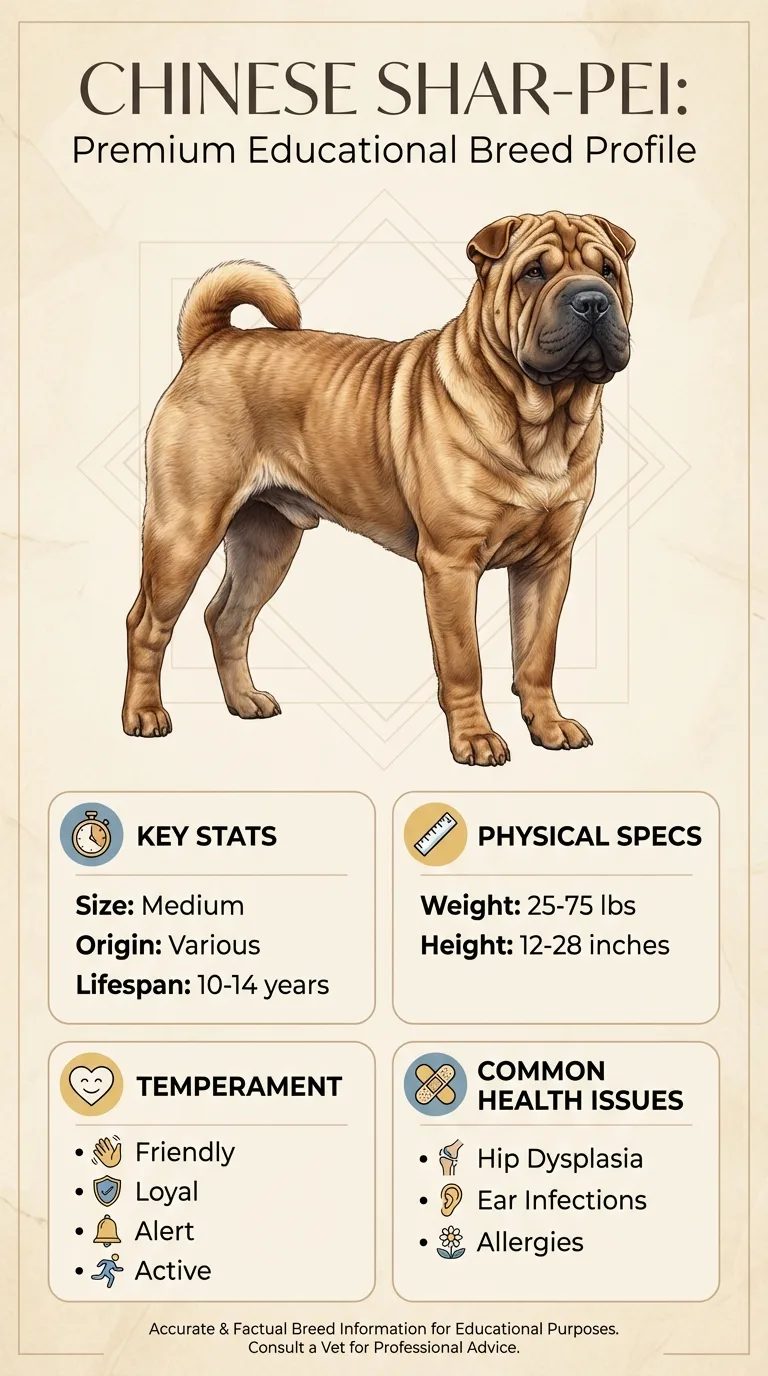
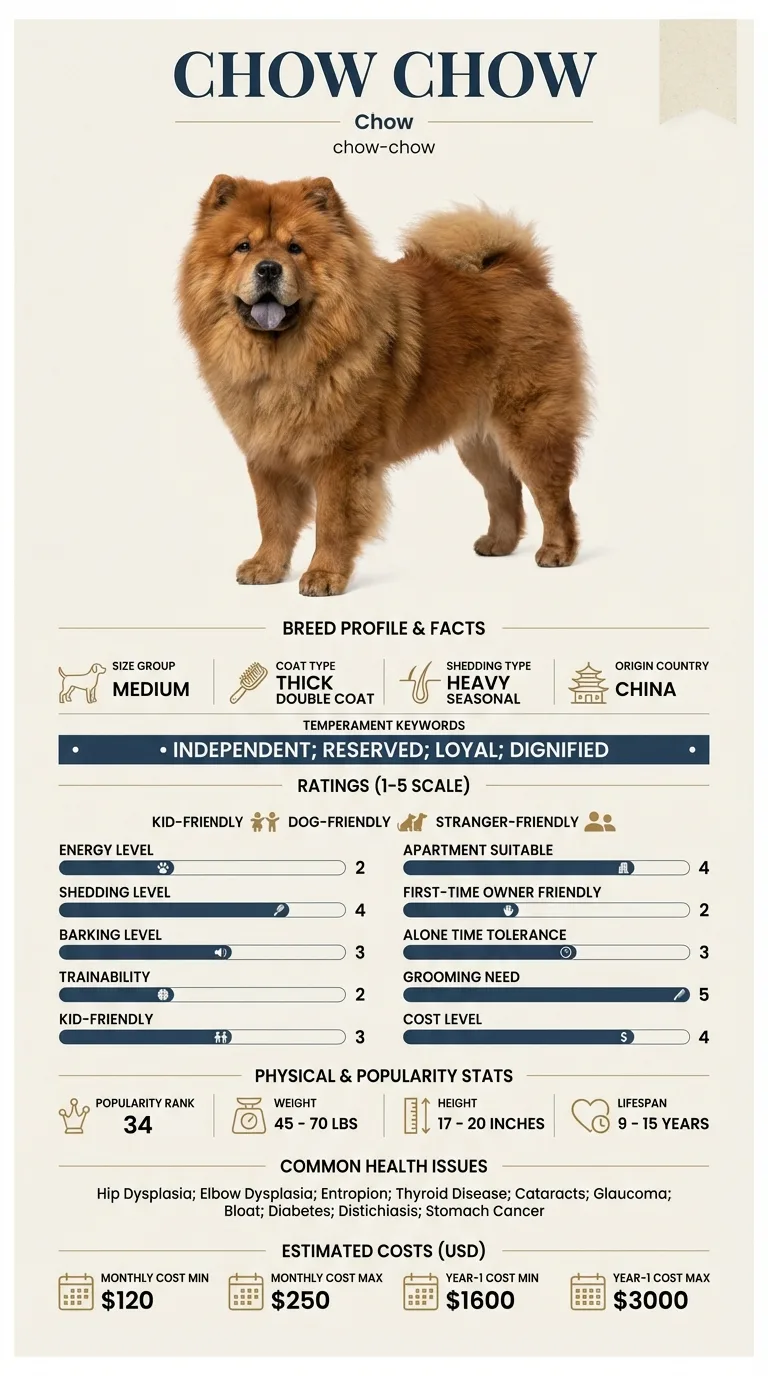
This is for someone already down to Chinese Shar-Pei and Chow Chow and deciding between them. For this pair the decision usually turns on grooming need and shedding, so those are covered first and in most detail. Both rate 4/5 for flats, so housing does not settle this one. There is no origin story here — only what changes about your week.
Between Chinese Shar-Pei and Chow Chow, grooming need is what separates them, and Chinese Shar-Pei is the lower-effort dog of the two to keep.
Choose Chinese Shar-Pei if you do not want a standing grooming appointment, shedding is a problem in your house and a smaller dog suits your car, your home or your back.
Choose Chow Chow if its temperament and look are what you want; on the measurable axes it gives up nothing to the other.
| Feature | chinese shar pei | chow chow | Winner |
|---|---|---|---|
| Size class | medium | medium | Equal |
| Weight | 45–60 lbs | 45–70 lbs | Equal |
| Height | 18–20 in | 17–20 in | Equal |
| Lifespan | 8–12 years | 9–15 years | chow chow |
| Exercise need | Low (2/5) | Low (2/5) | Equal |
| Grooming need | Low (2/5) | Very high (5/5) | chinese shar pei |
| Shedding | Low (2/5) | High (4/5) | chinese shar pei |
| Energy level | Low (2/5) | Low (2/5) | Equal |
| Barking | Low (2/5) | Moderate (3/5) | chinese shar pei |
| Apartment suitability | High (4/5) | High (4/5) | Equal |
| Good for first-time owners | Low (2/5) | Low (2/5) | Equal |
| Tolerates being alone | Moderate (3/5) | Moderate (3/5) | Equal |
| Trainability | Low (2/5) | Low (2/5) | Equal |
| Good with kids | Moderate (3/5) | Moderate (3/5) | Equal |
| Good with other dogs | Low (2/5) | Low (2/5) | Equal |
| Friendly to strangers | Low (2/5) | Low (2/5) | Equal |
| Cost level | High (4/5) | High (4/5) | Equal |
| Coat | Short and harsh | Thick double coat | Equal |
| Origin | Various | China | Equal |
| Typical monthly cost | $100–$200 | $120–$250 | Equal |
| Typical first-year cost | $1,400–$2,900 | $1,600–$3,000 | Equal |
The Chinese Shar-Pei and Chow Chow are close cousins on the size chart: both fall in the medium class, with the Shar-Pei's 45-to-60-pound frame overlapping almost entirely with the Chow Chow's 45-to-70-pound range, and height nearly identical at 18-20 inches versus 17-20 inches. Neither breed towers over the other, and side by side in a park they'd look like variations on a theme — sturdy, square-built dogs with dense frames rather than lanky sporting builds. The real distinguishing feature isn't size but silhouette: the Shar-Pei's loose, wrinkled skin versus the Chow Chow's blocky head framed by its famous ruff. Anyone choosing based on raw dimensions alone will find almost nothing to separate these two.
Neither of these breeds asks for much: the Chinese Shar-Pei and Chow Chow both rate low (2/5) for exercise need and low (2/5) for energy level, an unusually tidy tie for two unrelated-looking dogs. A pair of short walks and some yard time satisfies both, and neither is the type to demand a five-mile run or an off-leash field session. That shared low drive comes with a shared personality trait, too — both are described with the word 'independent' in their temperament lists, meaning neither breed is likely to pester an owner for constant activity or attention. For anyone who wants a calmer household pace without sacrificing a substantial-looking dog, this matchup offers two nearly identical options.
This is where the two breeds split hardest. The Chinese Shar-Pei's short, harsh coat needs only low (2/5) grooming and produces low (2/5) shedding — a wipe-down handles most weeks. The Chow Chow is the opposite story: its thick double coat drives grooming need to very high (5/5) and shedding to high (4/5), meaning regular brushing sessions, seasonal blowouts of undercoat, and a genuine time commitment most weeks of the year. Anyone who dislikes vacuuming or brushing should think hard before choosing the Chow Chow over the Shar-Pei; the wrinkle-coated breed is the far lower-maintenance option on paper, even though its skin folds bring their own separate care routine covered below in health.
Apartment suitability comes out tied at high (4/5) for both breeds, and both tolerate being left alone at a moderate (3/5) level, so neither is an obvious washout for apartment life. Noise is the small differentiator: the Chinese Shar-Pei rates low (2/5) for barking while the Chow Chow rates moderate (3/5), giving the Shar-Pei a slight edge for thin-walled buildings and close neighbors. Neither breed is naturally chatty compared to more vocal companion breeds, which fits their shared reserved, independent temperaments — these are dogs that tend to observe rather than announce. For most apartment dwellers the deciding factor between them will come down to coat maintenance, not noise or space.
Both breeds are rated low (2/5) for trainability and low (2/5) for suitability with first-time owners, an unusually matched pairing that reflects their shared independent, reserved character traits. Neither the Chinese Shar-Pei nor the Chow Chow is bred for eager obedience-ring responsiveness; both were shaped by history to think for themselves, and that same self-possession that makes them dignified companions can make basic commands a slower project than with a biddable retriever or spaniel. First-time owners drawn to either breed should plan on patient, consistent, reward-based training and ideally some professional guidance early on, because neither breed offers a built-in shortcut through the training process that beginners often hope for.
Kids, other dogs, and visitors line up identically on the comparison table: both breeds rate moderate (3/5) with children, low (2/5) with other dogs, and low (2/5) for friendliness toward strangers. That consistency isn't a coincidence — both the Chinese Shar-Pei and Chow Chow carry reserved, independent, loyal temperaments that translate into deep attachment to their own household but real wariness toward outsiders, canine or human. Families should supervise interactions with young children regardless of which breed they pick, and neither is a natural candidate for a multi-dog household without careful, gradual introductions. Anyone hosting frequent guests or block parties should expect both breeds to need a controlled, low-key introduction process rather than an instant welcome.
The Chow Chow has a longevity edge, with a lifespan of 9 to 15 years compared to the Chinese Shar-Pei's 8 to 12 — but its health list is twice as long, spanning hip dysplasia, elbow dysplasia, thyroid disease, cataracts, glaucoma, bloat, diabetes, distichiasis, and stomach cancer alongside entropion, a condition it shares with the Shar-Pei. The Shar-Pei's shorter list is dominated by its signature wrinkles: skin fold dermatitis and entropion both trace back to its loose skin, alongside familial Shar-Pei fever, a breed-specific inflammatory condition, plus hypothyroidism and ear infections. Prospective Shar-Pei owners should budget for ongoing skin-fold cleaning, while Chow Chow owners should ask breeders about joint and eye screening given the breadth of orthopedic and ocular conditions on its list.
Both breeds carry a high (4/5) cost rating, and the dollar figures land close together: the Chinese Shar-Pei runs $100 to $200 a month and $1,400 to $2,900 in year one, while the Chow Chow runs slightly higher at $120 to $250 monthly and $1,600 to $3,000 for the first year. That modest gap likely reflects the Chow Chow's heavier grooming demands — its very high (5/5) grooming need often means professional brushing or bathing appointments that the low-maintenance Shar-Pei coat simply doesn't require. Beyond the sticker price, Shar-Pei owners should factor in the ongoing cost of managing skin folds, while Chow Chow owners should budget for the grooming tools or salon visits their double coat necessitates.
Chinese Shar-Pei weighs 45–60 lbs and lives 8–12 years; Chow Chow weighs 45–70 lbs and lives 9–15 years. The two diverge most on grooming need and shedding. They are level on tolerates being alone, apartment suitability and cost level, so those cannot decide it. Where the table declares a winner it means less work for the owner, nothing more; descriptive rows are left as ties on purpose. The value here is in the differences between the two columns; treat any single score as approximate.

The Shar-Pei is far easier, rated low (2/5) for grooming versus the Chow Chow's very high (5/5), because the Chow's thick double coat requires regular brushing that the Shar-Pei's short, harsh coat does not.
Neither is especially social with other dogs — both rate low (2/5), reflecting their shared independent, reserved temperaments.
The Chow Chow sheds substantially more, rated high (4/5) versus the Shar-Pei's low (2/5).
The Chow Chow's list is longer, with ten flagged conditions including hip dysplasia, bloat, and diabetes, compared to five for the Shar-Pei, which centers on skin-fold and eye issues like entropion.
Not ideally — both rate low (2/5) for first-time owner suitability due to their independent, self-possessed temperaments.
The Chow Chow typically lives a bit longer, 9 to 15 years versus the Shar-Pei's 8 to 12 years.
The Chinese Shar-Pei is slightly cheaper, running about $1,400-$2,900 in year one versus $1,600-$3,000 for the Chow Chow.
The Chow Chow, rated moderate (3/5) versus the Shar-Pei's low (2/5).
The Chow Chow can run heavier, up to 70 lbs versus the Shar-Pei's 60 lb cap.
The Chinese Shar-Pei, by a wide margin.
Neither stands out — both rate low (2/5) for trainability.
Secure checkout on Stripe. We never see your card.
7-day money-back guarantee. Instant access.
Health information here is general and is not veterinary advice. If your dog shows pain, sudden behaviour change, or worsening symptoms, consult a licensed veterinarian.
Some links on this site are affiliate links. We may earn a commission at no extra cost to you, and we only suggest products we believe are helpful for dog owners.
We research and check what we publish, but we do not warrant that any figure, date, price, or statement is accurate, complete, or current, and we accept no liability for any loss, cost, injury, or other harm arising from the use of this site. Use it as one reference among several. You remain responsible for your own decisions and for your dog's care - confirm anything that matters with a licensed veterinarian or another qualified professional before you act on it. Full disclaimer.
Match your lifestyle to the right dog.
Take quizNot sure which breed is right for you? Take our 2-minute quiz to find out.
Take the quiz