Costs
Chihuahua cost in Chicago
About $60–$115/month, $920–$1,700 for year one — above average, with real winter de-icer exposure worth protecting this breed's tiny paws against.

See Chihuahua price across all cities →
Quick answer
Chihuahua cost in Chicago
About $60–$115/month, $920–$1,700 for year one — above average, with real winter de-icer exposure worth protecting this breed's tiny paws against.
A Chihuahua in Chicago costs about $60–$115 a month, with the first year around $920–$1,700 — above the national average, with one real winter hazard beyond just the cold itself.
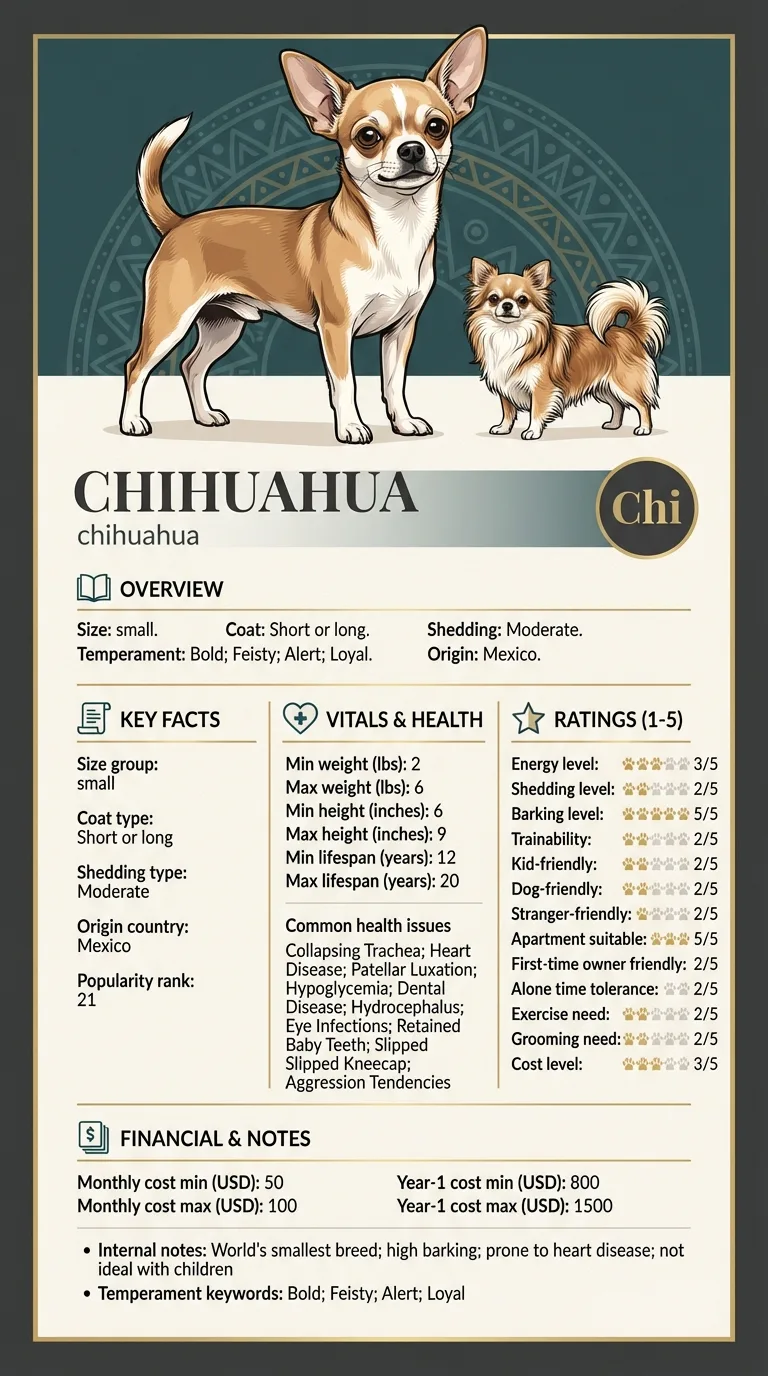
Heart disease and collapsing trachea are the two chronic conditions most worth a vet's early attention in this breed. Hypoglycemia is the acute risk specific to small puppies — a missed meal can turn dangerous fast in a dog this size.
These figures reflect Chicago's above-national-average pricing, with a real added line item for winter paw protection given how much direct de-icer exposure this breed's small size means.
Estimate · source: estimation · confidence: medium · updated 2026-09-05 · not a quote
| Item | Cost range |
|---|---|
Winter paw protection (booties, paw balm) A real, low-cost way to reduce rock-salt and de-icer exposure given this breed's small size and low ground clearance. | $25 - $55 |
One-time setup (initial vet visit, spay/neuter, gear) Covers the first exam, vaccinations, spay/neuter if needed, and basic gear — priced at Chicago's above-average rates. | $240 - $405 |
| Item | Cost range |
|---|---|
Food Genuinely low given this breed's tiny size, adjusted up for Chicago's above-average cost of living. | $15 - $27 |
Flea & tick prevention Illinois's real winters keep this seasonal rather than year-round. | $9 - $17 |
Each range starts from a national baseline for this breed's size class and is then adjusted for local cost of living and veterinary pricing. The baselines, and the source each one came from, are listed on our sources page (dataset 2026.09). Two inputs, the purchase price and the emergency reserve, have no published national figure we could verify, so we leave them to you rather than invent them.
These are planning estimates, not quotes. Your own numbers will move with the individual dog, your vet and your insurer. Build a budget with your own figures.
For a Chihuahua in Chicago, insurance is worth taking seriously given the breed's documented heart disease and collapsing trachea risk, on top of the city's above-average general vet pricing.
This breed's real heart-disease and tracheal-collapse statistics make insurance worth locking in early — a policy bought before any diagnosis covers costs a self-funded emergency fund alone often can't stretch to match.
Owners with a solid emergency fund and the discipline to leave it untouched for anything but a genuine vet emergency can reasonably self-insure instead.
Chicago's above-average costs are real, but this breed's low exercise needs and a couple of cheap winter habits go a long way here.
Chicago winters bring heavy, routine use of rock salt and chemical de-icers on sidewalks, building entrances and parking lots, and a dog this small, often walking with its belly close to the ground, ends up with far more direct paw and coat contact with that residue than a larger breed would. Beyond the discomfort, a dog that licks salt-crusted paws after a walk is a genuinely common source of stomach upset, and repeated season-long exposure can irritate sensitive pads. A quick paw rinse or wipe-down after any winter walk, and dog booties for the heaviest-salted blocks, are real, low-cost habits worth building.
Chicago's condo and apartment market, a major share of the city's housing stock, makes dog-walking or daycare a realistic recurring cost for many owners of larger, more active breeds, though this breed's low exercise needs make that less of a factor here than for most dogs this site covers.
Chicago's general cost of living runs above the national average, and Illinois's real winters keep flea-and-tick prevention seasonal rather than year-round.

A Chicago Chihuahua owner noticed their dog vomiting after several winter walks and initially suspected a food issue. A vet visit pointed to salt ingestion from paw-licking after walks through heavily de-iced sidewalks near their building. Switching to a quick paw rinse after every outdoor trip resolved the pattern entirely within a week.
Key takeaway: In Chicago specifically, this breed's small size means real, direct exposure to winter sidewalk chemicals — a simple post-walk habit prevents a genuinely common, avoidable vet visit.
About $60–$115, above the national average, consistent with Chicago's broader above-average cost of living.
Roughly $920–$1,700, including the initial vet exam, spay/neuter if needed, and gear on top of ongoing monthly costs.
A genuine, common one — this breed's small size means more direct paw and coat contact with rock salt and de-icer residue, and licking salt off the paws afterward is a real source of stomach upset, worth preventing with a quick rinse or booties.
Less often than a larger breed would — this breed's low exercise needs make the city's condo-heavy, yard-free housing stock less of a limitation than it is for most dogs this site covers.
Worth pricing out given the breed's documented heart disease and dental risk, bought while the dog is young and before anything is on record.
Around $480 covers a typical significant vet visit in this market, reflecting Chicago's above-average general pricing.
About $60–$115/month, $920–$1,700 for year one — above average, with real winter de-icer exposure worth protecting this breed's tiny paws against.
This guide is not medical advice. If your dog shows pain, sudden behavior change, or worsening symptoms, consult a licensed veterinarian.
Some links may be affiliate links. We may earn a commission at no extra cost to you. We only suggest products we believe are helpful for dog owners.
We research and check what we publish, but we do not warrant that any figure, date, price, or statement is accurate, complete, or current, and we accept no liability for any loss, cost, injury, or other harm arising from the use of this site. Use it as one reference among several. You remain responsible for your own decisions and for your dog's care - confirm anything that matters with a licensed veterinarian or another qualified professional before you act on it. Full disclaimer.
One sheet with every line item, the emergency fund and when insurance pays off - unlocks on this page.
You get: 12-month budget sheet
No spam. One-click unsubscribe. See our privacy policy.
Preview page 1 before you decide.