Behavior
Which needs more exercise?
The Corgi, rated high (4/5) versus the Chihuahua's low (2/5).

Quick answer
Which needs more exercise?
The Corgi, rated high (4/5) versus the Chihuahua's low (2/5).
Chihuahua or Pembroke Welsh Corgi? On paper they differ most on exercise need, and on the scales Pembroke Welsh Corgi is the heavier at 24–30 lbs. Here is how the two compare on everything that shapes an ordinary week.
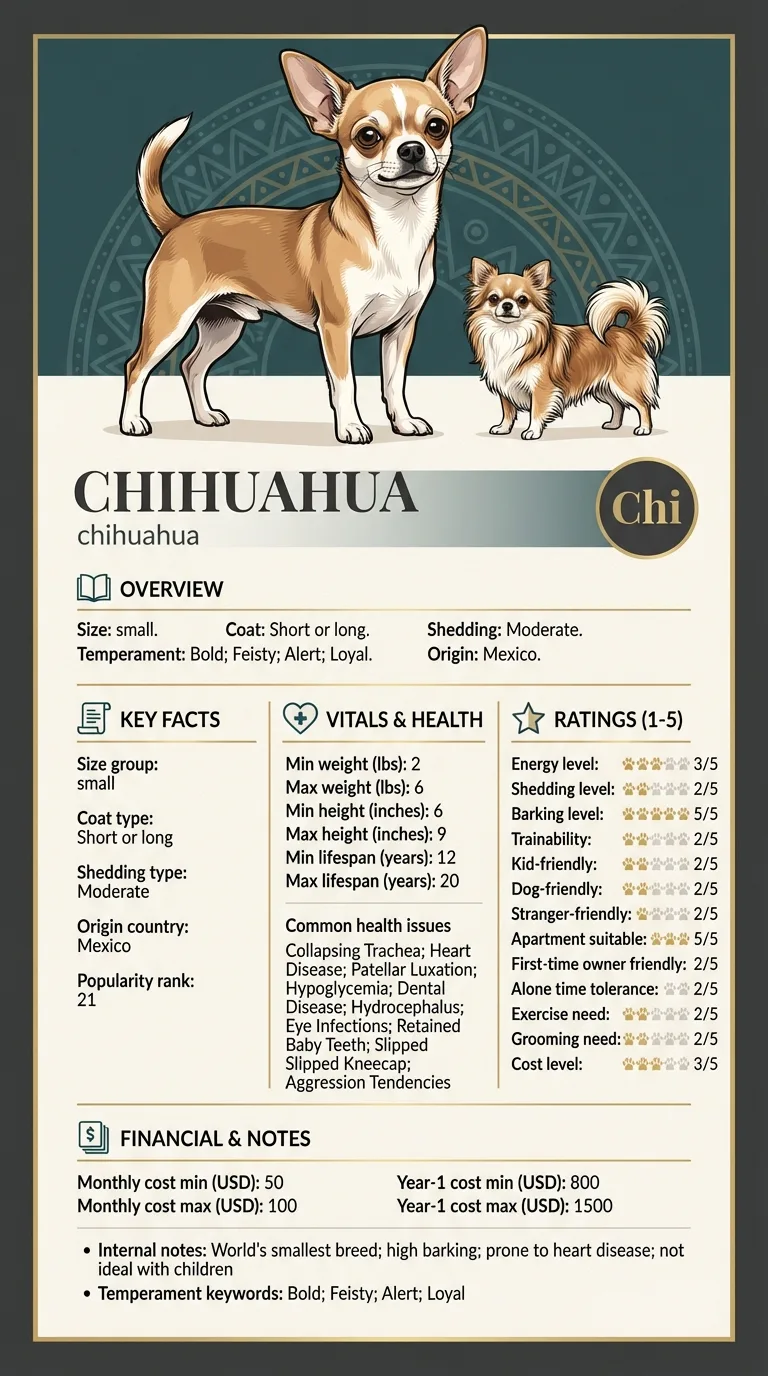
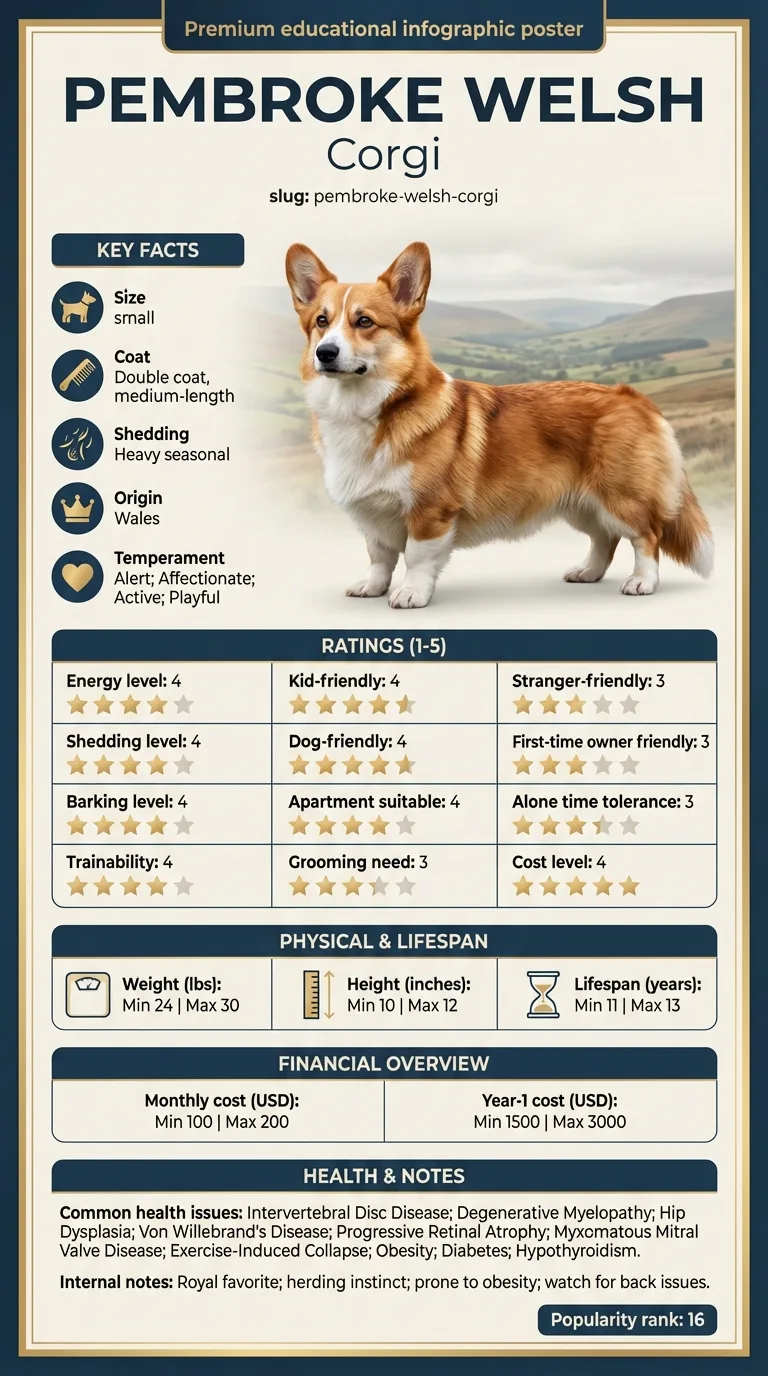
This is for someone already down to Chihuahua and Pembroke Welsh Corgi and deciding between them. For this pair the decision usually turns on exercise need and shedding, so those are covered first and in most detail. Anyone choosing from a flat has a clear answer here: Chihuahua rates 5/5 against 4/5. The focus throughout is on daily consequences rather than breed background.
Between Chihuahua and Pembroke Welsh Corgi, exercise need is what separates them, and Chihuahua is the lower-effort dog of the two to keep.
Choose Chihuahua if you are in a flat or a smaller home, you do not want a standing grooming appointment and shedding is a problem in your house.
Choose Pembroke Welsh Corgi if this is your first dog, the dog will be alone during the working day and there are young children at home.
| Feature | chihuahua | pembroke welsh corgi | Winner |
|---|---|---|---|
| Size class | small | small | Equal |
| Weight | 2–6 lbs | 24–30 lbs | Equal |
| Height | 6–9 in | 10–12 in | Equal |
| Lifespan | 12–20 years | 11–13 years | chihuahua |
| Exercise need | Low (2/5) | High (4/5) | chihuahua |
| Grooming need | Low (2/5) | Moderate (3/5) | chihuahua |
| Shedding | Low (2/5) | High (4/5) | chihuahua |
| Energy level | Moderate (3/5) | High (4/5) | Equal |
| Barking | Very high (5/5) | High (4/5) | pembroke welsh corgi |
| Apartment suitability | Very high (5/5) | High (4/5) | chihuahua |
| Good for first-time owners | Low (2/5) | Moderate (3/5) | pembroke welsh corgi |
| Tolerates being alone | Low (2/5) | Moderate (3/5) | pembroke welsh corgi |
| Trainability | Low (2/5) | High (4/5) | pembroke welsh corgi |
| Good with kids | Low (2/5) | High (4/5) | pembroke welsh corgi |
| Good with other dogs | Low (2/5) | High (4/5) | pembroke welsh corgi |
| Friendly to strangers | Low (2/5) | Moderate (3/5) | pembroke welsh corgi |
| Cost level | Moderate (3/5) | High (4/5) | chihuahua |
| Coat | Short or long | Double coat, medium-length | Equal |
| Origin | Mexico | Wales | Equal |
| Typical monthly cost | $50–$100 | $100–$200 | Equal |
| Typical first-year cost | $800–$1,500 | $1,500–$3,000 | Equal |
The Pembroke Welsh Corgi outweighs the Chihuahua substantially, 24-30 lbs against 2-6 lbs, while standing only 10-12 inches tall, just a few inches above the Chihuahua's 6-9 inches. That combination of real weight on a low, long frame is the Corgi's defining trait: a herding dog built to nip at cattle heels and duck under kicks, with a body length that puts real strain on its spine, unlike the compact, upright Chihuahua. Anyone picking a Corgi should notice it's a stockier, heavier dog than its short legs suggest, closer in mass to a mid-size breed than to the Chihuahua it's being compared against here.
The Corgi rates high (4/5) for exercise need, a full two steps above the Chihuahua's low (2/5), and its energy level runs high as well against the Chihuahua's moderate rating. Bred to herd cattle across open ground all day, the Corgi carries genuine working-dog stamina packed into a small body, and it needs structured daily activity, walks, herding games, or fetch, to avoid boredom-driven behaviors. The Chihuahua's lower exercise demand suits a more sedentary household. Anyone expecting Corgi-level cuteness to come with Chihuahua-level exercise needs will be caught off guard by how much activity this breed actually wants.
The Corgi's double coat pushes grooming to moderate (3/5) and shedding to high (4/5), both well above the Chihuahua's low (2/5) ratings on each. Corgis blow their coat seasonally, and owners describe near-constant light shedding punctuated by heavier seasonal coat blow periods that call for daily brushing to manage. The Chihuahua's short-or-long coat sheds far less consistently. For a household with dark furniture or allergy sensitivities, the Corgi's shedding profile is a real practical consideration that the Chihuahua simply doesn't present, even though neither breed needs professional grooming as a baseline.
Both breeds handle apartment living reasonably well; the Chihuahua rates very high (5/5) and the Corgi rates high (4/5), a strong showing for a herding breed with real exercise needs. Barking is close: very high (5/5) for the Chihuahua against high (4/5) for the Corgi, both vocal, alert breeds that will announce visitors. Where they differ more is tolerating alone time, moderate (3/5) for the Corgi versus low (2/5) for the Chihuahua, suggesting the Corgi's affectionate but more independent working-dog temperament copes somewhat better with solo hours than the more clingy Chihuahua.
The Corgi outperforms the Chihuahua clearly on trainability, high (4/5) versus low (2/5), and on first-time-owner suitability, moderate (3/5) versus low (2/5). As a breed developed for herding work that required responding to commands at a distance, the Corgi's alert, active temperament channels naturally into obedience training. The Chihuahua's bold, feisty nature makes for a slower training process regardless of owner experience. A first-time owner should still expect the Corgi to need real structure and mental stimulation, since its intelligence can turn to mischief without it, but the baseline trainability gap favors the Corgi clearly.
Family and social fit lean toward the Corgi across the board: high (4/5) with kids versus the Chihuahua's low (2/5), high (4/5) with other dogs versus low (2/5), and moderate (3/5) with strangers versus low (2/5). The Corgi's affectionate, playful temperament makes it a common family pick, though its herding instinct can show up as gentle nipping at running children's heels, a trait worth managing early with training. The Chihuahua's more guarded, loyal-to-one-person nature keeps it reserved around new people and pets by comparison, making the Corgi the more broadly adaptable of the two in a busy household.
The Chihuahua's 12-20 year lifespan comfortably exceeds the Corgi's 11-13 years. The Corgi's health list is notably long and centers on its distinctive long-backed, short-legged build: intervertebral disc disease and degenerative myelopathy both stem from spinal strain, alongside hip dysplasia, exercise-induced collapse, and a real tendency toward obesity and diabetes if overfed relative to its activity level. The Chihuahua's risks, collapsing trachea, hypoglycemia, dental disease, are unrelated in cause but comparably serious. Corgi owners in particular should avoid letting the dog jump from height or gain excess weight, given the spine and joint risks documented in the data.
The Corgi rates a high (4/5) overall cost level against the Chihuahua's moderate (3/5), running $100-$200 monthly and $1,500-$3,000 in year one, compared to the Chihuahua's $50-$100 monthly and $800-$1,500. Larger food portions for a 24-30 lb dog and a longer list of breed-associated health conditions to screen for both contribute to the higher figure. Given the Corgi's documented risk of obesity and diabetes, ongoing weight management and diet quality are worth budgeting for specifically, on top of the baseline cost gap between the two breeds.
Chihuahua weighs 2–6 lbs and lives 12–20 years; Pembroke Welsh Corgi weighs 24–30 lbs and lives 11–13 years. The two diverge most on exercise need, shedding and good with kids and 2 other rated axes. Almost every rated axis separates them at least slightly. The table below marks a winner only where one breed is genuinely easier for a typical owner; size and origin are facts rather than merits and stay level. Ratings come from one source applied to both breeds, so they are meaningful against each other rather than as absolute scores.

Their long spine and short legs put them at real risk for intervertebral disc disease and degenerative myelopathy, both listed as known health concerns for the breed.
The Corgi, rated high (4/5) for exercise need versus the Chihuahua's low (2/5); it's a working herding breed with real stamina.
Yes, rated high (4/5) versus the Chihuahua's low (2/5), though its herding instinct can lead to gentle heel-nipping that's worth training early.
Yes, rated high (4/5) with a double coat that blows out seasonally, versus the Chihuahua's low (2/5).
The Corgi, rated high (4/5) versus the Chihuahua's low (2/5).
Yes, obesity and diabetes are both listed as breed health concerns, making portion control and exercise especially important.
The Corgi, rated a high (4/5) cost level at $100-$200 monthly versus the Chihuahua's moderate (3/5) at $50-$100.
The Corgi, rated high (4/5) versus the Chihuahua's low (2/5).
The Corgi, rated high (4/5) versus the Chihuahua's low (2/5).
The Corgi, rated high (4/5) versus the Chihuahua's low (2/5).
The Corgi, rated high (4/5) versus the Chihuahua's low (2/5).
Secure checkout on Stripe. We never see your card.
7-day money-back guarantee. Instant access.
Health information here is general and is not veterinary advice. If your dog shows pain, sudden behaviour change, or worsening symptoms, consult a licensed veterinarian.
Some links on this site are affiliate links. We may earn a commission at no extra cost to you, and we only suggest products we believe are helpful for dog owners.
We research and check what we publish, but we do not warrant that any figure, date, price, or statement is accurate, complete, or current, and we accept no liability for any loss, cost, injury, or other harm arising from the use of this site. Use it as one reference among several. You remain responsible for your own decisions and for your dog's care - confirm anything that matters with a licensed veterinarian or another qualified professional before you act on it. Full disclaimer.
Match your lifestyle to the right dog.
Take quizNot sure which breed is right for you? Take our 2-minute quiz to find out.
Take the quiz