Health
What is the single most urgent sign?
Unproductive retching combined with a tight, swollen belly. That combination means emergency care now, not a wait-and-see evening.

Quick answer
What is the single most urgent sign?
Unproductive retching combined with a tight, swollen belly. That combination means emergency care now, not a wait-and-see evening.
GDV kills fast enough that whether your breed is statistically likely matters far less than whether you recognise it happening in front of you tonight.
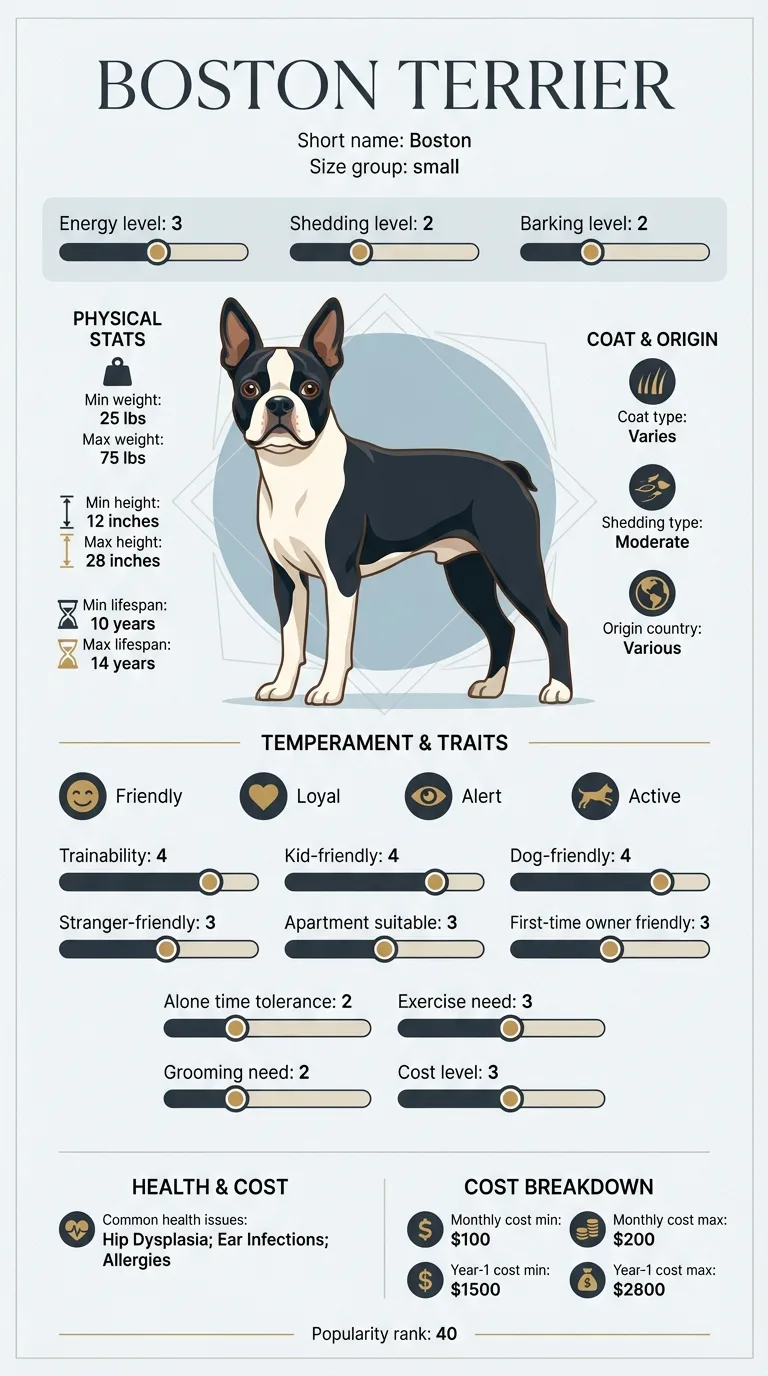
Owners who have heard bloat described as a big-dog problem and assumed it does not apply to them, and anyone whose Boston eats fast, competes with another dog for food, or already struggles for breath.
This guide is not medical advice. If your dog shows pain, sudden behavior change, or worsening symptoms, consult a licensed veterinarian.
Some links may be affiliate links. We may earn a commission at no extra cost to you. We only suggest products we believe are helpful for dog owners.
We research and check what we publish, but we do not warrant that any figure, date, price, or statement is accurate, complete, or current, and we accept no liability for any loss, cost, injury, or other harm arising from the use of this site. Use it as one reference among several. You remain responsible for your own decisions and for your dog's care - confirm anything that matters with a licensed veterinarian or another qualified professional before you act on it. Full disclaimer.
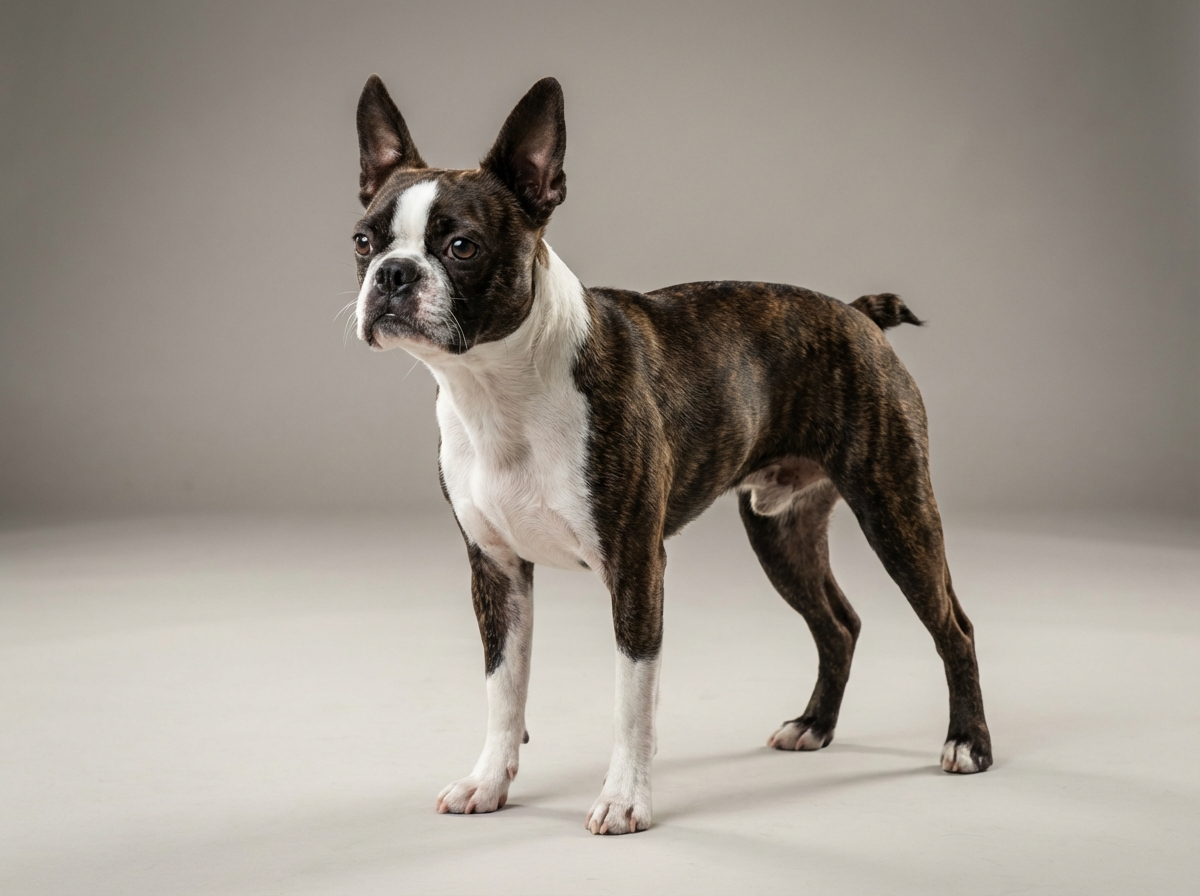
Gastric dilatation-volvulus is gas filling the stomach followed, in the worst cases, by the stomach twisting on itself and cutting off its own blood supply. The classic version of this disease belongs to deep-chested giant breeds. Boston Terriers reach a milder, less common version of the same emergency through a different door - air swallowed while struggling to breathe or eating too fast - and it still needs to be recognised as an emergency the moment it appears.
Uncommon in this breed and absent from its documented health list, which is headed by airway disease, patellar luxation, cataracts, corneal ulcers and deafness. Chest conformation works in the breed's favour here. Where it does occur, aerophagia from fast eating or significant airway obstruction is the more plausible route than the classic deep-chest rotation.
A compact, wide chest gives the stomach less room to swing than the deep, narrow chest that predisposes giant breeds, which is the main reason GDV is rare here. What the breed does contribute is airway obstruction: a dog working hard against a narrowed passage swallows extra air with every breath, and a food-motivated, comical, people-focused temperament makes for enthusiastic, sometimes gulping eaters.
Single large meals bolted rather than eaten slowly, exercise or excited play straight after eating, and competitive multi-dog feeding all increase how much air ends up in the stomach alongside the food. Stressful mealtimes - rushing, being watched, feeling threatened by another pet - make gulping worse regardless of the bowl used.
Discuss feeding routine and, if your dog has significant airway obstruction or is already booked for another abdominal procedure, ask whether a preventive gastropexy is worth considering. Treat as an immediate emergency, at any hour, a dog that is retching unproductively, has a visibly swollen or drum-tight abdomen, cannot settle, is drooling excessively, or shows pale gums, a racing pulse or weakness. Do not wait for morning and do not try to relieve the distension yourself - call ahead and go straight to an emergency clinic.
See all Boston Terrier health problems, which breeds are prone to gastric dilatation volvulus gdvbloat, or the full Boston Terrier breed guide for temperament, exercise needs and ownership costs.
Feeding changes take effect immediately - a slow-feed bowl slows a dog down the first time it is used. There is no timeline for GDV itself once it starts: it is a same-day surgical emergency, not something that is monitored and revisited.
A dog that eats at a measured pace from a bowl designed for it, rests quietly after meals, and an owner who has actually rehearsed in their head what they would do and where they would go if the signs above ever appeared.
The classic risk factor for GDV is a chest that is deep relative to its width. A deep, narrow thorax gives the stomach room to swing on its supporting ligaments and, in the worst case, rotate on its own axis and cut off its blood supply. A Boston's chest is compact and comparatively wide, which is mechanically a poor setup for that particular kind of rotation, and it is one reason this breed sits well outside the giant and large deep-chested group that dominates the bloat statistics.
A second, separate path exists, and it runs through the airway rather than the chest wall. A dog labouring to breathe through a narrowed passage swallows more air with every effortful breath - a phenomenon called aerophagia - and a fast, competitive or anxious eater swallows still more air along with each mouthful of food. That swallowed air collects in the stomach as gas. Gas alone can cause a simple, painful distension without any rotation at all, and in a minority of dogs a distended, mobile stomach can still turn.
This is why bloat in a Boston Terrier is uncommon rather than impossible, and why the useful precaution here is about eating behaviour and breathing effort rather than chest depth.

GDV progresses in hours, sometimes less. None of the following should be watched overnight.
Ziggy shared a kitchen floor with Priti's older Labrador, and mealtimes had always been a race - both dogs finished a bowl in under thirty seconds and Ziggy usually tried to steal from the Labrador's side afterward. One evening he would not settle after dinner. He paced, tried to lie down, got straight back up, and drooled onto the kitchen tiles. When Priti ran a hand along his side his belly felt tight, almost like a drum. The emergency vet found a stomach distended with gas but, on imaging, still in its normal position - dilatation without the rotation that makes GDV so dangerous. He was decompressed, stabilised overnight and sent home two days later. Ziggy now eats alone from a slow-feed bowl in a different room from the Labrador. Priti says the belly test - a quick press of the flank after every meal for the first month - was what actually made her feel like she had control of something that had frightened her badly.
Key takeaway: A compact chest lowers the odds; it does not remove them. Fast, competitive eating is the lever this breed's owners can actually pull.
It happens, but uncommonly, and it is not among the conditions documented for this breed. The mechanism differs from the giant-breed pattern: it is driven more by air swallowing than by a deep chest swinging on its ligaments.
Bloat, or gastric dilatation, is the stomach filling with gas and distending. GDV adds volvulus - the distended stomach rotating on its axis, twisting off its own blood supply and the exit routes for the gas. Dilatation alone is an emergency; volvulus is immediately life-threatening.
Through aerophagia rather than chest geometry. A dog struggling to breathe past a narrowed airway swallows extra air with every laboured breath, and a fast or competitive eater swallows more air with every mouthful, both filling the stomach with gas.
The evidence does not support that, and some studies have linked raised bowls with more risk in susceptible breeds, not less. A slow-feed bowl that forces smaller mouthfuls is the better-supported change.
Yes. Rapid, gulping eating swallows a surprising volume of air along with the food, and in a household with a food-motivated dog competing against another pet, that gulping gets worse rather than better.
A gastropexy, which tacks the stomach to the body wall so it cannot rotate, is sometimes discussed for high-risk individuals, often at the same time as another planned abdominal surgery. Whether it is appropriate for a given dog is a conversation for your vet, not a routine recommendation for this breed.
No. Ordinary post-meal fullness is soft and the dog is comfortable lying down. A bloated abdomen is tight, drum-tight to a light tap, and comes with visible distress - the two are not easily confused once you have seen the difference described.
Unproductive retching combined with a tight, swollen belly. That combination means emergency care now, not a wait-and-see evening.
Split meals into two or three smaller portions, use a slow-feed or puzzle bowl, and feed dogs separately in a multi-dog home.
Decompression and stabilisation alone is a significant cost, and surgery to correct rotation and prevent recurrence adds substantially more. Ask for an estimate before agreeing to a plan when possible.
A calm, separated feeding routine taught early reduces the competitive frenzy that drives fast eating far more reliably than the bowl you buy.
A one-page prep sheet for this condition: the signs, the questions to ask, what to get priced. Unlocks here.
You get: Vet visit prep sheet
No spam. One-click unsubscribe. See our privacy policy.
Preview page 1 before you decide.