Health
What triggers pancreatitis in dogs?
Most commonly a sudden high-fat meal or a scavenging episode, though a substantial proportion of cases have no identifiable trigger at all.

Quick answer
What triggers pancreatitis in dogs?
Most commonly a sudden high-fat meal or a scavenging episode, though a substantial proportion of cases have no identifiable trigger at all.
The posture is the giveaway. A dog stretching with its chest on the floor and its rear in the air is not playing, it is trying to relieve abdominal pain.
Owners the day after a holiday, a barbecue or a bin raid, whose Boston is vomiting and will not settle, and owners of dogs who have had one episode and want to prevent the next.
This guide is not medical advice. If your dog shows pain, sudden behavior change, or worsening symptoms, consult a licensed veterinarian.
Some links may be affiliate links. We may earn a commission at no extra cost to you. We only suggest products we believe are helpful for dog owners.
We research and check what we publish, but we do not warrant that any figure, date, price, or statement is accurate, complete, or current, and we accept no liability for any loss, cost, injury, or other harm arising from the use of this site. Use it as one reference among several. You remain responsible for your own decisions and for your dog's care - confirm anything that matters with a licensed veterinarian or another qualified professional before you act on it. Full disclaimer.
Pancreatitis is inflammation of the pancreas caused by digestive enzymes activating within the gland rather than in the intestine. It ranges from a mild, self-limiting upset to a severe systemic illness. The presentation is acute abdominal pain with vomiting and appetite loss, and in a small dog the associated fluid loss becomes dangerous quickly.
Pancreatitis is a routine emergency presentation in general practice across all breeds, with clear seasonal peaks around holidays. It is not a documented Boston Terrier breed problem; the conditions this breed is recognised for are brachycephalic airway syndrome, patellar luxation, cataracts, corneal ulcers and deafness. Diet and body condition are the practical risk factors for an individual dog.
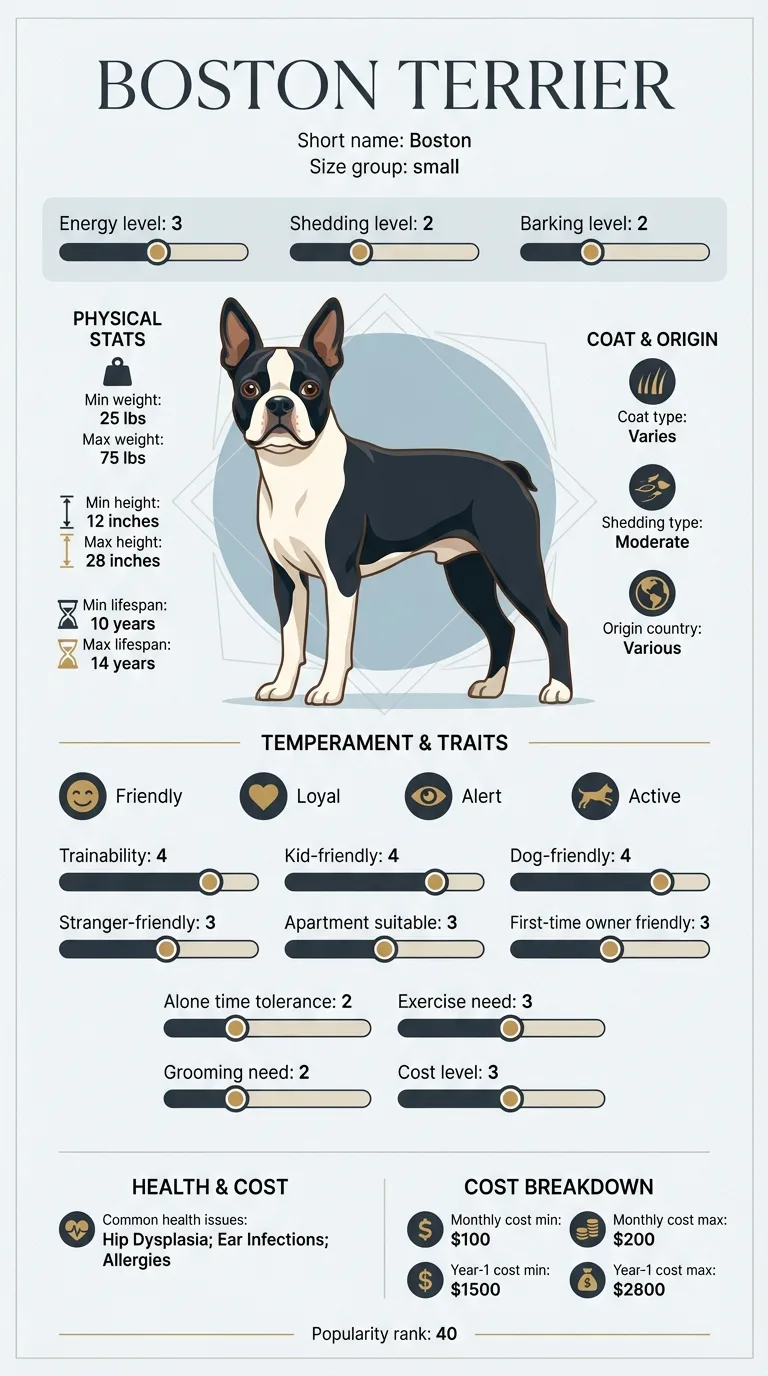
No specific pancreatic predisposition is documented in Boston Terriers. What the breed contributes is scale and appetite. At 12 to 25 pounds, the fluid reserve is small and dehydration from repeated vomiting develops faster than in a large dog. The breed's friendly, food-motivated character and its habit of soliciting from every person in the room make unauthorised fatty snacks a realistic household risk, and its modest exercise needs make weight gain, a recognised risk factor, easy to acquire.
Diet is the dominant environmental factor, specifically sudden exposure to fat that the dog is not accustomed to. Households with accessible bins, unsupervised counters or generous visitors supply the opportunity. Holidays concentrate all of these at once. Obesity raises baseline risk. Rapid diet changes and repeated small dietary indiscretions also feature in dogs with recurrent episodes.
Go the same day for repeated vomiting, complete refusal of food, a hunched or praying posture, or a dog that cannot settle. Go immediately, as an emergency, for collapse, pale or grey gums, a swollen tense abdomen, vomiting that will not stop, blood in vomit or stool, or a dog that is unresponsive. Do not withhold food and wait overnight to see whether it improves, because dehydration in a dog this size progresses fast. Never give human painkillers.
See all Boston Terrier health problems, which breeds are prone to pancreatitis, or the full Boston Terrier breed guide for temperament, exercise needs and ownership costs.
Mild cases typically improve within two to four days with fluids, pain relief and anti-nausea treatment. Moderate cases need three to seven days of hospital care. Dietary management continues for weeks after recovery at minimum, and permanently in dogs with recurrent episodes. Appetite is often the last thing to return fully.
A dog eating normally on a controlled low-fat diet, at a healthy weight, with no further episodes. In dogs with a recurrent pattern, success is fewer and milder flare-ups rather than none, and a household that has genuinely removed access to the triggers.
Pancreatitis presents as abdominal pain plus gastrointestinal upset, and the pain is often the more informative half.
The best-recognised trigger is a sudden high-fat meal. Dietary fat is a strong stimulus for pancreatic enzyme secretion, and a large unaccustomed load of it can be enough to tip a susceptible dog into an episode. Roast trimmings, barbecue scraps, butter, cheese, sausage and bin contents are the classic culprits, which is why emergency clinics see a predictable rise around holidays.
Not every case has an identifiable trigger. Some follow a period of scavenging, some accompany another illness, some are associated with certain medications, and a significant proportion appear with no explanation at all.
Treatment is supportive rather than curative, because there is no drug that switches the process off. Intravenous fluids restore circulating volume and support the pancreas through the inflammatory phase. Effective pain control is central and is not optional; pancreatitis is genuinely painful. Anti-nausea medication allows a dog to stop vomiting and start eating again.
The thinking on feeding has changed. Prolonged starvation is no longer standard, and early return to small, low-fat meals is generally favoured because it supports the gut lining. That decision belongs to the treating vet.
Mild cases can sometimes be managed with outpatient care and close monitoring. Moderate and severe cases need hospitalisation, and severe pancreatitis in a small dog can become life-threatening through dehydration, systemic inflammation and clotting disturbance. This is not a condition to manage at home on chicken and rice.

If you think your Boston has pancreatitis, the plan is three steps: write down what you have seen and when it started, book a veterinary appointment rather than waiting for the next flare, and take video of the behaviour or symptom before you go — the thing you are worried about rarely happens in the consulting room. Screening in the parents covers brachycephalic airway syndrome (boas), patellar luxation, cataracts.
What the vet visit should produce is a diagnosis and a written plan, not just reassurance: what is being ruled out, what the monitoring interval is, and which signs mean you come back sooner. Ask what the treatment costs across a year rather than per visit, because that is the number that decides whether you are managing this condition or reacting to it.
Between appointments, keep a short log — dates, what you saw, what changed. It is the single most useful thing an owner brings to a follow-up, and for pancreatitis it is often what separates a clear pattern from a guess.
Muriel was eight and had never had a day's illness. On Boxing Day morning she vomited four times before nine and then went and stood in the corner of the kitchen with her chest on the tiles and her back end in the air. Her owner Colm initially assumed she had simply eaten too much. It was the posture that worried him; she held it for several minutes at a time and would not lie down properly. At the emergency clinic her pancreatic blood test was strongly abnormal and ultrasound showed an inflamed pancreas. She was hospitalised for three days on fluids and pain relief. When Colm got home he worked out that at least three relatives had given her something from the table, and one had tipped a spoonful of goose fat over her dinner as a treat. None of them had thought a spoonful mattered. Muriel is ten now, on a permanent low-fat diet, and the family has a written rule taped inside the kitchen door.
Key takeaway: In a 15 pound dog, a spoonful of fat is not a spoonful. The praying posture is the sign worth learning, because it separates a dog with an upset stomach from a dog in real abdominal pain.
The breeds most frequently cited are Miniature Schnauzers, Yorkshire Terriers and Cocker Spaniels. Boston Terriers are not among them, and the breed's documented health issues are respiratory, orthopaedic and ocular. Any dog can develop pancreatitis, and the risk in a Boston is driven far more by diet and body condition than by breed.
By combining clinical signs with a specific pancreatic blood test and abdominal ultrasound. General bloodwork alone is not conclusive, and a normal result on a routine panel does not exclude it. Imaging also helps rule out the other causes of an acute painful abdomen.
Yes. Some dogs have a single episode and never another; others develop a recurrent or chronic pattern with repeated flare-ups. Dogs that have had one episode are managed on a long-term low-fat diet specifically to reduce that risk.
Anything high in fat, including table scraps, fatty meat trimmings, cheese, butter, sausages and most human leftovers. Follow whatever prescription or low-fat commercial diet your vet specifies, and make sure everyone in the household knows the rules apply to them too.
Significantly, and it is one of the situations where pain control is a core part of treatment rather than an add-on. If your dog is hunched, restless, or objects to being touched around the abdomen, assume pain and get it seen rather than trying to settle it at home.
Severe cases can be fatal, particularly where treatment is delayed and dehydration and systemic inflammation take hold. Most mild to moderate cases recover well with prompt supportive care, which is the argument for going in early rather than waiting overnight.
Most commonly a sudden high-fat meal or a scavenging episode, though a substantial proportion of cases have no identifiable trigger at all.
Mild cases often improve within two to four days of supportive care. More severe episodes require several days of hospitalisation and a longer dietary transition afterwards.
Outpatient management may be a few hundred dollars; hospitalisation with fluids, imaging and monitoring commonly runs into the low thousands depending on severity and region.
No. Withholding food and hoping risks rapid dehydration in a small dog. Suspected pancreatitis needs veterinary assessment, fluids and pain relief.
A one-page prep sheet for this condition: the signs, the questions to ask, what to get priced. Unlocks here.
You get: Vet visit prep sheet
No spam. One-click unsubscribe. See our privacy policy.
Preview page 1 before you decide.