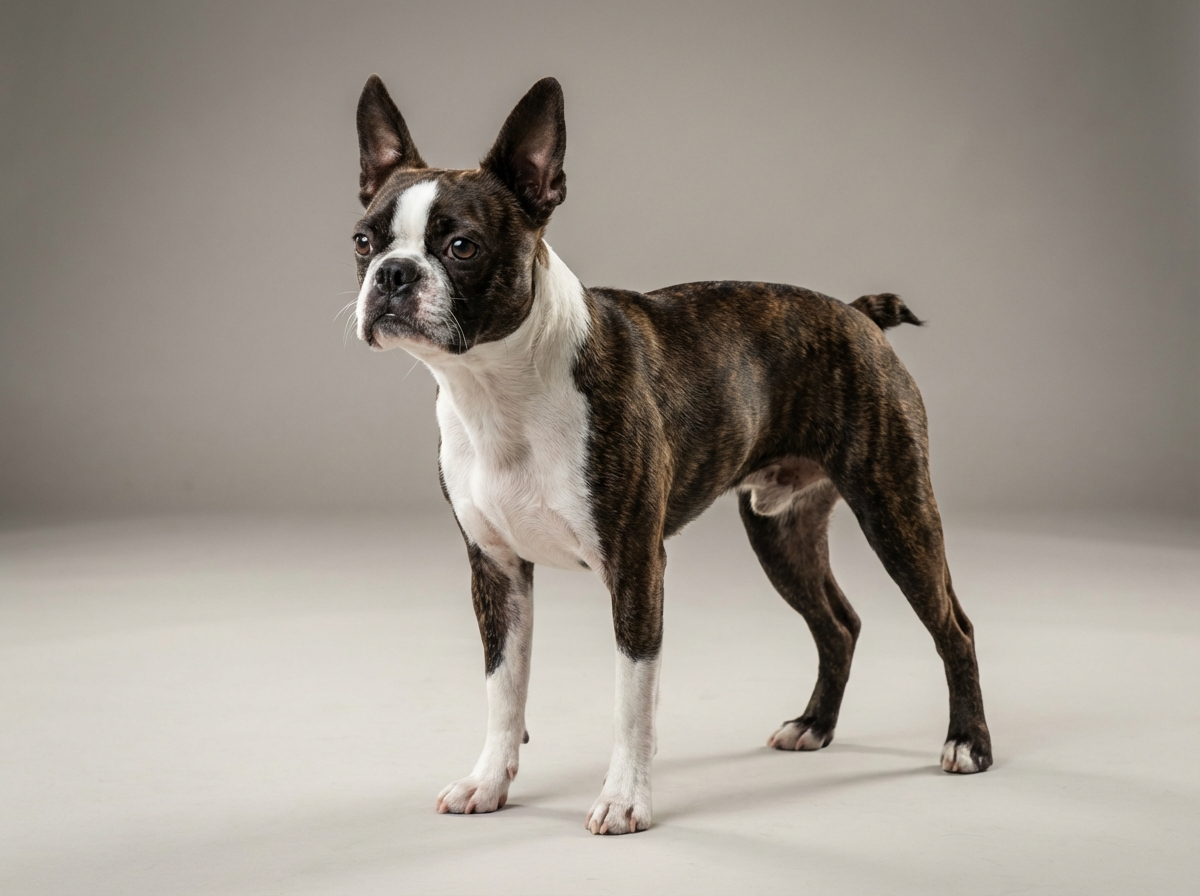
Health
What are the first signs of a back problem in a Boston Terrier?
A hunched posture, refusing to jump up, yelping when lifted, and trembling. Visible weakness in the hind legs usually comes later.

Quick answer
What are the first signs of a back problem in a Boston Terrier?
A hunched posture, refusing to jump up, yelping when lifted, and trembling. Visible weakness in the hind legs usually comes later.
The tail is a visible symptom of an invisible process. Vertebrae elsewhere in the spine can be built the same way, and the discs between them pay for it.
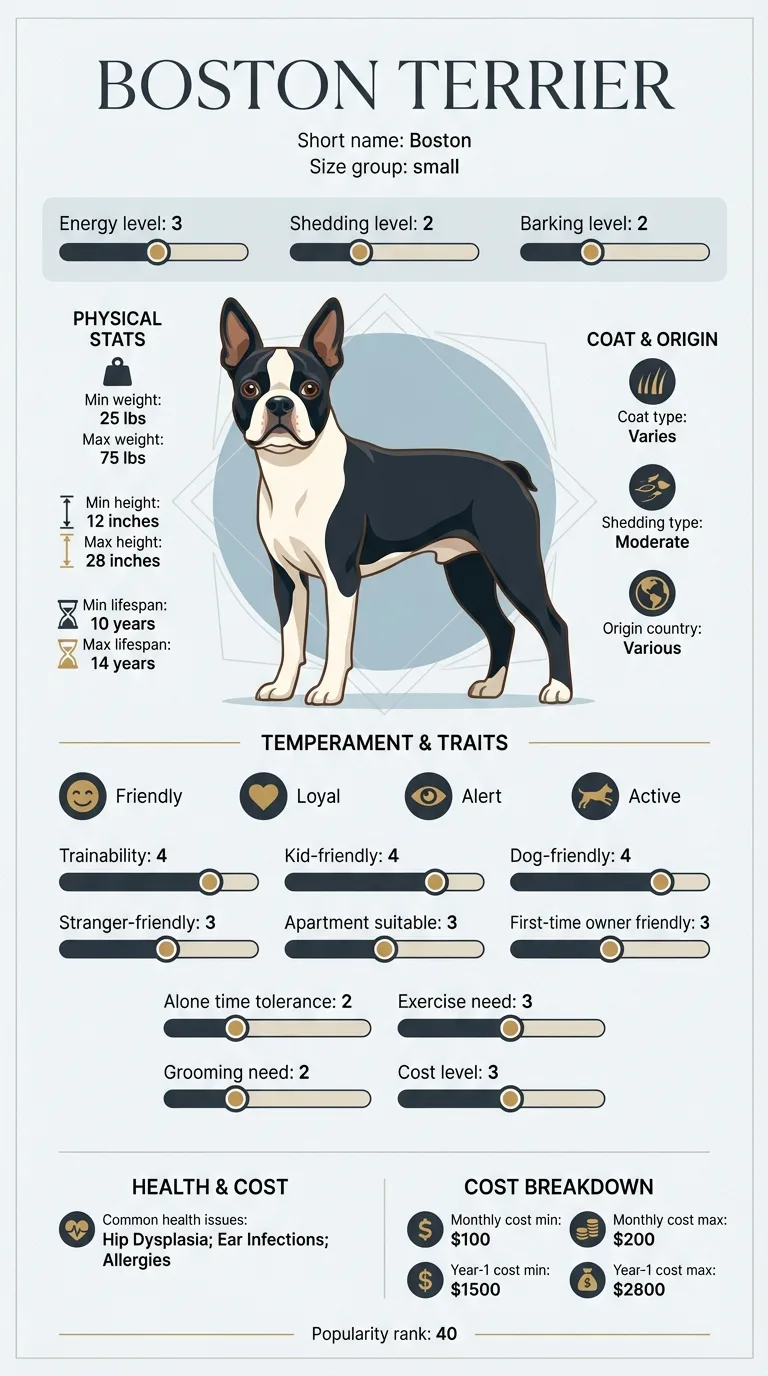
Owners noticing a Boston that is reluctant to jump, arches its back, or yelps when picked up, and owners who have just seen the word hemivertebra on a radiograph report.
This guide is not medical advice. If your dog shows pain, sudden behavior change, or worsening symptoms, consult a licensed veterinarian.
Some links may be affiliate links. We may earn a commission at no extra cost to you. We only suggest products we believe are helpful for dog owners.
We research and check what we publish, but we do not warrant that any figure, date, price, or statement is accurate, complete, or current, and we accept no liability for any loss, cost, injury, or other harm arising from the use of this site. Use it as one reference among several. You remain responsible for your own decisions and for your dog's care - confirm anything that matters with a licensed veterinarian or another qualified professional before you act on it. Full disclaimer.
Intervertebral disc disease is degeneration of the cushions between vertebrae, leading to material pressing on the spinal cord. In Boston Terriers the risk factor worth knowing about is vertebral shape: the same developmental process that produces the breed's screw tail can produce wedge-shaped vertebrae elsewhere, loading neighbouring discs unevenly.
Clinically significant disc disease is not one of the Boston Terrier's headline problems, which are brachycephalic airway syndrome, patellar luxation, cataracts, corneal ulcers and deafness. Incidental vertebral malformation, by contrast, is not rare in the breed and is often found by chance. Most dogs with it never develop signs, and the group who do is a minority within a minority.
Selection for the screw tail fixed a vertebral malformation in the breed as a cosmetic feature. Where the same pattern extends into the thoracic spine, the column loses its even alignment and the discs adjacent to the affected segment carry disproportionate strain. Add a compact, short-backed body of 12 to 25 pounds standing 15 to 17 inches, and the spine has little length over which to distribute the forces of jumping and twisting.
Household architecture does most of the damage. Repeated descents from beds and sofas, hard slippery floors with no grip, and stairs taken at speed all deliver sharp spinal loads. Excess weight increases every one of those forces. Being lifted badly, with the front end supported and the back end hanging, puts a shearing load through exactly the region most likely to be compromised.
Go the same day for any dog that yelps on being touched or lifted, stands hunched, will not settle, or is trembling without an obvious cause. Go immediately, as an emergency, for wobbling or crossing hind legs, dragging a foot, inability to stand, loss of bladder or bowel control, or a dog that cannot feel its hind feet. Spinal compression is time-sensitive and the window for the best surgical outcomes is measured in hours. Never give human anti-inflammatory medication to a dog with back pain.
See all Boston Terrier health problems, which breeds are prone to intervertebral disc disease ivdd, or the full Boston Terrier breed guide for temperament, exercise needs and ownership costs.
Conservative management of a painful but walking dog typically means four to six weeks of strict confinement, followed by a gradual return over a further month. Surgical cases are usually walking within days to weeks depending on how much function was lost, with rehabilitation continuing for months. Vertebral malformation itself does not change; management is permanent.
A dog that is comfortable, continent and walking normally, in a home rearranged so the highest-risk movements are no longer available. Success is not a normal spine on imaging. For a dog with hemivertebrae, success is a spine that never becomes a clinical problem.
A normal vertebra is roughly symmetrical, so a stack of them forms a straight column. A hemivertebra is wedge-shaped, formed when one side fails to develop fully. Stack several wedges and the column deviates, twists, or kinks.
The screw tail characteristic of the Boston Terrier is a run of these malformed vertebrae in the tail itself. In some dogs the same developmental pattern appears further forward, most often in the mid-back region. Many such dogs never have a problem and the finding is incidental on an X-ray taken for something else.
Where it does matter, the mechanism is straightforward. A kinked or angled segment cannot share load evenly with its neighbours, so the discs immediately above and below take more strain than they were built for. Over years that accelerates the normal degeneration every disc undergoes.
Separately, disc material itself can change early in some short-legged and short-bodied breeds, becoming mineralised and brittle rather than staying elastic. A brittle disc under uneven load is a disc that can fail suddenly rather than gradually.
The practical upshot is that back pain in a Boston Terrier deserves imaging rather than a fortnight of rest and hope. Two dogs with identical outward signs can have completely different spines underneath, and the plan depends on which one you have.

Full paralysis is unmistakable. The early signs are not, and they are the ones worth learning.
Alfie swallowed part of a squeaky toy at three, which bought him an abdominal radiograph and an anxious afternoon. The toy passed on its own. The report mentioned, almost in passing, two wedge-shaped vertebrae in his mid-back. His owner Jonah asked what to do about it. The answer was: nothing medical, and three things practical. Stop letting him jump off the back of the sofa. Learn to lift him properly. Keep him at 18 pounds rather than the 21 he was heading for. Jonah put a small ramp beside the sofa, which Alfie ignored for a fortnight and then used exclusively. He is nine now with no history of back pain at all. Whether the ramp did that or whether Alfie was never going to have a problem, nobody can say. It cost forty pounds to find out.
Key takeaway: An incidental finding of vertebral malformation is not a diagnosis and not a sentence. It is a reason to remove the two or three movements in your home that load the spine hardest.
They can. The breed is not on the standard shortlist headed by the Dachshund, but its documented screw tail reflects vertebral malformation, and dogs with malformed segments elsewhere carry additional strain on neighbouring discs. It is far from universal, and most Bostons live their lives without spinal trouble.
The tail vertebrae themselves rarely cause neurological problems, though a tight tail pocket can produce a persistent skin infection that owners do have to manage. The relevance to the spine is what the tail tells you about the developmental process rather than the tail's own function.
Not routinely in a dog with no signs. Incidental hemivertebrae are common and finding them in a comfortable dog changes little beyond how you handle furniture. Imaging becomes valuable the moment there is pain, weakness or a gait change.
They reduce peak spinal loading, which is the mechanism behind acute disc failure, so they are sensible in a dog known to have vertebral malformation. There is no trial proving they prevent IVDD in this breed. They are low cost and low harm, which is why most vets recommend them anyway.
Many mildly affected dogs do, with strict confinement and veterinary pain management over several weeks. Confinement means genuinely restricted movement, not a quiet week with sofa access. Dogs that lose the ability to walk, or that lose deep pain sensation, are a different and far more urgent category.
No. After a recovery period, controlled lead walking on level ground rebuilds the muscle that supports the spine. What usually stops permanently is jumping down from height, rough play with larger dogs, and stairs taken at speed.
A hunched posture, refusing to jump up, yelping when lifted, and trembling. Visible weakness in the hind legs usually comes later.
Yes, often severely. Spinal pain is one of the situations where dogs vocalise, which they otherwise rarely do, and it should never be managed with over-the-counter human medication.
Advanced imaging plus surgery commonly runs into several thousand dollars, with substantial variation by region and referral centre, plus aftercare and rehabilitation.
Going up is generally fine. Repeatedly descending stairs and jumping off furniture create the highest spinal loads, so ramps and lifting help most there.
A one-page prep sheet for this condition: the signs, the questions to ask, what to get priced. Unlocks here.
You get: Vet visit prep sheet
No spam. One-click unsubscribe. See our privacy policy.
Preview page 1 before you decide.