Health
What does deep pain sensation mean?
A vet firmly pinches a toe and watches for a conscious reaction such as turning the head. A leg reflex alone does not count. Its absence marks the most severe grade of spinal injury.

Quick answer
What does deep pain sensation mean?
A vet firmly pinches a toe and watches for a conscious reaction such as turning the head. A leg reflex alone does not count. Its absence marks the most severe grade of spinal injury.
This is the version that turns a normal Tuesday into an emergency drive. A dog that was fine at breakfast can be unable to stand by lunchtime.
Owners in the middle of it right now, trying to work out whether this is a wait-until-morning situation, and owners weighing a surgical estimate against conservative management.
This guide is not medical advice. If your dog shows pain, sudden behavior change, or worsening symptoms, consult a licensed veterinarian.
Some links may be affiliate links. We may earn a commission at no extra cost to you. We only suggest products we believe are helpful for dog owners.
We research and check what we publish, but we do not warrant that any figure, date, price, or statement is accurate, complete, or current, and we accept no liability for any loss, cost, injury, or other harm arising from the use of this site. Use it as one reference among several. You remain responsible for your own decisions and for your dog's care - confirm anything that matters with a licensed veterinarian or another qualified professional before you act on it. Full disclaimer.
Type I intervertebral disc disease is a sudden rupture of hardened disc material into the spinal canal. The cord is injured twice: once by the force of the impact and again by the ongoing pressure of the material sitting against it. Removing that pressure quickly is the only intervention that addresses the second half, which is why this is treated as a surgical emergency rather than a painful back.
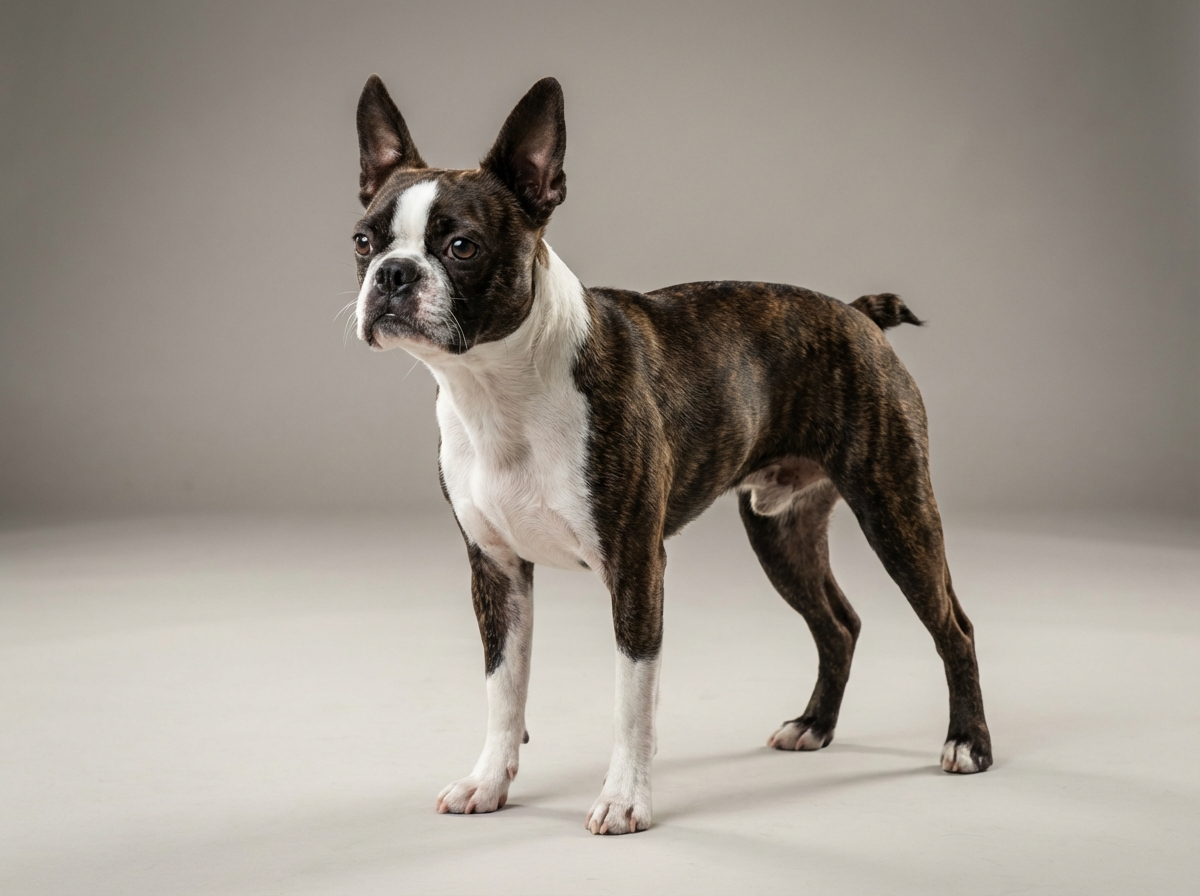
Acute Type I herniation is dramatically more frequent in the classic chondrodystrophic breeds, with the Dachshund far ahead of any other. Boston Terriers are not in that group, and their documented breed conditions lie elsewhere. When it does occur in a Boston, it behaves the same way it does in any other dog, and the same grading and timelines apply.
Two breed features are relevant and neither is universal. First, disc material in some short-legged and short-bodied dogs mineralises early, turning an elastic shock absorber into a brittle plug that can be forced out under load. Second, vertebral malformation of the kind that produces the Boston's screw tail can extend into the thoracic spine and concentrate strain on the discs around it. A Boston with neither feature is at ordinary risk.
The trigger is almost always a peak load rather than accumulated wear. Jumping down from height, slipping on hard flooring, and twisting at speed produce the forces that finish off a disc that was already compromised. Excess body weight raises every one of those forces. Households with a lot of furniture jumping and no traction underfoot supply the conditions repeatedly.
This condition is defined by urgency. Go immediately for any dog that cannot stand, drags or crosses its hind legs, has lost bladder control, or shows no response when a hind toe is firmly pinched. Go the same day for yelping, hunching, trembling, or a sudden refusal to jump. Do not wait overnight to see whether it settles, do not give human painkillers, and note the exact time signs began because it directly informs surgical decisions.
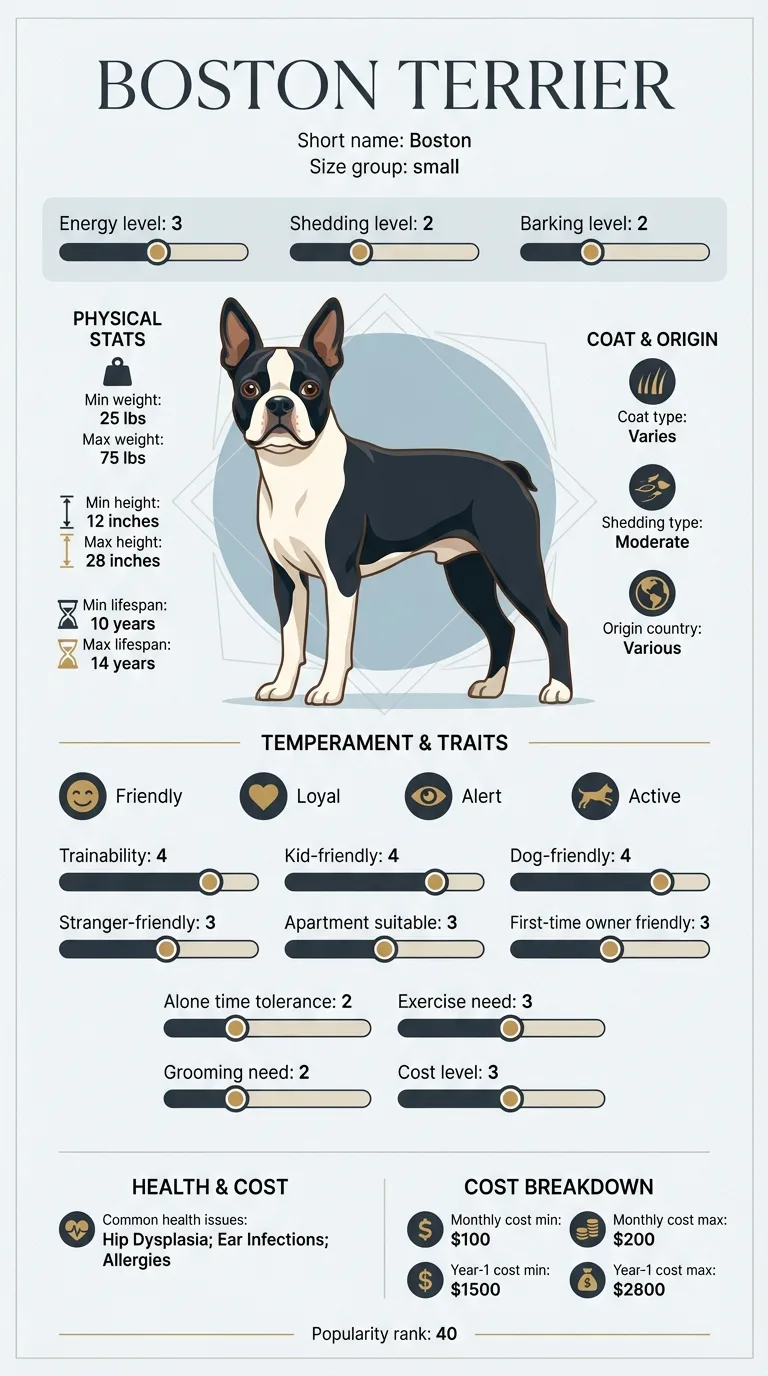
See all Boston Terrier health problems, which breeds are prone to intervertebral disc disease ivdd type i, or the full Boston Terrier breed guide for temperament, exercise needs and ownership costs.
Surgical patients typically spend two to five days hospitalised, then four to six weeks in strict confinement at home. Dogs that were still walking often improve within days. Dogs that were paralysed but retained deep pain sensation commonly regain walking over two to six weeks. Dogs operated on without deep pain sensation face a much longer and less certain course.
A dog that walks, controls its bladder, and is free of pain. Some recovered dogs keep a slightly wobbly gait or scuff a nail for life, and that is a good outcome rather than a failed one. Full return to pre-injury athleticism is not the target, and should not be attempted.
Vets grade spinal cord injury by function, not by imaging. The grade drives urgency, and the difference between grade four and grade five is the most consequential distinction in the whole field.
Stop all movement. Do not walk the dog around to assess it, do not encourage it to try standing, and do not carry it loosely against your chest. Support the spine as a single rigid unit, ideally by sliding the dog onto a flat, firm surface such as a chopping board, a baking tray or a stiff piece of cardboard, and lifting that.
Phone the practice on the way rather than before setting off, and say the words unable to walk or dragging back legs. Those phrases move a case to the front of the queue.
Do not give any human medication. Anti-inflammatory drugs from a bathroom cabinet are toxic to dogs at ordinary human doses, and even at safe doses they can complicate the steroid decisions a neurologist may need to make on arrival.
Do not apply heat or cold and do not massage the back. Neither helps a compressed cord and both cause pain in a dog that is already frightened.
Check the bladder question honestly. A paralysed dog that has not urinated in several hours may have a bladder that is overfilling without the dog being able to empty it, which becomes a problem in its own right. Mention it at triage.
Finally, note the time the signs started. Not roughly. As precisely as you can. In grade five cases the interval between loss of deep pain and surgery is one of the strongest predictors of whether the dog walks again, and the neurologist will ask.

Sunny was six when she jumped off the arm of a sofa on a Sunday afternoon, screamed once, and could not get up. Within ten minutes her hind legs were limp. Her owner Beth had read about spinal injuries a year earlier, for no particular reason, and did two things right. She slid Sunny onto a wooden chopping board rather than picking her up, and she phoned ahead saying the words back legs not working. The clinic had a nurse waiting at the door. Sunny still had deep pain sensation on assessment, which the neurologist described as the best news of the afternoon. She had surgery that evening. She was standing with support on day three, walking unsteadily by the end of week two, and back to normal walks at eight weeks. Beth's house now has a ramp to the sofa and no cushions on the arm. Sunny is nine and has not had a recurrence.
Key takeaway: Nothing Beth did was clever or expensive. She did not let Sunny move, she transported her flat, and she used words on the phone that communicated urgency. Those three things are available to anyone.
Type I is an explosive extrusion of hardened disc material, typical of chondrodystrophic breeds and usually sudden. Type II is a slow bulging of the outer disc ring, more common in larger and older dogs, producing gradual weakness over months. The urgency, treatment and prognosis differ completely.
Less so than the classic long-backed breeds. The Boston's documented health problems are the airway, kneecaps and eyes rather than the spine. What raises the risk in an individual Boston is vertebral malformation, which the breed's screw tail reflects and which sometimes extends further up the column.
For a dog that has lost deep pain sensation, sooner is dramatically better, and many neurologists treat the first day as the critical period. For dogs that retain deep pain, the urgency is high but the margin is wider. Nobody benefits from waiting to see if it improves overnight.
Some do, particularly those that still have deep pain sensation, with strict cage confinement and veterinary pain control over weeks. Recovery is slower and less complete on average than with surgery. Dogs without deep pain sensation have a poor outlook without decompression.
Typically several days in hospital, then four to six weeks of strict confinement at home with controlled toilet trips, bladder management if needed, and a structured rehabilitation plan. Owners are surprised by how much of the work is theirs rather than the surgeon's.
Recurrence at a different disc is possible, particularly in dogs whose disc material has mineralised broadly. Surgery addresses the disc that failed rather than the underlying tendency, so the household changes around ramps, lifting and weight stay permanent.
A vet firmly pinches a toe and watches for a conscious reaction such as turning the head. A leg reflex alone does not count. Its absence marks the most severe grade of spinal injury.
If the dog is yelping, cannot stand, or is dragging a limb, yes. Spinal compression progresses, and the cheapest version of this situation is the one seen earliest.
Flat and supported along the whole spine, ideally slid onto a rigid board rather than scooped up under the belly.
No. Human anti-inflammatories and painkillers are dangerous to dogs and can interfere with emergency treatment decisions. Wait for veterinary prescribing.
A one-page prep sheet for this condition: the signs, the questions to ask, what to get priced. Unlocks here.
You get: Vet visit prep sheet
No spam. One-click unsubscribe. See our privacy policy.
Preview page 1 before you decide.