Behavior
What are the signs of separation anxiety in a dog?
Distress starting within minutes of departure, damage focused on doors and windows, pacing, drooling, refusing food while alone, and reacting to departure cues before you leave.

Quick answer
What are the signs of separation anxiety in a dog?
Distress starting within minutes of departure, damage focused on doors and windows, pacing, drooling, refusing food while alone, and reacting to departure cues before you leave.
The chewed door frame is not revenge. It is what a panicking animal does when it is trying to get out of a place it cannot leave.
Owners returning to office work after a period at home, and anyone whose Boston follows them from room to room and cannot settle when a door closes.
This guide is not medical advice. If your dog shows pain, sudden behavior change, or worsening symptoms, consult a licensed veterinarian.
Some links may be affiliate links. We may earn a commission at no extra cost to you. We only suggest products we believe are helpful for dog owners.
We research and check what we publish, but we do not warrant that any figure, date, price, or statement is accurate, complete, or current, and we accept no liability for any loss, cost, injury, or other harm arising from the use of this site. Use it as one reference among several. You remain responsible for your own decisions and for your dog's care - confirm anything that matters with a licensed veterinarian or another qualified professional before you act on it. Full disclaimer.
Separation anxiety is panic triggered by being left alone. It produces vocalisation, destruction focused on exits, toileting indoors in an otherwise clean dog, and physical signs of distress such as drooling and pacing. It responds well to structured desensitisation and responds badly to almost everything else, including punishment and simply hoping the dog will get used to it.
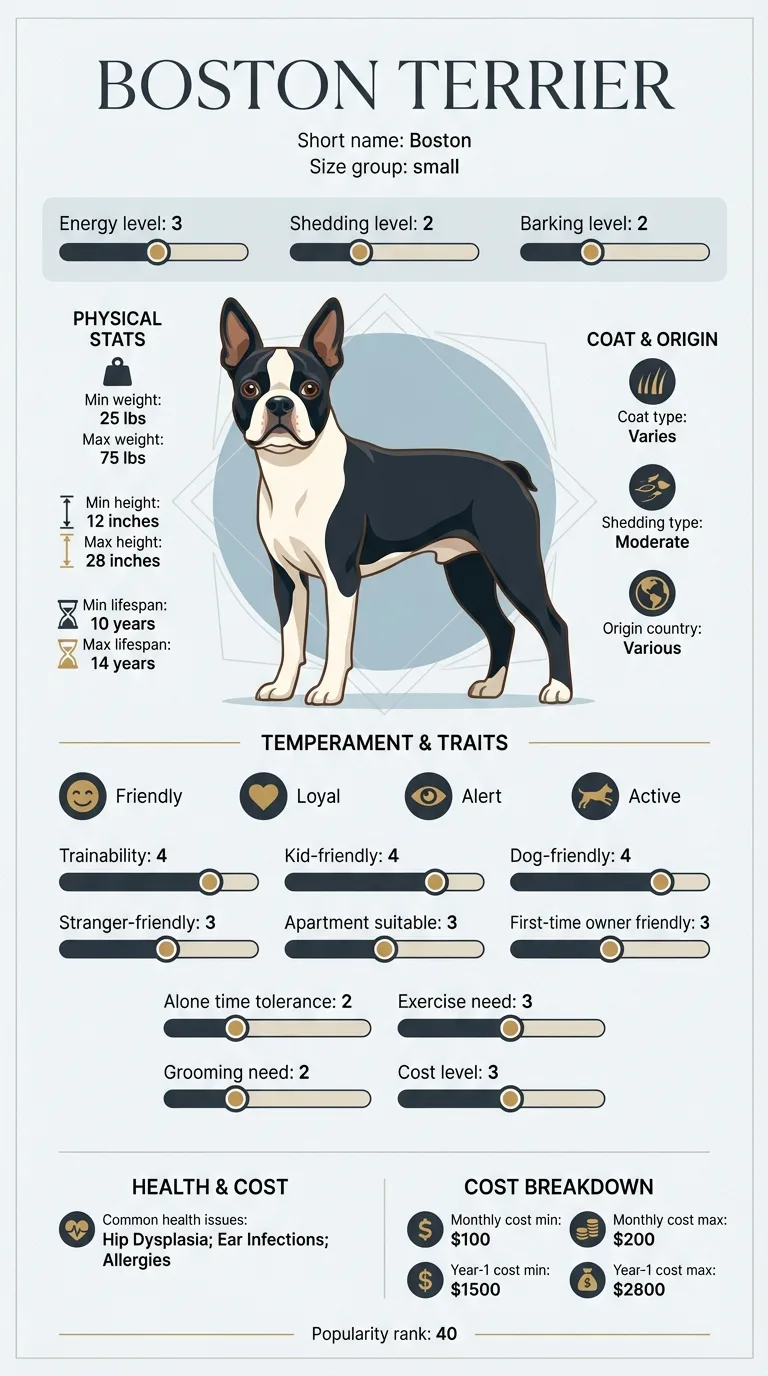
Separation-related behaviour is among the most frequently reported problems in companion dogs generally. Boston Terriers sit in the moderate range for alone-time tolerance, consistent with a breed developed for close human company rather than independent work. The breed is also highly trainable and adapts well, which means the prognosis with a proper protocol is genuinely good.
The Boston Terrier was bred as a companion and scores highly for kid-friendliness, stranger-friendliness and suitability for first-time owners. That sociability is the same trait that makes solitude difficult. Alone-time tolerance in the breed is moderate rather than high, and the breed's strong apartment suitability means many Bostons live in homes where the dog is with people almost constantly, so genuine alone time is rarely practised. High trainability, however, means the breed responds well to a structured protocol once one is started.
Abrupt routine change is the single most common trigger, and the shift back to office attendance after a long period of home working has produced a great many cases. Households where the dog is never deliberately separated leave no baseline to work from. Noise, deliveries and a view of the street can compound distress. Insufficient physical and mental activity before a departure leaves a dog with nothing to do but worry.
Early, and choose carefully. Look for a qualified behaviourist who works with reward-based methods and has specific experience of separation-related distress, ideally one who works remotely using your camera footage, which is now common practice. Avoid anyone recommending punishment, dominance framing, or simply leaving the dog to cry it out; flooding a panicking animal is both ineffective and harmful. Veterinary behaviourists can combine the training plan with medication where needed.
Book an appointment before assuming a behavioural cause if the change was sudden in an adult dog, since pain, cognitive decline and endocrine disease all present as new anxiety. Go the same day if your Boston has injured itself trying to escape, has broken teeth or bleeding nails, or is panting and distressed to the point of collapse. In a brachycephalic breed, prolonged panic panting carries a real risk of overheating, so severe cases warrant medical involvement rather than training alone.
See all Boston Terrier health problems, which breeds are prone to separation anxiety, or the full Boston Terrier breed guide for temperament, exercise needs and ownership costs.
Expect two to six months for a moderate case worked consistently, and longer where distress is severe or the dog cannot be prevented from being left during training. Progress is not linear; setbacks after a holiday or an illness are normal. The first genuine ten-minute absence often takes six weeks to reach and the next hour comes much faster.
A dog that settles within a few minutes of a departure, sleeps through most of the absence, eats a food toy while alone, and greets you calmly. Success is rarely a dog that is happy to be alone all day, and for a companion breed with moderate tolerance that should not be the target.
These two produce similar-looking damage and need completely different responses. Camera footage of the first thirty minutes settles it.
The method that works is graduated desensitisation, and its central rule is that the dog must not experience panic during training. Every episode of panic reinforces the association you are trying to break, so a session that goes too far sets you back further than a slow one costs you.
Start by breaking the departure ritual. Pick up your keys and sit back down. Put on your coat and make a cup of tea. Repeat until those cues produce no reaction at all, which usually takes several days of short sessions.
Then work on the door, not on time. Step outside and come back in immediately. Do this many times, with no greeting on return. The absence of an emotional arrival is part of the treatment.
Only then extend duration, and extend it in seconds rather than minutes. Vary the intervals so the dog cannot predict a pattern, and always return before any sign of distress. A camera is not optional here; you cannot judge the threshold from outside a door.
The hard constraint is that the dog should not be left beyond its threshold at any point during training, including on real workdays. That usually means arranging a sitter, a daycare place or a neighbour for the weeks the protocol takes. Owners who train on weekends and leave the dog panicking on weekdays generally make no progress at all.
Where distress is severe, veterinary involvement matters. Anti-anxiety medication is not a shortcut or an admission of failure; it lowers the panic threshold enough for the training to work, and for some dogs the training simply cannot progress without it.

If you think your Boston has separation anxiety, the plan is three steps: write down what you have seen and when it started, book a veterinary appointment rather than waiting for the next flare, and take video of the behaviour or symptom before you go — the thing you are worried about rarely happens in the consulting room. Screening in the parents covers brachycephalic airway syndrome (boas), patellar luxation, cataracts.
What the vet visit should produce is a diagnosis and a written plan, not just reassurance: what is being ruled out, what the monitoring interval is, and which signs mean you come back sooner. Ask what the treatment costs across a year rather than per visit, because that is the number that decides whether you are managing this condition or reacting to it.
Between appointments, keep a short log — dates, what you saw, what changed. It is the single most useful thing an owner brings to a follow-up, and for separation anxiety it is often what separates a clear pattern from a guess.
Otto was two when his owner Ffion went back to the office three days a week. Within a fortnight the neighbours had complained twice and the door frame was scored to bare wood at dog height. Ffion set up a camera and watched. Otto began pacing at fifty-eight seconds and was howling at four minutes. He never touched the stuffed food toy she had left. She arranged daycare for the three office days so he was never left over threshold, and started the protocol on her days at home. Keys and coat for the first week. Door open and shut for the second. By week four he could hold ninety seconds calmly. At week eleven he slept through a forty-minute absence. At four months she stopped daycare on one day. Ffion says the part she got wrong initially was trying to train on weekends while letting him panic all week, which cost her a month before she paid for the daycare that made it work.
Key takeaway: The protocol only works if the dog is never left over threshold, including on ordinary workdays. Paying for cover during the training period is not an optional extra; it is the thing that makes the training possible.
The breed was developed as a companion and its alone-time tolerance is moderate rather than high. Bostons are friendly, lively and strongly people-oriented, which is exactly the profile that struggles with long solitary days. That is a predisposition rather than an inevitability, and dogs given structured alone-time practice from puppyhood generally cope well.
Four hours is a reasonable working maximum for a well-adjusted adult, with a toilet break and interaction beyond that. A dog with any degree of separation distress should not be left at all beyond its current trained threshold, which early in a protocol may be measured in seconds.
Usually not. Separation anxiety in dogs is most often about a specific attachment to a person, and another dog does not substitute for that. It also risks a second dog learning the distress behaviour. Occasionally it helps, but it is a costly experiment with a poor success rate.
It depends on the individual. A dog with a genuinely positive crate association may settle better in one. A dog that panics in a crate can injure itself trying to escape, breaking teeth or nails against the door. If your Boston scratches frantically at the crate front, the crate is not the answer for this dog.
Keep arrivals and departures low-key rather than cold. A calm greeting after a few minutes of settled behaviour avoids the emotional peak that makes the contrast with your absence sharper. Elaborate goodbyes are the more damaging half.
Medication alone rarely resolves it. What it does, in appropriate cases, is reduce panic enough for behavioural training to take hold. It is prescribed and monitored by a vet, often alongside a qualified behaviourist, and is usually a time-limited part of a broader plan.
Distress starting within minutes of departure, damage focused on doors and windows, pacing, drooling, refusing food while alone, and reacting to departure cues before you leave.
Realistically two to six months of consistent daily work for a moderate case, longer for a severe one. Progress is measured in seconds added rather than in weeks passed.
Pheromone diffusers, calming music and pressure wraps help some dogs modestly. None substitutes for desensitisation training, and treating them as the plan wastes time.
Never. The dog cannot connect the punishment to behaviour from hours earlier, and adding fear to a fear-driven problem reliably makes it worse.
Behaviour changes often start with pain. The prep sheet for this page covers what to rule out, and what to ask.
You get: Vet visit prep sheet
No spam. One-click unsubscribe. See our privacy policy.
Preview page 1 before you decide.