Health
What grade of patellar luxation needs surgery?
There is no fixed cutoff. Grade three and four dogs are usually surgical candidates; grade one rarely is. Grade two depends on how much the dog is bothered.

Quick answer
What grade of patellar luxation needs surgery?
There is no fixed cutoff. Grade three and four dogs are usually surgical candidates; grade one rarely is. Grade two depends on how much the dog is bothered.
Grade is not a prescription. Plenty of grade two dogs never have surgery and are fine at twelve, and plenty of grade three dogs should have had it at two.
Owners holding a surgical estimate and trying to work out whether it is necessary now, later, or at all, and owners who chose conservative management and are wondering whether the ground has shifted.
This guide is not medical advice. If your dog shows pain, sudden behavior change, or worsening symptoms, consult a licensed veterinarian.
Some links may be affiliate links. We may earn a commission at no extra cost to you. We only suggest products we believe are helpful for dog owners.
We research and check what we publish, but we do not warrant that any figure, date, price, or statement is accurate, complete, or current, and we accept no liability for any loss, cost, injury, or other harm arising from the use of this site. Use it as one reference among several. You remain responsible for your own decisions and for your dog's care - confirm anything that matters with a licensed veterinarian or another qualified professional before you act on it. Full disclaimer.
Patellar luxation is a kneecap that leaves its groove, and it sits on the Boston Terrier's documented list of common health problems. The clinical question is rarely whether it exists but what to do about it. Conservative management and surgical stabilisation are both legitimate answers, and the right one depends on the individual dog rather than on the grade alone.
Common in the breed and in small companion breeds generally, which is why patella evaluation is a standard part of responsible breeding programmes. The majority of affected dogs are at the milder end. Surgery is a minority outcome, and being told your dog has a luxating patella is not the same as being told it needs an operation.
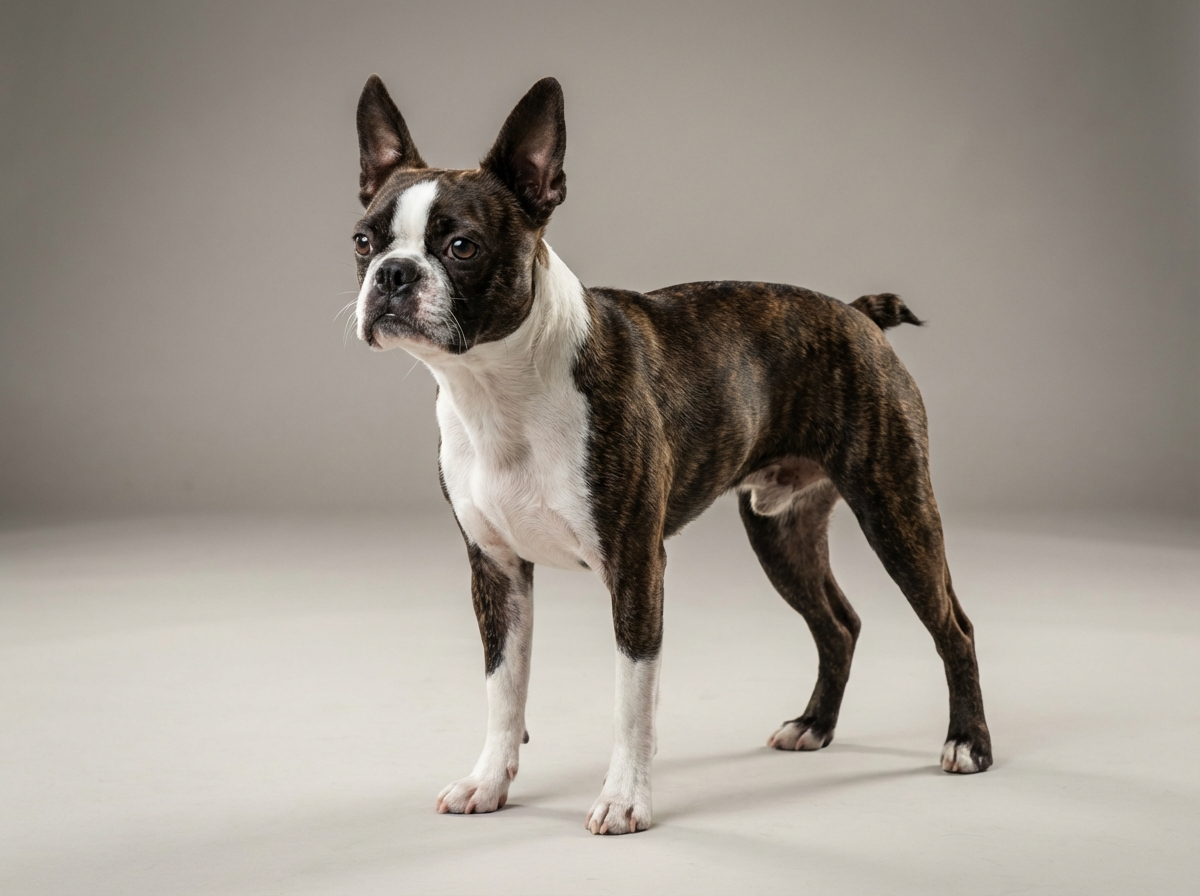
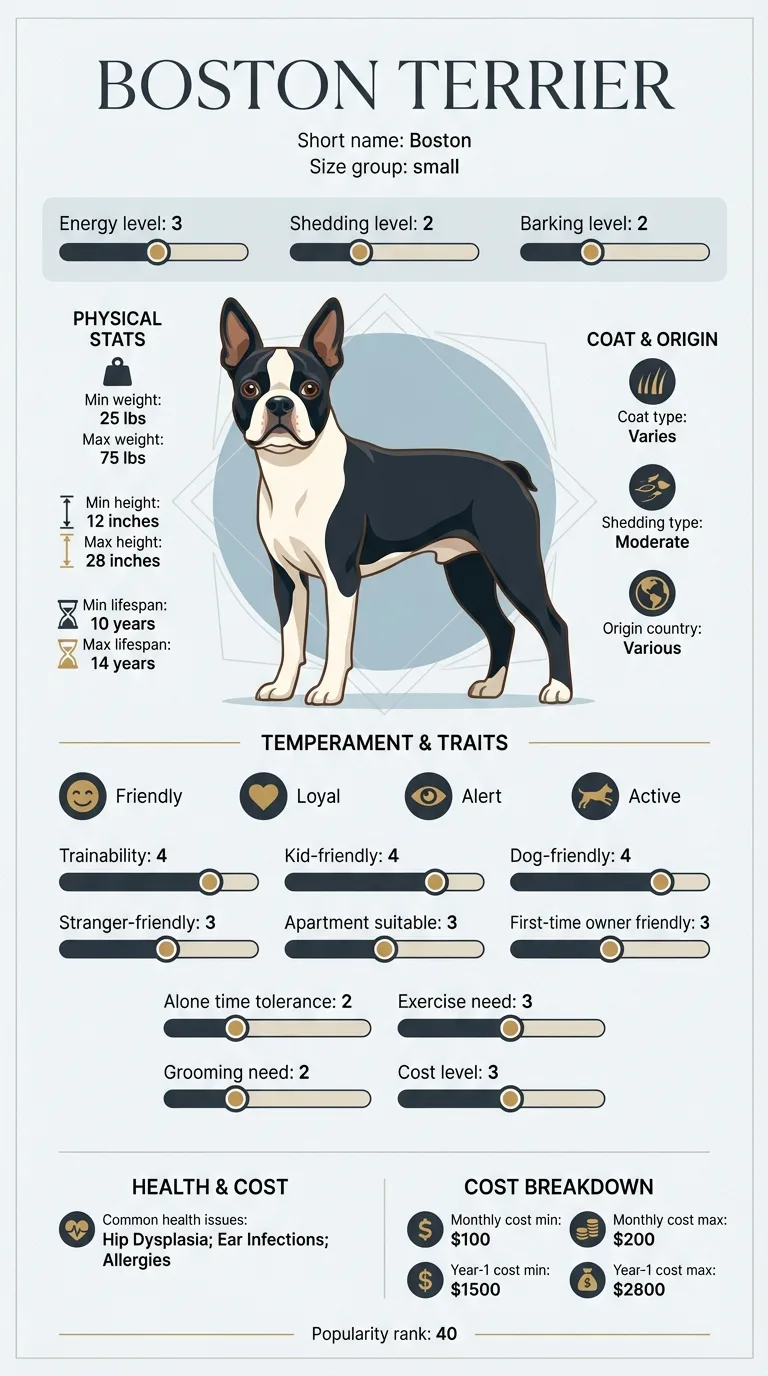
The anatomy behind it is developmental and inherited: a shallow trochlear groove, a tibial attachment point sitting too far medially, and sometimes subtle rotation in the limb bones. In a Boston Terrier standing 15 to 17 inches and weighing 12 to 25 pounds, the limb is short and the joint has little room to absorb misalignment. Because the trait is heritable, screening breeding stock is the only intervention that reduces incidence at population level.
Environment determines the rate of secondary damage rather than the presence of the malformation. Hard slippery flooring, repeated jumping down from furniture and cars, sharp turns during high-speed play, and excess body weight all accelerate cartilage wear and stretch the soft tissue that would otherwise help hold the kneecap in line. Recovery environment matters just as much after surgery.
Book a reassessment if the skipping becomes more frequent, if your Boston starts holding the leg up for more than a stride or two, if one thigh is visibly thinner, or if it has begun refusing activity it used to enjoy. Go the same day for sudden inability to bear weight, for a leg held up continuously, or for crying on handling, since an unstable knee is at raised risk of cruciate ligament rupture and that is a different injury needing different treatment.
See all Boston Terrier health problems, which breeds are prone to patellar luxation, or the full Boston Terrier breed guide for temperament, exercise needs and ownership costs.
Surgery involves a day procedure or overnight stay, eight weeks of strict restriction, and a graded return over four to eight weeks after that. Full muscle recovery takes three to six months. Conservative management has no endpoint; it is a permanent set of household habits reviewed annually.
A dog using the leg fully, with restored thigh muscle, moving without a skip, and comfortable after activity. Success does not mean a knee that will never develop arthritis, and it does not mean returning to a household where the dog jumps off the back of the sofa. The environment changes are part of the result.
Patellar stabilisation is not a single procedure. It is a combination selected for the individual leg, and understanding the components makes the estimate far less opaque.
Deepening the groove is the most common element. The shallow channel at the end of the thigh bone is cut deeper so the kneecap has a genuine track to sit in. Surgeons do this by lifting a wedge or block of cartilage and bone, removing material underneath, and replacing the surface so that living cartilage still lines the groove.
Realigning the attachment point addresses the pull. The tendon below the kneecap attaches to a bony prominence on the shin, and if that prominence sits too far to the inside, the whole mechanism is being pulled off-line. The surgeon detaches that piece of bone, moves it outward, and pins it in its new position.
Tightening and releasing soft tissue balances the joint capsule, loosening the side that has contracted and taking up slack on the other.
In severe cases with genuine bone deformity, corrective cuts to the femur may be needed. This is a bigger undertaking and is uncommon in dogs of this size.
Complication rates are meaningful rather than negligible. Implant irritation, re-luxation and delayed bone healing all occur, and the risk is higher in higher grades. A frank conversation with the surgeon about their own complication rate is a fair thing to ask for.

These are the questions a good orthopaedic consultation works through, and they are worth thinking about before you walk in.
If you think your Boston has patellar luxation, the plan is three steps: write down what you have seen and when it started, book a veterinary appointment rather than waiting for the next flare, and take video of the behaviour or symptom before you go — the thing you are worried about rarely happens in the consulting room. Screening in the parents covers brachycephalic airway syndrome (boas), patellar luxation, cataracts.
What the vet visit should produce is a diagnosis and a written plan, not just reassurance: what is being ruled out, what the monitoring interval is, and which signs mean you come back sooner. Ask what the treatment costs across a year rather than per visit, because that is the number that decides whether you are managing this condition or reacting to it.
Between appointments, keep a short log — dates, what you saw, what changed. It is the single most useful thing an owner brings to a follow-up, and for patellar luxation it is often what separates a clear pattern from a guess.
Freddie was grade two on the right and eight years old, with mild arthritis already on his radiographs. He skipped perhaps twice a week and had never stopped a walk early. His surgeon was honest: the operation would stabilise the joint but would not undo the arthritis, and at his age the gain was modest. Freddie was managed conservatively, lost two pounds, and got runners throughout the house. He is eleven and still walks forty minutes a day. Sasha was grade three on both sides at eighteen months, with obvious muscle loss and a crouched stance. She was not skipping occasionally; she was struggling constantly. Her owners staged two operations ten weeks apart and did every physiotherapy session. The second recovery was harder than the first because she had no fully sound leg to lean on. Sasha is four now and runs on the beach. Both decisions were correct, and the grade was only part of why.
Key takeaway: The same diagnosis produced opposite plans because age, severity, muscle condition and existing arthritis differed. Ask which of those factors is driving the recommendation you have been given.
No, and most do not. Patellar luxation is on the breed's documented health list, but a large share of affected dogs sit at grades one and two and live comfortably with weight control, muscle building and sensible surfaces. Surgery is for dogs whose function or comfort is genuinely compromised.
For a small dog, typically a low four-figure sum per knee at a general practice with orthopaedic capability, and more at a specialist referral centre. Bilateral cases roughly double it. Ask whether the quote includes imaging, implant removal if needed, and post-operative rechecks.
Around eight weeks of strict restriction, meaning lead-only toilet trips, no stairs, no furniture and no free running, followed by a graded return over a further month or two. Physiotherapy through that period materially improves the outcome and is worth budgeting for.
Some degree of joint change is likely in any knee that has been unstable, and surgery does not reverse what is already there. What stabilisation does is remove the ongoing cause, which slows further damage. Framing it as arthritis prevention rather than arthritis cure is more honest.
For lower grades, frequently yes, for the whole of a dog's life. It is not doing nothing. It means deliberate weight control, consistent muscle-building exercise, non-slip flooring, no jumping down from height, and annual reassessment to catch progression early.
Usually not. Recovering from bilateral surgery simultaneously is hard on a dog that then has no sound leg to favour. Most surgeons stage the two operations several weeks to a few months apart, though there are exceptions in specific cases.
There is no fixed cutoff. Grade three and four dogs are usually surgical candidates; grade one rarely is. Grade two depends on how much the dog is bothered.
Good to excellent function is the usual result in small dogs, particularly at lower grades. Complication and re-luxation rates rise with severity, so ask about them specifically.
Not during the eight-week restriction, and ideally not habitually afterwards. Ramps and steps should become permanent household fixtures rather than temporary aids.
It is not universally required but consistently improves outcomes, particularly muscle recovery and range of motion. Budget for it as part of the procedure rather than an optional extra.
A one-page prep sheet for this condition: the signs, the questions to ask, what to get priced. Unlocks here.
You get: Vet visit prep sheet
No spam. One-click unsubscribe. See our privacy policy.
Preview page 1 before you decide.