Health
How do I tell if my Boston Terrier is overweight?
Run your hands along the ribs. If you have to press to find them, the dog is carrying too much. Check for a waist from above and an abdominal tuck from the side.

Quick answer
How do I tell if my Boston Terrier is overweight?
Run your hands along the ribs. If you have to press to find them, the dog is carrying too much. Check for a waist from above and an abdominal tuck from the side.
Nothing else you can do for a Boston Terrier improves its breathing, its knees and its heart at the same time. Weight does all three.
Owners who have been told their dog is overweight and are quietly certain they do not overfeed it, and households where several people feed the dog and nobody knows the total.
This guide is not medical advice. If your dog shows pain, sudden behavior change, or worsening symptoms, consult a licensed veterinarian.
Some links may be affiliate links. We may earn a commission at no extra cost to you. We only suggest products we believe are helpful for dog owners.
We research and check what we publish, but we do not warrant that any figure, date, price, or statement is accurate, complete, or current, and we accept no liability for any loss, cost, injury, or other harm arising from the use of this site. Use it as one reference among several. You remain responsible for your own decisions and for your dog's care - confirm anything that matters with a licensed veterinarian or another qualified professional before you act on it. Full disclaimer.
Obesity in a Boston Terrier is a small absolute number with a large proportional effect. Because the breed has modest exercise needs, a persuasive expression and an airway with no spare capacity, the gain happens easily and costs more than it would in a bigger dog. It is also the most reversible problem on this breed's health list.
Overweight and obese dogs are estimated to make up a large share of the pet dog population in most developed countries, and small companion breeds are well represented. For Boston Terriers specifically, the combination of low exercise need, high apartment suitability and a short coat that hides body shape makes gradual gain easy to miss until a vet points it out.
Several breed traits pull in the same direction. Exercise requirements are modest, so daily energy expenditure is low. Apartment suitability means many Bostons live largely indoor lives. Heat sensitivity removes several months of outdoor activity each year in warm climates. The short smooth coat lies flat and disguises body outline less obviously than a fluffy coat but also gives owners no tactile prompt to check. And the breed's friendly, comical temperament makes food-based interaction a natural way to bond.
The dominant driver is unmeasured feeding. Estimating portions with a cup or by eye routinely overshoots, and in a dog this size the error is proportionally enormous. Multiple feeders in one household compound it. Sedentary winters and hot summers each remove exercise for months at a time. Food-based training without deduction adds a surprising number of calories over a week.
Book an appointment before starting a weight loss plan so a target weight and daily calorie figure can be set properly, and book urgently if weight gain is rapid, if the abdomen is distended, if drinking and urination have increased, or if there is symmetrical hair loss, since those combinations suggest an endocrine cause rather than overfeeding. Seek immediate care if an overweight Boston is struggling to breathe at rest, has blue or grey gums, or collapses in warm weather.
Every dog carries the joint and cardiovascular consequences of being overweight. A Boston Terrier carries a third consequence that longer-muzzled breeds do not.
Fat deposits in the neck and chest wall narrow an airway that was already narrow. The muscular work of breathing rises just as the space available falls. That is why weight loss produces such striking improvements in snoring and heat tolerance in this breed, often within weeks, and why airway surgeons routinely ask for weight loss before operating.
The second consequence is thermal. Fat is insulation, and a dog that cools itself by moving air through a compromised passage cannot afford extra insulation. Overweight Bostons run out of thermal headroom sooner on the same summer walk.
The third is orthopaedic and is specific rather than general. Patellar luxation is a documented breed problem, and an unstable kneecap is held in place partly by muscle and partly by the geometry of the load through it. Extra body weight worsens both.
The breed's own traits set the trap. Boston Terriers have modest exercise needs, adapt well to apartments, and are described as comical and adaptable. A dog that is content with a short walk and happy to lie on the sofa burns very little, and a dog with an expressive flat face is extraordinarily good at extracting food from humans.

See all Boston Terrier health problems, which breeds are prone to obesity, or the full Boston Terrier breed guide for temperament, exercise needs and ownership costs.
At one to two percent of body weight per week, a Boston needing to lose three pounds is looking at three to five months. Breathing and heat tolerance often improve noticeably in the first four to six weeks, well before the target is reached. Maintaining the loss is permanent work, and most dogs regain if the household reverts to unmeasured feeding.
Ribs easily felt, a visible waist, a dog that finishes walks comfortably and sleeps more quietly. The number on the scale matters less than body condition, and a lean 21 pound Boston with a good frame is healthier than a soft 18 pound one.
Most failed diets fail for the same reasons: the food was never measured, and one person in the house was not on board.
If you think your Boston has obesity, the plan is three steps: write down what you have seen and when it started, book a veterinary appointment rather than waiting for the next flare, and take video of the behaviour or symptom before you go — the thing you are worried about rarely happens in the consulting room. Screening in the parents covers brachycephalic airway syndrome (boas), patellar luxation, cataracts.
What the vet visit should produce is a diagnosis and a written plan, not just reassurance: what is being ruled out, what the monitoring interval is, and which signs mean you come back sooner. Ask what the treatment costs across a year rather than per visit, because that is the number that decides whether you are managing this condition or reacting to it.
Between appointments, keep a short log — dates, what you saw, what changed. It is the single most useful thing an owner brings to a follow-up, and for obesity it is often what separates a clear pattern from a guess.
Bear was 26 pounds at his annual check, up from 21 two years earlier. His owner Priti was adamant he was fed twice a day and nothing else. The vet asked her to keep a written record for one week, with every household member noting everything they gave him. The list came back with two measured meals, a dental chew from her husband each evening, crusts from her son at breakfast, a biscuit from her mother-in-law at every visit, and training treats that had never been counted. Nobody was overfeeding him. Four people were each feeding him a little. They moved to a written daily allowance on the fridge, weighed in grams, with the dental chew and the training treats deducted from his meals. Bear reached 21 pounds in six months. Priti says the change she noticed first was not his shape but that he stopped snoring loudly enough to be heard from the next room.
Key takeaway: In a multi-person household nobody is overfeeding and the dog is still overfed. The fix is a single shared number, written down, that everyone deducts from.
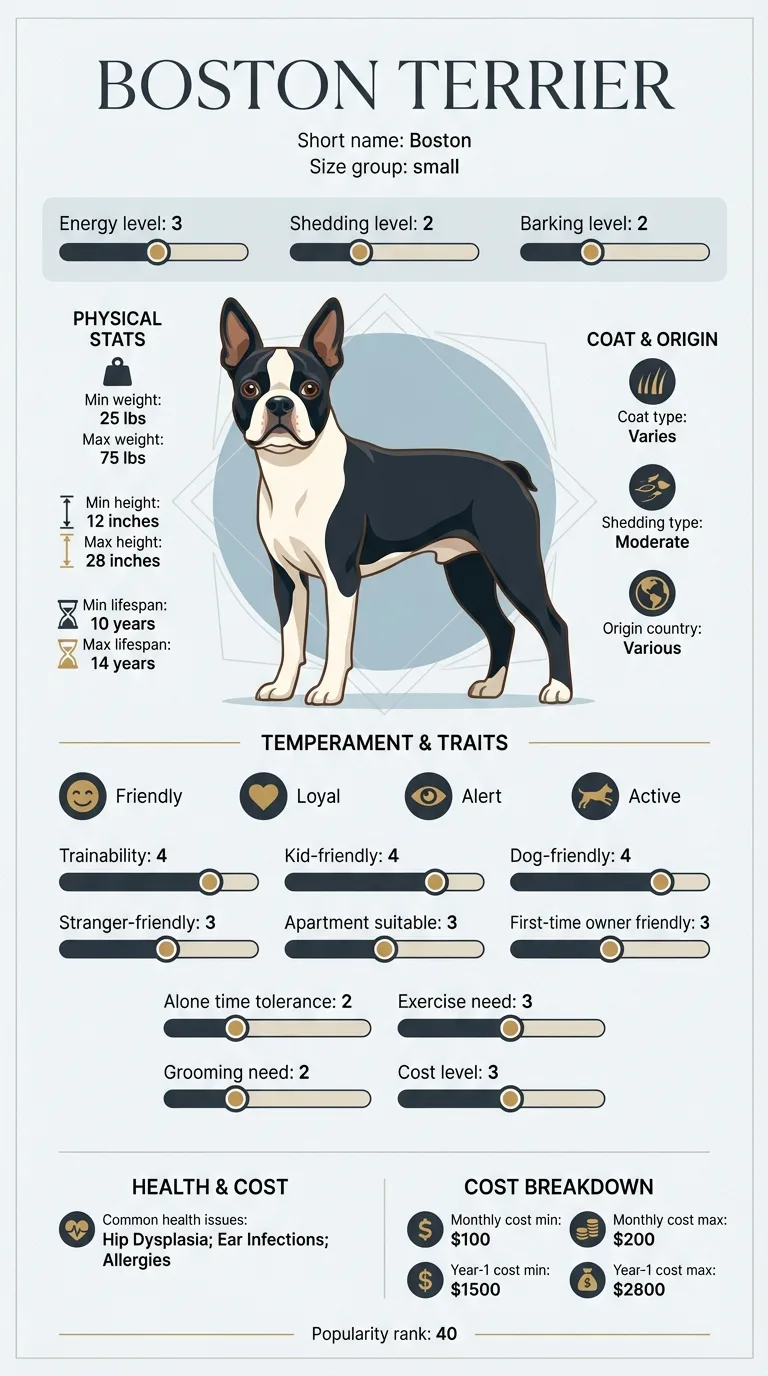
The breed range is roughly 12 to 25 pounds, which is wide because it spans genuinely different frame sizes. The useful measure is not the number but body condition: you should be able to feel ribs under light pressure, see a waist from above, and see a tuck-up from the side.
A persistently food-focused dog is common in companion breeds and is usually about learned reward rather than genuine hunger. That said, a sudden and marked increase in appetite alongside weight change, drinking more, or a pot-bellied appearance deserves veterinary investigation for an endocrine cause.
About one to two percent of body weight per week. On a 22 pound Boston that is roughly three to seven ounces weekly, which feels agonisingly slow and is the rate that preserves muscle. Crash dieting loses lean tissue and rebounds.
Not on its own, and in this breed it has a ceiling. Bostons have modest exercise needs and limited heat tolerance, so you cannot simply walk the weight off in July. Intake is the lever that works; activity supports muscle and mood.
Frequently and noticeably. Reducing fat around the neck and chest lowers the work of breathing, and owners often report quieter sleep and better walk tolerance within weeks. It will not change the underlying anatomy, but it is the cheapest intervention available.
It is worth discussing. These diets are formulated so that a reduced calorie intake still delivers full nutrition, which is harder to achieve by simply feeding less of a standard food. Your vet can calculate a target intake and monitor progress properly.
Run your hands along the ribs. If you have to press to find them, the dog is carrying too much. Check for a waist from above and an abdominal tuck from the side.
It varies by age, neutering status and activity, so ask your vet to calculate a specific daily figure rather than following packet guidelines, which are usually generous.
Energy requirements typically fall after neutering, so the same portion becomes an overfeed. Reducing intake at that point prevents most of the gain owners see afterwards.
Portions of the dog's own measured daily allowance work best. Small pieces of carrot or green bean suit many dogs; avoid grapes, raisins and anything containing xylitol.
A one-page prep sheet for this condition: the signs, the questions to ask, what to get priced. Unlocks here.
You get: Vet visit prep sheet
No spam. One-click unsubscribe. See our privacy policy.
Preview page 1 before you decide.