Health
What is the most urgent sign?
Blue, grey or brick-red gums, or a dog that cannot settle and is fighting for each breath. That is an emergency; cool the dog and drive.

Quick answer
What is the most urgent sign?
Blue, grey or brick-red gums, or a dog that cannot settle and is fighting for each breath. That is an emergency; cool the dog and drive.
A dog cannot sweat. Its only real cooling mechanism is moving air across wet tissue - which means in a Boston, the breathing problem and the overheating problem are the same problem.
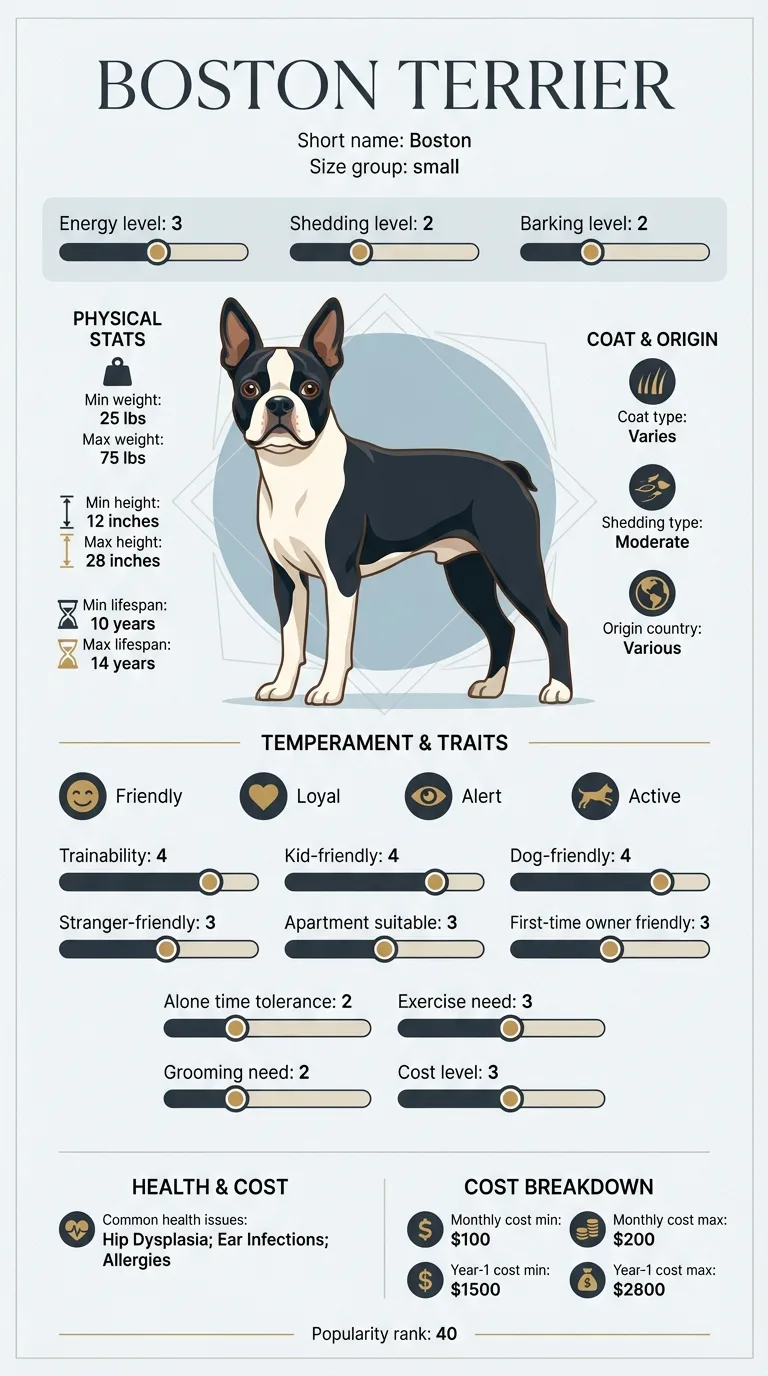
Owners whose Boston snorts through every walk and who have been told it is normal for the breed, people deciding whether surgery is justified, and anyone facing a first summer with a short-faced dog.
This guide is not medical advice. If your dog shows pain, sudden behavior change, or worsening symptoms, consult a licensed veterinarian.
Some links may be affiliate links. We may earn a commission at no extra cost to you. We only suggest products we believe are helpful for dog owners.
We research and check what we publish, but we do not warrant that any figure, date, price, or statement is accurate, complete, or current, and we accept no liability for any loss, cost, injury, or other harm arising from the use of this site. Use it as one reference among several. You remain responsible for your own decisions and for your dog's care - confirm anything that matters with a licensed veterinarian or another qualified professional before you act on it. Full disclaimer.
Brachycephalic airway syndrome is a combination of anatomical narrowings in a shortened skull that together make breathing harder work than it should be. It is the first-listed documented health issue in Boston Terriers. Its severity ranges from a snore that never troubles the dog to obstruction that limits exercise and becomes life-threatening in heat, and it tends to worsen over years because the effort of breathing damages the airway further.
Some degree of airway restriction is present in most Boston Terriers, which is why the syndrome heads the breed's documented health list. Bostons sit at the moderate end of the brachycephalic range rather than the extreme, so a substantial proportion live comfortably with sensible management. A meaningful minority are significantly affected and benefit from surgery.
Selection for a short, square muzzle compressed the length of the skull without reducing the volume of soft tissue inside it. The result is a normal amount of palate, tongue and throat lining fitted into a shorter space. Nostrils are narrowed by the same compression. Because the Boston is a moderately rather than extremely shortened breed, individual variation within the breed is wide - two Bostons from the same litter can have visibly different nostrils and very different exercise tolerance.
Temperature and humidity are the dominant external factors, because panting is a dog's only significant cooling route and panting is precisely what this anatomy makes inefficient. Air quality, altitude, a hot car, a warm crate in a car boot and even a heated house at night all raise the workload. Equipment matters too: a collar rather than a harness applies pressure exactly where the airway can least afford it.
Book an assessment if breathing noise is getting louder over months, if your dog cannot complete walks it used to manage, if it sleeps sitting up or with its head propped, or if it gags and retches after activity. Treat it as an immediate emergency if the gums are blue, grey or brick red, if the dog collapses, if breathing is frantic and does not settle within a few minutes of rest and cool air, or if there is foaming at the mouth. While travelling to the clinic, run the air conditioning, wet the coat with cool - not iced - water, and keep the dog still.
The critical thing to understand about BOAS is that it is progressive, and that the progression is mechanical rather than mysterious.
A dog with narrowed nostrils and an overlong palate must generate more suction to move each breath. That suction pulls the soft tissues of the throat inward. Over years, tissue that is repeatedly pulled inward becomes swollen and thickened, and the small laryngeal saccules turn outward into the airway. Each of those changes narrows the passage further, which requires more suction, which causes more damage.
This is why the advice for a mildly affected young dog is different from the advice for a badly affected eight-year-old, and why surgeons prefer to widen nostrils and shorten a palate before the secondary changes accumulate. A Boston is generally moderately rather than severely brachycephalic - less compressed than the flattest breeds - which means many do well, and also means the ones that are struggling are sometimes dismissed because the breed as a whole has a reputation for coping.

See all Boston Terrier health problems, which breeds are prone to brachycephalic airway syndrome boas, or the full Boston Terrier breed guide for temperament, exercise needs and ownership costs.
Weight loss and management changes usually show a difference within four to eight weeks. Where surgery is performed, most dogs are noticeably better within a month, with several weeks of restricted activity first. The underlying anatomy is permanent, so this is lifelong management rather than a course of treatment.
A dog that sleeps quietly, completes its walks without stopping to catch its breath, recovers to normal breathing within a couple of minutes of stopping, and has a summer routine that never puts it in the position of having to cope with heat.
BOAS is assessed as a set of separate anatomical features, and any given Boston will have its own combination. That is why two dogs with identical faces can breathe completely differently.
Ade had owned Bostons for fifteen years and thought he knew what normal sounded like. His third, Winston, snored heavily and always had. At six, Winston started stopping halfway up the hill on their usual route. Ade's vet asked him to film Winston breathing at rest, and then again after two minutes of trotting. Watching the second video at home, Ade heard something he had stopped noticing in person: the noise did not settle. Four minutes after stopping, Winston was still working. An airway examination found a long soft palate and everted saccules. Winston had surgery at six and a half. The snoring did not disappear, but the hill did stop being a problem, and Ade's summary was that he had been grading his dog against other Bostons rather than against a dog that could breathe.
Key takeaway: Breed-typical is not the same as fine. Judge your dog by how quickly it recovers after exercise, not by how it compares with other short-faced dogs.
It is common, which is not the same as normal. Snoring means tissue is vibrating in a partially obstructed airway. Mild noise in a dog that exercises freely and sleeps well is usually tolerated; loud noise, or noise while awake and at rest, deserves assessment.
By examining the nostrils, listening to breathing at rest and after a standardised short exercise test, and, where surgery is considered, by looking at the palate and larynx under sedation. Function matters more than appearance.
It improves it, often substantially, but the underlying skull shape does not change. Widening nostrils and shortening the palate reduces resistance and slows the damaging cycle. A tracheal narrowing cannot be corrected at all.
Earlier tends to be better, because the secondary changes accumulate with time. Many surgeons prefer to address significant obstruction in young adulthood rather than waiting for the dog to deteriorate. That judgment belongs to a surgeon who has examined your dog.
When the breathing noise gets louder rather than settling, when the dog widens its stance and extends its neck, or when the tongue looks broader and darker than usual. Stop at the first of those, not the third.
Yes. A neck collar transmits pull directly onto the trachea in a dog whose airway is already the constraint. A well-fitted Y-front harness removes that pressure entirely, and it is one of the cheapest meaningful changes you can make.
Enormously. Fat deposits around the throat narrow the airway further and extra body mass raises oxygen demand. In practice, weight loss produces some of the largest improvements seen in mildly affected dogs, without any surgery at all.
Blue, grey or brick-red gums, or a dog that cannot settle and is fighting for each breath. That is an emergency; cool the dog and drive.
Early morning and late evening only, on shaded routes, with water. Midday walks in warm weather are the single most common way Boston owners get into trouble.
Nostril and palate surgery is a significant but not extreme figure that varies widely by region and by whether a specialist centre is used. Get a written estimate including anaesthesia and aftercare.
Short sessions, indoors or in shade, using scent and thinking games rather than running. This breed is highly trainable and tires its brain far more safely than its lungs.
A one-page prep sheet for this condition: the signs, the questions to ask, what to get priced. Unlocks here.
You get: Vet visit prep sheet
No spam. One-click unsubscribe. See our privacy policy.
Preview page 1 before you decide.