Health
What is the first sign of diabetes in a dog?
Increased drinking and urination, usually followed by weight loss despite a good appetite. Cataract formation can be the sign that finally prompts a visit.

Quick answer
What is the first sign of diabetes in a dog?
Increased drinking and urination, usually followed by weight loss despite a good appetite. Cataract formation can be the sign that finally prompts a visit.
A dog can survive several bouts of pancreatitis and then, months later, present with a completely different disease from the same organ.
Owners of older Bostons who have had one or more pancreatic episodes and are now noticing increased thirst, and owners trying to understand why two apparently separate diagnoses keep being mentioned together.
This guide is not medical advice. If your dog shows pain, sudden behavior change, or worsening symptoms, consult a licensed veterinarian.
Some links may be affiliate links. We may earn a commission at no extra cost to you. We only suggest products we believe are helpful for dog owners.
We research and check what we publish, but we do not warrant that any figure, date, price, or statement is accurate, complete, or current, and we accept no liability for any loss, cost, injury, or other harm arising from the use of this site. Use it as one reference among several. You remain responsible for your own decisions and for your dog's care - confirm anything that matters with a licensed veterinarian or another qualified professional before you act on it. Full disclaimer.
Pancreatitis and diabetes are two diseases of one organ, connected because the insulin-producing islets sit embedded in the tissue that inflammation destroys. Repeated pancreatic episodes can therefore lead, months or years later, to permanent insulin dependence. The two conditions also worsen each other once both are present.
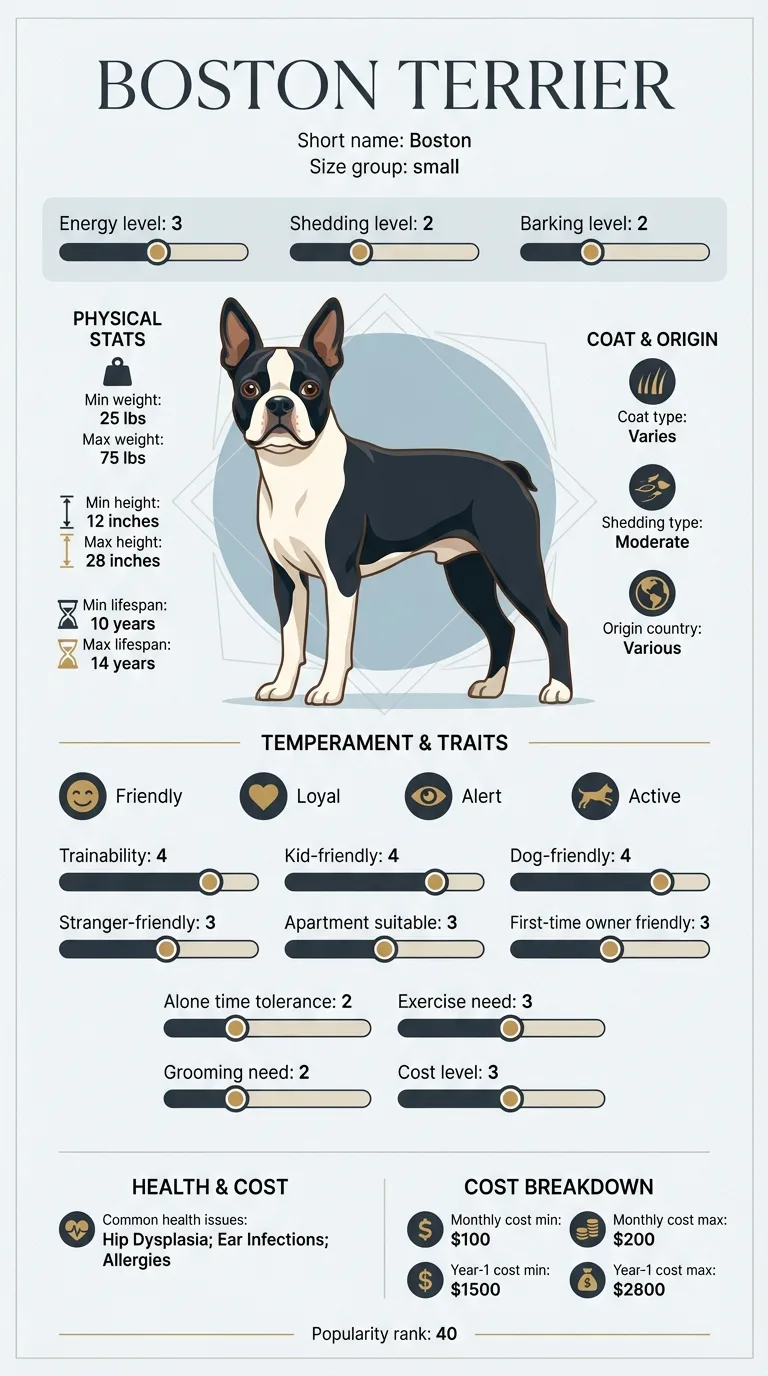
Neither condition is a documented Boston Terrier breed problem, and the breed's recognised issues lie in the airway, kneecaps and eyes. The combination matters here for two reasons: both diseases become more likely as a dog approaches the upper end of the breed's eleven to thirteen year lifespan, and diabetes interacts directly with the cataract tendency the breed already has.
The link between the two diseases is anatomical rather than breed-specific: islets sit within exocrine tissue and share its fate. The Boston-specific angle is ocular. Cataracts appear on this breed's documented health list, meaning many Bostons already carry a tendency toward lens opacity, and diabetic glucose loading of the lens accelerates that process dramatically. A diabetic Boston therefore faces a higher and faster risk of vision loss than a diabetic dog of a breed with no lens predisposition.
Obesity is the shared modifiable risk factor and the most useful thing an owner can address. High-fat feeding, repeated dietary indiscretion and access to scraps drive the pancreatic side. Once diabetes exists, inconsistency becomes the enemy: variable meal times, variable portions and inconsistent insulin timing destabilise glucose control far more than the specific food choice does.
Book promptly for increased drinking or urination, weight loss with a normal appetite, or new cloudiness in both eyes. Go the same day if a diabetic dog stops eating, vomits repeatedly, or seems unusually weak, because insulin dosing decisions in that situation cannot be made at home. Go immediately for collapse, seizures, disorientation, rapid breathing, or a sweet chemical smell on the breath, all of which suggest a diabetic crisis. Never skip or double an insulin dose without veterinary advice.
See all Boston Terrier health problems, which breeds are prone to pancreatitis diabetes, or the full Boston Terrier breed guide for temperament, exercise needs and ownership costs.
Establishing an insulin dose typically takes four to twelve weeks with repeated glucose monitoring, and adjustments continue over the dog's life. Diabetic cataracts can develop within weeks to months of diagnosis. Pancreatic episodes in a diabetic dog need same-day attention whenever they occur, and each one may shift insulin requirements afterwards.
A dog at a stable weight, drinking a normal amount, on a consistent insulin and feeding schedule, with no crises. Where cataracts have formed, success may include surgery and restored vision. Neither condition resolves, and success is measured in stability and quality of life across years.
During an episode of pancreatitis, activated enzymes and inflammatory cells damage the surrounding tissue indiscriminately. Islet cells sitting within that tissue are damaged along with everything else.
A single mild episode usually causes no lasting endocrine consequence, because the islets have reserve and the surviving cells compensate. Repeated or chronic inflammation is different. Each episode replaces functional tissue with scar, and the islet population steadily shrinks. Eventually the remaining cells cannot produce enough insulin to keep blood glucose controlled, and diabetes mellitus appears.
The relationship also runs the other way. Dogs with poorly controlled diabetes often have disturbed fat metabolism, and elevated circulating fats are themselves a risk factor for pancreatic inflammation. Once both conditions exist, they make each other harder to manage, and a diabetic dog in the middle of a pancreatitis flare is a genuinely difficult patient.
This is why the two get discussed together and why a dog with a pancreatitis history is monitored for glucose changes rather than simply discharged.
There is a specific consequence for this breed. Cataracts are a documented Boston Terrier health issue, and diabetes is one of the most reliable causes of rapid cataract formation in dogs. A diabetic Boston already has an inherited tendency toward lens opacity and now has a metabolic driver on top of it, which is why blindness can develop over weeks rather than years.

Diabetes announces itself differently from pancreatitis. There is no acute pain and no vomiting until late.
If you think your Boston has pancreatitis & diabetes, the plan is three steps: write down what you have seen and when it started, book a veterinary appointment rather than waiting for the next flare, and take video of the behaviour or symptom before you go — the thing you are worried about rarely happens in the consulting room. Screening in the parents covers brachycephalic airway syndrome (boas), patellar luxation, cataracts.
What the vet visit should produce is a diagnosis and a written plan, not just reassurance: what is being ruled out, what the monitoring interval is, and which signs mean you come back sooner. Ask what the treatment costs across a year rather than per visit, because that is the number that decides whether you are managing this condition or reacting to it.
Between appointments, keep a short log — dates, what you saw, what changed. It is the single most useful thing an owner brings to a follow-up, and for pancreatitis & diabetes it is often what separates a clear pattern from a guess.
Wilbur had pancreatitis at seven, again at eight, and mildly at nine. Each time he was treated, recovered, and went back onto his low-fat diet, and his owner Anita felt they had it under control. At ten, something different happened. He started emptying his water bowl twice a day and asking to go out at three in the morning. He was eating enthusiastically and had still lost a pound and a half. He was diagnosed with diabetes mellitus. His vet explained the connection, which Anita had never heard before, and warned her specifically to watch his eyes. Six weeks later, despite reasonable glucose control, both lenses had gone visibly cloudy. Wilbur had cataract surgery at eleven and got his sight back. Anita's regret is not that she missed the diabetes, which she caught quickly, but that nobody had told her after the second pancreatitis episode that this was a possibility worth monitoring for.
Key takeaway: A pancreatitis history is a reason to monitor water intake for years afterwards. The organ that caused an acute crisis at eight can cause a completely different chronic disease at ten.
No, and most do not. A single mild episode very rarely leads to diabetes. The risk rises with repeated or chronic inflammation, where cumulative loss of islet tissue eventually crosses a threshold. That is one of the strongest arguments for taking prevention of further episodes seriously.
The breeds most often cited include Samoyeds, Miniature Schnauzers, Miniature Poodles and Australian Terriers. The Boston Terrier is not a headline diabetic breed, and its documented issues are respiratory, orthopaedic and ocular. Where it becomes breed-relevant is the eye, because diabetes drives cataract formation and cataracts are already a documented Boston problem.
In dogs, unlike cats, it is almost always permanent and requires lifelong insulin. Where it follows islet destruction from pancreatitis, the lost cells do not regenerate. Good management produces a stable, comfortable dog rather than a cured one.
Sometimes within weeks. Excess glucose entering the lens draws water in and disrupts its structure, and the change can progress from clear to functionally blind faster than owners expect. Prompt referral to a veterinary ophthalmologist matters, because surgery is often successful in a well-controlled diabetic.
Considerably. Inflammation raises insulin requirements unpredictably, appetite falls just as insulin is being given, and vomiting complicates dosing. Any diabetic dog that stops eating needs veterinary contact the same day rather than a skipped dose decided at home.
It has to satisfy two competing requirements: low fat for the pancreas and a consistent, controlled carbohydrate load for glucose stability. That balance is a veterinary prescribing decision, and consistency of timing matters as much as the food itself.
Increased drinking and urination, usually followed by weight loss despite a good appetite. Cataract formation can be the sign that finally prompts a visit.
By persistently elevated blood glucose alongside glucose in the urine, supported by a marker of longer-term glucose levels to exclude a stress-related rise.
Insulin, syringes, monitoring supplies and regular rechecks typically add up to a significant recurring monthly cost, higher in the first months while the dose is being established.
Cataracts can form even in reasonably controlled dogs. Surgery is often possible and successful, so a blind diabetic dog should still be assessed by an ophthalmologist.
A one-page prep sheet for this condition: the signs, the questions to ask, what to get priced. Unlocks here.
You get: Vet visit prep sheet
No spam. One-click unsubscribe. See our privacy policy.
Preview page 1 before you decide.