Health
What is the riskiest moment for a Boston Terrier under anaesthesia?
Recovery, not surgery. The period after the breathing tube comes out is when airway swelling and reduced muscle tone combine, and it needs observed, oxygen-ready monitoring.

Quick answer
What is the riskiest moment for a Boston Terrier under anaesthesia?
Recovery, not surgery. The period after the breathing tube comes out is when airway swelling and reduced muscle tone combine, and it needs observed, oxygen-ready monitoring.
The danger for a Boston with a heart problem is rarely the couch. It is the anaesthetic table, the July sidewalk, and the ten minutes of frantic play in the park.
Owners scheduling a dental or spay for a dog with a known cardiac finding, and owners of active Bostons who have been told to limit exertion but not told what limit means in practice.
This guide is not medical advice. If your dog shows pain, sudden behavior change, or worsening symptoms, consult a licensed veterinarian.
Some links may be affiliate links. We may earn a commission at no extra cost to you. We only suggest products we believe are helpful for dog owners.
We research and check what we publish, but we do not warrant that any figure, date, price, or statement is accurate, complete, or current, and we accept no liability for any loss, cost, injury, or other harm arising from the use of this site. Use it as one reference among several. You remain responsible for your own decisions and for your dog's care - confirm anything that matters with a licensed veterinarian or another qualified professional before you act on it. Full disclaimer.
Heart problems in Boston Terriers rarely present as a dramatic cardiac event out of nowhere. They present as narrowed margins: less tolerance for anaesthesia, less tolerance for heat, less tolerance for a sprint. The practical work of owning a Boston with a cardiac finding is identifying those margins and staying inside them.
Only a minority of Boston Terriers carry a cardiac diagnosis at any age, and the breed's documented health problems are led by brachycephalic airway syndrome, patellar luxation, cataracts, corneal ulcers and deafness. The interaction described here matters because when a cardiac problem does exist in this breed, the airway raises the stakes of every situation involving exertion or sedation.
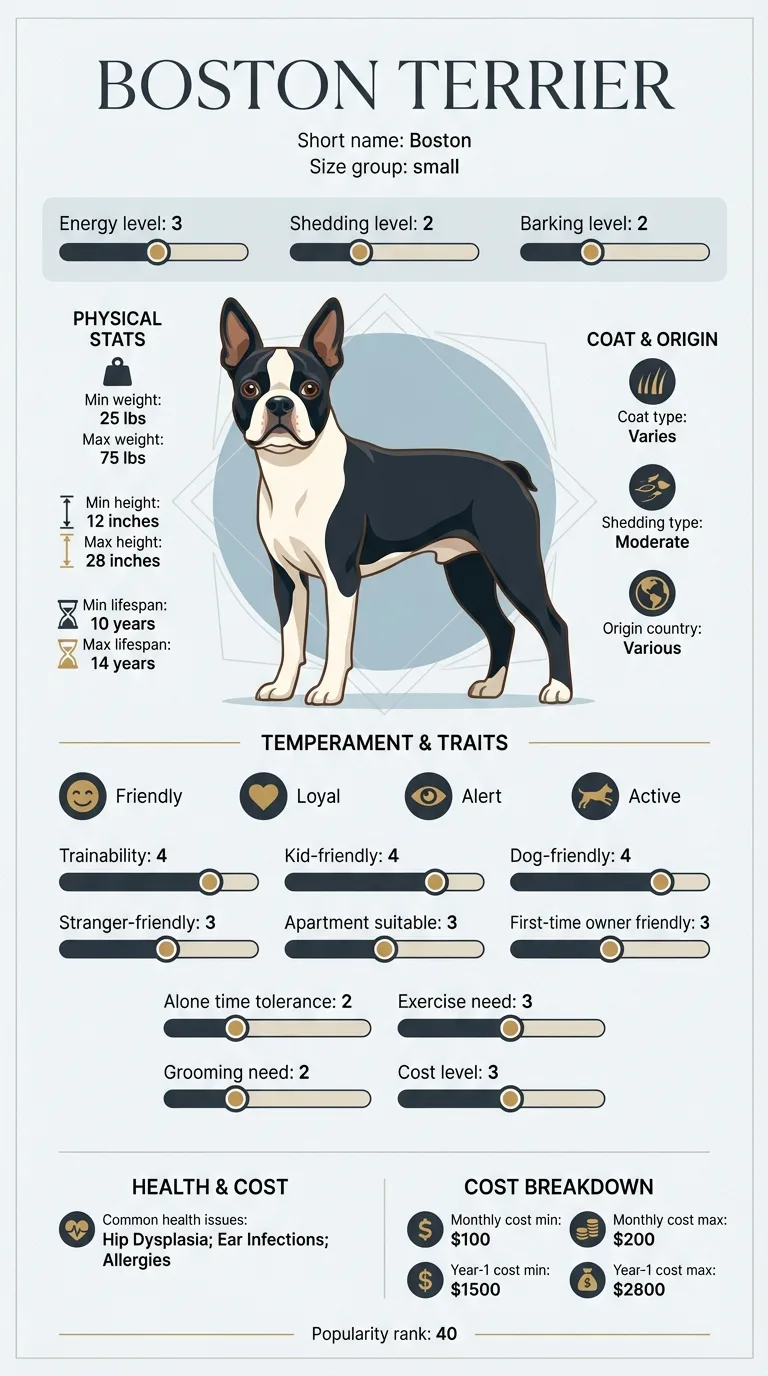
Boston Terriers were bred for a compact 12 to 25 pound body and a foreshortened skull. Soft tissue in the nose and throat did not shrink to match, so air moves through a narrower channel at higher resistance. Every breath costs more effort than it would in a longer-muzzled dog of the same weight, and that effort has to be paid for by the cardiovascular system. Add a leaking valve or an irregular rhythm and the reserve that absorbs stress gets thin.
Temperature is the dominant environmental variable. Above roughly 24 degrees Celsius with meaningful humidity, a Boston's cooling system starts losing ground and heart rate rises to compensate. Excitement, unfamiliar dogs, stairs, thick collars and being carried in a hot car all add smaller amounts of the same load.
Any collapse, faint, or period where your Boston cannot get a breath is an emergency, and heat plus laboured breathing plus a bluish tongue means going straight to a clinic rather than calling first. Book promptly, not urgently, if your dog is newly reluctant to walk in weather it used to handle, is coughing after lying down, or has started sleeping in a propped-up position. Before any anaesthetic, tell the practice explicitly about every cardiac finding on record.
See all Boston Terrier health problems, which breeds are prone to heart problems, or the full Boston Terrier breed guide for temperament, exercise needs and ownership costs.
Behavioural and environmental changes take effect immediately, which is unusual in this field. Arousal training takes four to eight weeks of short daily sessions to become reliable. Cardiac workup before a planned procedure realistically needs two to four weeks of lead time to book imaging and get a report back.
A dog that gets its dental done safely, sleeps through summer nights without distress, and plays hard in short controlled bursts instead of long uncontrolled ones. Success here is measured in avoided emergencies, which never feel like achievements at the time.
In a short-muzzled dog, oxygen delivery has two chokepoints instead of one. These are the moments both get squeezed at once.
Start earlier than you think you need to. If your dog has any recorded murmur, arrhythmia or exercise intolerance, ask for the cardiac workup weeks before the procedure, not the morning of it. Rescheduling a dental is trivial; rescheduling because an unexpected finding turned up during pre-med is not.
Ask three specific questions when you book. Will a dedicated person monitor the dog during recovery rather than only during surgery. Is intubation and oxygen support available for as long as the dog needs it after extubation. Does the practice want cardiac imaging first, and if not, why not.
Expect a longer stay. Many practices keep brachycephalic patients in a quiet, cool, observed area for hours after they would send a Labrador home, because obstruction and swelling can appear late. That is good practice, not overcaution.
Bring the dog cool and calm. A Boston that has been panting in a hot car for twenty minutes arrives with a higher body temperature and a stressed cardiovascular system, which is a worse starting point than one that walked in from an air-conditioned car with an empty bladder and a calm handler.
Finally, do not defer dental work indefinitely out of fear. Chronic oral infection places its own ongoing load on the heart, and the risk of a well-planned anaesthetic is usually lower than the risk of years of untreated dental disease.

Winnie was an eight-year-old Boston with a grade three murmur, moderate snoring, and a mouth that needed serious work. Her owner Tomas had cancelled the procedure twice out of fear, and by the second cancellation two teeth were clearly painful. His vet took a different approach. She sent Winnie for an echocardiogram, which showed a moderate valve leak with a heart still within normal measurements. She booked the dental for a Tuesday morning in October rather than August, arranged for Winnie to be first on the list so she would recover with a full staff watching, and asked Tomas to bring her in cool and unfed rather than after a walk. Winnie was extubated late, kept on oxygen for twenty minutes, and went home that evening with six extractions behind her. She ate soft food that night for the first time in months without turning her head away.
Key takeaway: The right response to a cardiac finding before a procedure is more planning, not indefinite postponement. Untreated dental disease is not a neutral option while you wait.
Very rarely is the answer a flat no. It is usually a question of what workup is done first, which drugs are chosen, and how recovery is staffed. A cardiologist and an anaesthetist can often bring a dog that sounds unsafe on paper into an acceptable risk band with planning.
Airway trouble is loudest on inspiration, worse with heat and excitement, and eases with rest and cooling. Cardiac trouble tends to raise the breathing rate during sleep, produces a cough that is worse lying down, and does not settle. Any dog can have both, which is why imaging beats deduction.
Ask your vet for a number: minutes, pace and temperature ceiling. As a general shape, several short flat walks in cool air beat one long one, and free-running with larger dogs is usually the first thing to drop. Bostons have modest exercise needs to begin with, which makes this easier than it would be in a working breed.
It can, but the size of the effect depends entirely on which problem and what stage. Many dogs with mild findings reach the breed's usual eleven to thirteen years. A dog that has already had congestive failure has a genuinely shortened outlook, and it is fair to be told that directly.
Heat more often triggers an airway crisis, but in a dog with limited cardiac reserve the two events blur. Overheating raises heart rate sharply while oxygen intake falls, and collapse in that state is an emergency regardless of which system failed first.
Not automatically. Elective procedures are commonly delayed until the murmur is characterised, then done with an appropriate plan. Leaving a dog intact carries its own downstream considerations, so this is a conversation with your vet rather than a rule.
Recovery, not surgery. The period after the breathing tube comes out is when airway swelling and reduced muscle tone combine, and it needs observed, oxygen-ready monitoring.
Many airlines already restrict short-muzzled breeds in cargo, and a cardiac finding makes air travel a genuinely poor idea. Discuss alternatives with your vet before booking anything.
If any abnormal sound or rhythm has ever been recorded, yes. For a dog with a consistently normal exam, standard pre-anaesthetic bloodwork and a fresh auscultation are usually enough.
Yes. A collar concentrates pressure on an already narrow airway when the dog pulls. A well-fitted Y-shaped harness spreads the load and reduces respiratory effort on walks.
A one-page prep sheet for this condition: the signs, the questions to ask, what to get priced. Unlocks here.
You get: Vet visit prep sheet
No spam. One-click unsubscribe. See our privacy policy.
Preview page 1 before you decide.