Living
Boston Terrier or Vizsla — which should I choose?
Choose the Boston for apartment life, low exercise needs, and an easy first dog. Choose the Vizsla only if you're genuinely active and can be home most of the time — it doesn't do well alone.

Quick answer
Boston Terrier or Vizsla — which should I choose?
Choose the Boston for apartment life, low exercise needs, and an easy first dog. Choose the Vizsla only if you're genuinely active and can be home most of the time — it doesn't do well alone.
Boston Terrier or Vizsla? On paper they differ most on apartment suitability, and on the scales Vizsla is the heavier at 45–65 lbs. Here is how the two compare on everything that shapes an ordinary week.
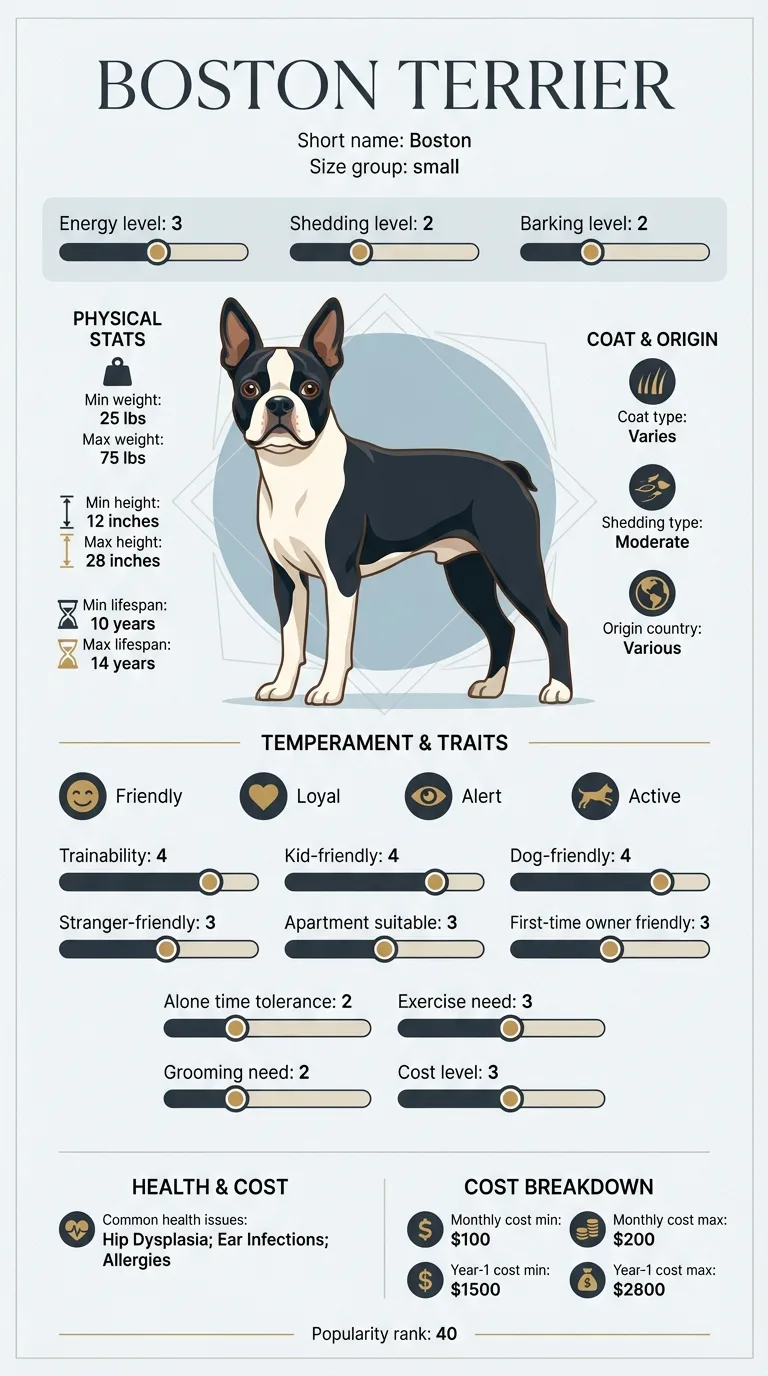
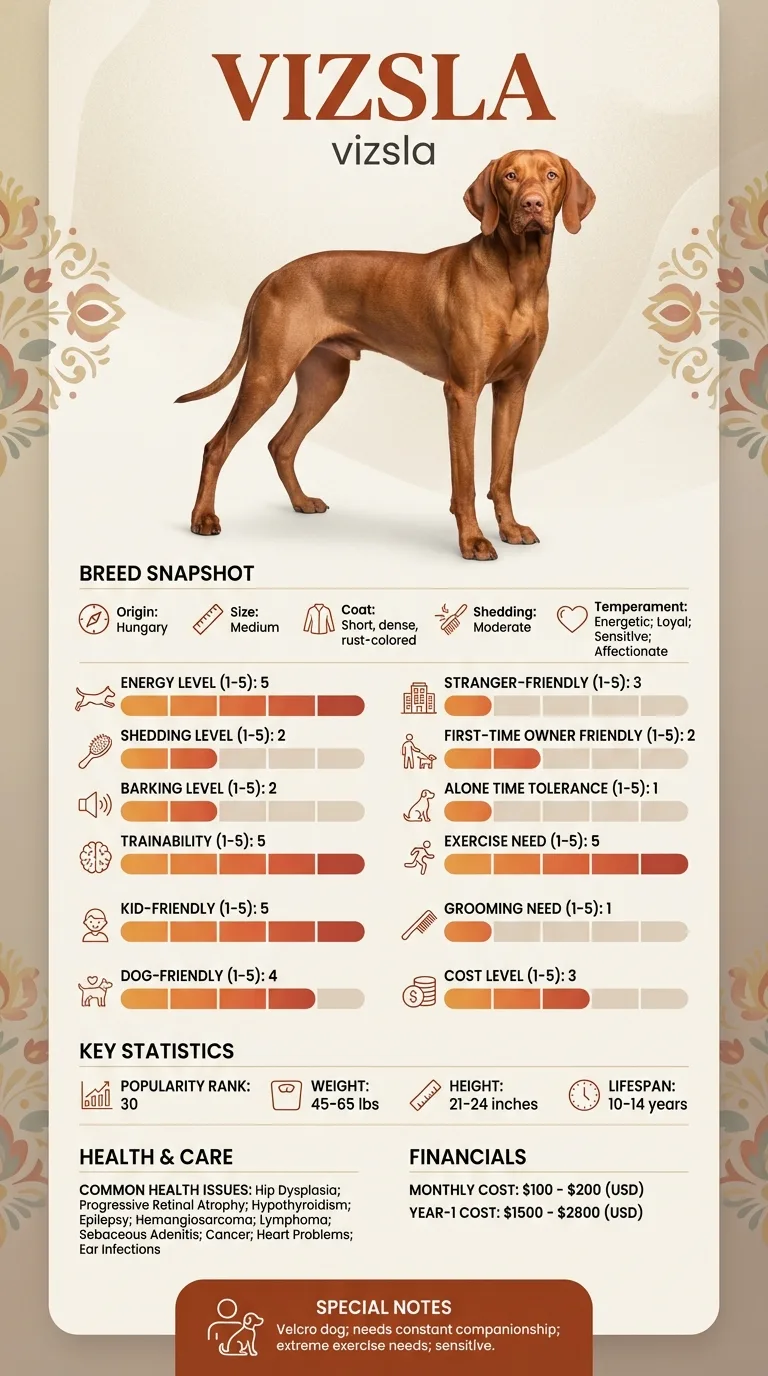
This is for someone already down to Boston Terrier and Vizsla and deciding between them. For this pair the decision usually turns on apartment suitability and exercise need, so those are covered first and in most detail. Anyone choosing from a flat has a clear answer here: Boston Terrier rates 5/5 against 1/5. The focus throughout is on daily consequences rather than breed background.
Between Boston Terrier and Vizsla, apartment suitability is what separates them, and Boston Terrier is the lower-effort dog of the two to keep.
Choose Boston Terrier if you are in a flat or a smaller home, this is your first dog and your walking routine is modest.
Choose Vizsla if you want a dog that picks up training quickly, you want a dog that can keep up with an active routine and you want a dog that is more watchful with visitors.
| Feature | boston terrier | vizsla | Winner |
|---|---|---|---|
| Size class | small | medium | Equal |
| Weight | 12–25 lbs | 45–65 lbs | Equal |
| Height | 15–17 in | 21–24 in | Equal |
| Lifespan | 11–13 years | 10–14 years | Equal |
| Exercise need | Low (2/5) | Very high (5/5) | boston terrier |
| Grooming need | Very low (1/5) | Very low (1/5) | Equal |
| Shedding | Low (2/5) | Low (2/5) | Equal |
| Energy level | Moderate (3/5) | Very high (5/5) | Equal |
| Barking | Low (2/5) | Low (2/5) | Equal |
| Apartment suitability | Very high (5/5) | Very low (1/5) | boston terrier |
| Good for first-time owners | Very high (5/5) | Low (2/5) | boston terrier |
| Tolerates being alone | Moderate (3/5) | Very low (1/5) | boston terrier |
| Trainability | High (4/5) | Very high (5/5) | vizsla |
| Good with kids | Very high (5/5) | Very high (5/5) | Equal |
| Good with other dogs | High (4/5) | High (4/5) | Equal |
| Friendly to strangers | High (4/5) | Moderate (3/5) | boston terrier |
| Cost level | Moderate (3/5) | Moderate (3/5) | Equal |
| Coat | Short and smooth | Short, dense, rust-colored | Equal |
| Origin | Various | Hungary | Equal |
| Typical monthly cost | $80–$150 | $100–$200 | Equal |
| Typical first-year cost | $1,100–$2,300 | $1,500–$2,800 | Equal |
On the scale, the Vizsla dwarfs the Boston — 45 to 65 pounds and 21 to 24 inches, against the Boston's 12 to 25 pounds and 15 to 17 inches. Both wear a short, low-maintenance coat, but where the Boston is compact and boxy, the Vizsla is lean, athletic, and built like the pointing dog it is. Don't let the shared 'short coat' description fool you into thinking these are similarly sized dogs.
The Vizsla is about as high-drive as dogs get, rated 5/5 for both exercise need and energy level — this breed was built to run alongside hunters for hours and it still expects that kind of output. The Boston's 2/5 exercise need puts it in an entirely different category. A bored, under-exercised Vizsla is a genuinely difficult dog to live with; a bored Boston just naps.
Both breeds are easy on the grooming front — a 1/5 need for each — and shedding stays low for both, 2/5 for the Boston and similarly low for the Vizsla. This is one of the few categories where these two are functionally interchangeable. Neither will demand brushes, clippers, or grooming appointments.
The Boston is built for small spaces, rating 5/5 for apartment living and just 2/5 for barking. The Vizsla rates a 1/5 for apartments and a rock-bottom 1/5 for tolerating being alone — this is a breed known for developing real separation anxiety without enough company and exercise. If your home is a small unit and your schedule keeps you out most of the day, the Vizsla's numbers here should give you pause.
The Vizsla actually out-trains the Boston on paper, a 5/5 versus 4/5 for trainability — it's an intelligent, eager-to-please breed. But it rates only 2/5 for first-time owners against the Boston's 5/5, because that trainability comes bundled with high energy and a strong need for engagement that a first dog owner may not be ready to supply consistently.
Both breeds score a full 5/5 with kids, and the Boston edges ahead with strangers (4/5 versus 3/5), while both handle other dogs equally well at 4/5. The Vizsla is documented as sensitive and affectionate in its temperament profile — it tends to bond hard to its people, which is part of why it struggles so much with being left alone.
Lifespan runs close for both — 11 to 13 years for the Boston, 10 to 14 for the Vizsla — with real overlap in the middle of that range. Their health profiles don't overlap at all in this data, though: the Vizsla's list runs long and includes several cancers (hemangiosarcoma, lymphoma) along with hip dysplasia and epilepsy, while the Boston's stays centered on its short face, eyes, and hearing.
Both breeds carry a moderate 3/5 cost rating, but real numbers favor the Boston: $80–$150 monthly against the Vizsla's $100–$200, and $1,100–$2,300 in year one versus $1,500–$2,800. Some of that gap is simply food volume for a dog nearly triple the Boston's weight.
Boston Terrier weighs 12–25 lbs and lives 11–13 years; Vizsla weighs 45–65 lbs and lives 10–14 years. The two diverge most on apartment suitability, exercise need and good for first-time owners and 2 other rated axes. They are level on barking, cost level and good with other dogs, so those cannot decide it. The table below marks a winner only where one breed is genuinely easier for a typical owner; size and origin are facts rather than merits and stay level. Ratings come from one source applied to both breeds, so they are meaningful against each other rather than as absolute scores.

Considerably — the Vizsla runs 45 to 65 pounds against the Boston's 12 to 25, and stands several inches taller. Both have short coats, but the size difference is significant.
Not really, based on this data — it rates just 1/5 for apartment suitability and a rock-bottom 1/5 for tolerating being alone. The Boston Terrier, at 5/5 on apartment fit, is the much easier fit for small-space living.
The Boston Terrier, rated 5/5 for first-timers against the Vizsla's 2/5. The Vizsla is actually more trainable on paper (5/5) but its intensity and need for constant engagement make it a harder breed to start with.
No, both are low-shedding — the Boston rates 2/5, the Vizsla similarly low. Grooming is easy for both, each rated just 1/5.
The Vizsla runs higher, $100-200 a month against the Boston's $80-150, and $1,500-2,800 in the first year versus $1,100-2,300 — partly food volume for a much larger dog.
No overlap shows up in this data. The Vizsla's list includes several cancers along with hip dysplasia and epilepsy, while the Boston's centers on its short muzzle and eyes — two genuinely different risk profiles to research separately.
Not well — it rates a 1/5 for tolerating being alone, among the lowest scores in this data. Vizslas are known to develop separation anxiety without enough company, which is worth taking seriously before committing to one.
Choose the Boston for apartment life, low exercise needs, and an easy first dog. Choose the Vizsla only if you're genuinely active and can be home most of the time — it doesn't do well alone.
$80-150 for the Boston, $100-200 for the Vizsla.
The Vizsla, maxed out at 5/5 versus the Boston's 2/5 — this breed needs serious daily output.
They're close — 11-13 years for the Boston, 10-14 for the Vizsla, with real overlap in the middle.
Secure checkout on Stripe. We never see your card.
7-day money-back guarantee. Instant access.
Health information here is general and is not veterinary advice. If your dog shows pain, sudden behaviour change, or worsening symptoms, consult a licensed veterinarian.
Some links on this site are affiliate links. We may earn a commission at no extra cost to you, and we only suggest products we believe are helpful for dog owners.
We research and check what we publish, but we do not warrant that any figure, date, price, or statement is accurate, complete, or current, and we accept no liability for any loss, cost, injury, or other harm arising from the use of this site. Use it as one reference among several. You remain responsible for your own decisions and for your dog's care - confirm anything that matters with a licensed veterinarian or another qualified professional before you act on it. Full disclaimer.
Match your lifestyle to the right dog.
Take quizNot sure which breed is right for you? Take our 2-minute quiz to find out.
Take the quiz