Behavior
Which needs more exercise?
The Corgi, High (4/5) versus the Bichon Frise's Low (2/5).

Quick answer
Which needs more exercise?
The Corgi, High (4/5) versus the Bichon Frise's Low (2/5).
Bichon Frise or Pembroke Welsh Corgi? On paper they differ most on shedding, and on the scales Pembroke Welsh Corgi is the heavier at 24–30 lbs. Here is how the two compare on everything that shapes an ordinary week.
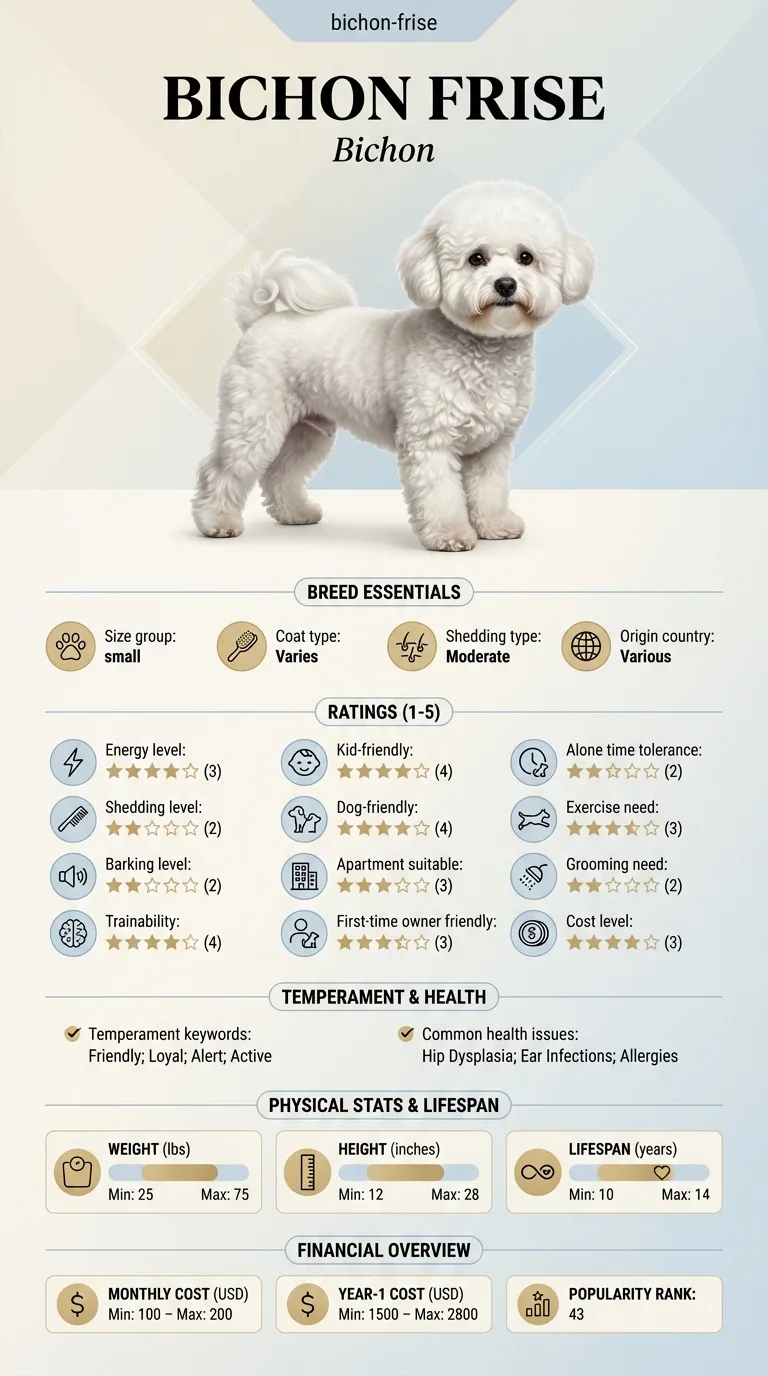
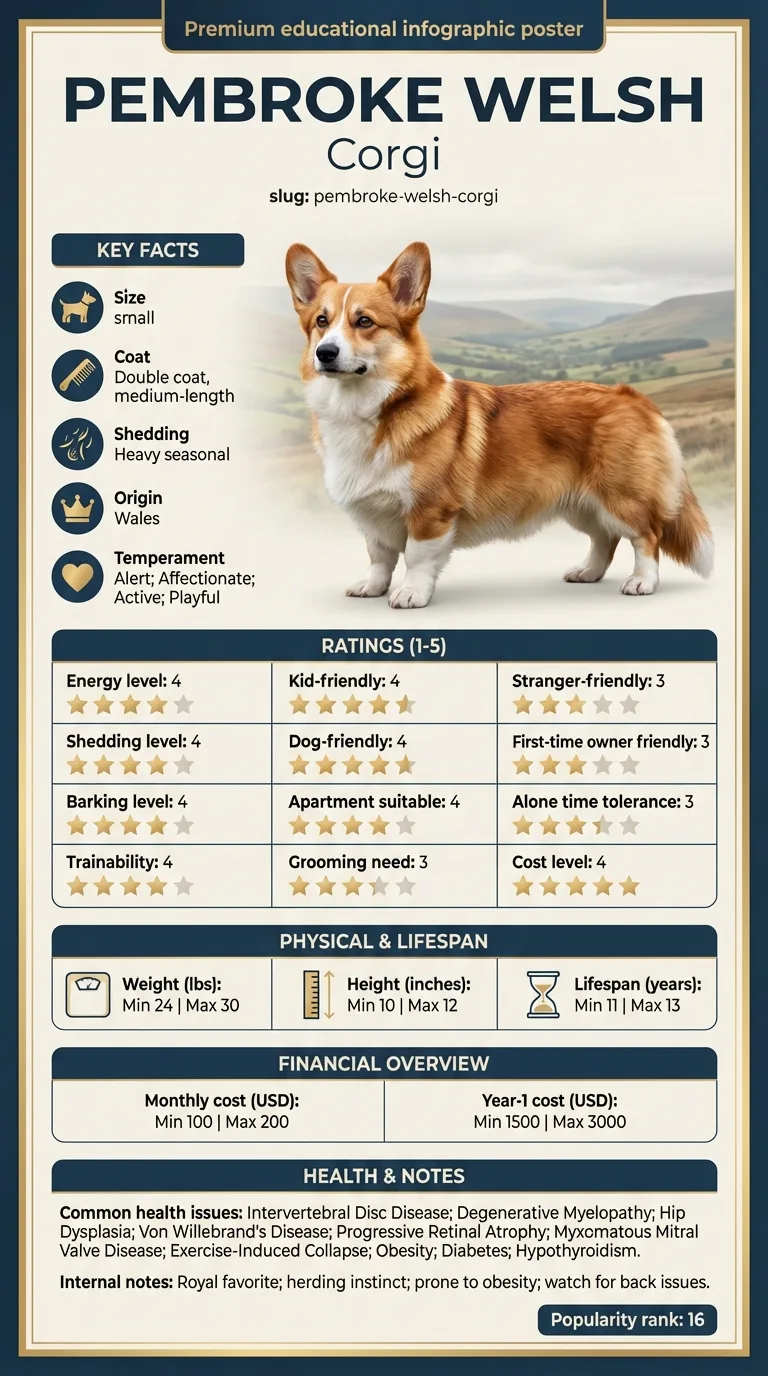
This is for someone already down to Bichon Frise and Pembroke Welsh Corgi and deciding between them. For this pair the decision usually turns on shedding and exercise need, so those are covered first and in most detail. Anyone choosing from a flat has a clear answer here: Bichon Frise rates 5/5 against 4/5. It is written for the decision rather than the breed history.
Between Bichon Frise and Pembroke Welsh Corgi, shedding is what separates them, and Bichon Frise is the lower-effort dog of the two to keep.
Choose Bichon Frise if you are in a flat or a smaller home, this is your first dog and shedding is a problem in your house.
Choose Pembroke Welsh Corgi if you do not want a standing grooming appointment, the dog will be alone during the working day and you want a dog that picks up training quickly.
| Feature | bichon frise | pembroke welsh corgi | Winner |
|---|---|---|---|
| Size class | small | small | Equal |
| Weight | 12–18 lbs | 24–30 lbs | Equal |
| Height | 9–12 in | 10–12 in | Equal |
| Lifespan | 14–15 years | 11–13 years | bichon frise |
| Exercise need | Low (2/5) | High (4/5) | bichon frise |
| Grooming need | Very high (5/5) | Moderate (3/5) | pembroke welsh corgi |
| Shedding | Very low (1/5) | High (4/5) | bichon frise |
| Energy level | Moderate (3/5) | High (4/5) | Equal |
| Barking | Moderate (3/5) | High (4/5) | bichon frise |
| Apartment suitability | Very high (5/5) | High (4/5) | bichon frise |
| Good for first-time owners | High (4/5) | Moderate (3/5) | bichon frise |
| Tolerates being alone | Low (2/5) | Moderate (3/5) | pembroke welsh corgi |
| Trainability | Moderate (3/5) | High (4/5) | pembroke welsh corgi |
| Good with kids | High (4/5) | High (4/5) | Equal |
| Good with other dogs | High (4/5) | High (4/5) | Equal |
| Friendly to strangers | High (4/5) | Moderate (3/5) | bichon frise |
| Cost level | Moderate (3/5) | High (4/5) | bichon frise |
| Coat | Curly, dense double coat | Double coat, medium-length | Equal |
| Origin | Various | Wales | Equal |
| Typical monthly cost | $80–$150 | $100–$200 | Equal |
| Typical first-year cost | $1,100–$2,300 | $1,500–$3,000 | Equal |
Heights are nearly identical — 9–12 inches for the Bichon Frise against 10–12 for the Pembroke Welsh Corgi — but weight tells a completely different story: 12–18 lbs versus 24–30 lbs, meaning a full-grown Corgi can weigh close to double a Bichon despite standing at roughly the same shoulder level. That's the Corgi's famous long, low, heavy-boned build at work — a herding dog compressed into a small dog's footprint. Anyone picking a carrier, car crate, or dog ramp based on height alone will be caught off guard by how much more substantial a Corgi actually is to lift or carry compared to the fluffier but lighter Bichon.
Exercise need is a clear split: Low (2/5) for the Bichon Frise against High (4/5) for the Pembroke Welsh Corgi, a genuine herding breed that needs real daily activity to stay balanced. Energy level scores close but not identical, Moderate (3/5) for the Bichon and High (4/5) for the Corgi, and that extra drive shows up in the Corgi's Active, Playful temperament tags. A Corgi that doesn't get enough structured exercise is prone to herding behavior directed at kids or other pets — nipping at heels — simply because that instinct needs somewhere to go. The Bichon's lower exercise bar makes it the easier fit for owners without a yard or a regular walking routine.
The Bichon Frise needs more grooming effort, Very High (5/5) versus the Pembroke Welsh Corgi's Moderate (3/5), but the Corgi sheds dramatically more — High (4/5) against the Bichon's Very Low (1/5). That means Corgi owners are trading less time at the grooming table for a lot more time with a vacuum, especially during the breed's twice-yearly coat blowouts, when its double coat comes out in noticeable clumps. The Bichon's curly coat, by contrast, traps loose hair rather than shedding it, so mats become the bigger risk instead of fur on the couch. Anyone with allergies should lean Bichon; anyone who'd rather avoid brushing and clipping bills should lean Corgi and invest in a good vacuum instead.
Both breeds handle apartment living reasonably well — Very High (5/5) for the Bichon Frise, High (4/5) for the Pembroke Welsh Corgi — but the Corgi is the more vocal of the two, High (4/5) barking against the Bichon's Moderate (3/5), a trait tied to its herding-dog alertness. Alone-time tolerance favors the Corgi, Moderate (3/5) versus the Bichon's Low (2/5), so a Corgi is somewhat better equipped for an owner's occasional long day out. For a downstairs neighbor's sake, though, the Corgi's tendency to bark at hallway noise is worth weighing against the Bichon's slightly quieter, if more anxious, disposition when left home.
The Pembroke Welsh Corgi rates High (4/5) on trainability, ahead of the Bichon Frise's Moderate (3/5), which tracks with its herding-dog intelligence and Alert, Active temperament. Even so, the Bichon rates better for first-time owners overall, High (4/5) against the Corgi's Moderate (3/5) — a smart, biddable dog can still be a handful for a beginner if that intelligence comes paired with a strong herding instinct and a high exercise requirement that needs consistent management. A newcomer who wants a naturally cooperative small dog without much of a learning curve around instinctive behaviors will likely find the Bichon the more forgiving choice.
Kids and other dogs both tie at High (4/5), so families and multi-dog households can reasonably consider either breed on those fronts. The Bichon Frise pulls ahead with strangers, High (4/5) versus the Corgi's Moderate (3/5) — the Corgi's Alert nature, useful for watchdog behavior, tends to make it a bit more reserved or vocal with unfamiliar visitors than the openly Affectionate Bichon. Families who entertain often or live somewhere with frequent foot traffic may find the Bichon's easier warmth toward strangers the more convenient trait, while those who want a dog that notices when someone's approaching the house may prefer the Corgi's watchfulness.
The Bichon Frise's 14–15 year lifespan runs a few years past the Pembroke Welsh Corgi's 11–13, and the health gap is significant: the Corgi's list runs to ten tracked conditions against the Bichon's five. Intervertebral disc disease and degenerative myelopathy stand out in particular — both linked to the Corgi's long spine and short legs — alongside hip dysplasia, von Willebrand's disease, progressive retinal atrophy, myxomatous mitral valve disease, exercise-induced collapse, obesity, diabetes, and hypothyroidism. Corgi owners should be especially careful about jumping on and off furniture and about weight management, since obesity compounds the spinal risk. The Bichon's list — skin allergies, patellar luxation, bladder stones, cataracts, dental disease — carries no comparable back-injury risk.
Cost level rates High (4/5) for the Pembroke Welsh Corgi against Moderate (3/5) for the Bichon Frise, with monthly ranges of $100–$200 versus $80–$150 and first-year totals of $1,500–$3,000 versus $1,100–$2,300. Some of that gap likely reflects the Corgi's much longer health-issue list — ten tracked conditions including spinal disease and diabetes tend to mean more diagnostic visits and potential specialist care over a lifetime — plus the higher food volume for a 24–30 lb dog compared to a 12–18 lb one. Corgi owners may also want to budget for pet insurance given the breed's IVDD risk, an expense Bichon owners are less likely to need.
Bichon Frise weighs 12–18 lbs and lives 14–15 years; Pembroke Welsh Corgi weighs 24–30 lbs and lives 11–13 years. The two diverge most on shedding, exercise need and grooming need. They are level on good with other dogs and good with kids, so those cannot decide it. In the table, a "winner" means easier for an ordinary household — not better. Size, coat and origin are recorded without a verdict. Because both breeds are scored the same way, the gaps are reliable even where the absolute numbers are rough.

Heavier, yes — 24–30 lbs versus the Bichon's 12–18 lbs — though the two stand at nearly the same shoulder height.
The Pembroke Welsh Corgi, rated High (4/5) versus the Bichon Frise's Low (2/5).
The Corgi, rated High (4/5) versus the Bichon's Very Low (1/5).
Yes — intervertebral disc disease and degenerative myelopathy are both tracked risks tied to the breed's long spine and short legs.
The Bichon Frise, rated High (4/5) versus the Corgi's Moderate (3/5).
The Bichon Frise, 14–15 years versus the Corgi's 11–13 years.
The Corgi, rated High (4/5) cost level, $100–$200 monthly versus the Bichon's $80–$150.
The Corgi, High (4/5) versus the Bichon Frise's Low (2/5).
The Bichon Frise, Very Low (1/5).
The Corgi, High (4/5) versus the Bichon's Moderate (3/5).
The Bichon Frise, 14–15 years versus the Corgi's 11–13.
Secure checkout on Stripe. We never see your card.
7-day money-back guarantee. Instant access.
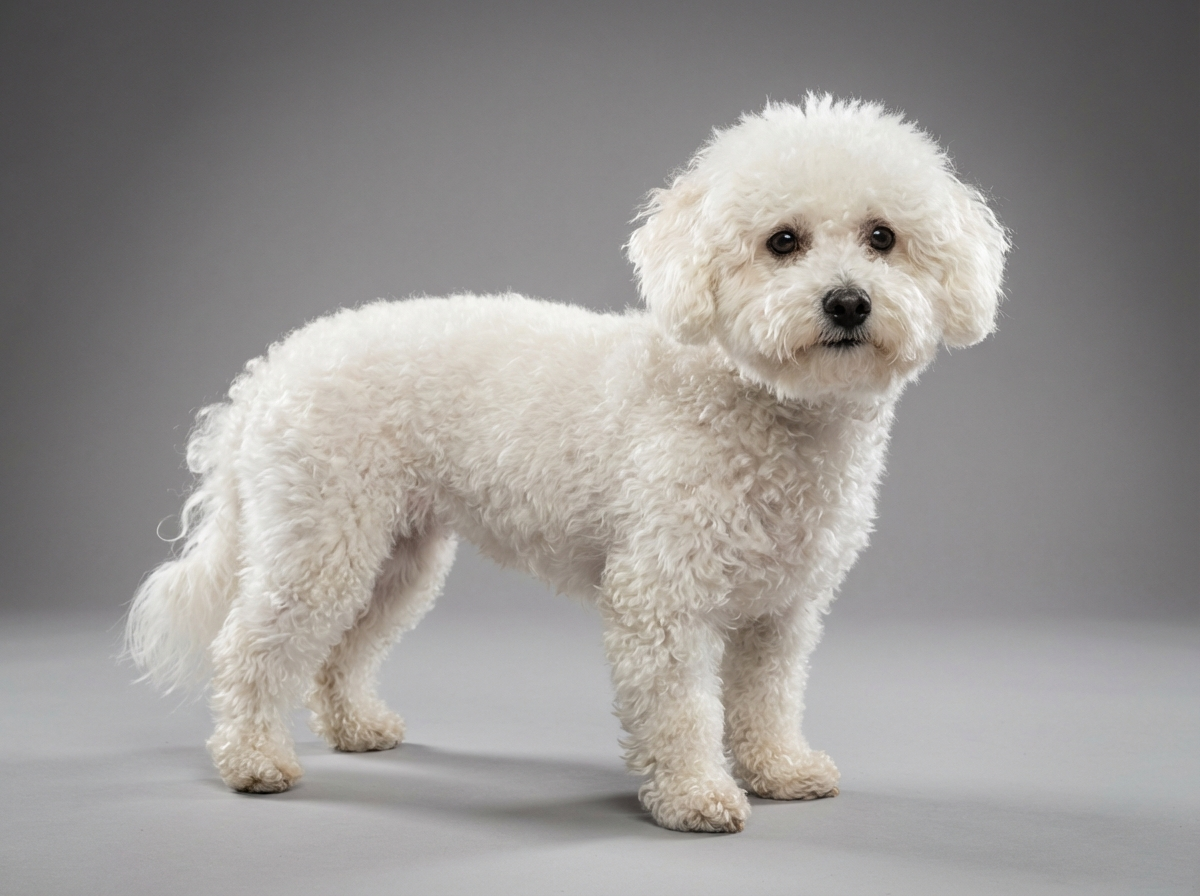
Health information here is general and is not veterinary advice. If your dog shows pain, sudden behaviour change, or worsening symptoms, consult a licensed veterinarian.
Some links on this site are affiliate links. We may earn a commission at no extra cost to you, and we only suggest products we believe are helpful for dog owners.
We research and check what we publish, but we do not warrant that any figure, date, price, or statement is accurate, complete, or current, and we accept no liability for any loss, cost, injury, or other harm arising from the use of this site. Use it as one reference among several. You remain responsible for your own decisions and for your dog's care - confirm anything that matters with a licensed veterinarian or another qualified professional before you act on it. Full disclaimer.
Match your lifestyle to the right dog.
Take quizNot sure which breed is right for you? Take our 2-minute quiz to find out.
Take the quiz