Behavior
Why is my Bichon barking so much?
Identify the function first: alarm at a trigger, demand aimed at you, distress when alone, or boredom. Each needs a different plan.

Quick answer
Why is my Bichon barking so much?
Identify the function first: alarm at a trigger, demand aimed at you, distress when alone, or boredom. Each needs a different plan.
Barking is not a single behaviour with a single cure; it is four different behaviours that happen to make the same sound, and telling them apart is most of the work.
Apartment owners fielding complaints from neighbours, people working from home whose calls are interrupted, and anyone who has tried shouting quiet for six months and noticed it changing nothing.
This guide is not medical advice. If your dog shows pain, sudden behavior change, or worsening symptoms, consult a licensed veterinarian.
Some links may be affiliate links. We may earn a commission at no extra cost to you. We only suggest products we believe are helpful for dog owners.
We research and check what we publish, but we do not warrant that any figure, date, price, or statement is accurate, complete, or current, and we accept no liability for any loss, cost, injury, or other harm arising from the use of this site. Use it as one reference among several. You remain responsible for your own decisions and for your dog's care - confirm anything that matters with a licensed veterinarian or another qualified professional before you act on it. Full disclaimer.
Excessive barking is not a diagnosis but a description, covering at least four distinct behaviours with different causes and different solutions. In the Bichon Frise it most often takes the form of alarm barking at household triggers, demand barking directed at owners, or distress barking when left alone. Effective plans start by identifying which function is driving the noise rather than by trying to suppress the sound.
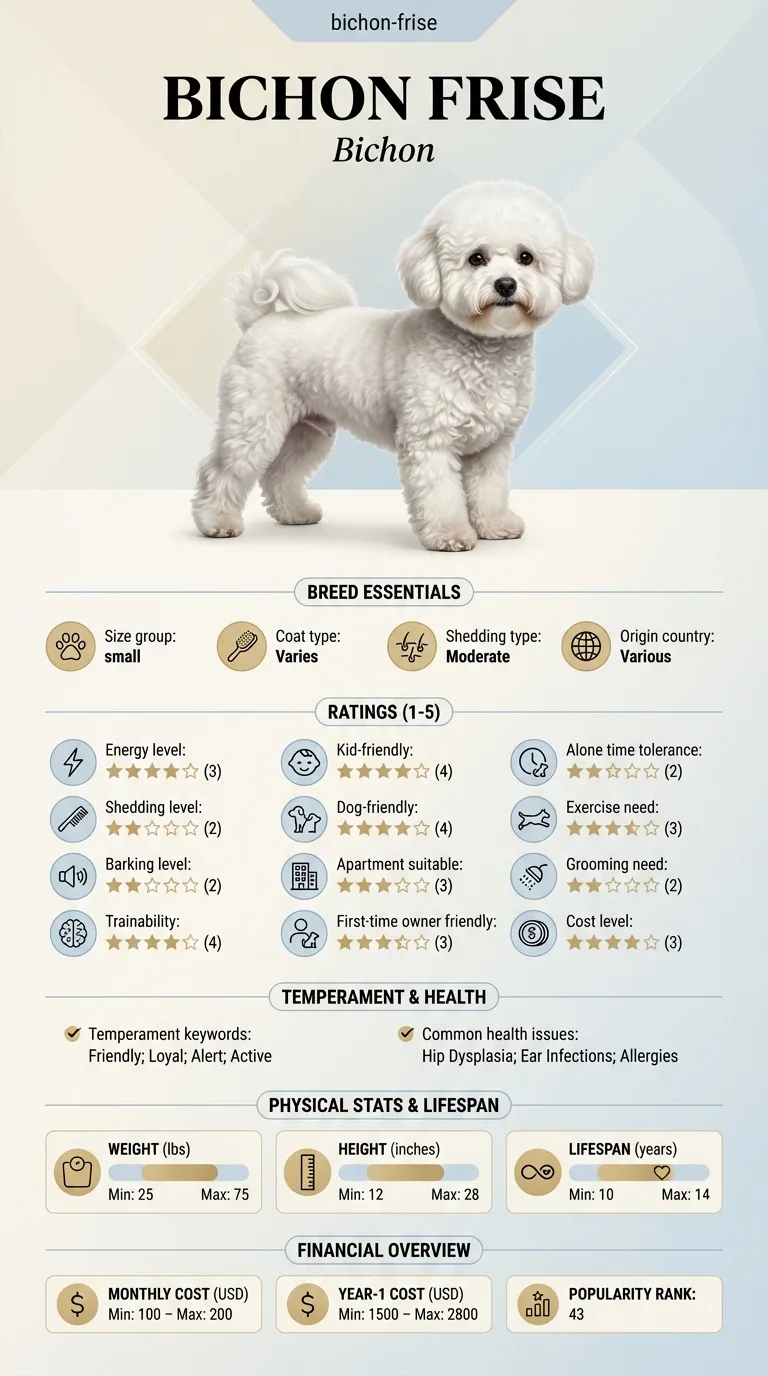
Barking is one of the most frequent reasons owners of small companion dogs seek behaviour advice, and it is a leading source of complaints in flats. Given that this breed rates five out of five for apartment suitability and two out of five for coping alone, a great many Bichons live in exactly the setting where alarm and separation barking are most likely and least tolerated.
The Bichon Frise was developed as a companion, and companionship is the trait that shapes this problem. A dog rated four out of five for friendliness toward strangers and only two out of five for tolerating time alone is one that finds isolation genuinely difficult and finds human attention genuinely rewarding, which is the ideal combination for both distress barking and demand barking. Its middling barking level of three out of five means it is not predisposed to constant noise, but it is alert enough to notice everything. A trainability rating of three means plans work, but they need consistency rather than a couple of good sessions.
Where a Bichon lives shapes what it barks at. Flats deliver a stream of triggers no house does: footsteps in a shared corridor at all hours, lift doors, other residents' dogs, and thin walls that carry sound both ways. Ground-floor windows overlooking a pavement give a constant stream of passers-by. Working patterns matter enormously, since a household that was home all day and then returns to an office creates the exact conditions for separation distress. And in a home where barking has ever succeeded in producing a biscuit, the behaviour has been trained without anyone intending to.
Involve a qualified, reward-based behaviour professional when barking occurs mainly in your absence, when neighbours are complaining and time pressure is real, when your dog also shows destruction, drooling or house soiling when alone, or when eight weeks of consistent work has produced no measurable change. Separation-related distress in particular benefits from structured professional support, because the graduated absence protocols are easy to rush and rushing them sets progress back. Group classes suit alarm and demand barking; one-to-one support suits distress.
Book a veterinary appointment before assuming any sudden change in barking is behavioural, particularly in a dog over eight. New or increased vocalisation can reflect pain, hearing loss, or age-related cognitive change, and dental disease is documented in this breed and is a common hidden source of discomfort. Book promptly for barking that has appeared abruptly with no change in circumstances, for night-time vocalising in an older dog, for disorientation or apparent confusion, or for barking alongside any physical sign such as limping, reduced appetite or weight change. A behaviour plan built on top of an untreated painful condition will not work.
See all Bichon Frise health problems, which breeds are prone to excessive barking, or the full Bichon Frise breed guide for temperament, exercise needs and ownership costs.
Demand barking usually gets noticeably worse for a week or two before improving, because a behaviour that stops working is tried harder before it is abandoned. Expect four to six weeks for a meaningful change if you are consistent. Alarm barking responds over a similar period with counter-conditioning plus management. Separation-related barking is the slowest, commonly taking three to six months of graduated work, and it does not respond to shortcuts. Consistency across every person in the household matters more than technique.
Success is a dog that gives two or three barks at the doorbell and then settles, that can be left for a normal working absence without vocalising, and that asks for attention by coming over rather than by shouting. It is not a silent dog, and aiming for one is both unrealistic and unkind. A Bichon Frise that alerts and then stops is behaving exactly as an alert companion breed should.
Identify the function by looking at what happens immediately before the barking starts and what the dog appears to want. The bark that follows a doorbell is not the bark that follows you picking up your keys.
There are two reasons a quiet cue used alone tends to fail, and both are worth understanding before spending months on it.
The first is that shouting is, from the dog's point of view, joining in. You have arrived, you are making noise at the thing your dog was making noise at, and for a socially motivated Bichon that is often a reward rather than a correction. Attention delivered during barking maintains barking regardless of the tone it is delivered in.
The second is that a cue does not change why the dog barked. A dog that barks because a stranger's footsteps in the hallway are alarming still finds them alarming when it stops barking. You have suppressed the symptom while leaving the feeling underneath entirely intact, and suppressed behaviours reappear under pressure.
What works instead is addressing the function. For alarm barking, that means changing the dog's emotional response to the trigger, usually by pairing the sound with something good before the barking starts, and by managing the environment so the trigger is less intense.
For demand barking, it means making barking stop working while making a different behaviour work reliably. For distress, it means treating the separation problem itself. For boredom, it means a day with more in it.

If you think your Bichon has excessive barking, the plan is three steps: write down what you have seen and when it started, book a veterinary appointment rather than waiting for the next flare, and take video of the behaviour or symptom before you go — the thing you are worried about rarely happens in the consulting room. Screening in the parents covers skin allergies, patellar luxation, bladder stones.
What the vet visit should produce is a diagnosis and a written plan, not just reassurance: what is being ruled out, what the monitoring interval is, and which signs mean you come back sooner. Ask what the treatment costs across a year rather than per visit, because that is the number that decides whether you are managing this condition or reacting to it.
Between appointments, keep a short log — dates, what you saw, what changed. It is the single most useful thing an owner brings to a follow-up, and for excessive barking it is often what separates a clear pattern from a guess.
Marek had been given a formal warning by his building's management about his three-year-old Bichon Frise, Luna. He had spent four months telling her to be quiet with no improvement whatsoever. His behaviour consultant asked for a week of notes before doing anything: time, trigger, and what happened next. The pattern was unmistakable and not what Marek expected. Almost none of the barking was at the door. It clustered between eight and nine in the morning, in bouts lasting up to twenty minutes, always beginning around four minutes after he left for work. Luna was not being noisy; she was distressed. The plan changed accordingly. It was not a quiet cue but a graduated absence programme, starting at ten seconds and building over months, alongside a food puzzle at departure and a camera so Marek could see progress rather than guess at it. It took five months. Luna now settles within two minutes of the door closing. Marek's observation is that four months of telling her to be quiet had been aimed at a problem she did not have.
Key takeaway: Write down when the barking happens before deciding what to do about it, because the time of day usually names the cause more accurately than the sound does.
They sit in the middle of the range at three out of five for barking, so they are neither a silent breed nor a notably vocal one. What raises the risk in practice is their combination of alertness, sociability and a low tolerance for being alone, rated two out of five, which is exactly the mix that produces alarm and distress barking in apartments.
Work below the level that triggers barking. Play a recorded doorbell at a volume your dog notices but does not react to, and follow it immediately with something excellent. Increase the volume gradually over sessions. Alongside that, teach a specific alternative such as going to a mat, and manage the real doorbell in the meantime.
Two things at once, because either alone fails. Stop the barking working, which means no eye contact, no talking and no touching while it continues, and expect it to get worse before it improves. Simultaneously make a quiet behaviour reliably successful, rewarding your dog generously for settling before it starts rather than only after it stops.
No, and treating it as a noise problem makes it worse. Barking that begins soon after departure, with pacing, drooling, scratching at doors or house soiling, indicates genuine distress. That needs a graduated plan for time alone and often professional support, and punishment for the noise increases the underlying anxiety.
They may suppress noise, but they do so by causing discomfort or startle without addressing the reason, and they risk creating fear and worsening anxiety-driven barking in particular. Behaviour professionals generally advise against them. A dog barking from distress that is then punished for it is left with the distress and no outlet.
Less than owners assume physically and more than they assume mentally. This breed's exercise requirement is modest at two out of five, so more walking alone rarely fixes barking. Scentwork, food puzzles, training sessions and chewing opportunities tire a curious dog far more effectively than an extra mile does.
Identify the function first: alarm at a trigger, demand aimed at you, distress when alone, or boredom. Each needs a different plan.
Rarely on its own. Attention during barking often reinforces it, and a cue does not change why the dog started.
Manage the triggers: block window views to a corridor, use background sound to mask footsteps, and move the dog's bed away from the front door.
Scatter feeding, snuffle mats, short training sessions and scentwork games. Mental work tires this breed far more efficiently than extra walking.
When barking happens mainly in your absence, when neighbours are complaining, or when eight weeks of consistent work has produced no change.
Behaviour changes often start with pain. The prep sheet for this page covers what to rule out, and what to ask.
You get: Vet visit prep sheet
No spam. One-click unsubscribe. See our privacy policy.
Preview page 1 before you decide.