Living
Which is smaller, Bichon Frise or Brussels Griffon?
The Brussels Griffon, at 8-12 lbs versus the Bichon's 12-18 lbs.

Quick answer
Which is smaller, Bichon Frise or Brussels Griffon?
The Brussels Griffon, at 8-12 lbs versus the Bichon's 12-18 lbs.
Bichon Frise or Brussels Griffon? On paper they differ most on grooming need, and on the scales Bichon Frise is the heavier at 12–18 lbs. Here is how the two compare on everything that shapes an ordinary week.
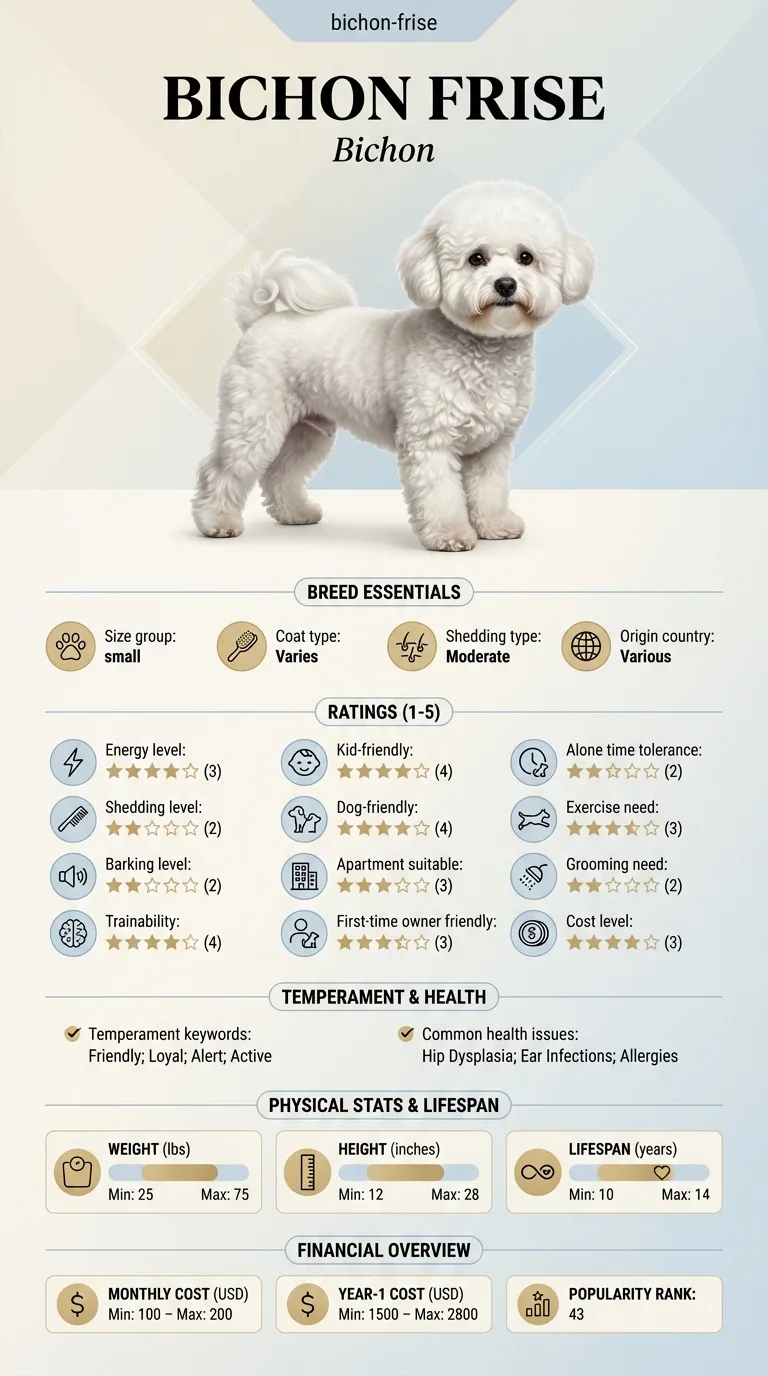
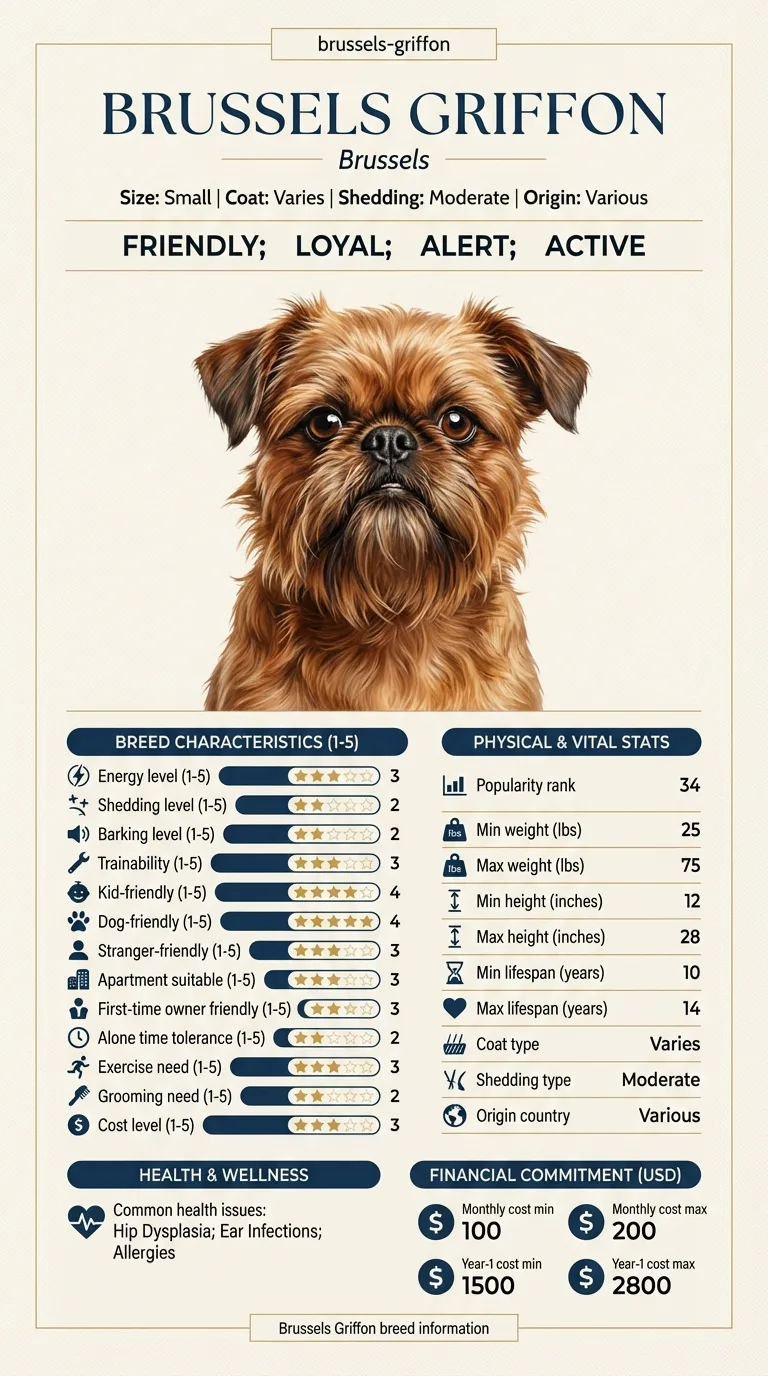
This is for someone already down to Bichon Frise and Brussels Griffon and deciding between them. For this pair the decision usually turns on grooming need, so those are covered first and in most detail. Both rate 5/5 for flats, so housing does not settle this one. The focus throughout is on daily consequences rather than breed background.
Between Bichon Frise and Brussels Griffon, grooming need is what separates them, and Brussels Griffon is the lower-effort dog of the two to keep.
Choose Bichon Frise if this is your first dog, shedding is a problem in your house and there are young children at home.
Choose Brussels Griffon if you do not want a standing grooming appointment, a smaller dog suits your car, your home or your back and you want a dog that is more watchful with visitors.
| Feature | bichon frise | brussels griffon | Winner |
|---|---|---|---|
| Size class | small | small | Equal |
| Weight | 12–18 lbs | 8–12 lbs | Equal |
| Height | 9–12 in | 7–10 in | Equal |
| Lifespan | 14–15 years | 12–15 years | bichon frise |
| Exercise need | Low (2/5) | Low (2/5) | Equal |
| Grooming need | Very high (5/5) | Moderate (3/5) | brussels griffon |
| Shedding | Very low (1/5) | Low (2/5) | bichon frise |
| Energy level | Moderate (3/5) | Moderate (3/5) | Equal |
| Barking | Moderate (3/5) | Moderate (3/5) | Equal |
| Apartment suitability | Very high (5/5) | Very high (5/5) | Equal |
| Good for first-time owners | High (4/5) | Moderate (3/5) | bichon frise |
| Tolerates being alone | Low (2/5) | Low (2/5) | Equal |
| Trainability | Moderate (3/5) | Moderate (3/5) | Equal |
| Good with kids | High (4/5) | Moderate (3/5) | bichon frise |
| Good with other dogs | High (4/5) | Moderate (3/5) | bichon frise |
| Friendly to strangers | High (4/5) | Moderate (3/5) | bichon frise |
| Cost level | Moderate (3/5) | Moderate (3/5) | Equal |
| Coat | Curly, dense double coat | Rough or smooth | Equal |
| Origin | Various | Various | Equal |
| Typical monthly cost | $80–$150 | $80–$150 | Equal |
| Typical first-year cost | $1,100–$2,300 | $1,100–$2,300 | Equal |
This is a rare matchup where the comparison breed is actually smaller than the Bichon Frise: the Brussels Griffon weighs just 8-12 lbs and stands 7-10 inches, versus the Bichon's 12-18 lbs and 9-12 inches. Both tie on the small size class, but the Griffon is meaningfully more diminutive, giving it an even lighter footprint in the home. Its rough or smooth coat, owners can choose between coat types within the breed, contrasts with the Bichon's uniformly curly, dense double coat, and its stockier, more square-set body differs from the Bichon's rounder silhouette.
Exercise need ties at Low (2/5) and energy level ties at Moderate (3/5), making this one of the most evenly matched comparisons on the activity front. Neither the Playful, Curious Bichon nor the Alert, Sensitive Griffon needs vigorous daily exercise, both are content with short walks and indoor play. The Griffon's Sensitive trait is worth noting operationally, though: this is a breed that can be easily overwhelmed by chaotic environments or harsh handling, so its low physical exercise needs shouldn't be mistaken for low emotional-care needs.
The Bichon Frise's Very high (5/5) grooming need well exceeds the Brussels Griffon's Moderate (3/5), the Bichon's curly double coat requires far more brushing and professional trimming than the Griffon's rough or smooth coat options. Shedding is closer, Very low (1/5) for the Bichon against Low (2/5) for the Griffon, so neither breed leaves much hair behind. An owner drawn to the Bichon's fluffy look should expect meaningfully more grooming time and expense than the comparatively low-key Griffon requires.
Both breeds tie at Very high (5/5) for apartment suitability and Moderate (3/5) for barking, making this comparison unusually close on the living-situation front. Both also tie at Low (2/5) for tolerating being alone, meaning neither the Cheerful Bichon nor the Devoted Griffon does well with long stretches of solitude, the Griffon in particular is known for forming intense one-on-one bonds and can struggle emotionally when left alone regularly, a trait consistent with its Devoted temperament descriptor.
Trainability ties at Moderate (3/5) for both breeds, but first-time-owner suitability tips toward the Bichon, High (4/5) versus the Griffon's Moderate (3/5). The Griffon's Sensitive nature means training needs a gentler touch, harsh corrections can shut the breed down, while the more resilient, Cheerful Bichon tends to bounce back more easily from a new owner's early mistakes. Neither breed is difficult to train in an absolute sense, but the Griffon rewards a more patient, emotionally attuned approach.
The Bichon Frise pulls ahead across the board here: High (4/5) with kids versus the Griffon's Moderate (3/5), High (4/5) with other dogs versus Moderate (3/5), and High (4/5) friendliness to strangers versus Moderate (3/5). This pattern lines up with temperament, the Bichon's Playful, Affectionate profile suits a busy household with visitors and other pets, while the Griffon's Alert, Sensitive nature makes it more selective about company and better suited to a quieter home with fewer moving parts, especially around boisterous young children.
Lifespan slightly favors the Bichon at 14-15 years against the Griffon's 12-15 years. Health-wise, the Griffon's five-item list (Brachycephalic Airway Syndrome (BOAS), Patellar Luxation, Hip Dysplasia, Eye Injuries, Syringomyelia) is the same length as the Bichon's five (Skin Allergies, Patellar Luxation, Bladder Stones, Cataracts, Dental Disease), but the Griffon's flat face brings BOAS-related breathing risk, and Syringomyelia is a serious neurological condition worth discussing with a breeder or vet. Patellar Luxation appears on both lists, a shared risk for small breeds generally.
Both breeds land at Moderate (3/5) cost level with identical monthly ($80-150) and first-year ($1,100-2,300) cost ranges, an unusually tidy tie on the financial side of this comparison. The composition of spending likely differs even though the totals match: the Bichon's budget leans harder into grooming given its Very high grooming need, while the Griffon's Moderate grooming score and BOAS-related health risk may push its spending toward veterinary monitoring rather than the salon.
Bichon Frise weighs 12–18 lbs and lives 14–15 years; Brussels Griffon weighs 8–12 lbs and lives 12–15 years. The two diverge most on grooming need. They are level on tolerates being alone, apartment suitability and barking, so those cannot decide it. The table below marks a winner only where one breed is genuinely easier for a typical owner; size and origin are facts rather than merits and stay level. Ratings come from one source applied to both breeds, so they are meaningful against each other rather than as absolute scores.

Yes, the Griffon typically weighs 8-12 lbs and stands 7-10 inches, compared to the Bichon Frise's 12-18 lbs and 9-12 inches.
The Brussels Griffon, rated Moderate (3/5) versus the Bichon Frise's Very high (5/5).
They rate Moderate (3/5), lower than the Bichon Frise's High (4/5), the Griffon's Sensitive temperament tends to prefer calmer, quieter households.
Brachycephalic Airway Syndrome (BOAS) is on the Griffon's health list due to its flat face, a risk the Bichon Frise doesn't share.
The Bichon Frise, rated High (4/5) versus the Griffon's Moderate (3/5).
Very little, it rates Low (2/5) for exercise need, the same as the Bichon Frise.
Neither does well, both tie at Low (2/5) for tolerating being alone, so plan for company or a dog walker either way.
The Brussels Griffon, at 8-12 lbs versus the Bichon's 12-18 lbs.
The Brussels Griffon, rated Moderate (3/5) versus the Bichon's Very high (5/5).
The Bichon Frise, rated High (4/5) versus the Griffon's Moderate (3/5).
Neither, both share the same typical monthly ($80-150) and first-year ($1,100-2,300) cost ranges.
Secure checkout on Stripe. We never see your card.
7-day money-back guarantee. Instant access.
Health information here is general and is not veterinary advice. If your dog shows pain, sudden behaviour change, or worsening symptoms, consult a licensed veterinarian.
Some links on this site are affiliate links. We may earn a commission at no extra cost to you, and we only suggest products we believe are helpful for dog owners.
We research and check what we publish, but we do not warrant that any figure, date, price, or statement is accurate, complete, or current, and we accept no liability for any loss, cost, injury, or other harm arising from the use of this site. Use it as one reference among several. You remain responsible for your own decisions and for your dog's care - confirm anything that matters with a licensed veterinarian or another qualified professional before you act on it. Full disclaimer.
Match your lifestyle to the right dog.
Take quizNot sure which breed is right for you? Take our 2-minute quiz to find out.
Take the quiz