Health
Is cherry eye a Bichon Frise breed problem?
No. It is concentrated in bulldogs, spaniels and beagles, and is not on this breed's documented health list.

Quick answer
Is cherry eye a Bichon Frise breed problem?
No. It is concentrated in bulldogs, spaniels and beagles, and is not on this breed's documented health list.
The lump itself looks alarming but is not the real issue; the real issue is that this gland produces a substantial proportion of the eye's tears, and what is done about it determines whether the eye stays comfortable for the next decade.
Owners who have found a red swelling in the corner of their dog's eye and want to know what it is and how urgent it is. Also anyone who has been offered removal as a solution and wants to understand why that recommendation is controversial.
This guide is not medical advice. If your dog shows pain, sudden behavior change, or worsening symptoms, consult a licensed veterinarian.
Some links may be affiliate links. We may earn a commission at no extra cost to you. We only suggest products we believe are helpful for dog owners.
We research and check what we publish, but we do not warrant that any figure, date, price, or statement is accurate, complete, or current, and we accept no liability for any loss, cost, injury, or other harm arising from the use of this site. Use it as one reference among several. You remain responsible for your own decisions and for your dog's care - confirm anything that matters with a licensed veterinarian or another qualified professional before you act on it. Full disclaimer.
Cherry eye is the prolapse of the tear-producing gland of the third eyelid, which slips out from behind the eyelid and sits visible in the inner corner as a smooth pink or red mass. It happens when the connective tissue anchoring the gland gives way. The condition is strongly associated with particular breeds, and the Bichon Frise is not among them. Its importance lies less in appearance than in preserving the gland's tear production.
Frequent in the predisposed breeds, where a general practice sees it regularly in young dogs. Not a recognised Bichon Frise problem and absent from the breed's documented health list. Owners of this breed who find something red in the corner of an eye are statistically more likely to be looking at conjunctivitis or damp inflamed skin than at a displaced gland.
The gland is held in place by a fibrous attachment to the tissue around the eye socket. In predisposed breeds that attachment appears to be inherently weaker, which is why cherry eye clusters so tightly in particular families and why it so often occurs in young dogs rather than old ones. The Bichon Frise has not been identified with that weakness, and its eye-related breed problem is cataracts, which affects the lens deep inside the eye rather than any structure of the eyelid. That is a genuinely different part of the anatomy with a different set of consequences.
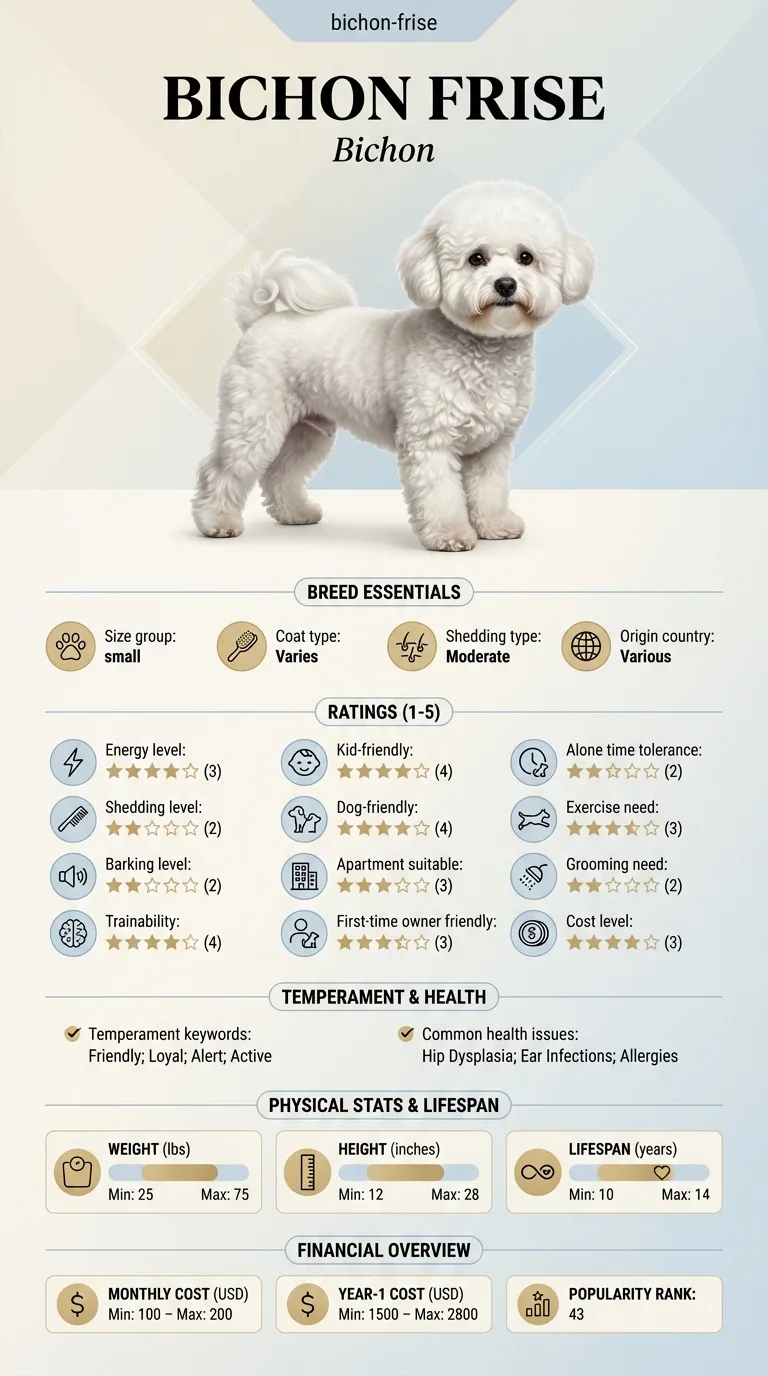
Environment does not cause a gland to prolapse, but it strongly influences the conditions Bichon owners actually see in the eye corner. This breed's grooming need rates five out of five, and hair around the eye that is allowed to grow long wicks tears onto the face and holds moisture against the skin, producing the damp, reddened, sometimes infected corner that owners often photograph in alarm. Homes with dusty air, aerosols and strong fragrances add conjunctival irritation, and a dog with the allergic tendency documented in this breed reacts to those more than most.
Book within a few days for a smooth pink mass appearing in the inner corner, for persistent redness, or for discharge that keeps returning after cleaning. Book promptly rather than waiting for a third eyelid that has come across the eye without a mass, since that is often a sign of pain or illness elsewhere. Seek same-day or emergency care for an eye held tightly closed, obvious pain, a cloudy or blue-tinged surface, blood in the eye, a suspected foreign body, an eye that looks larger than its partner, or any sudden change in vision. Eye problems deteriorate quickly and a day's delay can cost sight.
See all Bichon Frise health problems, which breeds are prone to cherry eye, or the full Bichon Frise breed guide for temperament, exercise needs and ownership costs.
A prolapsed gland that is repositioned surgically usually settles within two to three weeks, with swelling and mild discharge in the first days being normal. Recurrence, when it happens, tends to occur within the first few months. Conjunctivitis treated appropriately generally improves within a week, though where it is driven by underlying allergy it recurs until the allergy itself is managed, which is a longer project measured in months rather than weeks.
Success is a comfortable eye with a normal glossy surface, a dry clean corner, no squinting and no rubbing, and a tear film doing its job without pharmaceutical help. Where a gland has been repositioned, success is a gland that stays where it was put and continues producing tears for the rest of a long life. Avoiding a decade of drops for dry eye is the real prize, and it is decided by which surgery is chosen.
For many years the standard treatment was to snip the prolapsed gland off. It is quick, it is cheap, and it makes the visible problem disappear immediately. It is also now widely regarded as the wrong approach in most cases.
The reason is what that gland does. It is a significant contributor to the watery portion of the tear film, and the tear film is what keeps the surface of the eye alive. Remove the gland and a proportion of dogs go on to develop dry eye, where the surface is chronically under-lubricated.
Dry eye is not a cosmetic problem. It causes a thick sticky discharge, chronic discomfort, pigment and scarring across the surface of the eye, and in bad cases vision loss. It is managed with lifelong drops given several times a day, potentially for a decade or more in a breed that lives fourteen to fifteen years.
The modern approach is to reposition the gland surgically and secure it, preserving its function. It is a more involved procedure and it occasionally needs repeating, but it protects tear production.
If anyone proposes removing the gland, the reasonable question is whether repositioning has been considered and why it is not appropriate in this particular eye.

Cherry eye is strongly breed-associated, and the association is with a particular group. The Bichon Frise is not in it, and its documented health issues are skin allergies, patellar luxation, bladder stones, cataracts and dental disease. So a red corner in a Bichon has several other explanations worth considering first.
If you think your Bichon has cherry eye, the plan is three steps: write down what you have seen and when it started, book a veterinary appointment rather than waiting for the next flare, and take video of the behaviour or symptom before you go — the thing you are worried about rarely happens in the consulting room. Screening in the parents covers skin allergies, patellar luxation, bladder stones.
What the vet visit should produce is a diagnosis and a written plan, not just reassurance: what is being ruled out, what the monitoring interval is, and which signs mean you come back sooner. Ask what the treatment costs across a year rather than per visit, because that is the number that decides whether you are managing this condition or reacting to it.
Between appointments, keep a short log — dates, what you saw, what changed. It is the single most useful thing an owner brings to a follow-up, and for cherry eye it is often what separates a clear pattern from a guess.
Teddy was fourteen months old when a firm pink swelling appeared in the corner of his right eye overnight. His owner, Kwame, took him in the next morning and was offered removal of the gland as a same-week procedure. Something about the speed of the recommendation prompted him to ask what the gland actually did. The answer, that it produced a large share of the eye's tears, sent him looking for a second opinion. The second practice offered repositioning instead, explaining that it was more involved, cost more and occasionally needed repeating, but that it kept the gland working. Teddy had the surgery and the gland stayed in place. He is six now with normal tear production and no daily drops. Kwame's reflection is that he nearly agreed to the quicker option purely because he did not know enough to ask what was being removed.
Key takeaway: Before agreeing to remove anything from an eye, ask what it does, because a gland that looks like a nuisance for a week may be preventing a decade of dry eye.
It is not among the breed's documented health issues. Cherry eye is concentrated in breeds such as English and French bulldogs, cocker spaniels, beagles and shih tzus, where the connective tissue anchoring the gland is weaker. An individual Bichon can develop it, but a red corner in this breed more often has another explanation.
The prolapse itself is usually more uncomfortable than acutely painful, but the exposed gland dries out, becomes inflamed and can be rubbed by the dog, which makes it sore. It is not an emergency in the sense that it needs treating overnight, but it should be seen within a few days rather than watched for weeks.
Do not attempt it. You risk injuring the eye surface, introducing infection, and causing pain, and even a successful push generally does not hold because the anchoring tissue has failed. Book an appointment and leave the eye alone in the meantime beyond stopping your dog rubbing at it.
Dry eye means insufficient tear production, and the classic picture is a thick, sticky, often yellow-green discharge with a dull-looking eye surface that lacks its usual glossy shine. Dogs squint and rub. It is diagnosed with a simple tear measurement test that takes about a minute in a consulting room.
Recurrence is possible after repositioning, and rates vary with technique and with the individual dog. That is a known limitation rather than a surgical failure, and a second procedure may be needed. It remains preferable to removal, which trades a visible lump for a lifelong tear deficiency.
No. A third eyelid that has come partly across the eye without a protruding mass is a sign that something else is going on, often pain in the eye, a foreign body, dehydration or general illness. It is worth investigating, and the reason matters more than the appearance.
No. It is concentrated in bulldogs, spaniels and beagles, and is not on this breed's documented health list.
Only in specific circumstances your vet can justify. Routine removal risks lifelong dry eye, because that gland produces much of the tear film.
Not an overnight emergency, but book within a few days. An exposed gland dries out and becomes inflamed quickly.
Conjunctivitis or moisture dermatitis from tear staining, both connected to the allergic tendency documented in this breed.
More than removal, which is part of why removal persisted. Ask about both, and about the long-term cost of lifelong drops if dry eye follows.
A one-page prep sheet for this condition: the signs, the questions to ask, what to get priced. Unlocks here.
You get: Vet visit prep sheet
No spam. One-click unsubscribe. See our privacy policy.
Preview page 1 before you decide.