Living
Which is smaller?
The Chihuahua, at 2-6 lbs versus the Bichon's 12-18 lbs.

Quick answer
Which is smaller?
The Chihuahua, at 2-6 lbs versus the Bichon's 12-18 lbs.
Bichon Frise or Chihuahua? On paper they differ most on grooming need, and on the scales Bichon Frise is the heavier at 12–18 lbs. Here is how the two compare on everything that shapes an ordinary week.
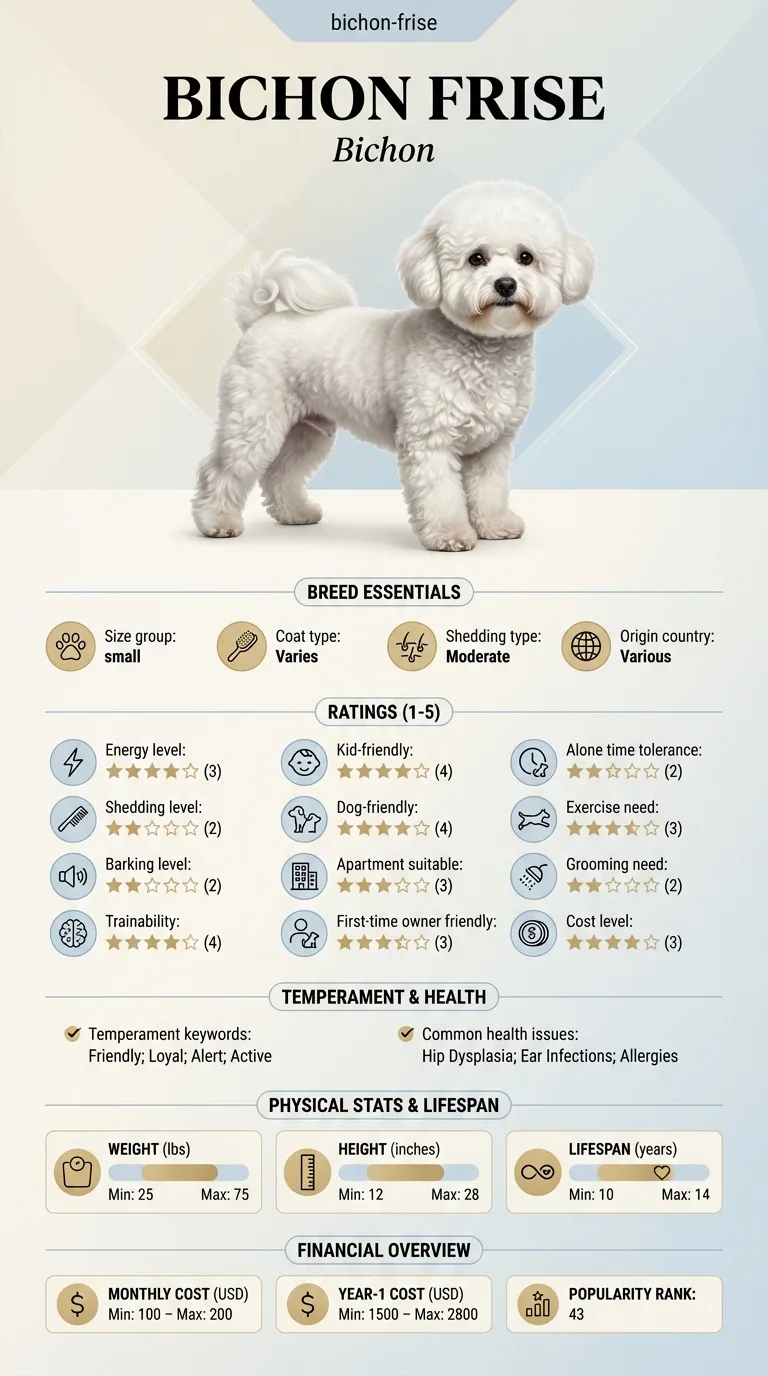
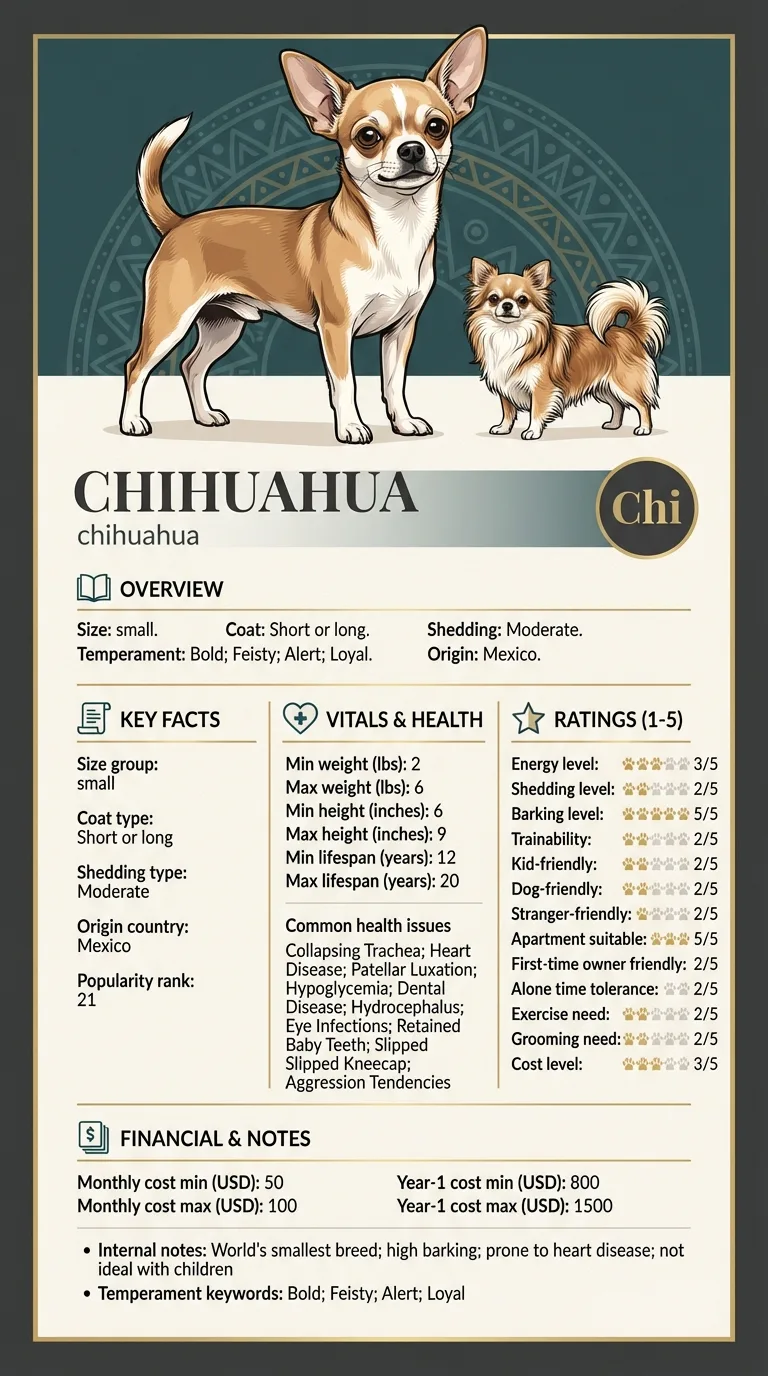
This is for someone already down to Bichon Frise and Chihuahua and deciding between them. For this pair the decision usually turns on grooming need and good for first-time owners, so those are covered first and in most detail. Both rate 5/5 for flats, so housing does not settle this one. It is written for the decision rather than the breed history.
Between Bichon Frise and Chihuahua, grooming need is what separates them, and Chihuahua is the lower-effort dog of the two to keep.
Choose Bichon Frise if this is your first dog, shedding is a problem in your house and there are young children at home.
Choose Chihuahua if you do not want a standing grooming appointment, a smaller dog suits your car, your home or your back and you want a dog that is more watchful with visitors.
| Feature | bichon frise | chihuahua | Winner |
|---|---|---|---|
| Size class | small | small | Equal |
| Weight | 12–18 lbs | 2–6 lbs | Equal |
| Height | 9–12 in | 6–9 in | Equal |
| Lifespan | 14–15 years | 12–20 years | chihuahua |
| Exercise need | Low (2/5) | Low (2/5) | Equal |
| Grooming need | Very high (5/5) | Low (2/5) | chihuahua |
| Shedding | Very low (1/5) | Low (2/5) | bichon frise |
| Energy level | Moderate (3/5) | Moderate (3/5) | Equal |
| Barking | Moderate (3/5) | Very high (5/5) | bichon frise |
| Apartment suitability | Very high (5/5) | Very high (5/5) | Equal |
| Good for first-time owners | High (4/5) | Low (2/5) | bichon frise |
| Tolerates being alone | Low (2/5) | Low (2/5) | Equal |
| Trainability | Moderate (3/5) | Low (2/5) | bichon frise |
| Good with kids | High (4/5) | Low (2/5) | bichon frise |
| Good with other dogs | High (4/5) | Low (2/5) | bichon frise |
| Friendly to strangers | High (4/5) | Low (2/5) | bichon frise |
| Cost level | Moderate (3/5) | Moderate (3/5) | Equal |
| Coat | Curly, dense double coat | Short or long | Equal |
| Origin | Various | Mexico | Equal |
| Typical monthly cost | $80–$150 | $50–$100 | Equal |
| Typical first-year cost | $1,100–$2,300 | $800–$1,500 | Equal |
The Chihuahua is dramatically smaller even than the already-small Bichon Frise: 2-6 lbs and 6-9 inches versus the Bichon's 12-18 lbs and 9-12 inches, the Bichon can outweigh a Chihuahua by three to nine times depending on individual dogs. Both tie on the small size class label, but a Chihuahua's tiny frame makes it considerably more fragile around rough handling, small children, or larger dogs, while the sturdier Bichon can absorb more physical interaction without injury risk. This size gap runs through nearly every other category in this comparison.
Exercise need ties at Low (2/5) and energy level ties at Moderate (3/5), both breeds are content with minimal physical activity, unusual for how differently they're perceived. The Bold, Feisty Chihuahua often seems more energetic in personality than its exercise score suggests, but that reflects alertness and vocal reactivity rather than a need for physical exertion. Both breeds suit owners who want a companion rather than an exercise partner, though the Chihuahua's tiny size means even its modest exercise needs are easily met in a small space.
The Bichon Frise's Very high (5/5) grooming need towers over the Chihuahua's Low (2/5), the Bichon's curly double coat needs professional trims, while the Chihuahua's short or long coat options need only routine brushing. Shedding favors the Bichon slightly, Very low (1/5) versus Low (2/5) for the Chihuahua. Between the two, the Chihuahua is by far the lower-maintenance coat, one reason it's popular among owners who want a small dog without a grooming budget attached.
Both breeds tie at Very high (5/5) for apartment suitability, but barking tells a very different story: the Chihuahua rates Very high (5/5) for barking against the Bichon's Moderate (3/5), and the Chihuahua's Alert temperament trait backs up its reputation as a vocal, reactive small dog quick to sound off at noises or strangers. Both tie at Low (2/5) for tolerating being alone. An apartment neighbor's biggest concern with a Chihuahua is likely to be noise rather than space, the opposite of most larger-breed apartment concerns.
The Bichon Frise leads clearly here: High (4/5) for first-time owners versus the Chihuahua's Low (2/5), and Moderate (3/5) trainability versus the Chihuahua's Low (2/5). The Chihuahua's Bold, Feisty temperament can translate into a strong-willed, sometimes stubborn training subject, and its health list even flags Aggression Tendencies by name, a trait that responsible, consistent early socialization can meaningfully improve but that first-time owners should be prepared to actively manage rather than assume away.
This is one of the widest gaps in the entire batch: the Bichon Frise rates High (4/5) with kids, other dogs, and strangers, while the Chihuahua rates Low (2/5) across all three. Chihuahuas are frequently one-person or one-family dogs, wary of unfamiliar people and other animals, and their small size makes rough play with young kids genuinely risky for the dog's safety, not just a matter of temperament. Families with children or a busy household of visitors will find the Bichon the far more forgiving social companion of the two.
The Chihuahua actually outlives the Bichon Frise here, 12-20 years against the Bichon's 14-15 years, with the top end of that range among the longest of any breed on this site. Health-wise, the Chihuahua's ten-item list includes Collapsing Trachea, Heart Disease, Hypoglycemia, and Hydrocephalus alongside dental issues shared with the Bichon (Dental Disease, Retained Baby Teeth). The Bichon's five-item list is shorter but the Chihuahua's greater longevity potential is a real point in its favor despite the longer condition list.
The Chihuahua is the cheapest breed to keep in this comparison: monthly costs of $50-100 against the Bichon's $80-150, and first-year costs of $800-1,500 versus $1,100-2,300, with both rated Moderate (3/5) on the overall cost scale. Its tiny size means less food, smaller medication doses, and no grooming-salon bills to speak of. The main budget wildcard for a Chihuahua owner is the health list, Hypoglycemia and dental issues like Retained Baby Teeth can mean unplanned vet visits, but the baseline cost of ownership remains the lowest in this batch.
Bichon Frise weighs 12–18 lbs and lives 14–15 years; Chihuahua weighs 2–6 lbs and lives 12–20 years. The two diverge most on grooming need, good for first-time owners and barking and 3 other rated axes. They are level on tolerates being alone, apartment suitability and cost level, so those cannot decide it. In the table, a "winner" means easier for an ordinary household — not better. Size, coat and origin are recorded without a verdict. Because both breeds are scored the same way, the gaps are reliable even where the absolute numbers are rough.

The Chihuahua, at 2-6 lbs, is significantly smaller than the Bichon Frise's 12-18 lbs, up to nine times lighter.
Yes, they rate Very high (5/5) for barking, the highest rating in this comparison, versus the Bichon Frise's Moderate (3/5).
The Chihuahua, with a typical lifespan of 12-20 years that can exceed the Bichon Frise's 14-15 years at the upper end.
Not especially, they rate Low (2/5) for compatibility with kids, versus the Bichon Frise's High (4/5), and their small size makes them vulnerable to injury from rough handling.
The Chihuahua, with a typical first-year cost of $800-1,500 versus the Bichon Frise's $1,100-2,300, the lowest cost in this comparison.
It rates Low (2/5) for first-time-owner suitability, versus the Bichon Frise's High (4/5), partly due to its Bold, Feisty temperament and the Aggression Tendencies noted on its health list.
The Chihuahua, rated Low (2/5) versus the Bichon Frise's Very high (5/5).
The Chihuahua, at 2-6 lbs versus the Bichon's 12-18 lbs.
The Chihuahua, rated Very high (5/5) versus the Bichon's Moderate (3/5).
The Chihuahua, at $800-1,500 typical first-year cost.
The Bichon Frise, rated High (4/5) versus the Chihuahua's Low (2/5).
Secure checkout on Stripe. We never see your card.
7-day money-back guarantee. Instant access.
Health information here is general and is not veterinary advice. If your dog shows pain, sudden behaviour change, or worsening symptoms, consult a licensed veterinarian.
Some links on this site are affiliate links. We may earn a commission at no extra cost to you, and we only suggest products we believe are helpful for dog owners.
We research and check what we publish, but we do not warrant that any figure, date, price, or statement is accurate, complete, or current, and we accept no liability for any loss, cost, injury, or other harm arising from the use of this site. Use it as one reference among several. You remain responsible for your own decisions and for your dog's care - confirm anything that matters with a licensed veterinarian or another qualified professional before you act on it. Full disclaimer.
Match your lifestyle to the right dog.
Take quizNot sure which breed is right for you? Take our 2-minute quiz to find out.
Take the quiz