Health
What does cherry eye look like?
A round, reddish lump in the inner corner of the eye, appearing suddenly rather than developing gradually.

Quick answer
What does cherry eye look like?
A round, reddish lump in the inner corner of the eye, appearing suddenly rather than developing gradually.
A round, reddish lump suddenly appearing in the corner of your Aussie's eye looks alarming, but it's a mechanical problem with a name and a well-established fix, not a mystery illness.
This tends to show up in young dogs, often under two years old, and owners are usually caught off guard by how suddenly it appears — one day the eye looks normal, the next there's a visible lump.
This guide is not medical advice. If your dog shows pain, sudden behavior change, or worsening symptoms, consult a licensed veterinarian.
Some links may be affiliate links. We may earn a commission at no extra cost to you. We only suggest products we believe are helpful for dog owners.
We research and check what we publish, but we do not warrant that any figure, date, price, or statement is accurate, complete, or current, and we accept no liability for any loss, cost, injury, or other harm arising from the use of this site. Use it as one reference among several. You remain responsible for your own decisions and for your dog's care - confirm anything that matters with a licensed veterinarian or another qualified professional before you act on it. Full disclaimer.
Cherry eye is a mechanical condition where the tear-producing gland behind a dog's third eyelid prolapses forward, appearing as a red, rounded lump in the corner of the eye. It typically appears suddenly in young dogs and is fixed with a surgical procedure that repositions rather than removes the gland.
Cherry eye occurs across many breeds and shows up often enough in young dogs generally that most vets recognize it immediately on sight. It's not among this breed's most frequently documented conditions but is a familiar, well-understood issue when it does occur.
Cherry eye stems from weakness in the connective tissue anchoring the tear gland in place, allowing it to prolapse forward under normal everyday movement and eye activity. This is a mechanical, structural issue rather than an infection or allergic reaction.
There's no strong environmental trigger for cherry eye the way there is for allergies — it's primarily a structural predisposition that shows up on its own timeline, most often in a young dog's first two years.
See your vet within a few days of noticing the lump, since a prolapsed gland exposed to air and irritation for too long can become inflamed or dry. Sudden severe swelling, apparent pain, or the dog pawing aggressively at the eye warrants a sooner visit.
Cherry eye is a mechanical problem, not an infection, and treating it like one usually just delays the actual fix.
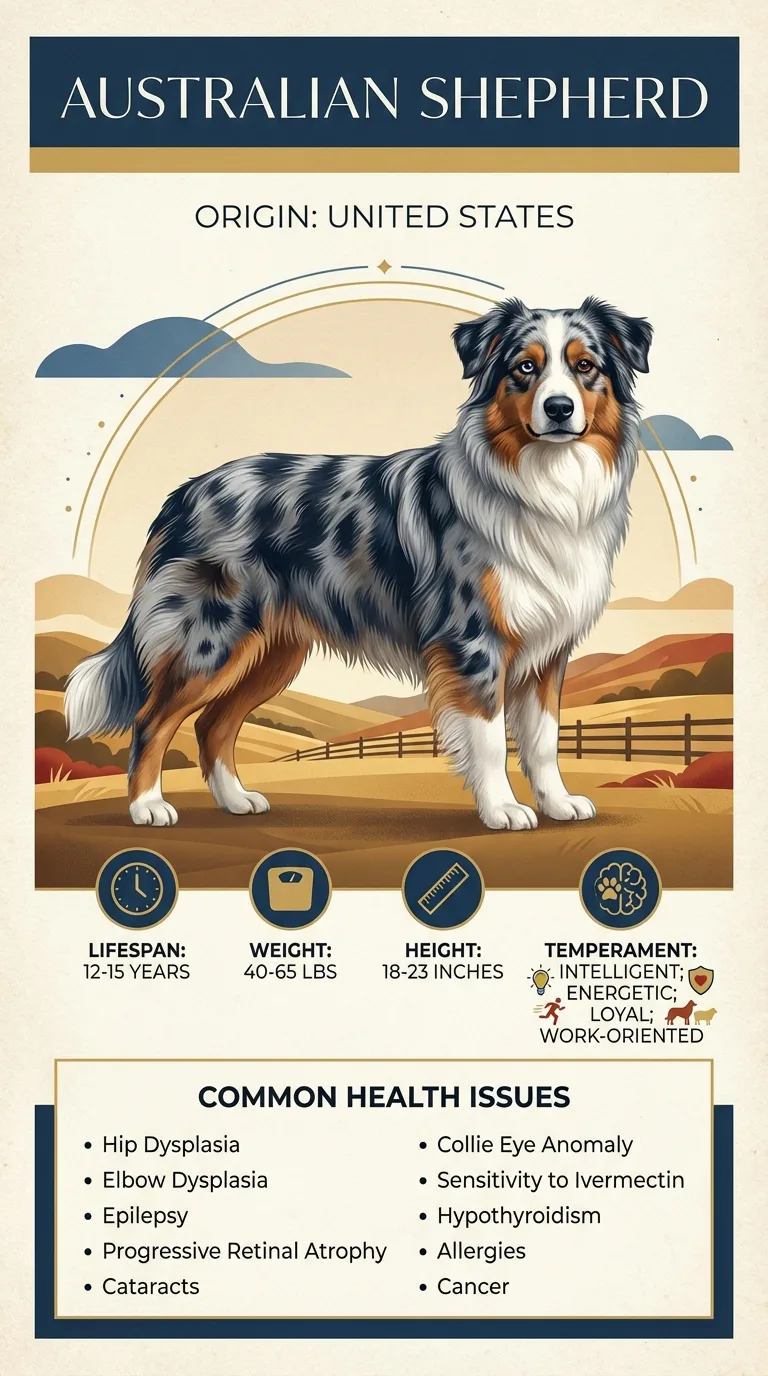
See all Australian Shepherd health problems, which breeds are prone to cherry eye, or the full Australian Shepherd breed guide for temperament, exercise needs and ownership costs.
Surgery is typically scheduled within a week or two of diagnosis, and recovery with a cone and follow-up care usually takes about two weeks before the eye is fully healed.
Success means a normal-looking eye with intact tear production after the repositioning procedure. A small number of dogs need a second procedure if the gland prolapses again, which doesn't reflect anything the owner did wrong.
The historical approach to cherry eye was simply removing the gland, but that's fallen out of favor because the gland produces a meaningful share of the eye's tear film. Removing it can lead to chronic dry eye later in life, which is its own lasting problem.
The modern standard is a surgical technique that repositions the gland back into its normal place and secures it there, preserving its tear-production function. This is a well-established procedure with a good success rate, though a small number of dogs experience a recurrence and need a second procedure.

If you think your Aussie has cherry eye, the plan is three steps: write down what you have seen and when it started, book a veterinary appointment rather than waiting for the next flare, and take video of the behaviour or symptom before you go — the thing you are worried about rarely happens in the consulting room. Screening in the parents covers hip dysplasia, elbow dysplasia, epilepsy.
What the vet visit should produce is a diagnosis and a written plan, not just reassurance: what is being ruled out, what the monitoring interval is, and which signs mean you come back sooner. Ask what the treatment costs across a year rather than per visit, because that is the number that decides whether you are managing this condition or reacting to it.
Between appointments, keep a short log — dates, what you saw, what changed. It is the single most useful thing an owner brings to a follow-up, and for cherry eye it is often what separates a clear pattern from a guess.
Bodhi was eleven months old when his owner, Sam, woke up to find a red bulge in the corner of his left eye that hadn't been there the night before. A same-week vet visit confirmed cherry eye, and Bodhi had the repositioning surgery ten days later. He wore a cone for about two weeks during recovery, clearly annoyed but otherwise unaffected. Eight months later, the same prolapse appeared in his right eye, which Sam recognized immediately and had treated just as quickly the second time around.
Key takeaway: Cherry eye showing up in one eye is common enough that many owners see it again in the other, and recognizing it early the second time makes for a much smoother, faster fix.
It's a prolapse of the tear-producing gland behind a dog's third eyelid, which pops out of place and becomes visible as a red, rounded lump in the corner of the eye.
It rarely resolves completely without treatment, and leaving it can lead to irritation, dryness, or chronic inflammation of the exposed gland.
Surgery to reposition the gland is the standard, most effective treatment. Some vets may try conservative management first in very mild cases, but most cases ultimately need the procedure.
Removing the gland can lead to chronic dry eye later, since it contributes meaningfully to tear production. Repositioning it preserves that function while still fixing the visible problem.
Yes, dogs that develop it in one eye have an increased chance of developing it in the other, so both eyes should be monitored even after one is treated.
Costs vary by clinic and region but typically fall in the low-to-mid hundreds of dollars for a straightforward repositioning procedure.
A round, reddish lump in the inner corner of the eye, appearing suddenly rather than developing gradually.
It's not immediately life-threatening, but it should be seen by a vet within a few days to prevent irritation or drying of the exposed gland.
No, home attempts to push the gland back rarely hold and can cause more irritation. A vet visit is needed for a lasting fix.
Yes, the modern repositioning technique has a good success rate, though a small percentage of dogs experience recurrence.
It most often shows up in dogs under two years old, though it can occur at any age.
A one-page prep sheet for this condition: the signs, the questions to ask, what to get priced. Unlocks here.
You get: Vet visit prep sheet
No spam. One-click unsubscribe. See our privacy policy.
Preview page 1 before you decide.