Heart Conditions in Bernese Mountain Dogs: A Screening Calendar
Quick answer
What is the single most useful heart check I can do at home?
Count your dog's breaths while he is fully asleep, for thirty seconds, once a week, and write it down. A sleeping Berner drifting from the low twenties into the thirties needs an appointment.
Cardiac trouble in this breed rarely announces itself. It shows up as a dog who takes the last flight of stairs slower than he did in spring.
Owners who want to know what a responsible checkup schedule looks like, and owners of a six or seven year old Berner who has started resting more and cannot tell whether that is age or something else.
Important reminder
This guide is not medical advice. If your dog shows pain, sudden behavior change, or worsening symptoms, consult a licensed veterinarian.
Some links may be affiliate links. We may earn a commission at no extra cost to you. We only suggest products we believe are helpful for dog owners.
We research and check what we publish, but we do not warrant that any figure, date, price, or statement is accurate, complete, or current, and we accept no liability for any loss, cost, injury, or other harm arising from the use of this site. Use it as one reference among several. You remain responsible for your own decisions and for your dog's care - confirm anything that matters with a licensed veterinarian or another qualified professional before you act on it. Full disclaimer.
What this problem looks like
Heart conditions in Bernese Mountain Dogs cover several unrelated mechanisms: congenital narrowing below the aortic valve, adult-onset stretching of the heart muscle, electrical rhythm faults, and ordinary valve wear in older dogs. They differ in onset age and in what detects them, which is why one yearly listen is a starting point rather than a full answer.
Common triggers
Exercise in warm weather, which unmasks limited cardiac reserve
Rapid weight gain, adding workload to an already large heart
Untreated low thyroid function, compounding fatigue and weight
Anesthesia and sedation, which stress an undiagnosed heart
Sustained excitement, such as greeting visitors, in a dog with a rhythm fault
Cardiac disease is a real but secondary concern here. Cancer, hip and elbow dysplasia, bloat and degenerative myelopathy account for more Bernese suffering. Congenital aortic narrowing and adult-onset muscle disease appear in large working breeds often enough that careful breeders screen for them, so know the signs without assuming your dog will develop one.
Why this happens
Breed factors
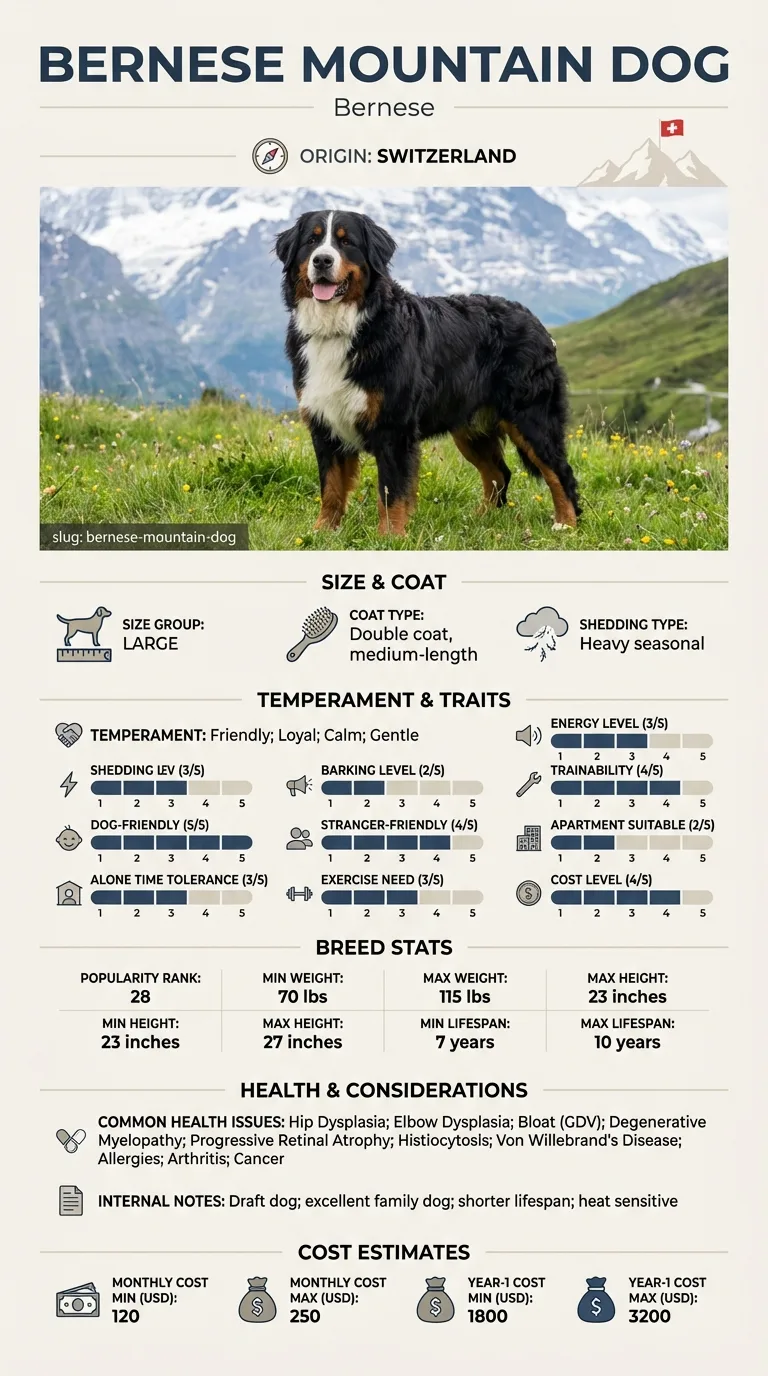
Size is the underlying driver. A dog carrying 70 to 115 pounds needs a large heart, and large hearts are more prone to the chamber stretching that defines adult-onset muscle disease. The deep chest that gave this Swiss draft breed its pulling capacity also makes murmurs harder to hear. Congenital aortic narrowing runs in lines rather than appearing at random, so pedigree information from a breeder is worth more than any general statistic.
Environment factors
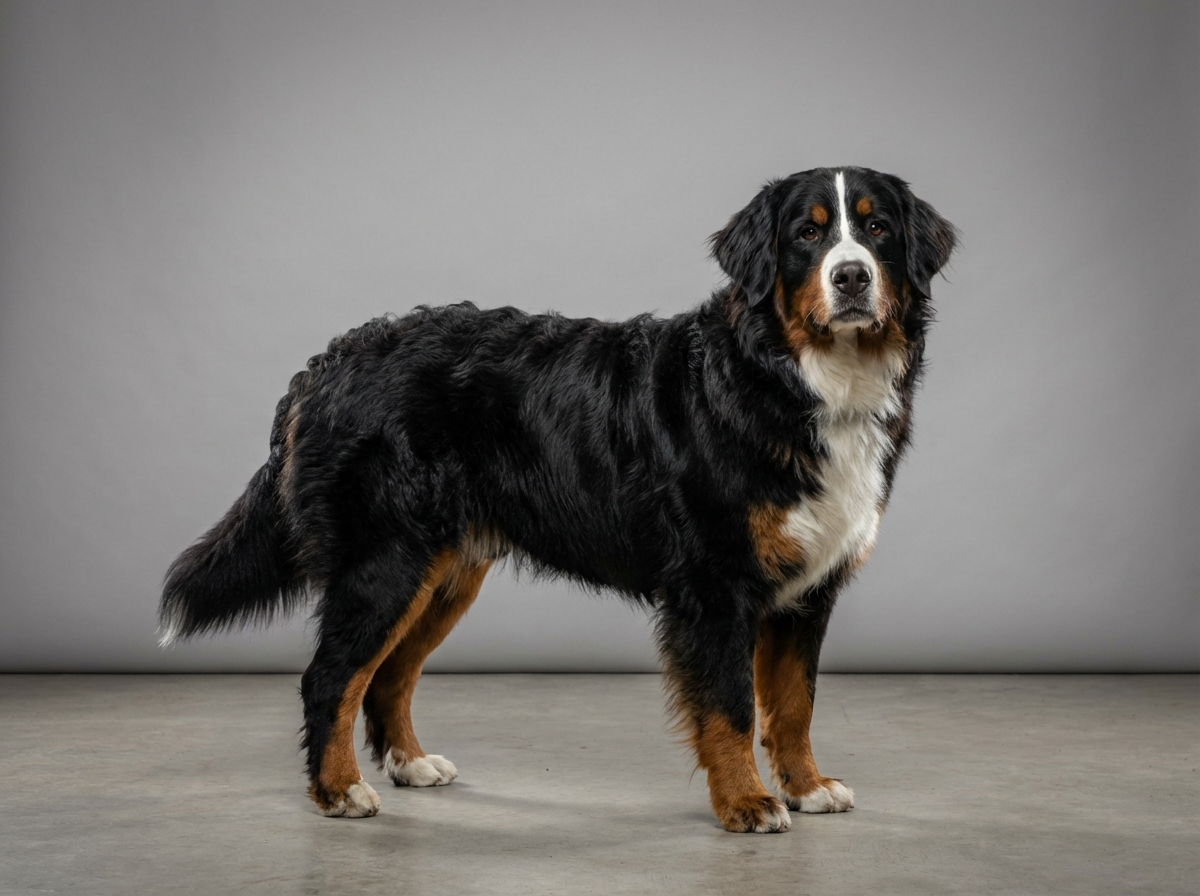
Heat matters most for a Bernese. A double coat built for Swiss winters traps warmth, and a dog with reduced cardiac reserve loses his safety margin fastest on a warm day. Weight is second: this breed accepts a calm indoor life easily, and calories a working farm dog would have burned turn into pounds the heart must supply. Humidity and forced running beside a bicycle compress that margin further.
What you can do at home (once it is not an emergency)
When to talk to your vet
Go the same day if your Bernese collapses or faints, stands with elbows out and neck extended to breathe, has blue or grey gums, or is breathing hard at complete rest. Those are emergencies, not overnight watch-and-see situations. Within the week, call about a resting breath rate that has climbed, a cough that appears on lying down, a belly distended without weight gain elsewhere, or a clear drop in walking distance on a cool day.
At home, alongside your vet's plan
Keep a written weekly log of sleeping breath counts. A rising trend over several weeks says more than any single reading.
Weigh your dog monthly rather than judging by eye. A dense coat hides several pounds, and weight is the one cardiac variable fully under your control.
Move walks to early morning and late evening from late spring onward, and pick flat shaded routes over hills.
Film any collapse or fainting episode. The video is often more useful to a cardiologist than the description you can give afterwards.
Ask for the murmur grade in writing at every visit so change over time is documented rather than remembered.
More Bernese Mountain DOG health & behavior issues
Screening answers come fast; management runs for years. A puppy murmur is usually resolved or diagnosed within a few months. An adult diagnosis settles into a stable medicated routine in roughly four to eight weeks, followed by recheck imaging at intervals your cardiologist sets. In a breed averaging seven to ten years, a dog diagnosed at seven is being managed for the rest of a normal life.
Success is a stable dog rather than a cured one: a resting breath count that stays flat month after month, two or three short walks a day still enjoyed, weight held at the leaner end of range, and no emergency visits between scheduled rechecks. For congenital cases caught early, success often means a mild lesion that never progresses at all.
The four cardiac patterns seen in this breed
Cardiac disease is not one condition in this breed. It is four mechanisms with four ages of onset, and telling them apart is the point of screening.
Congenital narrowing below the aortic valve, present from birth and usually caught as a murmur between eight and sixteen weeks.
Dilated heart muscle disease, an adult-onset problem where the chamber stretches, the walls thin, and pumping strength fades before anyone notices.
Electrical rhythm faults, which can hide behind a structurally normal scan. These are the ones behind fainting and unexplained collapse.
Age-related valve thickening, more a small-dog problem but not impossible in an aging Berner. The murmur grows louder over years, not months.
Secondary strain from other Bernese problems: chronic joint pain, obesity, and untreated low thyroid all make an aging heart work harder.
When to check, given a seven to ten year lifespan
In a breed that commonly reaches only nine or ten, a heart check every other year is not frequent enough. The schedule most Bernese owners land on has three stages.
Puppyhood is stage one. Ask your veterinarian to grade anything they hear at each vaccine visit. A soft murmur in an eight week old sometimes fades by four months. A murmur still present at six months, or one that has grown louder, argues for imaging rather than wait-and-see.
Stage two runs from two to five years. This is the quiet window, and one annual listen is usually enough unless your dog faints, tires abruptly, or a close relative has a cardiac diagnosis on file.
Stage three starts around six. Adult-onset muscle disease and rhythm faults tend to surface then in large breeds, and it is also when a Berner slows for ordinary reasons. Because both look identical from the outside, the annual exam is worth turning into a real conversation about stamina.
One detail specific to this breed: a dense double coat and a deep chest muffle heart sounds. A quiet stethoscope exam is less reassuring here than in a thin-coated dog.
Heart Conditions in Bernese Mountain Dogs: A Screening Calendar - When to check, given a seven to ten year lifespan
What to do next about heart conditions in Berneses
If you think your Bernese has heart conditions, the plan is three steps: write down what you have seen and when it started, book a veterinary appointment rather than waiting for the next flare, and take video of the behaviour or symptom before you go — the thing you are worried about rarely happens in the consulting room. Screening in the parents covers hip dysplasia, elbow dysplasia, bloat (gdv).
What the vet visit should produce is a diagnosis and a written plan, not just reassurance: what is being ruled out, what the monitoring interval is, and which signs mean you come back sooner. Ask what the treatment costs across a year rather than per visit, because that is the number that decides whether you are managing this condition or reacting to it.
Between appointments, keep a short log — dates, what you saw, what changed. It is the single most useful thing an owner brings to a follow-up, and for heart conditions it is often what separates a clear pattern from a guess.
The stairs told Nora's owners before the stethoscope did
Nora was six and a half, a 94 pound Bernese who had followed her family upstairs at bedtime her whole life. In February her owners noticed she had started sleeping at the bottom of the stairs instead. They blamed her elbows, which had mild changes on file, and mentioned it almost in passing at her annual exam.
Her vet heard nothing dramatic, which is common in a deep-chested dog with that much coat, but the stairs detail was specific enough to justify a referral. The ultrasound showed early chamber enlargement. Nora started a cardiac medication protocol and a weight plan that took eleven pounds off her over five months.
Two years on she still walks twice a day, on flat ground, in the cool part of the morning.
Key takeaway: The most useful cardiac information in this breed usually comes from the owner, not the stethoscope. A specific, dated behavior change beats a vague sense that a dog is slowing down.
Frequently asked questions
How common are heart conditions in Bernese Mountain Dogs?
Cardiac disease is not the leading concern in this breed. Cancer, joint disease and bloat account for more Bernese losses. Still, large deep-chested dogs are over-represented for adult-onset muscle disease, so cardiac screening belongs on the checklist rather than at the top of it.
My vet heard a murmur in my Bernese puppy. Is that serious?
It depends on the grade and on whether it persists. Some soft puppy murmurs are innocent and disappear by four months. One that is loud, still present at six months, or louder at each visit should be imaged. Ask for the grade in writing so you can compare rather than rely on memory.
What are the earliest signs of heart trouble in a Berner?
Reduced stamina almost always comes first, and it arrives slowly enough to be missed. Other early signals are a soft cough after lying down, breathing that stays fast during sleep, and a fuller-looking belly. A weekly sleeping breath count catches change earlier than any of these.
Should I get a cardiac ultrasound for a healthy Bernese Mountain Dog?
Not routinely. With no murmur, no fainting and normal exercise tolerance, an annual physical is a reasonable baseline. Imaging earns its cost when there is a murmur, a collapse episode, an unexplained stamina drop, or a cardiac diagnosis in a parent or sibling.
Can a Bernese Mountain Dog with a heart condition still be walked?
Usually yes, but the shape of the exercise changes. Short, frequent, flat walks in cool weather ask far less of a compromised heart than one long hike. Your veterinarian sets the limit from the imaging; your job at home is to stop before your dog does.
Does the breed's short lifespan mean heart problems are inevitable?
No. The seven to ten year average is driven largely by cancer, not cardiac failure, and many Bernese never develop a heart condition at all. The short lifespan matters because it shortens the window in which screening helps, which argues for checking earlier rather than more anxiously.
Is fainting always a heart problem in this breed?
Not always, but it should always be investigated. Collapse can come from rhythm faults, from a seizure disorder, or from heat. A phone video of the episode is genuinely useful, because how the dog goes down and how fast he recovers points toward one cause over the others.
What is the single most useful heart check I can do at home?
Count your dog's breaths while he is fully asleep, for thirty seconds, once a week, and write it down. A sleeping Berner drifting from the low twenties into the thirties needs an appointment.
Health
At what age should Bernese heart screening get more serious?
Around six. That is when adult-onset cardiac disease tends to surface in large breeds, and it is early relative to this breed's seven to ten year lifespan.
Living
Does a Bernese Mountain Dog's coat affect heart exams?
It can. A dense double coat and a deep chest muffle heart sounds, so a quiet stethoscope exam is less reassuring in this breed than in a thin-coated dog.
Costs
Is pet insurance worth it for cardiac risk in this breed?
Berners already sit in a high cost tier, roughly 120 to 250 dollars a month in ordinary care. A policy taken out before any murmur is documented is far more useful than one bought after.