Living
Which is smaller?
The Pug, at 14-18 lbs versus the Bernese's 70-115 lbs.

Quick answer
Which is smaller?
The Pug, at 14-18 lbs versus the Bernese's 70-115 lbs.
Bernese Mountain Dog or Pug? On paper they differ most on apartment suitability, and on the scales Bernese Mountain Dog is the heavier at 70–115 lbs. Here is how the two compare on everything that shapes an ordinary week.
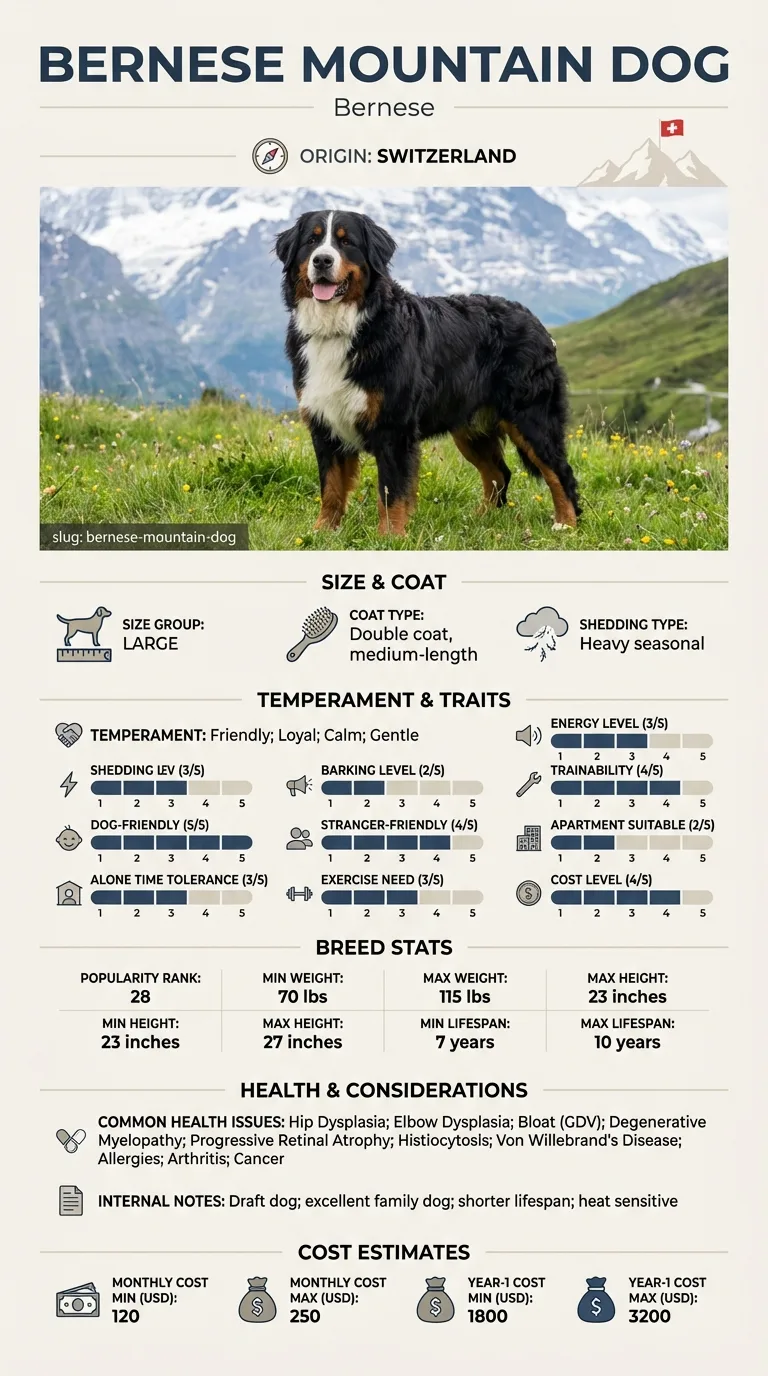
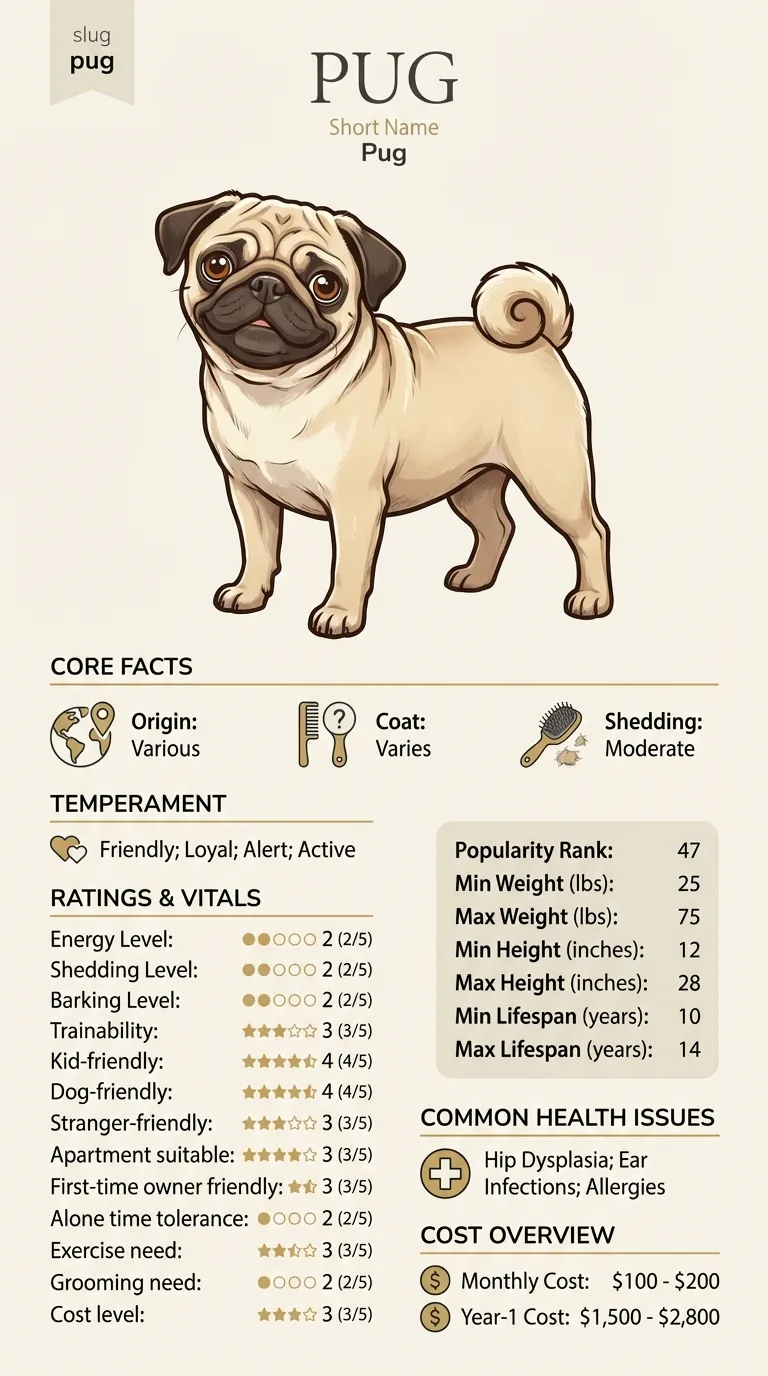
This is for someone already down to Bernese Mountain Dog and Pug and deciding between them. For this pair the decision usually turns on apartment suitability, so those are covered first and in most detail. Anyone choosing from a flat has a clear answer here: Pug rates 5/5 against 2/5. It is written for the decision rather than the breed history.
Between Bernese Mountain Dog and Pug, apartment suitability is what separates them, and Pug is the lower-effort dog of the two to keep.
Choose Bernese Mountain Dog if the dog will be alone during the working day, you already have another dog and you want a dog that picks up training quickly.
Choose Pug if you are in a flat or a smaller home, this is your first dog and you do not want a standing grooming appointment.
| Feature | bernese mountain dog | pug | Winner |
|---|---|---|---|
| Size class | large | small | Equal |
| Weight | 70–115 lbs | 14–18 lbs | Equal |
| Height | 23–27 in | 10–13 in | Equal |
| Lifespan | 7–10 years | 13–15 years | pug |
| Exercise need | Moderate (3/5) | Low (2/5) | pug |
| Grooming need | Moderate (3/5) | Low (2/5) | pug |
| Shedding | High (4/5) | High (4/5) | Equal |
| Energy level | Moderate (3/5) | Low (2/5) | Equal |
| Barking | Low (2/5) | Low (2/5) | Equal |
| Apartment suitability | Low (2/5) | Very high (5/5) | pug |
| Good for first-time owners | High (4/5) | Very high (5/5) | pug |
| Tolerates being alone | Moderate (3/5) | Low (2/5) | bernese mountain dog |
| Trainability | High (4/5) | Moderate (3/5) | bernese mountain dog |
| Good with kids | Very high (5/5) | Very high (5/5) | Equal |
| Good with other dogs | Very high (5/5) | High (4/5) | bernese mountain dog |
| Friendly to strangers | High (4/5) | Very high (5/5) | pug |
| Cost level | High (4/5) | Moderate (3/5) | pug |
| Coat | Double coat, medium-length | Short, smooth double coat | Equal |
| Origin | Switzerland | Various | Equal |
| Typical monthly cost | $120–$250 | $80–$150 | Equal |
| Typical first-year cost | $1,800–$3,200 | $1,100–$2,300 | Equal |
The Bernese Mountain Dog towers over the Pug in every dimension: 70-115 lbs and 23-27 in against the Pug's compact 14-18 lbs and 10-13 in. Where the Bernese's build reflects generations of Swiss cart-pulling and farm work, the Pug's short, square, muscular frame was bred purely for companionship in imperial courts, and its flat face marks it as a brachycephalic breed with its own distinct set of physical considerations. Anyone weighing these two should recognize the decision isn't just about size, it's about choosing between a working-dog physique and a companion-bred one with real structural differences.
The Pug rates low (2/5) for both exercise need and energy level, well below the Bernese's moderate (3/5) on both counts, matching its reputation as a low-key lap companion rather than an active partner. That lower activity level is partly a function of the Pug's brachycephalic, or flat-faced, structure, which limits how much sustained exertion it can safely handle, especially in heat. Owners wanting a genuinely relaxed housemate that doesn't demand daily vigorous exercise will find the Pug delivers that more reliably than even the comparatively calm Bernese.
Grooming need favors the Pug, low (2/5) against the Bernese's moderate (3/5), thanks to its short, smooth double coat that needs far less brushing than the Bernese's medium-length coat. Shedding, however, is tied at high (4/5) for both breeds, a surprising result given the Pug's small size, since short-coated dogs are often assumed to shed less. In practice, Pug owners deal with fine, hard-to-remove hair on clothing and furniture just as much as Bernese owners deal with longer fur, just in a different texture.
The Pug is rated very high (5/5) for apartment suitability against the Bernese's low (2/5), a clear result of its small size and low exercise needs. Both breeds are quiet, tied at low (2/5) for barking, so noise complaints are unlikely to factor into this particular decision either way. Alone-time tolerance is where both fall short, moderate (3/5) for the Bernese, low (2/5) for the Pug, so neither breed is ideal for an owner regularly gone for long stretches, regardless of how well either fits physically into a small apartment.
The Pug rates very high (5/5) for first-time owners, ahead of the Bernese's high (4/5), but trainability actually favors the Bernese, high (4/5) against the Pug's moderate (3/5), a combination that reflects the Pug's easygoing, low-demand nature more than any deficit in intelligence. Its Mischievous temperament tag hints at a stubborn streak that can slow obedience progress even in an otherwise beginner-friendly dog. First-time owners wanting the path of least resistance day-to-day will find the Pug easier to live with, while those who want a dog that masters commands quickly may find the Bernese more responsive.
Both breeds rate very high (5/5) with kids, and the Pug actually edges ahead with strangers, very high (5/5) against the Bernese's high (4/5), living up to its famously Affectionate and Charming reputation with new people. The Bernese holds a slight edge with other dogs, very high (5/5) versus the Pug's high (4/5). Overall this is one of the more evenly matched household-fit comparisons in this batch, since both breeds are genuinely sociable, just expressed through very different-sized, differently energetic packages.
The Pug lives longer on average, 13-15 years against the Bernese's 7-10, but its five-condition health list centers on serious breed-specific concerns tied to its flat face and compact spine, Brachycephalic Airway Syndrome (BOAS), Pug Dog Encephalitis, Corneal Ulcers and Hemivertebrae, plus a real risk of Obesity given its low exercise needs. The Bernese's ten-condition list is longer but spread across orthopedic and cancer-related issues rather than airway-specific ones. Prospective Pug owners should take BOAS seriously, since it affects breathing, heat tolerance and exercise capacity, while Bernese owners should prioritize cancer and Bloat screening with their breeder.
The Pug costs meaningfully less to keep: moderate cost rating (3/5) against the Bernese's high (4/5), a monthly range of $80-$150 versus $120-$250, and a first-year range of $1,100-$2,300 versus $1,800-$3,200. Much of that gap traces to food volume and the sheer scale difference in vet-care pricing for a 14-18 lb dog versus a 70-115 lb one. Pug owners should still budget for potential BOAS-related veterinary costs, including possible corrective surgery, which can offset some of the day-to-day savings over the dog's lifetime.
Bernese Mountain Dog weighs 70–115 lbs and lives 7–10 years; Pug weighs 14–18 lbs and lives 13–15 years. The two diverge most on apartment suitability. They are level on barking, good with kids and shedding, so those cannot decide it. In the table, a "winner" means easier for an ordinary household — not better. Size, coat and origin are recorded without a verdict. Because both breeds are scored the same way, the gaps are reliable even where the absolute numbers are rough.

In many ways yes, it rates very high (5/5) for first-time owners and low (2/5) for exercise need, both easier marks than the Bernese, though its brachycephalic health risks need separate consideration.
Yes, despite their short coat, Pugs rate high (4/5) for shedding, tied with the Bernese Mountain Dog.
The Pug, rated very high (5/5) against the Bernese's high (4/5).
Brachycephalic Airway Syndrome (BOAS), Pug Dog Encephalitis, Corneal Ulcers, Hemivertebrae and Obesity, mostly tied to its flat face and compact build.
The Pug, typically 13-15 years compared to the Bernese's 7-10 years.
The Bernese, rated moderate (3/5) against the Pug's low (2/5).
The Pug, with a first-year cost of $1,100-$2,300 versus the Bernese's $1,800-$3,200.
The Pug, at 14-18 lbs versus the Bernese's 70-115 lbs.
The Pug, rated low (2/5) versus the Bernese's moderate (3/5).
The Pug, rated very high (5/5) versus the Bernese's low (2/5).
The Bernese Mountain Dog, rated high (4/5) versus the Pug's moderate (3/5).
See every pug comparison.
Secure checkout on Stripe. We never see your card.
7-day money-back guarantee. Instant access.
Health information here is general and is not veterinary advice. If your dog shows pain, sudden behaviour change, or worsening symptoms, consult a licensed veterinarian.
Some links on this site are affiliate links. We may earn a commission at no extra cost to you, and we only suggest products we believe are helpful for dog owners.
We research and check what we publish, but we do not warrant that any figure, date, price, or statement is accurate, complete, or current, and we accept no liability for any loss, cost, injury, or other harm arising from the use of this site. Use it as one reference among several. You remain responsible for your own decisions and for your dog's care - confirm anything that matters with a licensed veterinarian or another qualified professional before you act on it. Full disclaimer.
Match your lifestyle to the right dog.
Take quizNot sure which breed is right for you? Take our 2-minute quiz to find out.
Take the quiz