Living
How do I clean a drop-eared dog's ears properly?
Fill the canal with solution, hold the ear closed and massage the base for twenty to thirty seconds until you hear a squelch, then let the dog shake and wipe only what is visible.

Quick answer
How do I clean a drop-eared dog's ears properly?
Fill the canal with solution, hold the ear closed and massage the base for twenty to thirty seconds until you hear a squelch, then let the dog shake and wipe only what is visible.
The part of the ear you can see is not where the infection is. Everything about treatment follows from that.
Owners cleaning a Berner's ears weekly without improvement, and owners who have been given drops twice and want to understand why the vet is now asking to look down a microscope.
This guide is not medical advice. If your dog shows pain, sudden behavior change, or worsening symptoms, consult a licensed veterinarian.
Some links may be affiliate links. We may earn a commission at no extra cost to you. We only suggest products we believe are helpful for dog owners.
We research and check what we publish, but we do not warrant that any figure, date, price, or statement is accurate, complete, or current, and we accept no liability for any loss, cost, injury, or other harm arising from the use of this site. Use it as one reference among several. You remain responsible for your own decisions and for your dog's care - confirm anything that matters with a licensed veterinarian or another qualified professional before you act on it. Full disclaimer.
Ear infection is overgrowth of organisms that normally live in small numbers in the canal, following a change that makes the environment favour them. Warmth, moisture and inflammation of the canal lining are the usual precursors, and the L-shaped anatomy means debris accumulates where an owner cannot reach it.
Ear disease is among the most frequent reasons any dog is presented to a vet, and drop-eared breeds are over-represented. In a Bernese, recurrent episodes usually indicate an underlying cause rather than repeated bad luck, and identifying that cause is what breaks the pattern.
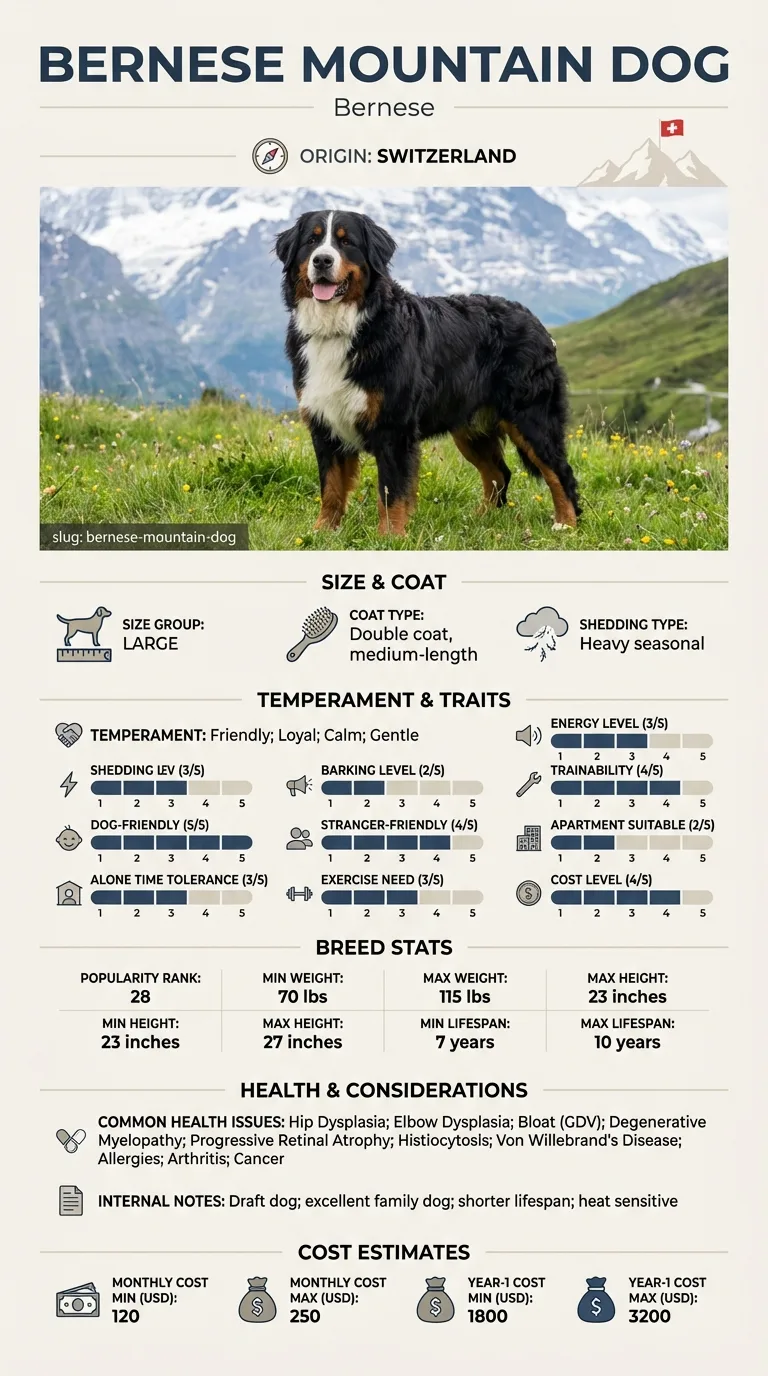
Ear carriage and coat are the relevant traits. A Bernese has hanging ears well covered with hair, which lie over the canal opening and hold warmth and humidity against it. The breed's documented allergy tendency provides the inflammation that starts the process, and its dense double coat slows drying after any wetting. None of that is preventable, which is why routine matters more than blame.
Swimming, wet country walks and humid weather all raise moisture in the canal. Grass seeds and plant awns picked up on rural walks are a specific mechanical cause and produce sudden, intense, one-sided discomfort. Household cleaning habits matter too, since over-enthusiastic weekly cleaning of a healthy ear can create the very irritation it is meant to prevent.
Contact your vet the same day for a head tilt, wobbling, rapid flicking eye movements, sudden deafness, or an ear so painful that your dog cries or will not let you near it, since these suggest the middle or inner ear is affected and some ear products are unsafe if the eardrum is damaged. Sudden violent head shaking with one-sided distress after a walk in long grass suggests a grass seed and needs same-day attention too. Book promptly for smell, discharge, redness or repeated scratching, and ask specifically for cytology if this is not the first infection this year.
This is a condition where owner technique is a substantial part of whether treatment works.
Start here: Bernese Mountain Dog Most Common Genetic Disorders
See all Bernese Mountain DOG health problems, which breeds are prone to ear infections, or the full Bernese Mountain DOG breed guide for temperament, exercise needs and ownership costs.
A straightforward infection resolves in one to three weeks with correct medication and technique, confirmed by a recheck. Recurrent cases need the underlying cause addressed, which takes months rather than weeks.
An ear that smells of nothing, a dog that offers its head for a check, and a year with no more than one flare.
Cytology means taking a swab, rolling it on a slide and looking at it under a microscope. It takes a few minutes and it tells your vet which organism is involved: budding yeast, round bacteria, or rod-shaped bacteria, which are the ones that most often signal a resistant, harder-to-treat infection. Those three findings lead to three different products. Treating repeatedly without cytology is how an ear ends up on its fourth course of the wrong thing, and it is the single most valuable test in ear medicine.
The cleaning technique matters just as much. Fill the canal generously with the solution your vet has supplied, then hold the base of the ear closed and massage firmly at the bottom for twenty to thirty seconds. You should hear a squelch, which means the fluid has reached the horizontal section. Only then let the dog shake, which brings loosened debris up the canal. Wipe away what appears on the visible part with cotton wool, never a bud, and never push anything down into the canal. On a Bernese this is a two-handed job on a heavy head, so it is worth doing while the dog is lying down.
The drop ears of this breed matter here. A hanging ear leaf covered in hair holds warmth and moisture over the opening, which is a good environment for organisms and a poor one for drying. That is anatomy, not neglect, and it means drying after swimming and after wet walks is a specific task rather than an afterthought.
One warning sign changes everything. A head tilt, loss of balance, rapid eye flicking or new deafness suggests the disease has reached the middle or inner ear. Stop cleaning and telephone your vet the same day.

Bruno had been treated three times in a year and his owner Aiden was convinced the drops were useless. At the fourth visit the nurse asked him to demonstrate how he cleaned the ear. He tipped in a little solution, wiped the inside of the ear leaf with cotton wool, and stopped. She showed him the difference: fill generously, hold the base closed, massage firmly until you hear the squelch, then let him shake. Cytology that day identified yeast, and Bruno was given the appropriate product with the corrected technique. The ear cleared in twelve days and has flared once in the two years since.
Key takeaway: The medication had never reached the infection. Ear treatment fails on technique far more often than it fails on the prescription.
For a healthy ear, only as often as needed, which for many dogs is every few weeks or after swimming. Over-cleaning irritates the canal lining and can cause problems of its own. During treatment, follow the specific schedule your vet gives you.
Because yeast, cocci bacteria and rod bacteria all look and smell broadly similar to an owner but need different medications. Cytology takes minutes and directs treatment precisely, which is why repeat infections should always prompt it rather than another empirical course.
Less than people think. A sweet or musty odour is often associated with yeast and a sharper, more offensive one with bacteria, but these impressions are unreliable. Smell is a useful prompt to book an appointment, not a basis for choosing treatment.
Water entering a drop-eared canal contributes, but it is rarely the whole story. Recurrent infections in a dog with no obvious water exposure usually have an underlying driver such as allergic skin disease. If your Berner swims, dry the ears thoroughly afterwards regardless.
Long-standing inflammation thickens and eventually calcifies the canal, which narrows it permanently and makes medication unable to reach where it is needed. That is an end-stage change and sometimes requires surgery, which is a strong argument for treating recurrent infections properly early.
Yes, treat it as urgent. Head tilt, stumbling, flicking eye movements or sudden deafness suggest the middle or inner ear is involved. Do not put anything further into the ear and contact your vet the same day, because some products are unsafe if the eardrum is damaged.
Fill the canal with solution, hold the ear closed and massage the base for twenty to thirty seconds until you hear a squelch, then let the dog shake and wipe only what is visible.
Head tilt, loss of balance, flicking eyes, sudden deafness, or an ear too painful to touch. Stop cleaning and phone your vet the same day.
No. Different organisms need different medication, and using the wrong product encourages resistance. Every new infection deserves a fresh assessment.
Yes, and cytology at each episode is a small cost that prevents larger ones. End-stage canal disease can require surgery, which is far more expensive.
Teach a chin rest and pair every ear touch with a reward, starting when the ears are healthy. A hundred-pound dog that objects cannot be treated properly.
A one-page prep sheet for this condition: the signs, the questions to ask, what to get priced. Unlocks here.
You get: Vet visit prep sheet
No spam. One-click unsubscribe. See our privacy policy.
Preview page 1 before you decide.