Living
Bigger dog?
Great Dane, by a huge margin - giant class versus small class.

Quick answer
Bigger dog?
Great Dane, by a huge margin - giant class versus small class.
Cavalier King Charles Spaniel or Great Dane? On paper they differ most on apartment suitability, and on the scales Great Dane is the heavier at 110–175 lbs. Here is how the two compare on everything that shapes an ordinary week.
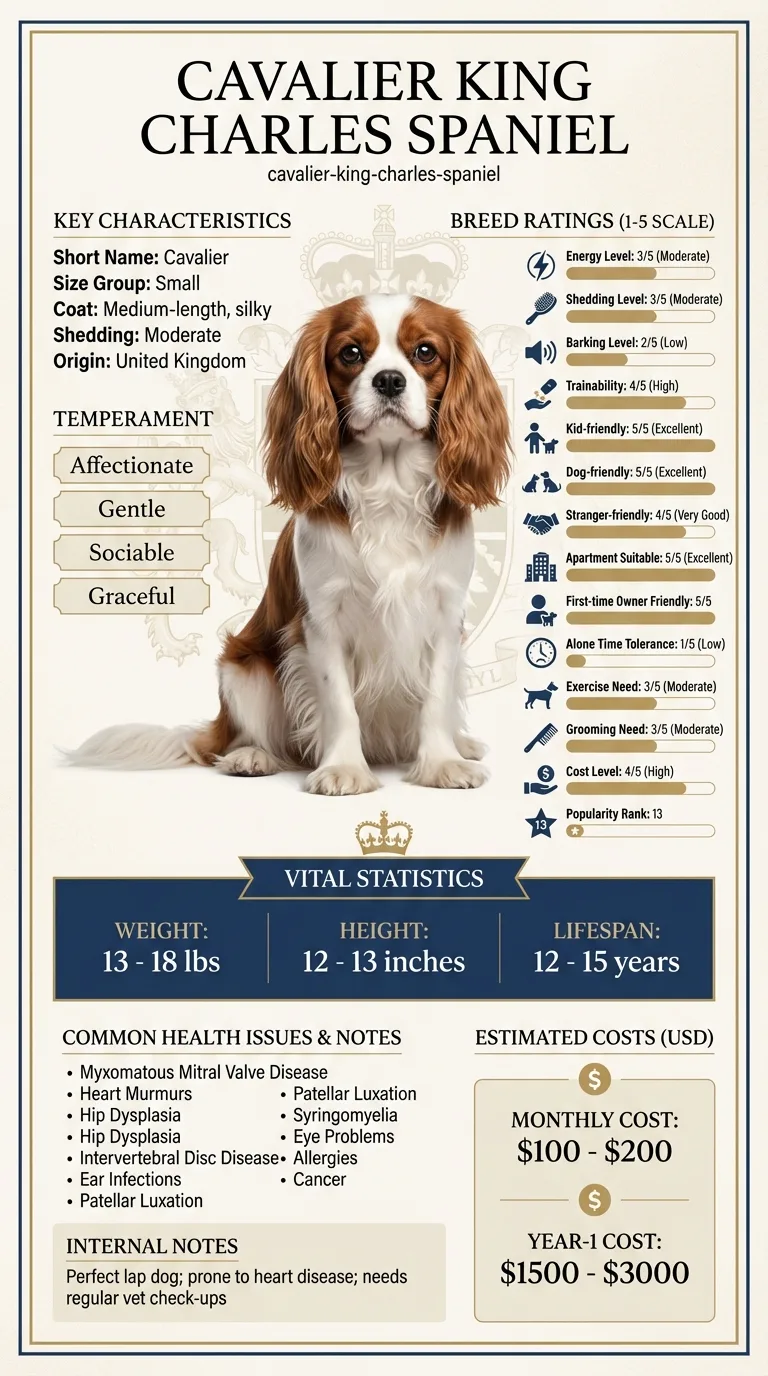
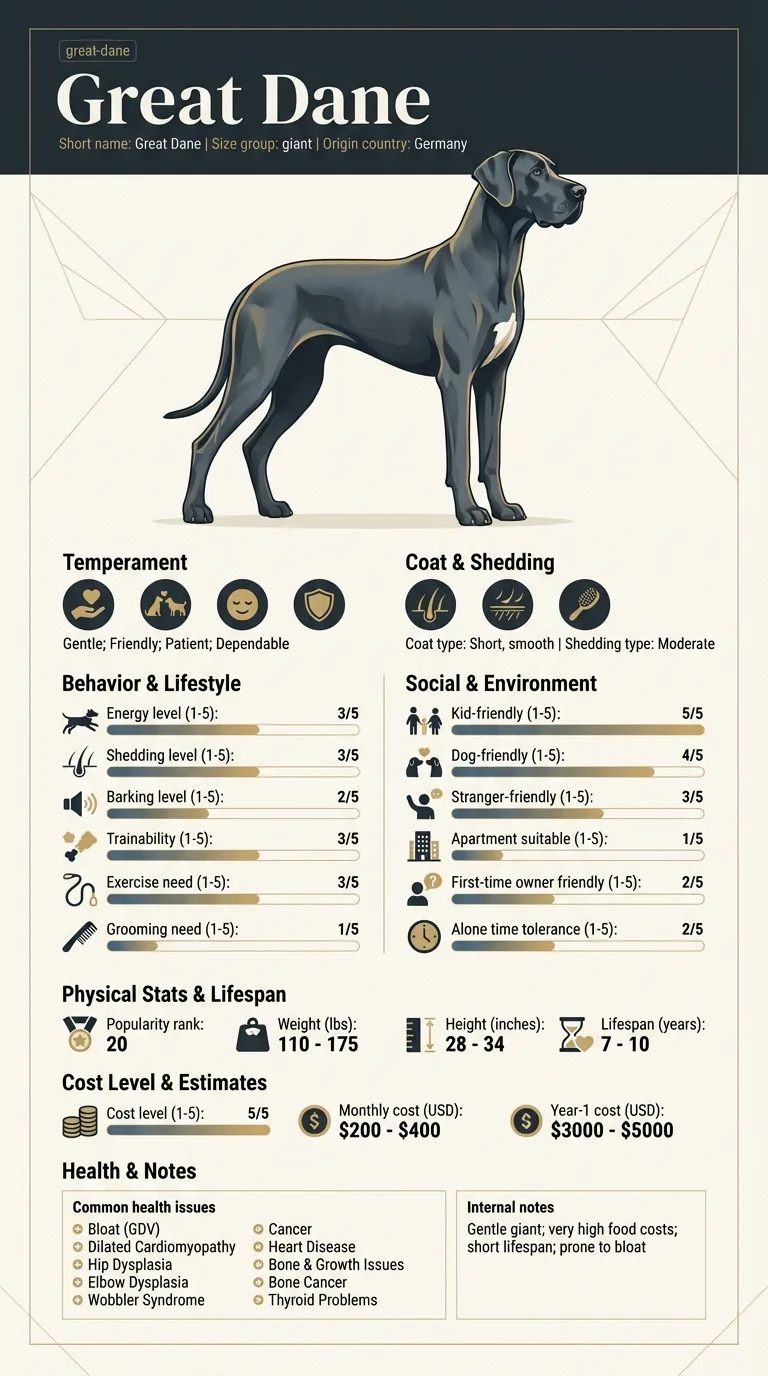
This is for someone already down to Cavalier King Charles Spaniel and Great Dane and deciding between them. For this pair the decision usually turns on apartment suitability and good for first-time owners, so those are covered first and in most detail. Anyone choosing from a flat has a clear answer here: Cavalier King Charles Spaniel rates 5/5 against 1/5. It is written for the decision rather than the breed history.
Between Cavalier King Charles Spaniel and Great Dane, apartment suitability is what separates them, and Cavalier King Charles Spaniel is the lower-effort dog of the two to keep.
Choose Cavalier King Charles Spaniel if you are in a flat or a smaller home, this is your first dog and you already have another dog.
Choose Great Dane if you do not want a standing grooming appointment and you want a dog that is more watchful with visitors.
| Feature | cavalier king charles spaniel | great dane | Winner |
|---|---|---|---|
| Size class | small | giant | Equal |
| Weight | 13–18 lbs | 110–175 lbs | Equal |
| Height | 12–13 in | 28–34 in | Equal |
| Lifespan | 12–15 years | 7–10 years | cavalier king charles spaniel |
| Exercise need | Moderate (3/5) | Moderate (3/5) | Equal |
| Grooming need | Moderate (3/5) | Very low (1/5) | great dane |
| Shedding | Moderate (3/5) | Moderate (3/5) | Equal |
| Energy level | Moderate (3/5) | Moderate (3/5) | Equal |
| Barking | Low (2/5) | Low (2/5) | Equal |
| Apartment suitability | Very high (5/5) | Very low (1/5) | cavalier king charles spaniel |
| Good for first-time owners | Very high (5/5) | Low (2/5) | cavalier king charles spaniel |
| Tolerates being alone | Very low (1/5) | Low (2/5) | great dane |
| Trainability | High (4/5) | Moderate (3/5) | cavalier king charles spaniel |
| Good with kids | Very high (5/5) | Very high (5/5) | Equal |
| Good with other dogs | Very high (5/5) | High (4/5) | cavalier king charles spaniel |
| Friendly to strangers | High (4/5) | Moderate (3/5) | cavalier king charles spaniel |
| Cost level | High (4/5) | Very high (5/5) | cavalier king charles spaniel |
| Coat | Medium-length, silky | Short, smooth | Equal |
| Origin | United Kingdom | Germany | Equal |
| Typical monthly cost | $100–$200 | $200–$400 | Equal |
| Typical first-year cost | $1,500–$3,000 | $3,000–$5,000 | Equal |
Few match-ups on this site span a wider gulf than this one: a 13-18 lb Cavalier standing 12-13 inches at the shoulder next to a Great Dane that can reach 110-175 lbs and 28-34 inches. Both are officially classed at opposite ends of the size spectrum ("small" versus "giant"), and the difference shows up everywhere from furniture to car size. The Cavalier is built compact and portable; the Dane's sheer mass means even a gentle lean or a wagging tail can knock over a toddler or a coffee table. Anyone torn between the two should picture daily life with a 150 lb dog before falling for a puppy photo.
Surprisingly, both breeds land at Moderate (3/5) for exercise need and energy level, so raw numbers don't separate them the way you'd expect from their size. A Great Dane's exercise is more about controlled leash walks than fetch marathons, since its joints and growing frame are vulnerable to overexertion, while the Cavalier is happy with a couple of shorter walks and some living-room play. Neither breed demands the mileage of a working dog, but a Dane's bulk means every walk takes more planning around heat, hips, and how much space it needs to simply turn around indoors.
Grooming is one category where the giant breed actually wins: the Great Dane's short, smooth coat needs only occasional brushing and rates Very low (1/5) for grooming effort, while the Cavalier's medium-length, silky coat rates Moderate (3/5) and needs regular brushing to prevent mats around the ears and feathering. Shedding itself ties at Moderate (3/5) for both, so neither is a hypoallergenic pick, but the Dane's short coat means less fur clinging to fabric. Owners trade grooming time for drool management with the Dane, and trade drool for ear maintenance with the Cavalier.
Apartment suitability could not be more different: Very high (5/5) for the Cavalier versus Very low (1/5) for the Great Dane, and anyone who has tried to navigate a giant breed around a studio apartment's furniture understands why. Barking ties at Low (2/5) for both, so noise complaints from vocalizing are unlikely with either. Neither breed handles solitude well, though - the Cavalier rates Very low (1/5) on tolerating being alone and the Dane only slightly better at Low (2/5). Both are prone to separation-related distress, so a Dane in a small space left alone all day is a genuine welfare concern, not just a space problem.
The Cavalier rates Very high (5/5) for first-time owners and High (4/5) for trainability, making it a forgiving choice for someone new to dog ownership. The Great Dane scores just Low (2/5) for first-timers and Moderate (3/5) for trainability - not because it's willful, but because managing a dog that will outweigh most adults requires confident handling and early socialization before it reaches full size. A first-time owner who skips puppy training with a Dane can end up physically unable to control a 150 lb adult on leash, so the training investment upfront matters far more here than with the Cavalier.
Both breeds tie at Very high (5/5) for compatibility with kids, and gentle, patient, and dependable are words that show up for the Great Dane just as affectionate and gentle do for the Cavalier. Where they separate slightly is sociability beyond the household: the Cavalier edges ahead with other dogs (5/5 versus 4/5) and strangers (High versus Moderate), reflecting its consistently sociable, graceful temperament against the Dane's more reserved, watchful side. In practice a Dane's calm patience with children is real, but supervision matters simply because of size and weight, while a Cavalier's smaller frame makes rough toddler play less risky.
Lifespan is the starkest number on this page: 12-15 years for the Cavalier against just 7-10 for the Great Dane, a gap typical of giant breeds. The Cavalier's health risks center on the heart and spine - Myxomatous Mitral Valve Disease, heart murmurs, and syringomyelia are the conditions prospective owners research most. The Dane's risk list reads differently: Bloat (GDV), Dilated Cardiomyopathy, Wobbler Syndrome, and Bone Cancer are all serious, size-driven conditions that require owners to know bloat symptoms and consider a prophylactic gastropexy. Both breeds share hip dysplasia and cancer risk, but the underlying causes and monitoring needs diverge sharply.
Cost level rates High (4/5) for the Cavalier and Very high (5/5) for the Great Dane, and the monthly numbers back that up: $100-200 for the Cavalier against $200-400 for the Dane, largely driven by food volume alone for an animal that can weigh as much as an adult human. First-year costs follow the same pattern, $1,500-3,000 versus $3,000-5,000, before factoring in giant-breed-sized crates, beds, and vet visits that often require larger equipment and higher-dose medications. A Dane owner should budget for a food bill that can rival a second grocery run each month.
Cavalier King Charles Spaniel weighs 13–18 lbs and lives 12–15 years; Great Dane weighs 110–175 lbs and lives 7–10 years. The two diverge most on apartment suitability, good for first-time owners and grooming need. They are level on barking, energy level and exercise need, so those cannot decide it. In the table, a "winner" means easier for an ordinary household — not better. Size, coat and origin are recorded without a verdict. Because both breeds are scored the same way, the gaps are reliable even where the absolute numbers are rough.

The Cavalier, rated Very high (5/5) for first-time owners against the Great Dane's Low (2/5). The Dane's sheer size means training and handling mistakes are much harder to recover from as the dog reaches its full 110-175 lb weight.
Not comfortably - it rates Very low (1/5) for apartment suitability against the Cavalier's Very high (5/5). A dog that size needs real floor space just to turn around and lie down.
Yes, considerably. Great Danes typically live 7-10 years compared to 12-15 years for a Cavalier, a common pattern among giant breeds.
Shedding ties at Moderate (3/5) for both, but the Dane's short coat means less fur clings to fabric even though the volume is similar.
Both tie at Very high (5/5) for compatibility with kids. The Dane is gentle and patient, but its size still means adult supervision matters more than with the smaller Cavalier.
Roughly double - $200-400 a month against $100-200 for the Cavalier, driven mostly by the sheer volume of food a giant breed needs.
Neither tolerates it well. The Dane rates Low (2/5) and the Cavalier Very low (1/5), so both need company or a plan for the workday.
Great Dane, by a huge margin - giant class versus small class.
Cavalier, High (4/5) against the Dane's Moderate (3/5).
Cavalier, on both monthly and first-year cost.
Cavalier, 12-15 years against 7-10 for the Great Dane.
Secure checkout on Stripe. We never see your card.
7-day money-back guarantee. Instant access.
Health information here is general and is not veterinary advice. If your dog shows pain, sudden behaviour change, or worsening symptoms, consult a licensed veterinarian.
Some links on this site are affiliate links. We may earn a commission at no extra cost to you, and we only suggest products we believe are helpful for dog owners.
We research and check what we publish, but we do not warrant that any figure, date, price, or statement is accurate, complete, or current, and we accept no liability for any loss, cost, injury, or other harm arising from the use of this site. Use it as one reference among several. You remain responsible for your own decisions and for your dog's care - confirm anything that matters with a licensed veterinarian or another qualified professional before you act on it. Full disclaimer.
Match your lifestyle to the right dog.
Take quizNot sure which breed is right for you? Take our 2-minute quiz to find out.
Take the quiz