Living
Quieter breed?
Cavalier King Charles Spaniel.

Quick answer
Quieter breed?
Cavalier King Charles Spaniel.
Cavalier King Charles Spaniel or Jack Russell Terrier? On paper they differ most on apartment suitability, and on the scales Cavalier King Charles Spaniel is the heavier at 13–18 lbs. Here is how the two compare on everything that shapes an ordinary week.
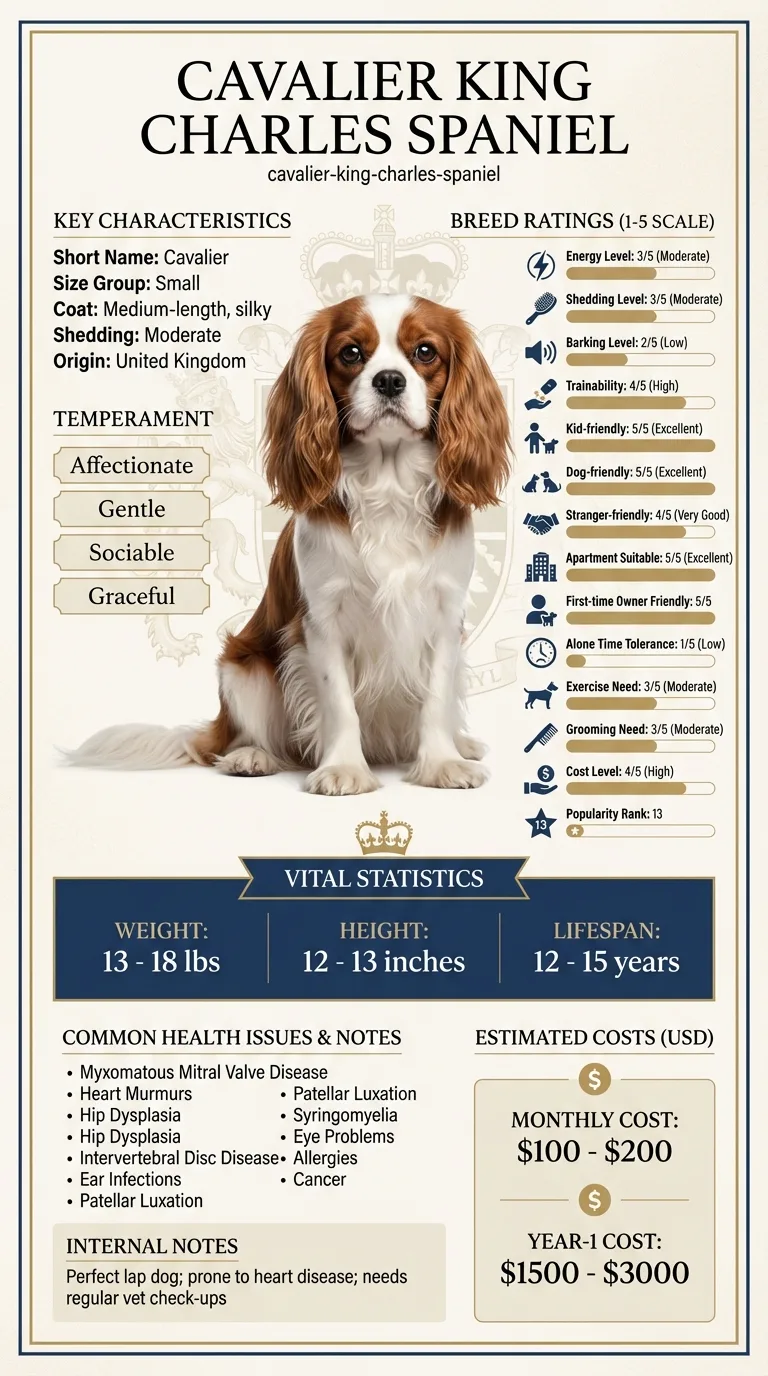
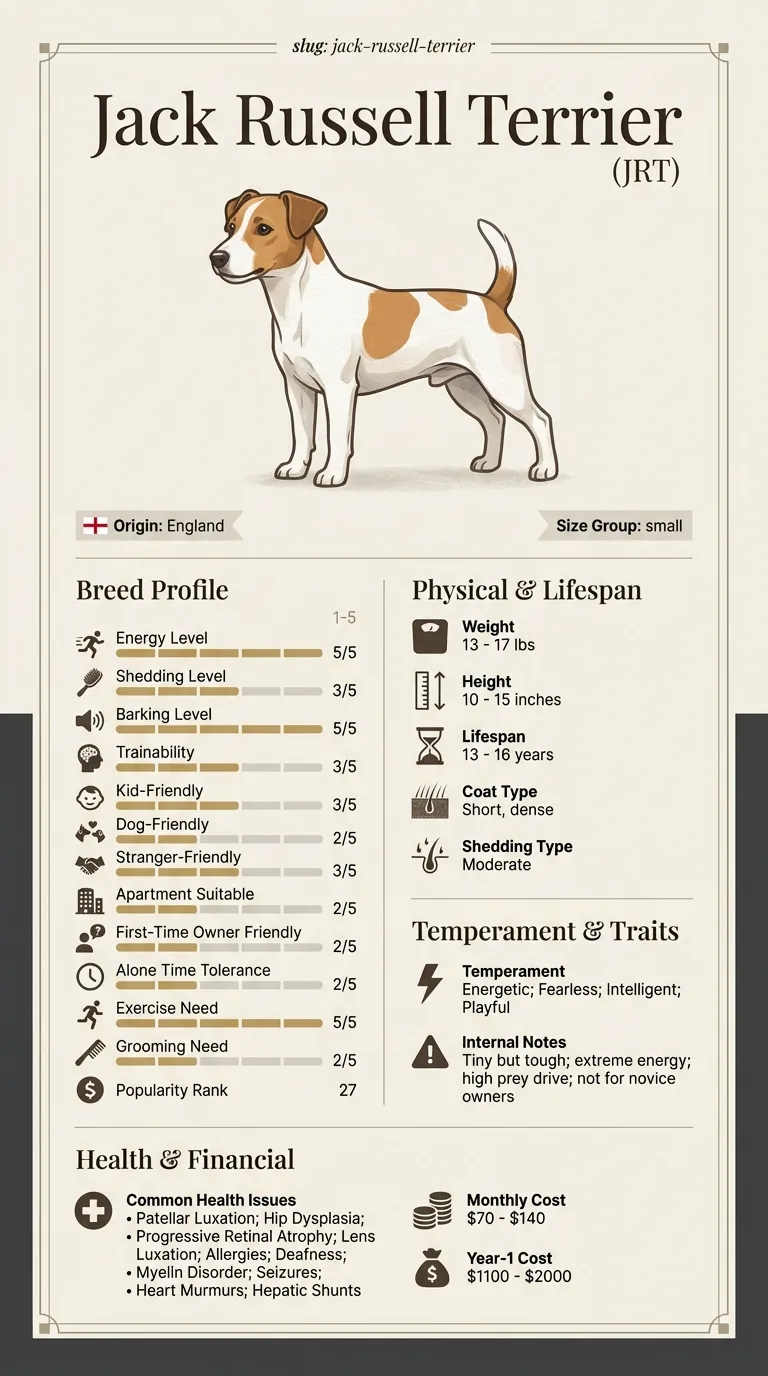
This is for someone already down to Cavalier King Charles Spaniel and Jack Russell Terrier and deciding between them. For this pair the decision usually turns on apartment suitability and good for first-time owners, so those are covered first and in most detail. Anyone choosing from a flat has a clear answer here: Cavalier King Charles Spaniel rates 5/5 against 2/5. Breed history is left out; what follows is what you will actually live with.
Between Cavalier King Charles Spaniel and Jack Russell Terrier, apartment suitability is what separates them, and Cavalier King Charles Spaniel is the lower-effort dog of the two to keep.
Choose Cavalier King Charles Spaniel if you are in a flat or a smaller home, this is your first dog and your walking routine is modest.
Choose Jack Russell Terrier if you do not want a standing grooming appointment, a smaller dog suits your car, your home or your back and you want a dog that can keep up with an active routine.
| Feature | cavalier king charles spaniel | jack russell terrier | Winner |
|---|---|---|---|
| Size class | small | small | Equal |
| Weight | 13–18 lbs | 13–17 lbs | Equal |
| Height | 12–13 in | 10–15 in | Equal |
| Lifespan | 12–15 years | 13–16 years | jack russell terrier |
| Exercise need | Moderate (3/5) | Very high (5/5) | cavalier king charles spaniel |
| Grooming need | Moderate (3/5) | Low (2/5) | jack russell terrier |
| Shedding | Moderate (3/5) | Moderate (3/5) | Equal |
| Energy level | Moderate (3/5) | Very high (5/5) | Equal |
| Barking | Low (2/5) | Very high (5/5) | cavalier king charles spaniel |
| Apartment suitability | Very high (5/5) | Low (2/5) | cavalier king charles spaniel |
| Good for first-time owners | Very high (5/5) | Low (2/5) | cavalier king charles spaniel |
| Tolerates being alone | Very low (1/5) | Low (2/5) | jack russell terrier |
| Trainability | High (4/5) | Moderate (3/5) | cavalier king charles spaniel |
| Good with kids | Very high (5/5) | Moderate (3/5) | cavalier king charles spaniel |
| Good with other dogs | Very high (5/5) | Low (2/5) | cavalier king charles spaniel |
| Friendly to strangers | High (4/5) | Moderate (3/5) | cavalier king charles spaniel |
| Cost level | High (4/5) | Low (2/5) | jack russell terrier |
| Coat | Medium-length, silky | Short, dense | Equal |
| Origin | United Kingdom | England | Equal |
| Typical monthly cost | $100–$200 | $70–$140 | Equal |
| Typical first-year cost | $1,500–$3,000 | $1,100–$2,000 | Equal |
Weight-wise these two breeds are nearly interchangeable on paper - 13-18 lbs for the Cavalier and 13-17 lbs for the Jack Russell Terrier - but the Jack Russell's shorter 10-15 inch frame and compact, dense build make it feel like a different kind of dog entirely once it's moving. Where the Cavalier's medium-length silky coat and graceful gait read as a lap dog, the Jack Russell was bred to go to ground after quarry, and its athletic body reflects that working history even though the two sit within a few inches and pounds of each other.
The exercise gap is the real story here: Moderate (3/5) for the Cavalier against Very high (5/5) for the Jack Russell Terrier, a rating that undersells just how much a bored JRT can dismantle a house. Energetic, fearless, and playful are the words used to describe the terrier's temperament, and all three show up in its need for real off-leash running, not just a stroll. The Cavalier's moderate energy is satisfied with a couple of daily walks and some fetch, while a Jack Russell that doesn't get sustained physical and mental work tends to invent its own entertainment, usually destructively.
Grooming favors the terrier slightly, Low (2/5) against the Cavalier's Moderate (3/5), since the Jack Russell's short, dense coat needs little more than an occasional brush while the Cavalier's silky feathering around the ears and legs mats if neglected. Shedding ties at Moderate (3/5) for both, so allergy sufferers won't find relief with either breed. The practical difference shows up in time spent, not fur volume: a Cavalier needs a weekly brushing session and periodic ear checks, while a Jack Russell's coat care is closer to a quick wipe-down after a muddy dig session in the yard.
Barking separates these two sharply - Low (2/5) for the Cavalier versus Very high (5/5) for the Jack Russell Terrier, a difference that matters enormously for apartment living and thin-walled housing. Apartment suitability follows the same pattern, Very high (5/5) against Low (2/5), since a JRT's terrier instincts mean it will bark at every hallway noise and squirrel outside the window. Neither breed handles solitude gracefully - Very low (1/5) for the Cavalier and Low (2/5) for the terrier - so both are poor fits for owners who need to leave a dog alone for full workdays without a plan.
Cavaliers rate Very high (5/5) for first-time owners and High (4/5) for trainability, a combination that makes them a common recommendation for new dog owners. Jack Russells score Low (2/5) for first-timers and Moderate (3/5) for trainability, and the gap is really about temperament, not intelligence - this is a genuinely intelligent, fearless breed that will out-stubborn an inexperienced handler if training isn't consistent from puppyhood. Owners who've handled a strong-willed terrier before tend to do fine with a Jack Russell; owners hoping for a biddable first dog usually have an easier road with the Cavalier.
Good with kids favors the Cavalier at Very high (5/5) against the Jack Russell's Moderate (3/5), and the pattern repeats with other dogs - Very high (5/5) versus Low (2/5) - since a JRT's prey drive and fearless nature can translate into scrappiness with unfamiliar dogs or small pets. Friendly to strangers also tilts toward the Cavalier, High (4/5) against Moderate (3/5). None of this makes the Jack Russell a bad family dog, but its energetic, playful nature works better with older kids who can keep up and in homes without small caged pets that could trigger its prey drive.
The Jack Russell actually edges out the Cavalier on raw lifespan, 13-16 years against 12-15, and its health list looks different in kind: Progressive Retinal Atrophy, Lens Luxation, Deafness, and Hepatic Shunts are the conditions terrier breeders and vets watch most closely, alongside patellar luxation shared with the Cavalier. The Cavalier's list is dominated by heart and neurological conditions instead - Myxomatous Mitral Valve Disease, heart murmurs, and syringomyelia - which tend to be progressive and require lifelong cardiac monitoring. Both breeds share allergy risk, but a Jack Russell buyer should ask specifically about eye and hearing tests on the parents.
Cost level rates High (4/5) for the Cavalier and just Low (2/5) for the Jack Russell Terrier, and the monthly figures show why: $100-200 versus $70-140. First-year costs follow suit at $1,500-3,000 for the Cavalier against $1,100-2,000 for the terrier. Some of that gap reflects the Cavalier's grooming needs and its greater predisposition toward cardiac screening and ongoing veterinary monitoring, while a generally hardier Jack Russell often needs less specialized care. Neither number accounts for the JRT's knack for finding trouble, though, which can turn into unplanned vet bills of its own.
Cavalier King Charles Spaniel weighs 13–18 lbs and lives 12–15 years; Jack Russell Terrier weighs 13–17 lbs and lives 13–16 years. The two diverge most on apartment suitability, good for first-time owners and barking and 5 other rated axes. Almost every rated axis separates them at least slightly. The comparison marks an easier option only where one exists. Facts like weight and country of origin are not scored. Both dogs are rated from the same dataset, which is what makes the numbers comparable with each other even though any individual dog sits somewhere inside its breed's range.

The Jack Russell by a wide margin - it rates Very high (5/5) for barking against the Cavalier's Low (2/5), owing to its alert terrier instincts.
For most apartment dwellers, yes. It rates Low (2/5) for apartment suitability against the Cavalier's Very high (5/5), driven mainly by its Very high (5/5) exercise need and barking.
The Cavalier, rated Very high (5/5) against the Jack Russell's Low (2/5); the terrier's prey drive can make it scrappy with unfamiliar dogs.
Slightly, yes - typically 13-16 years compared to 12-15 years for the Cavalier.
The Cavalier, rated Very high (5/5) for first-timers against the Jack Russell's Low (2/5) due to its stronger will and higher exercise demands.
Yes - cost level rates Low (2/5) against the Cavalier's High (4/5), with monthly costs of $70-140 versus $100-200.
The Jack Russell Terrier, rated Very high (5/5) against the Cavalier's Moderate (3/5).
Cavalier King Charles Spaniel.
Jack Russell Terrier.
Jack Russell Terrier.
Cavalier King Charles Spaniel.
Secure checkout on Stripe. We never see your card.
7-day money-back guarantee. Instant access.


Health information here is general and is not veterinary advice. If your dog shows pain, sudden behaviour change, or worsening symptoms, consult a licensed veterinarian.
Some links on this site are affiliate links. We may earn a commission at no extra cost to you, and we only suggest products we believe are helpful for dog owners.
We research and check what we publish, but we do not warrant that any figure, date, price, or statement is accurate, complete, or current, and we accept no liability for any loss, cost, injury, or other harm arising from the use of this site. Use it as one reference among several. You remain responsible for your own decisions and for your dog's care - confirm anything that matters with a licensed veterinarian or another qualified professional before you act on it. Full disclaimer.
Match your lifestyle to the right dog.
Take quizNot sure which breed is right for you? Take our 2-minute quiz to find out.
Take the quiz