Living
Which is bigger?
The English Cocker Spaniel, at 26-34 lbs versus the Cavalier's 13-18 lbs.

Quick answer
Which is bigger?
The English Cocker Spaniel, at 26-34 lbs versus the Cavalier's 13-18 lbs.
Cavalier King Charles Spaniel or English Cocker Spaniel? On paper they differ most on exercise need, and on the scales English Cocker Spaniel is the heavier at 26–34 lbs. Here is how the two compare on everything that shapes an ordinary week.
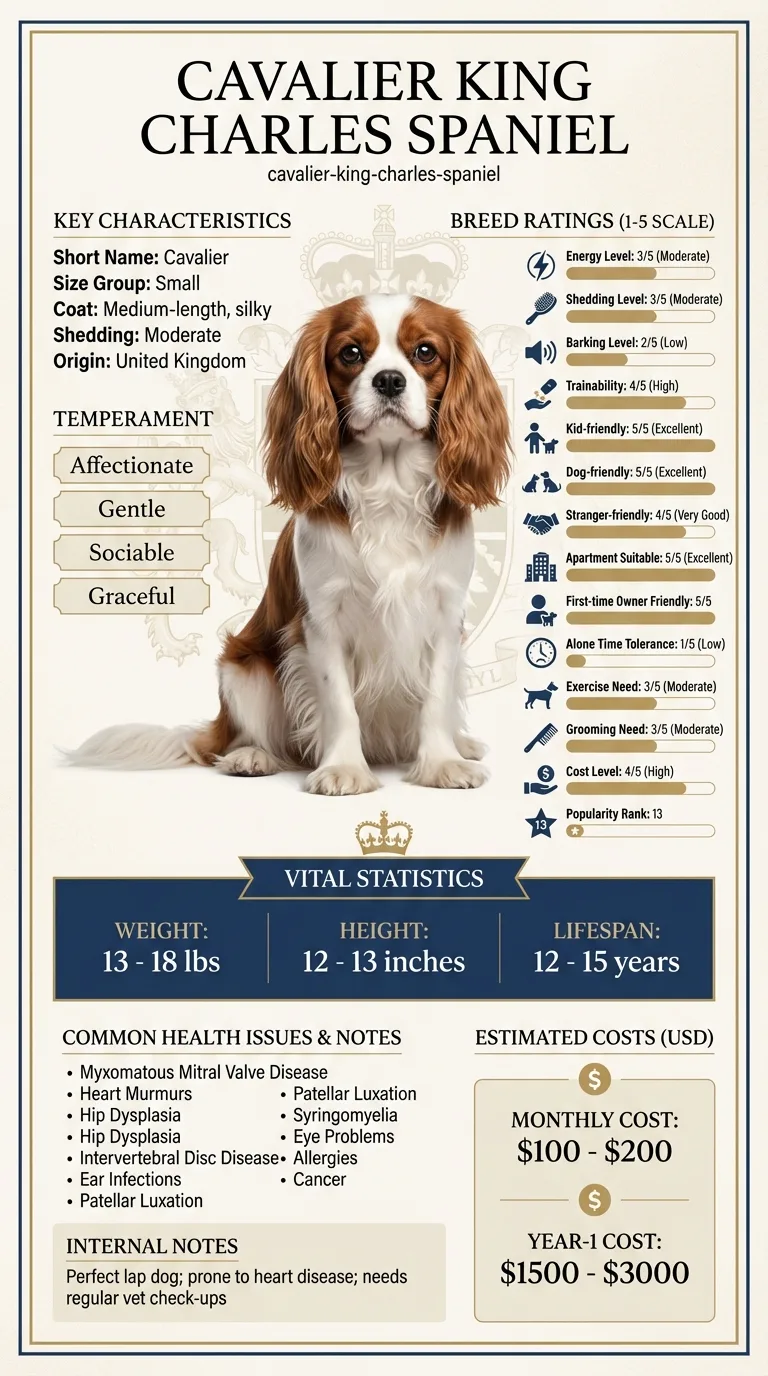
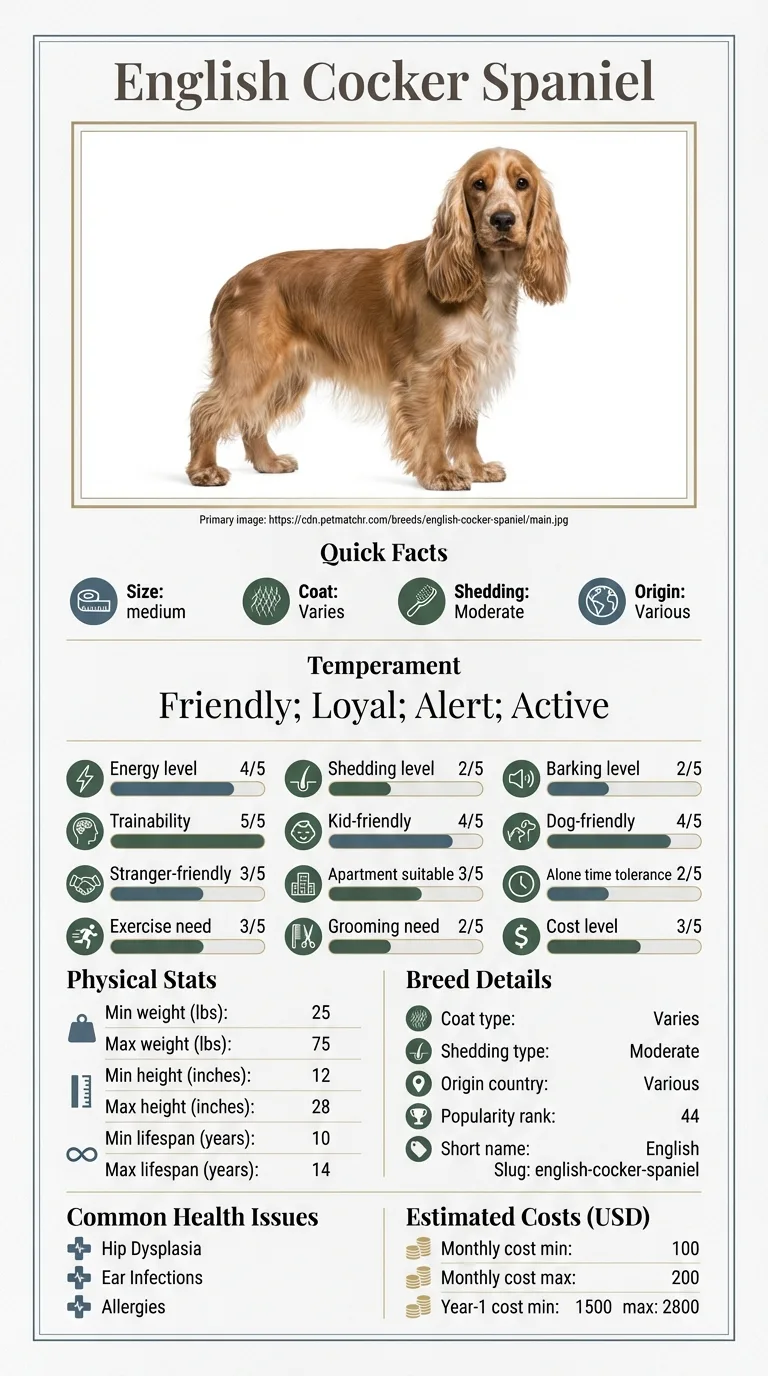
This is for someone already down to Cavalier King Charles Spaniel and English Cocker Spaniel and deciding between them. Because the two are so evenly matched, the page works through every axis rather than leading with one. Anyone choosing from a flat has a clear answer here: Cavalier King Charles Spaniel rates 5/5 against 4/5. The focus throughout is on daily consequences rather than breed background.
Between Cavalier King Charles Spaniel and English Cocker Spaniel, they are closer than most pairings, and the choice comes down to temperament, and Cavalier King Charles Spaniel is the lower-effort dog of the two to keep.
Choose Cavalier King Charles Spaniel if you are in a flat or a smaller home, this is your first dog and you do not want a standing grooming appointment.
Choose English Cocker Spaniel if you want a dog that can keep up with an active routine.
| Feature | cavalier king charles spaniel | english cocker spaniel | Winner |
|---|---|---|---|
| Size class | small | medium | Equal |
| Weight | 13–18 lbs | 26–34 lbs | Equal |
| Height | 12–13 in | 15–17 in | Equal |
| Lifespan | 12–15 years | 12–14 years | cavalier king charles spaniel |
| Exercise need | Moderate (3/5) | High (4/5) | cavalier king charles spaniel |
| Grooming need | Moderate (3/5) | High (4/5) | cavalier king charles spaniel |
| Shedding | Moderate (3/5) | Moderate (3/5) | Equal |
| Energy level | Moderate (3/5) | High (4/5) | Equal |
| Barking | Low (2/5) | Moderate (3/5) | cavalier king charles spaniel |
| Apartment suitability | Very high (5/5) | High (4/5) | cavalier king charles spaniel |
| Good for first-time owners | Very high (5/5) | High (4/5) | cavalier king charles spaniel |
| Tolerates being alone | Very low (1/5) | Low (2/5) | english cocker spaniel |
| Trainability | High (4/5) | High (4/5) | Equal |
| Good with kids | Very high (5/5) | Very high (5/5) | Equal |
| Good with other dogs | Very high (5/5) | High (4/5) | cavalier king charles spaniel |
| Friendly to strangers | High (4/5) | High (4/5) | Equal |
| Cost level | High (4/5) | Moderate (3/5) | english cocker spaniel |
| Coat | Medium-length, silky | Medium, silky and feathered | Equal |
| Origin | United Kingdom | Various | Equal |
| Typical monthly cost | $100–$200 | $100–$200 | Equal |
| Typical first-year cost | $1,500–$3,000 | $1,400–$2,900 | Equal |
An English Cocker Spaniel outweighs a Cavalier by up to 16 pounds at the top of each range -- 26 to 34 pounds against 13 to 18 -- and stands two to four inches taller at 15-17 inches, classing it as medium where the Cavalier stays small. Both wear medium-length, silky, feathered coats that look similar in photos, but the English Cocker's larger, more athletic sporting-dog build sets it apart in person, closer to a working gundog than a toy companion. A household deciding between them purely on small-dog expectations should note the English Cocker will need a bigger crate, bigger bed, and bigger food budget than the Cavalier from day one.
Exercise need runs High (4/5) for the English Cocker against Moderate (3/5) for the Cavalier, and energy level shows the same gap. This tracks with the breed's working gundog background -- English Cockers were bred to flush and retrieve game over full days in the field, and that drive shows up even in pet lines as a need for real daily exercise, not just a walk around the block. The Cavalier's moderate energy suits a more relaxed routine. A family that already runs, hikes, or plays fetch daily will find the English Cocker a willing partner; a Cavalier in the same household may simply nap through the extra activity.
Grooming need rates High (4/5) for the English Cocker against Moderate (3/5) for the Cavalier, though both share the same Moderate (3/5) shedding score. The English Cocker's feathering along the ears, chest, legs, and belly needs frequent brushing and regular trimming to stay free of mats and field debris, a legacy of its working background. The Cavalier's shorter feathering is comparatively easy to keep tidy with less frequent attention. Both breeds' floppy ears warrant regular checking -- Ear Infections appear on both of their health lists -- so ear care is one grooming task neither owner gets to skip regardless of which breed they choose.
The Cavalier edges ahead for apartment living, Very high (5/5) against the English Cocker's High (4/5), and barking runs Low (2/5) for the Cavalier versus Moderate (3/5) for the Cocker. Both breeds share a real weakness for solo time -- the Cavalier at Very low (1/5) tolerance for being alone, the English Cocker only slightly better at Low (2/5) -- so neither is a good match for an owner gone ten hours a day without a plan for company or enrichment. Given the English Cocker's higher exercise need on top of low alone-tolerance, an apartment dweller choosing this breed should have a firm daily exercise routine locked in before bringing one home.
Trainability ties at High (4/5), and both breeds score High (4/5) or better for first-time owners -- the Cavalier at Very high (5/5), the English Cocker at High (4/5). The English Cocker's biddable, merry temperament reflects a breed literally selected for working alongside a handler, which tends to make obedience and field-style training feel natural rather than forced. The Cavalier's gentle, affectionate nature responds especially well to praise-heavy, low-pressure sessions. Both are reasonable choices for someone new to dog ownership, though the English Cocker's higher energy means training sessions may need to double as a partial outlet for exercise.
Both breeds rate Very high (5/5) with kids, and both tie High (4/5) for friendliness to strangers. The Cavalier edges ahead with other dogs, Very high (5/5) against the English Cocker's High (4/5), a small but real gap for households already anchored by another dog. The English Cocker's merry, energetic temperament tends to show up as enthusiastic, sometimes boisterous greetings, which is usually well tolerated by older kids and confident visitors but worth managing around toddlers or nervous guests. The Cavalier's gentler energy generally reads as calmer in the same situations, though neither breed shows any real red flag in this category.
Lifespan is close -- 12-15 years for the Cavalier against 12-14 for the English Cocker -- but the health lists diverge in focus. The Cavalier's ten conditions lean cardiac and neurological, led by Myxomatous Mitral Valve Disease and Syringomyelia, while the English Cocker's shorter five-item list includes two conditions the Cavalier's doesn't: Familial Nephropathy, a kidney disease, and Adult-Onset Neuropathy, a nerve disorder specific to the breed. Both share Hip Dysplasia, Ear Infections, and Progressive Retinal Atrophy. A Cavalier's owner should plan on periodic cardiac screening; an English Cocker's owner should ask breeders about kidney-function testing given the nephropathy risk specific to the line.
Cost level favors the English Cocker slightly, Moderate (3/5) against the Cavalier's High (4/5), and the monthly ranges nearly match at $100-200 for both, while first-year costs run $1,400-2,900 for the English Cocker against $1,500-3,000 for the Cavalier. The real budget difference likely shows up over the dog's lifetime rather than in the first year -- the English Cocker's High (4/5) grooming need and higher exercise demands can mean more time and money spent on coat care and activity gear, while the Cavalier's cardiac-heavy health list can translate into earlier specialist visits. Neither breed is inexpensive, but both sit in a similar overall range.
Cavalier King Charles Spaniel weighs 13–18 lbs and lives 12–15 years; English Cocker Spaniel weighs 26–34 lbs and lives 12–14 years. No rated axis separates them by more than a single point, which makes this one of the closer pairings on the site. They are level on good with kids, shedding and friendly to strangers, so those cannot decide it. The table below marks a winner only where one breed is genuinely easier for a typical owner; size and origin are facts rather than merits and stay level. Ratings come from one source applied to both breeds, so they are meaningful against each other rather than as absolute scores.

Size and energy -- the English Cocker is larger (26-34 lbs) and rated High (4/5) for exercise need, against the Cavalier's 13-18 lbs and Moderate (3/5) exercise need.
The English Cocker, which carries Familial Nephropathy on its health list, a condition not shared by the Cavalier.
The English Cocker Spaniel, rated High (4/5) against the Cavalier's Moderate (3/5).
Yes, both rate Very high (5/5) with kids.
The English Cocker Spaniel, rated Moderate (3/5) cost level against the Cavalier's High (4/5), though monthly ranges are close.
Neither -- both rate Moderate (3/5) shedding.
The Cavalier, rated Very high (5/5) for first-time owners against the English Cocker's still-solid High (4/5).
The English Cocker Spaniel, at 26-34 lbs versus the Cavalier's 13-18 lbs.
The English Cocker Spaniel, rated High (4/5) against the Cavalier's Moderate (3/5).
The Cavalier, rated Low (2/5) against the English Cocker's Moderate (3/5).
Both tie at High (4/5) trainability.
Secure checkout on Stripe. We never see your card.
7-day money-back guarantee. Instant access.

Health information here is general and is not veterinary advice. If your dog shows pain, sudden behaviour change, or worsening symptoms, consult a licensed veterinarian.
Some links on this site are affiliate links. We may earn a commission at no extra cost to you, and we only suggest products we believe are helpful for dog owners.
We research and check what we publish, but we do not warrant that any figure, date, price, or statement is accurate, complete, or current, and we accept no liability for any loss, cost, injury, or other harm arising from the use of this site. Use it as one reference among several. You remain responsible for your own decisions and for your dog's care - confirm anything that matters with a licensed veterinarian or another qualified professional before you act on it. Full disclaimer.
Match your lifestyle to the right dog.
Take quizNot sure which breed is right for you? Take our 2-minute quiz to find out.
Take the quiz