Living
Cavalier or Labradoodle overall?
Depends on your exercise budget: the Cavalier fits a lower-key, apartment-friendly life, while the Labradoodle needs a genuinely active household to thrive.

Quick answer
Cavalier or Labradoodle overall?
Depends on your exercise budget: the Cavalier fits a lower-key, apartment-friendly life, while the Labradoodle needs a genuinely active household to thrive.
Cavalier King Charles Spaniel or Labradoodle? On paper they differ most on apartment suitability, and on the scales Labradoodle is the heavier at 15–65 lbs. Here is how the two compare on everything that shapes an ordinary week.
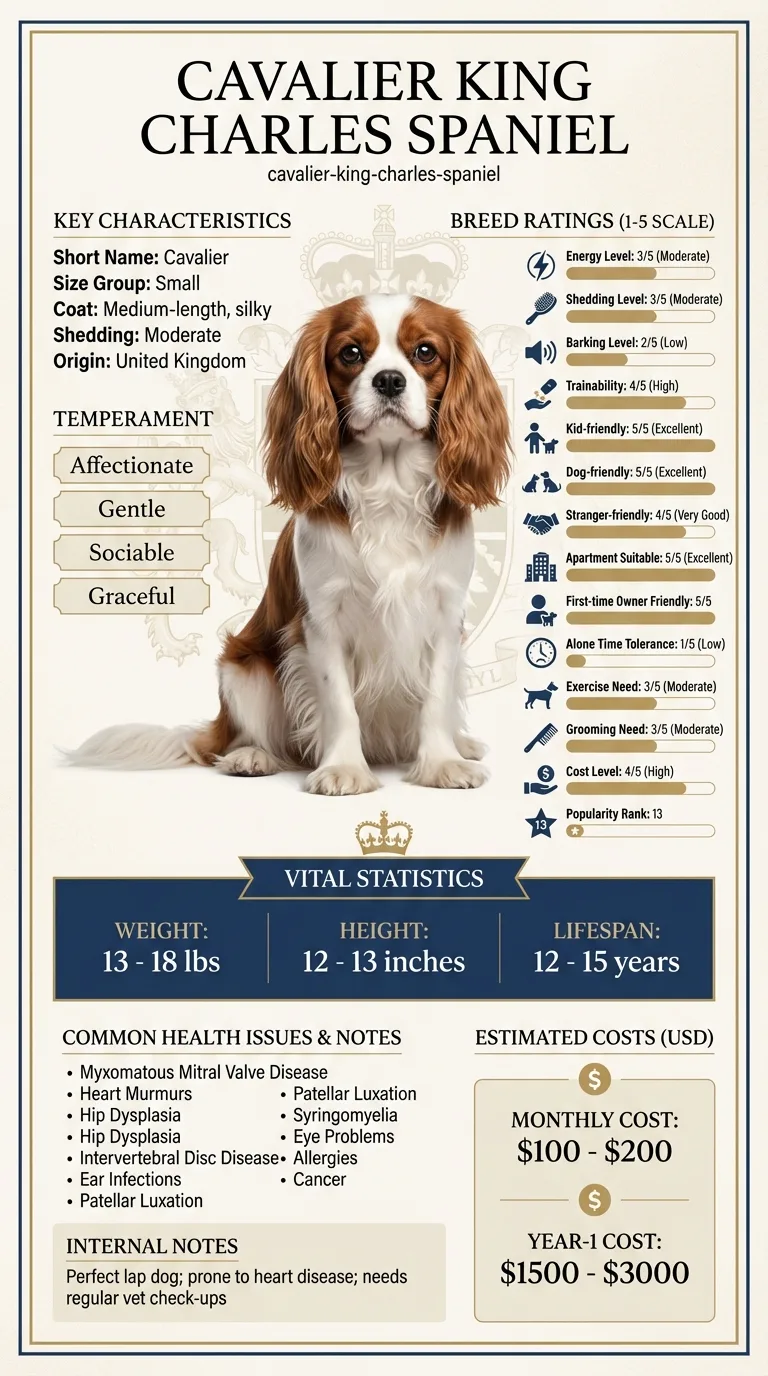
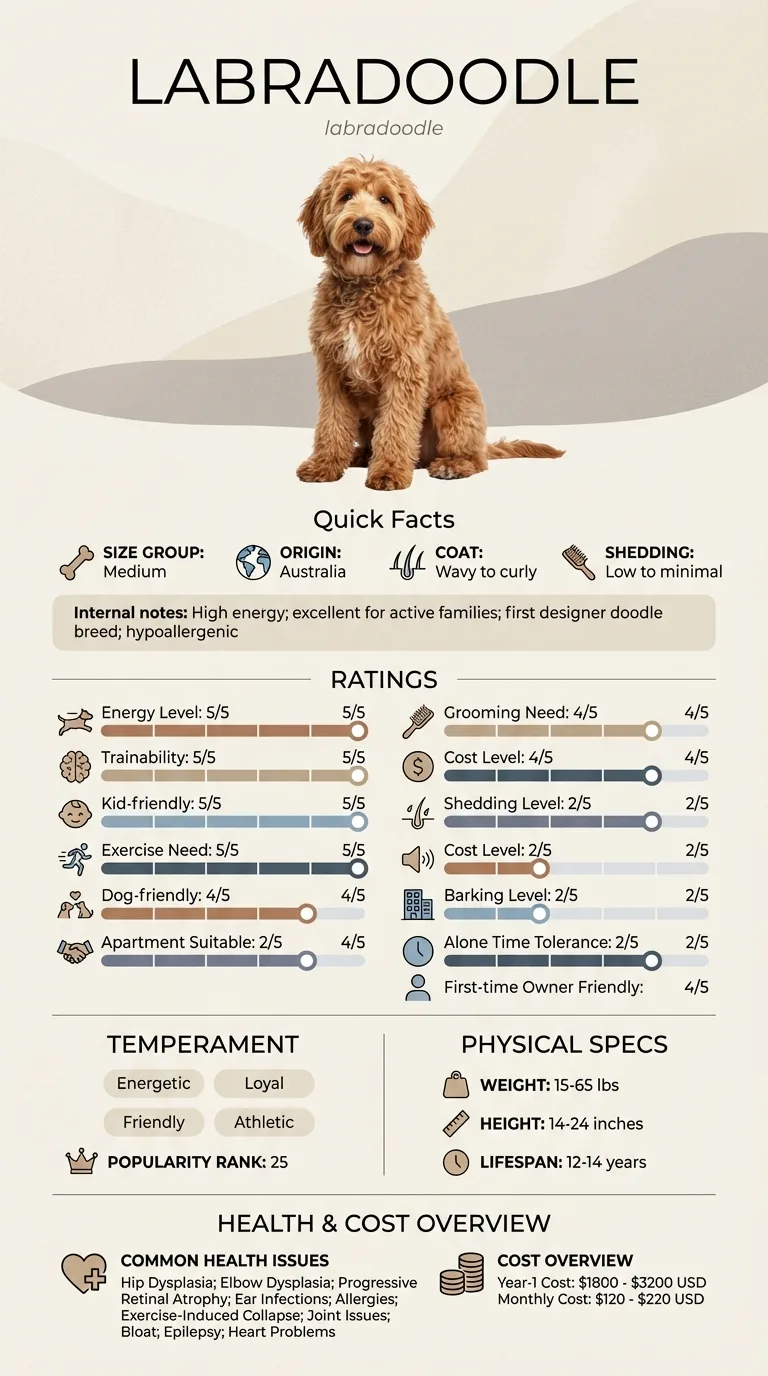
This is for someone already down to Cavalier King Charles Spaniel and Labradoodle and deciding between them. For this pair the decision usually turns on apartment suitability and exercise need, so those are covered first and in most detail. Anyone choosing from a flat has a clear answer here: Cavalier King Charles Spaniel rates 5/5 against 2/5. There is no origin story here — only what changes about your week.
Between Cavalier King Charles Spaniel and Labradoodle, apartment suitability is what separates them, and Cavalier King Charles Spaniel is the lower-effort dog of the two to keep.
Choose Cavalier King Charles Spaniel if you are in a flat or a smaller home, this is your first dog and you do not want a standing grooming appointment.
Choose Labradoodle if shedding is a problem in your house, you want a dog that picks up training quickly and you want a dog that can keep up with an active routine.
| Feature | cavalier king charles spaniel | labradoodle | Winner |
|---|---|---|---|
| Size class | small | medium | Equal |
| Weight | 13–18 lbs | 15–65 lbs | Equal |
| Height | 12–13 in | 14–24 in | Equal |
| Lifespan | 12–15 years | 12–14 years | cavalier king charles spaniel |
| Exercise need | Moderate (3/5) | Very high (5/5) | cavalier king charles spaniel |
| Grooming need | Moderate (3/5) | High (4/5) | cavalier king charles spaniel |
| Shedding | Moderate (3/5) | Low (2/5) | labradoodle |
| Energy level | Moderate (3/5) | Very high (5/5) | Equal |
| Barking | Low (2/5) | Low (2/5) | Equal |
| Apartment suitability | Very high (5/5) | Low (2/5) | cavalier king charles spaniel |
| Good for first-time owners | Very high (5/5) | High (4/5) | cavalier king charles spaniel |
| Tolerates being alone | Very low (1/5) | Low (2/5) | labradoodle |
| Trainability | High (4/5) | Very high (5/5) | labradoodle |
| Good with kids | Very high (5/5) | Very high (5/5) | Equal |
| Good with other dogs | Very high (5/5) | High (4/5) | cavalier king charles spaniel |
| Friendly to strangers | High (4/5) | High (4/5) | Equal |
| Cost level | High (4/5) | High (4/5) | Equal |
| Coat | Medium-length, silky | Wavy to curly | Equal |
| Origin | United Kingdom | Australia | Equal |
| Typical monthly cost | $100–$200 | $120–$220 | Equal |
| Typical first-year cost | $1,500–$3,000 | $1,800–$3,200 | Equal |
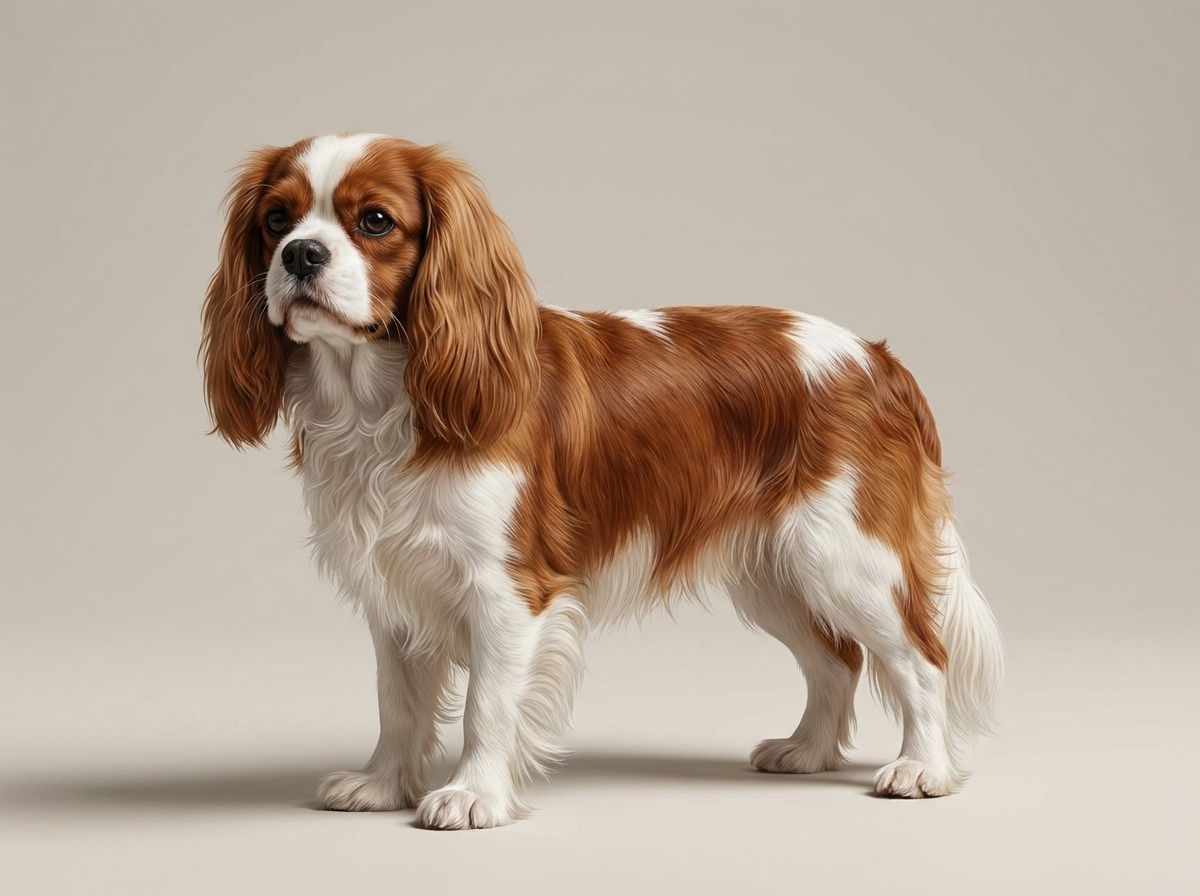
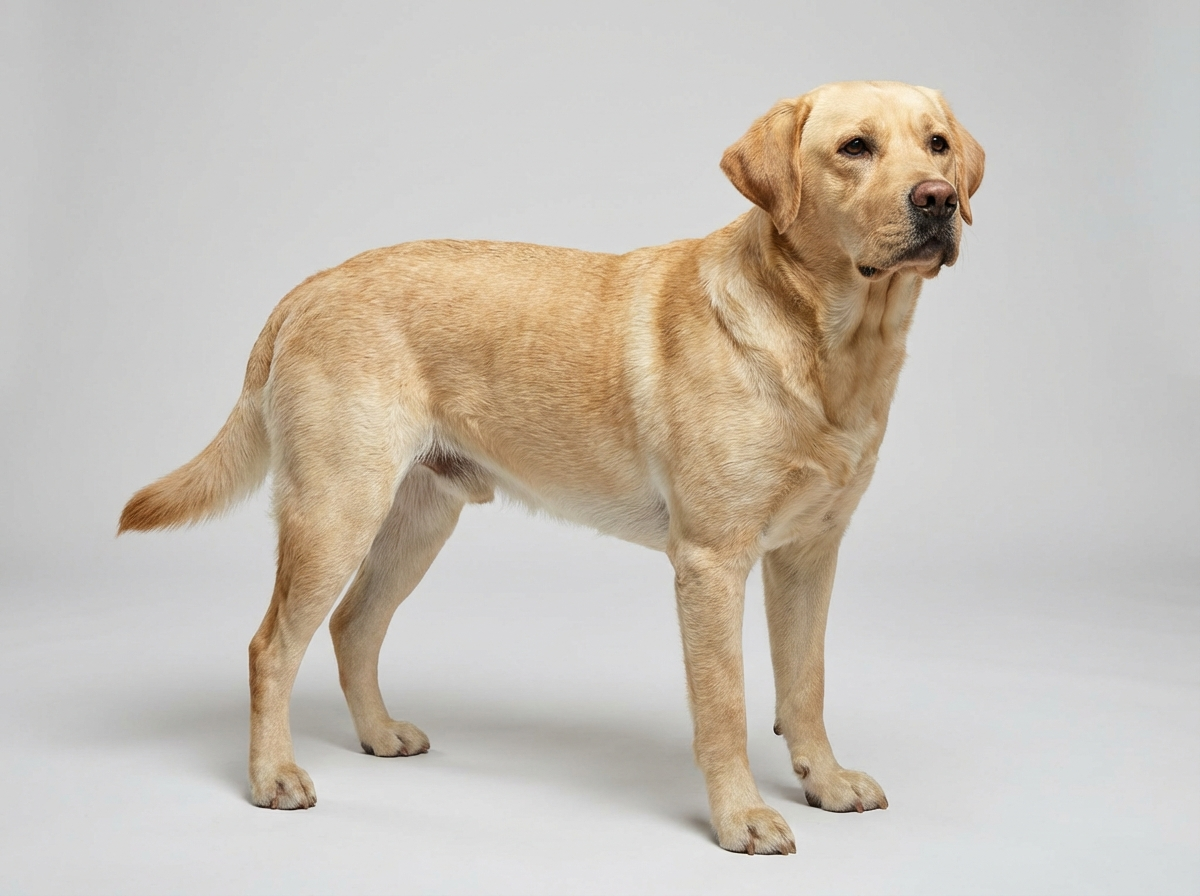
A Cavalier tops out around 18 lbs and 13 inches at the shoulder — small enough to carry through an airport. Labradoodle covers a much wider band, 15 to 65 lbs and 14 to 24 inches, because breeders sell them from miniature to standard. That means a big standard Labradoodle can outweigh a Cavalier three or four times over, so check which size line you're actually looking at before comparing the two.
The exercise gap here is real: Cavalier sits at moderate, 3 out of 5, while Labradoodle rates very high at 5 out of 5. A couple of leash walks and some fetch in the hallway satisfies a Cavalier. A Labradoodle wants sustained daily activity — a jog, a long hike, a job to do — and tends to get destructive without it.
Cavalier grooming sits at moderate (3/5) with moderate shedding (3/5) — regular brushing, occasional vacuuming. Labradoodle grooming runs higher (4/5) since that wavy-to-curly coat mats without routine brushing and periodic trims, but shedding drops to low (2/5). So you're trading less hair on the couch for more time with a brush or a groomer's bill.
Both breeds bark low (2/5), so noise complaints aren't the issue. Space is: Cavalier rates very high (5/5) for apartment living, Labradoodle only low (2/5) — that high exercise need doesn't fit a small unit well. Neither tolerates being left alone comfortably (Cavalier very low at 1/5, Labradoodle low at 2/5), so long solo workdays are a problem either way.
Both are workable for newer owners — Cavalier rates very high (5/5) for first-timers, Labradoodle a close high (4/5). Trainability actually favors the Labradoodle, very high (5/5) against the Cavalier's high (4/5), reflecting the Poodle intelligence in its ancestry. Expect the Labradoodle to pick up commands faster but need more structured outlets for that brainpower.
Both score very high (5/5) with kids, so that's a wash. Cavalier edges ahead with other dogs, very high (5/5) versus the Labradoodle's still-solid high (4/5), and both are equally welcoming to strangers at high (4/5). Neither breed brings guarding instinct to the table — these are companions, not watchdogs.
Cavalier lifespan runs 12-15 years against the Labradoodle's 12-14, a modest edge for the smaller dog. Cavaliers carry a heavy cardiac load — mitral valve disease and heart murmurs show up consistently in the breed — plus hip dysplasia and syringomyelia. Labradoodles face their own list: hip and elbow dysplasia, bloat, exercise-induced collapse. Ear infections and allergies turn up on both sides.
Monthly costs land close together — $100-200 for the Cavalier, $120-220 for the Labradoodle — and both sit at high (4/5) on overall cost level. First-year totals follow the same pattern: $1,500-3,000 versus $1,800-3,200. The Labradoodle's higher end usually comes down to grooming appointments; budget for a groomer every 6-8 weeks if the coat runs curly.
Cavalier King Charles Spaniel weighs 13–18 lbs and lives 12–15 years; Labradoodle weighs 15–65 lbs and lives 12–14 years. The two diverge most on apartment suitability, exercise need and energy level. They are level on barking, cost level and good with kids, so those cannot decide it. Where the table declares a winner it means less work for the owner, nothing more; descriptive rows are left as ties on purpose. The value here is in the differences between the two columns; treat any single score as approximate.

The Labradoodle, by a wide margin once you factor in size lines — it ranges from 15 to 65 lbs against the Cavalier's tight 13-18 lb window. A miniature Labradoodle might land close to Cavalier size, but a standard-line dog will be three or four times heavier.
The Labradoodle, rated low (2/5) shedding against the Cavalier's moderate (3/5). That's the trade-off for its higher grooming requirement (4/5) — less hair on your floors, more brushing and clipping on your end.
Yes, both are — Cavalier rates very high (5/5) for first-timers and Labradoodle rates high (4/5). The Cavalier's lower exercise demand makes it the easier of the two if this is genuinely your first dog.
The Cavalier, clearly — very high (5/5) apartment suitability against the Labradoodle's low (2/5). The Labradoodle's very-high exercise need is the deciding factor; without a yard or serious daily exercise routine, that energy has nowhere to go.
Plan on $100-200 for a Cavalier and $120-220 for a Labradoodle. Both land at high (4/5) on overall cost level, so neither is a budget breed, but the Labradoodle's coat maintenance pushes its range slightly higher.
Hip dysplasia, ear infections, and allergies appear on both breeds' lists. Beyond that they diverge — Cavaliers are known for mitral valve disease and syringomyelia, while Labradoodles are more associated with bloat and exercise-induced collapse.
Neither does it well. Cavalier rates very low (1/5) for tolerating alone time and Labradoodle only low (2/5) — both were bred to stick close to people, so long workdays without a plan (dog walker, doggy daycare) will be hard on either one.
Depends on your exercise budget: the Cavalier fits a lower-key, apartment-friendly life, while the Labradoodle needs a genuinely active household to thrive.
Close: $100-200 for the Cavalier versus $120-220 for the Labradoodle, with the gap mostly coming from grooming.
Cavalier is moderate (3/5); Labradoodle is very high (5/5) — a substantial gap that should drive your decision if you're not an active household.
The Cavalier, typically — 12-15 years against the Labradoodle's 12-14, though both are solid mid-teens dogs when healthy.
Secure checkout on Stripe. We never see your card.
7-day money-back guarantee. Instant access.
Health information here is general and is not veterinary advice. If your dog shows pain, sudden behaviour change, or worsening symptoms, consult a licensed veterinarian.
Some links on this site are affiliate links. We may earn a commission at no extra cost to you, and we only suggest products we believe are helpful for dog owners.
We research and check what we publish, but we do not warrant that any figure, date, price, or statement is accurate, complete, or current, and we accept no liability for any loss, cost, injury, or other harm arising from the use of this site. Use it as one reference among several. You remain responsible for your own decisions and for your dog's care - confirm anything that matters with a licensed veterinarian or another qualified professional before you act on it. Full disclaimer.
Match your lifestyle to the right dog.
Take quizNot sure which breed is right for you? Take our 2-minute quiz to find out.
Take the quiz