Living
Which is smaller?
The Cavalier, at 13-18 lbs versus the Cocker Spaniel's 20-30 lbs.

Quick answer
Which is smaller?
The Cavalier, at 13-18 lbs versus the Cocker Spaniel's 20-30 lbs.
Cavalier King Charles Spaniel or Cocker Spaniel? On paper they differ most on grooming need, and on the scales Cocker Spaniel is the heavier at 20–30 lbs. Here is how the two compare on everything that shapes an ordinary week.
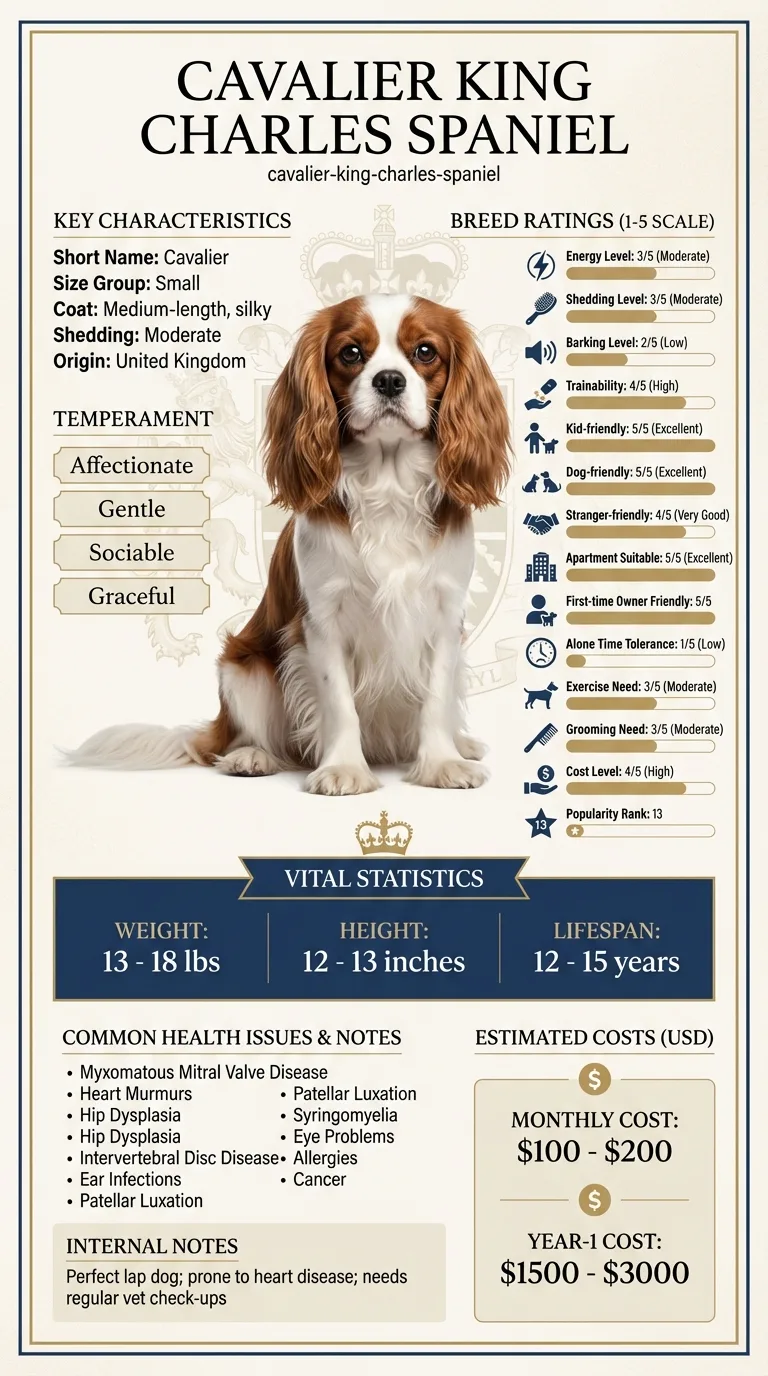
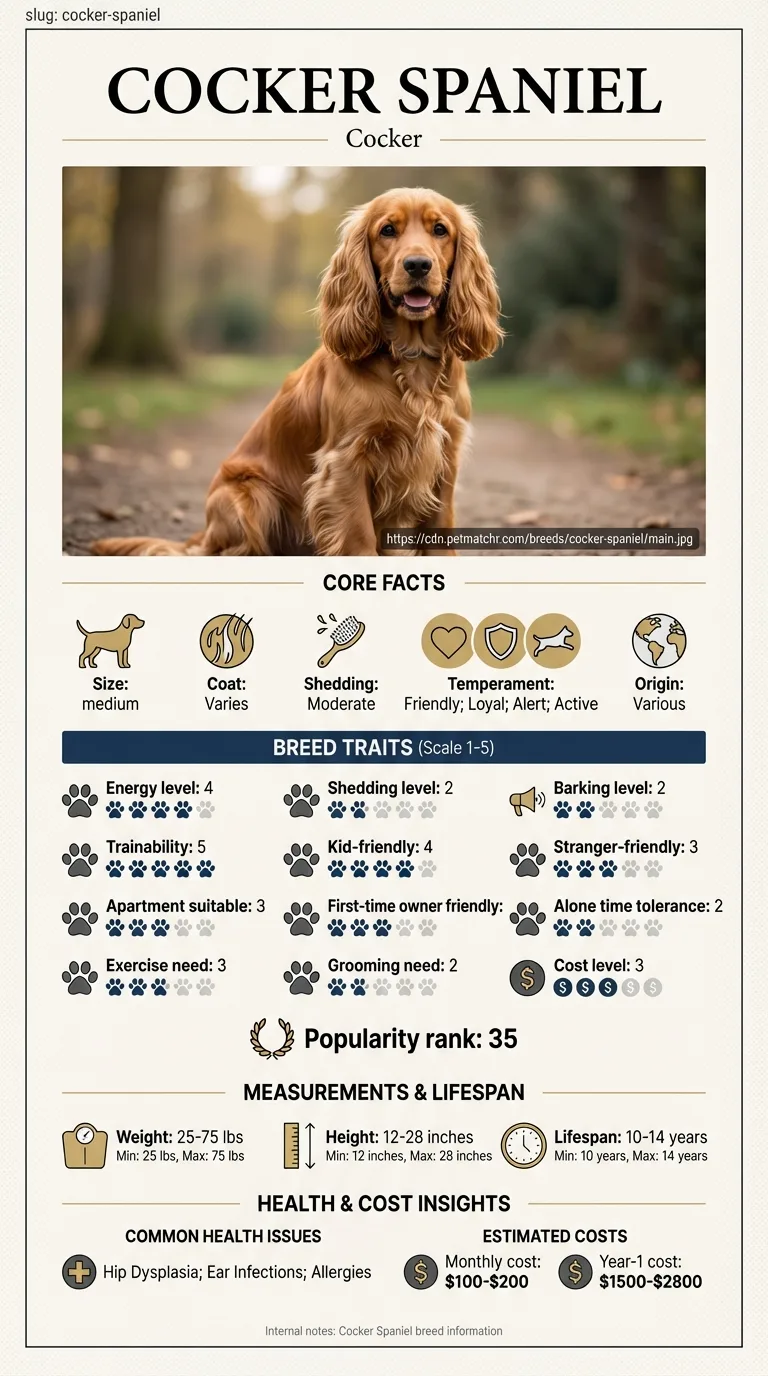
This is for someone already down to Cavalier King Charles Spaniel and Cocker Spaniel and deciding between them. For this pair the decision usually turns on grooming need, so those are covered first and in most detail. Anyone choosing from a flat has a clear answer here: Cavalier King Charles Spaniel rates 5/5 against 4/5. Breed history is left out; what follows is what you will actually live with.
Between Cavalier King Charles Spaniel and Cocker Spaniel, grooming need is what separates them, and Cavalier King Charles Spaniel is the lower-effort dog of the two to keep.
Choose Cavalier King Charles Spaniel if you are in a flat or a smaller home, this is your first dog and you do not want a standing grooming appointment.
Choose Cocker Spaniel if its temperament and look are what you want; on the measurable axes it gives up nothing to the other.
| Feature | cavalier king charles spaniel | cocker spaniel | Winner |
|---|---|---|---|
| Size class | small | small | Equal |
| Weight | 13–18 lbs | 20–30 lbs | Equal |
| Height | 12–13 in | 13–16 in | Equal |
| Lifespan | 12–15 years | 10–14 years | cavalier king charles spaniel |
| Exercise need | Moderate (3/5) | Moderate (3/5) | Equal |
| Grooming need | Moderate (3/5) | Very high (5/5) | cavalier king charles spaniel |
| Shedding | Moderate (3/5) | Moderate (3/5) | Equal |
| Energy level | Moderate (3/5) | Moderate (3/5) | Equal |
| Barking | Low (2/5) | Moderate (3/5) | cavalier king charles spaniel |
| Apartment suitability | Very high (5/5) | High (4/5) | cavalier king charles spaniel |
| Good for first-time owners | Very high (5/5) | High (4/5) | cavalier king charles spaniel |
| Tolerates being alone | Very low (1/5) | Low (2/5) | cocker spaniel |
| Trainability | High (4/5) | High (4/5) | Equal |
| Good with kids | Very high (5/5) | Very high (5/5) | Equal |
| Good with other dogs | Very high (5/5) | High (4/5) | cavalier king charles spaniel |
| Friendly to strangers | High (4/5) | High (4/5) | Equal |
| Cost level | High (4/5) | Moderate (3/5) | cocker spaniel |
| Coat | Medium-length, silky | Silky and feathered | Equal |
| Origin | United Kingdom | Various | Equal |
| Typical monthly cost | $100–$200 | $80–$150 | Equal |
| Typical first-year cost | $1,500–$3,000 | $1,100–$2,300 | Equal |
Weight is where these two small breeds actually separate: a Cavalier tops out around 18 pounds, while a Cocker Spaniel can reach 30, and the height gap of 12-13 inches versus 13-16 inches adds a visibly leggier frame to the Cocker. Both carry silky, feathered coats -- the Cavalier's medium-length coat and the Cocker's longer, more heavily feathered one -- but the extra few inches and roughly ten extra pounds put the Cocker closer to a compact sporting dog than a toy breed. Anyone picturing a true lap dog should note the Cocker can outgrow that role, while the Cavalier stays lap-sized its whole life.
Exercise need and energy level match exactly between these two -- Moderate (3/5) across the board -- making this one of the closer pairings on activity level. Both were bred with sporting or spaniel backgrounds that give them more get-up-and-go than a typical toy breed, needing daily walks and some active play rather than just a stroll around the block. Neither breed demands the mileage of a true field dog, so a household offering 30-45 minutes of combined walking and play should satisfy either one. The real differentiator between this pair lies elsewhere -- grooming, cost, and alone tolerance -- not energy.
Grooming need jumps from Moderate (3/5) for the Cavalier to Very high (5/5) for the Cocker Spaniel, even though shedding is rated identically Moderate (3/5) for both. The Cocker's longer, more heavily feathered coat around the ears, legs, and belly mats easily and typically needs professional trimming every four to six weeks, plus daily brushing to keep feathering tangle-free. The Cavalier's shorter, silkier coat is comparatively easy to maintain with a couple of brushing sessions a week. A Cocker's floppy, low-set ears also trap moisture and debris more than the Cavalier's, contributing to the Ear Infections that top its own health list too.
Both breeds suit smaller homes well, though the Cavalier edges ahead at Very high (5/5) apartment suitability against the Cocker's High (4/5), and barking runs Low (2/5) for the Cavalier versus Moderate (3/5) for the Cocker. Alone tolerance is the more meaningful gap: the Cavalier scores Very low (1/5), among the lowest on the whole site, while the Cocker scores a still-modest Low (2/5) -- neither breed is suited to being left alone for full workdays without a plan. A merry, eager-to-please Cocker may settle into a routine departure cue faster than the intensely attached Cavalier, but both need real preparation before long solo stretches.
Trainability ties at High (4/5) for both breeds, and both score strongly for first-time owners -- Very high (5/5) for the Cavalier, High (4/5) for the Cocker -- making either a reasonable choice for someone new to dog ownership. The Cocker's eager-to-please, merry temperament channels well into obedience work, while the Cavalier's gentle, affectionate nature makes it responsive to praise-based training in particular. Neither breed carries a stubborn streak in its temperament list, so training struggles with this pair usually trace back to inconsistency rather than the dog's nature. First-time owners can lean on either breed's eagerness to bond as the core training tool.
With kids, both breeds rate Very high (5/5), reflecting temperaments built around affection and gentleness -- the Cavalier's is described as affectionate and gentle, the Cocker's as gentle and merry. The Cavalier edges ahead with other dogs, Very high (5/5) against the Cocker's High (4/5), while both tie at High (4/5) for friendliness to strangers. In a busy multi-dog household or one that hosts often, either breed handles the social load well, though the Cavalier's slightly higher other-dog score may matter more in a home already anchored by another dog. Neither breed shows any red flags in this category -- both were built as companion dogs first.
Lifespan favors the Cavalier, 12-15 years against the Cocker's 10-14, but the health-list length tells a different story: the Cavalier carries ten listed conditions to the Cocker's five. The Cavalier's list is heavily weighted toward cardiac and neurological issues -- Myxomatous Mitral Valve Disease, Heart Murmurs, Syringomyelia -- while the Cocker's shorter list centers on Ear Infections, eye conditions like Cataracts and Progressive Retinal Atrophy, Hip Dysplasia, and Autoimmune Hemolytic Anemia, an immune condition worth discussing with any Cocker breeder. Both share Hip Dysplasia. A Cavalier's heart should be checked by a cardiologist periodically; a Cocker's ears need routine cleaning given how prone the breed is to infection.
Cost level actually favors the Cocker Spaniel, Moderate (3/5) against the Cavalier's High (4/5), and the ranges confirm it: $80-150 monthly and $1,100-2,300 in year one for the Cocker, versus $100-200 and $1,500-3,000 for the Cavalier. Much of that gap likely reflects purchase price and the Cavalier's longer, cardiac-heavy health list driving up expected veterinary and insurance costs over time. The Cocker's Very high (5/5) grooming need does add recurring professional grooming bills that partly offset its lower baseline cost. Overall, a Cocker Spaniel tends to be the more budget-friendly of the two despite its higher grooming demands.
Cavalier King Charles Spaniel weighs 13–18 lbs and lives 12–15 years; Cocker Spaniel weighs 20–30 lbs and lives 10–14 years. The two diverge most on grooming need. They are level on energy level, exercise need and good with kids, so those cannot decide it. The comparison marks an easier option only where one exists. Facts like weight and country of origin are not scored. Both dogs are rated from the same dataset, which is what makes the numbers comparable with each other even though any individual dog sits somewhere inside its breed's range.

The Cocker Spaniel, rated Very high (5/5) against the Cavalier's Moderate (3/5), due to its longer, more heavily feathered coat.
The Cocker Spaniel, with a Moderate (3/5) cost rating and $1,100-2,300 first-year range, against the Cavalier's High (4/5) rating and $1,500-3,000 range.
Both -- Ear Infections appear on both breeds' health lists, and both have long, floppy ears that need regular cleaning.
The Cavalier edges ahead, rated Very high (5/5) against the Cocker's High (4/5), though both are considered strong with other dogs.
The Cavalier, at 12-15 years, against the Cocker Spaniel's 10-14 years.
The Cavalier's list is longer and centers on cardiac and neurological issues like Myxomatous Mitral Valve Disease and Syringomyelia, while the Cocker's shorter list includes Autoimmune Hemolytic Anemia.
The Cavalier, rated Very high (5/5) against the Cocker's High (4/5), though both are considered suitable for smaller homes.
The Cavalier, at 13-18 lbs versus the Cocker Spaniel's 20-30 lbs.
Both are tied at Moderate (3/5) shedding.
The Cavalier, needing far less frequent professional grooming.
The Cocker Spaniel, rated Low (2/5) versus the Cavalier's Very low (1/5).
Secure checkout on Stripe. We never see your card.
7-day money-back guarantee. Instant access.

Health information here is general and is not veterinary advice. If your dog shows pain, sudden behaviour change, or worsening symptoms, consult a licensed veterinarian.
Some links on this site are affiliate links. We may earn a commission at no extra cost to you, and we only suggest products we believe are helpful for dog owners.
We research and check what we publish, but we do not warrant that any figure, date, price, or statement is accurate, complete, or current, and we accept no liability for any loss, cost, injury, or other harm arising from the use of this site. Use it as one reference among several. You remain responsible for your own decisions and for your dog's care - confirm anything that matters with a licensed veterinarian or another qualified professional before you act on it. Full disclaimer.
Match your lifestyle to the right dog.
Take quizNot sure which breed is right for you? Take our 2-minute quiz to find out.
Take the quiz