Behavior
Bernedoodle or Cavalier -- overall pick?
With temperament and trainability this close, size, coat, and the Cavalier's cardiac risk are what should actually drive the decision.

Quick answer
Bernedoodle or Cavalier -- overall pick?
With temperament and trainability this close, size, coat, and the Cavalier's cardiac risk are what should actually drive the decision.
Bernedoodle or Cavalier King Charles Spaniel? On paper they differ most on apartment suitability, and on the scales Bernedoodle is the heavier at 20–90 lbs. Here is how the two compare on everything that shapes an ordinary week.
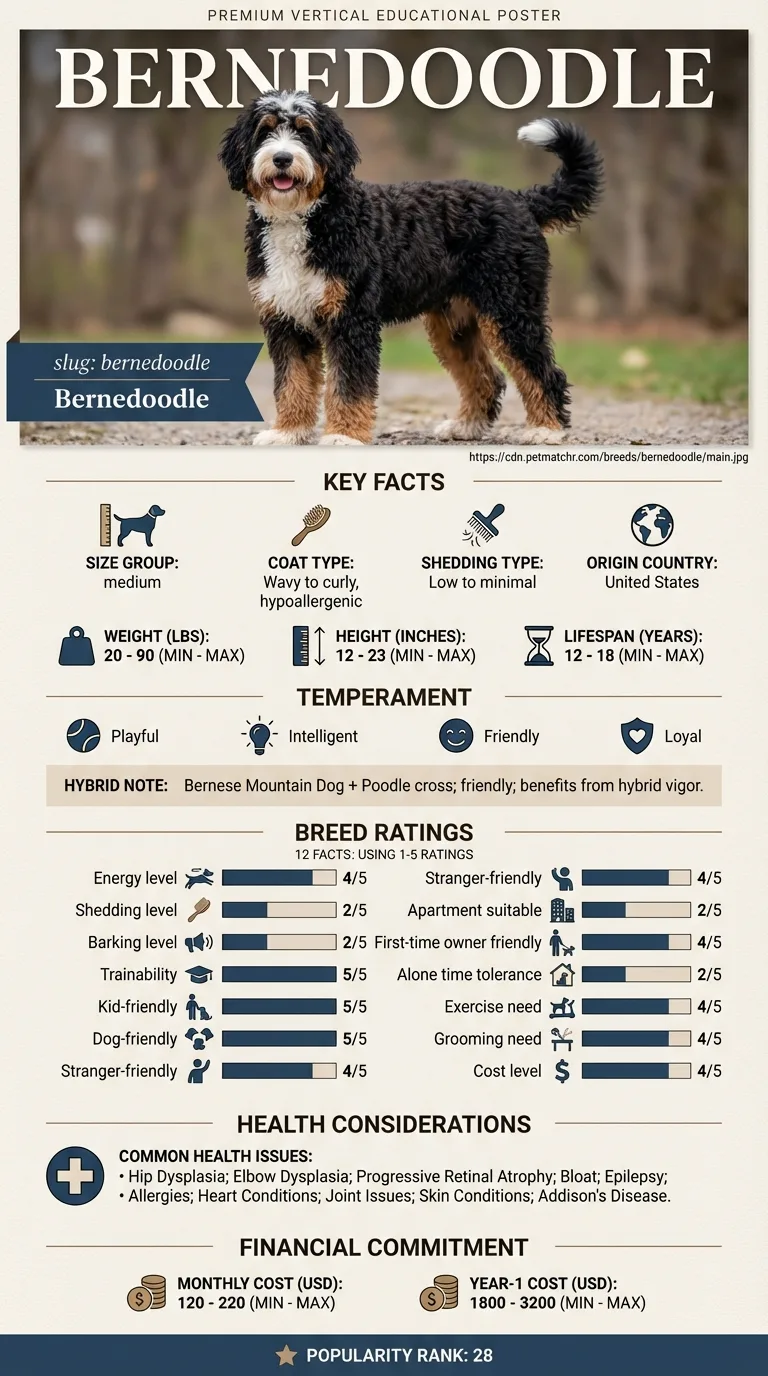
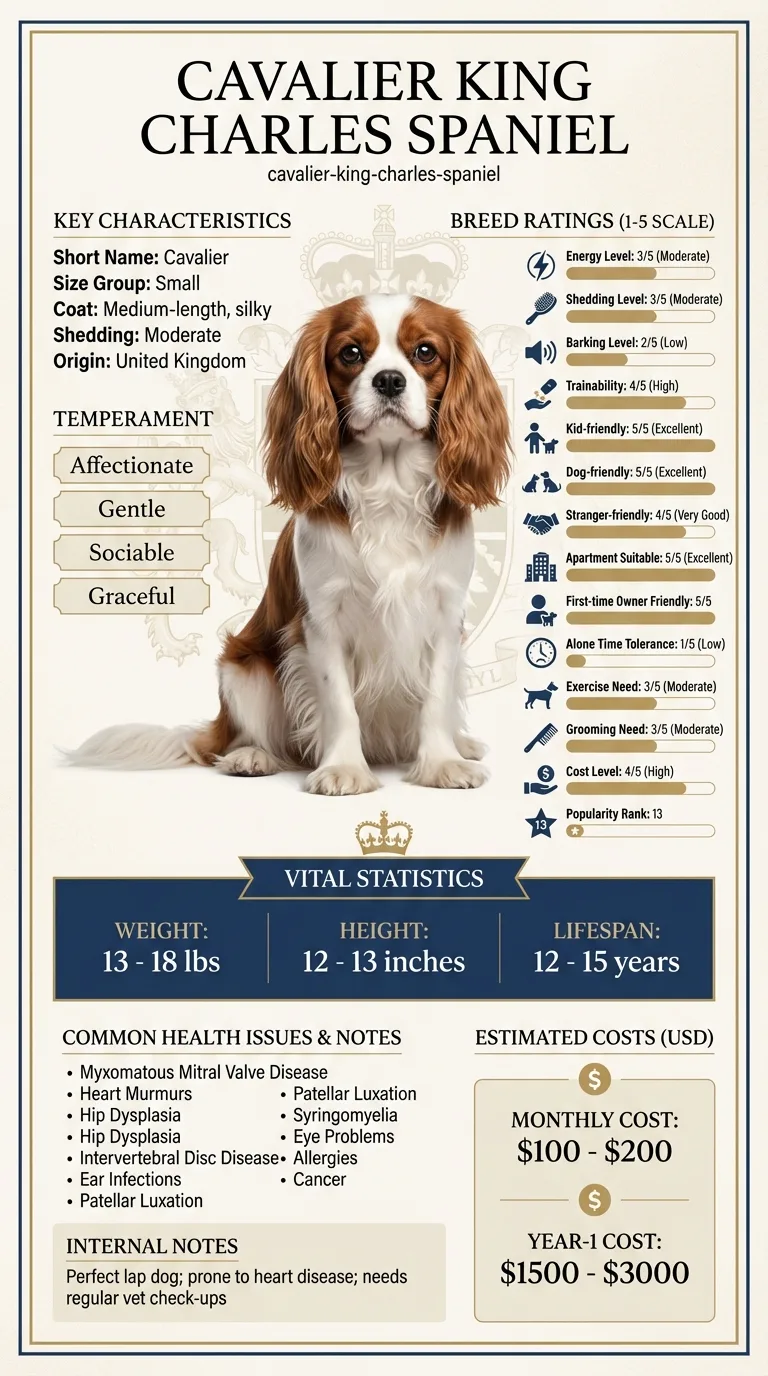
This is for someone already down to Bernedoodle and Cavalier King Charles Spaniel and deciding between them. For this pair the decision usually turns on apartment suitability, so those are covered first and in most detail. Anyone choosing from a flat has a clear answer here: Cavalier King Charles Spaniel rates 5/5 against 2/5. The focus throughout is on daily consequences rather than breed background.
Between Bernedoodle and Cavalier King Charles Spaniel, apartment suitability is what separates them, and Cavalier King Charles Spaniel is the lower-effort dog of the two to keep.
Choose Bernedoodle if shedding is a problem in your house, you want a dog that picks up training quickly and you want a dog that can keep up with an active routine.
Choose Cavalier King Charles Spaniel if you are in a flat or a smaller home, this is your first dog and you do not want a standing grooming appointment.
| Feature | bernedoodle | cavalier king charles spaniel | Winner |
|---|---|---|---|
| Size class | medium | small | Equal |
| Weight | 20–90 lbs | 13–18 lbs | Equal |
| Height | 12–23 in | 12–13 in | Equal |
| Lifespan | 12–18 years | 12–15 years | bernedoodle |
| Exercise need | High (4/5) | Moderate (3/5) | cavalier king charles spaniel |
| Grooming need | High (4/5) | Moderate (3/5) | cavalier king charles spaniel |
| Shedding | Low (2/5) | Moderate (3/5) | bernedoodle |
| Energy level | High (4/5) | Moderate (3/5) | Equal |
| Barking | Low (2/5) | Low (2/5) | Equal |
| Apartment suitability | Low (2/5) | Very high (5/5) | cavalier king charles spaniel |
| Good for first-time owners | High (4/5) | Very high (5/5) | cavalier king charles spaniel |
| Tolerates being alone | Low (2/5) | Very low (1/5) | bernedoodle |
| Trainability | Very high (5/5) | High (4/5) | bernedoodle |
| Good with kids | Very high (5/5) | Very high (5/5) | Equal |
| Good with other dogs | Very high (5/5) | Very high (5/5) | Equal |
| Friendly to strangers | High (4/5) | High (4/5) | Equal |
| Cost level | High (4/5) | High (4/5) | Equal |
| Coat | Wavy to curly, hypoallergenic | Medium-length, silky | Equal |
| Origin | United States | United Kingdom | Equal |
| Typical monthly cost | $120–$220 | $100–$200 | Equal |
| Typical first-year cost | $1,800–$3,200 | $1,500–$3,000 | Equal |
The Cavalier King Charles Spaniel is a small breed through and through -- 13-18 lbs, 12-13 inches -- while the Bernedoodle's 20-90 lb range starts above where the Cavalier tops out. Height is closer than weight, since the Bernedoodle's 12-23 inch range overlaps the Cavalier's at the low end, but on the whole this is a toy-adjacent breed against a doodle that can grow considerably larger.
The Bernedoodle wants more activity -- 4/5 exercise need against the Cavalier's 3/5 moderate -- though the gap isn't as stark as with some smaller breeds. Cavaliers enjoy walks and play but don't demand the same volume of exercise a Bernedoodle does. Energy level tells a similar story at 4/5 versus 3/5, both landing on the more active side for their respective size classes.
Both breeds need real coat maintenance -- Bernedoodle 4/5, Cavalier 3/5 -- since the Cavalier's medium-length silky coat mats and needs regular brushing too, just somewhat less than the Bernedoodle's wavy-to-curly texture. Shedding favors the Bernedoodle at 2/5 low versus the Cavalier's 3/5 moderate. Neither is the lowest-maintenance option on the market, but the Bernedoodle asks for more grooming time overall.
The Cavalier is built for smaller spaces -- 5/5 apartment suitability against the Bernedoodle's 2/5 -- and both breeds bark rarely, tying at 2/5. Alone tolerance is where the Cavalier actually loses ground: it rates just 1/5, the lowest possible score, against the Bernedoodle's 2/5. Cavaliers are known for strong attachment to their people and don't do well left solo for long stretches, apartment or not.
The Cavalier edges out slightly for first-time owners (5/5 vs 4/5), while the Bernedoodle rates a bit higher on raw trainability (5/5 vs 4/5). Both are considered easy, eager breeds to work with -- this is one of the closer categories in the comparison, and either would suit a new owner comfortable with the size and coat trade-offs already discussed.
Kids, other dogs, and strangers all tie at 5/5, 5/5, and 4/5 respectively. Cavaliers are known for a gentle, sociable temperament that matches the Bernedoodle's friendliness closely, so this comparison won't separate the two on how they'll behave in a busy, social household. The decision here rests more on size and health considerations than temperament.
Lifespans overlap closely -- 12-18 years for the Bernedoodle, 12-15 for the Cavalier -- but the Cavalier's health list carries real weight: myxomatous mitral valve disease (MMVD) is a leading cause of death in the breed, paired here with heart murmurs, syringomyelia, and IVDD, all serious conditions common enough to be considered breed hallmarks. The Bernedoodle's ten-item list is broader but doesn't concentrate around one dominant, well-documented risk the way the Cavalier's heart disease does.
Costs run close -- $100-200 monthly for the Cavalier versus $120-220 for the Bernedoodle, both rated 4/5 on overall cost level. The similarity is notable given the size difference; cardiac screening and monitoring for MMVD can add real ongoing expense to a Cavalier's budget that partially offsets its smaller food bill.
Bernedoodle weighs 20–90 lbs and lives 12–18 years; Cavalier King Charles Spaniel weighs 13–18 lbs and lives 12–15 years. The two diverge most on apartment suitability. They are level on barking, cost level and good with other dogs, so those cannot decide it. The table below marks a winner only where one breed is genuinely easier for a typical owner; size and origin are facts rather than merits and stay level. Ratings come from one source applied to both breeds, so they are meaningful against each other rather than as absolute scores.

The Cavalier, at 13-18 lbs against the Bernedoodle's 20-90 lb range. Even the smallest mini Bernedoodle is likely to outweigh a Cavalier.
Yes, it rates 5/5 for apartment suitability. The catch is its alone-tolerance score of just 1/5 -- it needs company more than it needs square footage.
Myxomatous mitral valve disease (MMVD), a heart condition common enough in the breed to be considered a hallmark risk, alongside heart murmurs and syringomyelia.
They're close -- Cavalier at 5/5, Bernedoodle at 4/5 for first-time-owner suitability. Both are considered easy, responsive breeds to raise.
$100-200 for the Cavalier, $120-220 for the Bernedoodle -- a smaller gap than the size difference between them might suggest, partly due to Cavalier cardiac care costs.
They're close -- 12-18 years for the Bernedoodle, 12-15 for the Cavalier -- with meaningful overlap in the middle of both ranges.
Both tie at 5/5 for kids and other dogs, and 4/5 for friendliness to strangers. This comparison doesn't separate them on social temperament.
With temperament and trainability this close, size, coat, and the Cavalier's cardiac risk are what should actually drive the decision.
Cavalier $100-200, Bernedoodle $120-220 -- closer than the size gap between them would suggest.
Bernedoodle 4/5, Cavalier 3/5 -- a modest gap, not a dramatic one.
Close: 12-18 years for the Bernedoodle, 12-15 for the Cavalier.
Secure checkout on Stripe. We never see your card.
7-day money-back guarantee. Instant access.
Health information here is general and is not veterinary advice. If your dog shows pain, sudden behaviour change, or worsening symptoms, consult a licensed veterinarian.
Some links on this site are affiliate links. We may earn a commission at no extra cost to you, and we only suggest products we believe are helpful for dog owners.
We research and check what we publish, but we do not warrant that any figure, date, price, or statement is accurate, complete, or current, and we accept no liability for any loss, cost, injury, or other harm arising from the use of this site. Use it as one reference among several. You remain responsible for your own decisions and for your dog's care - confirm anything that matters with a licensed veterinarian or another qualified professional before you act on it. Full disclaimer.
Match your lifestyle to the right dog.
Take quizNot sure which breed is right for you? Take our 2-minute quiz to find out.
Take the quiz