Living
What's the overall choice?
Choose the Maltese for a tiny, budget-friendly apartment dog; choose the Bernedoodle if you have kids in the house or want a dog closer to a normal, sturdy size.

Quick answer
What's the overall choice?
Choose the Maltese for a tiny, budget-friendly apartment dog; choose the Bernedoodle if you have kids in the house or want a dog closer to a normal, sturdy size.
Bernedoodle or Maltese? On paper they differ most on apartment suitability, and on the scales Bernedoodle is the heavier at 20–90 lbs. Here is how the two compare on everything that shapes an ordinary week.
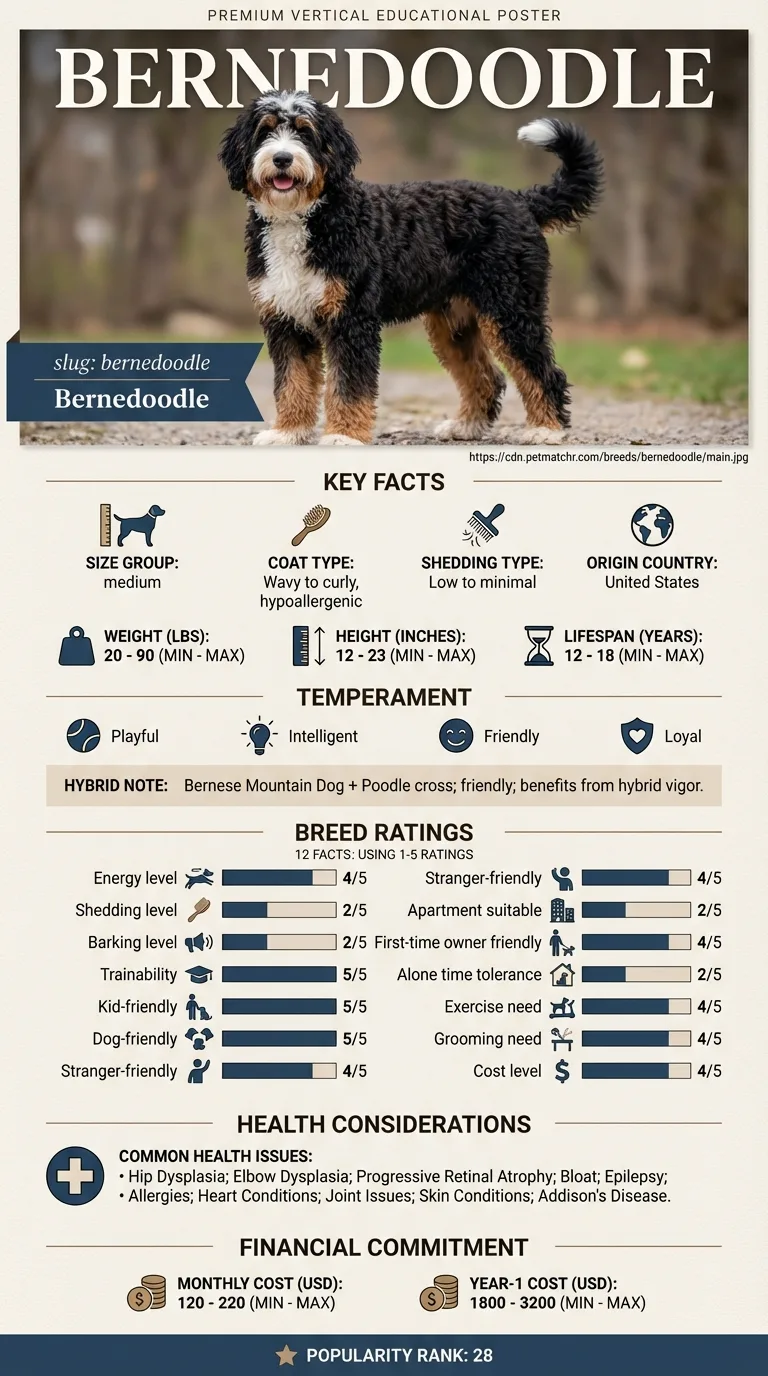
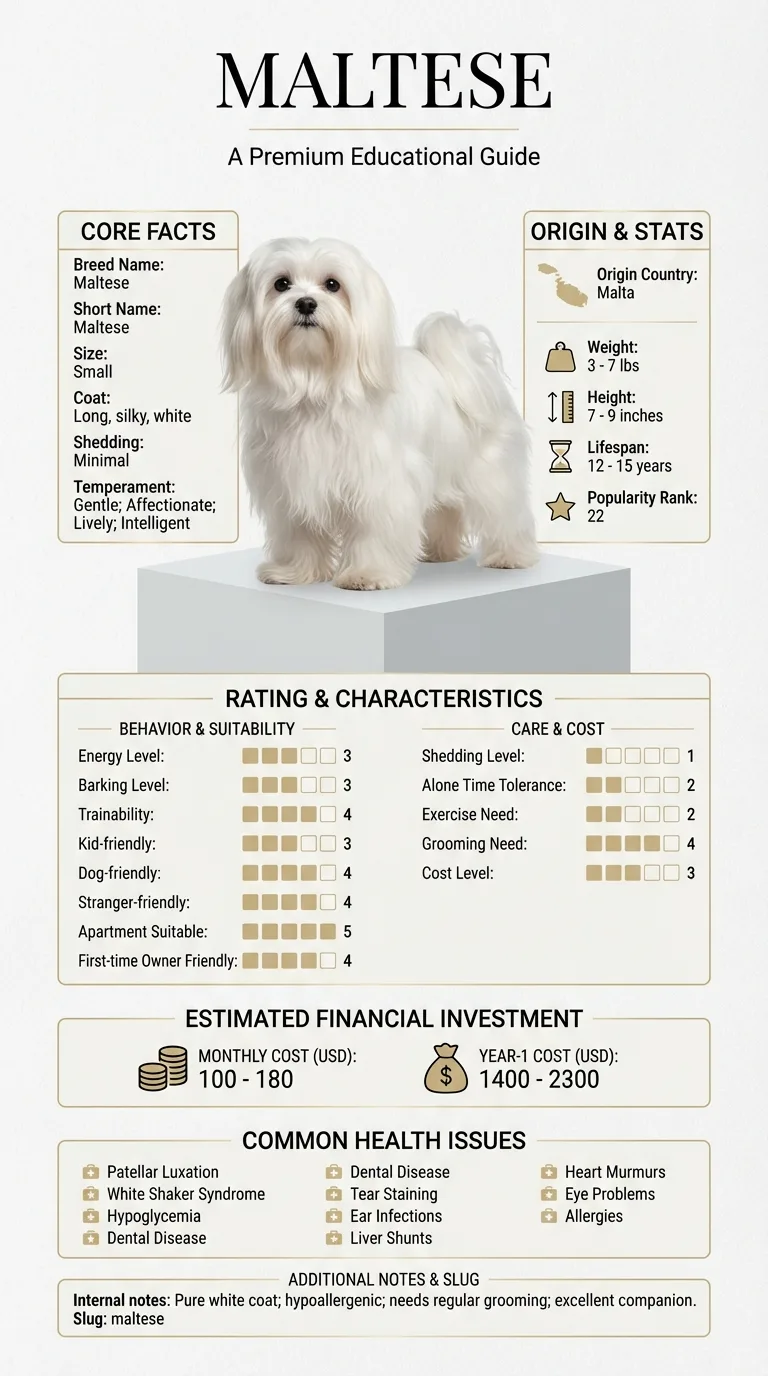
This is for someone already down to Bernedoodle and Maltese and deciding between them. For this pair the decision usually turns on apartment suitability and exercise need, so those are covered first and in most detail. Anyone choosing from a flat has a clear answer here: Maltese rates 5/5 against 2/5. The focus throughout is on daily consequences rather than breed background.
Between Bernedoodle and Maltese, apartment suitability is what separates them, and Maltese is the lower-effort dog of the two to keep.
Choose Bernedoodle if there are young children at home, you already have another dog and you want a dog that picks up training quickly.
Choose Maltese if you are in a flat or a smaller home, shedding is a problem in your house and your walking routine is modest.
| Feature | bernedoodle | maltese | Winner |
|---|---|---|---|
| Size class | medium | small | Equal |
| Weight | 20–90 lbs | 3–7 lbs | Equal |
| Height | 12–23 in | 7–9 in | Equal |
| Lifespan | 12–18 years | 12–15 years | bernedoodle |
| Exercise need | High (4/5) | Low (2/5) | maltese |
| Grooming need | High (4/5) | High (4/5) | Equal |
| Shedding | Low (2/5) | Very low (1/5) | maltese |
| Energy level | High (4/5) | Moderate (3/5) | Equal |
| Barking | Low (2/5) | Moderate (3/5) | bernedoodle |
| Apartment suitability | Low (2/5) | Very high (5/5) | maltese |
| Good for first-time owners | High (4/5) | High (4/5) | Equal |
| Tolerates being alone | Low (2/5) | Low (2/5) | Equal |
| Trainability | Very high (5/5) | High (4/5) | bernedoodle |
| Good with kids | Very high (5/5) | Moderate (3/5) | bernedoodle |
| Good with other dogs | Very high (5/5) | High (4/5) | bernedoodle |
| Friendly to strangers | High (4/5) | High (4/5) | Equal |
| Cost level | High (4/5) | Moderate (3/5) | maltese |
| Coat | Wavy to curly, hypoallergenic | Long, silky, white | Equal |
| Origin | United States | Malta | Equal |
| Typical monthly cost | $120–$220 | $100–$180 | Equal |
| Typical first-year cost | $1,800–$3,200 | $1,400–$2,300 | Equal |
A Maltese weighs as little as 3 pounds and tops out at 7 -- genuinely one of the smallest dogs you can own, at 7 to 9 inches tall. Set next to a Bernedoodle's 20-to-90-pound, 12-to-23-inch range, this isn't really a comparison of similar-sized dogs. If you have small kids in the house, that size gap has real safety implications in both directions -- a Maltese is fragile around rough play, while a large Bernedoodle can accidentally knock a toddler over just by being enthusiastic.
The Maltese needs comparatively little: exercise rated low (2/5) against the Bernedoodle's high (4/5). Energy level splits similarly, moderate (3/5) versus high (4/5). A Maltese is genuinely content with short indoor play and a modest walk; a Bernedoodle left with that little activity will act out.
Grooming ties at high (4/5) -- the Maltese's long, silky white coat is famous for showing every bit of dirt and needs daily attention to avoid staining and matting, on par with the upkeep a Bernedoodle's curly coat demands. Shedding favors the Maltese slightly, very low (1/5) against the Bernedoodle's low (2/5), though neither breed leaves much hair around.
Apartment suitability heavily favors the Maltese, very high (5/5) against the Bernedoodle's low (2/5) -- a 3-to-7-pound dog is simply easier to exercise adequately in a small space. Barking runs the other way, though: moderate (3/5) for the Maltese versus low (2/5) for the Bernedoodle, so factor that in if noise is a concern for neighbors.
Trainability favors the Bernedoodle, very high (5/5) against the Maltese's high (4/5), but the first-time-owner rating ties at high (4/5) for both. Both breeds are reasonably approachable for a new owner, though a Maltese's small size makes housetraining occasionally trickier -- small bladders, small accidents that are easy to miss.
This is a category where size matters directly: the Bernedoodle rates very high (5/5) with kids against the Maltese's moderate (3/5), largely because a tiny dog is more vulnerable to rough handling from young children. The Bernedoodle also edges ahead with other dogs, very high (5/5) versus high (4/5) for the Maltese. Both tie for friendliness to strangers, high (4/5).
Lifespans overlap closely, 12-18 years for the Bernedoodle against 12-15 for the Maltese, both solidly long-lived. The health lists barely intersect, though -- the Maltese carries small-breed-specific risks like patellar luxation, hypoglycemia, white shaker syndrome, and liver shunts, none of which appear on the Bernedoodle's list of hip and elbow dysplasia, bloat, and epilepsy.
The Maltese is the more budget-friendly dog: $100-180 a month against $120-220 for the Bernedoodle, and $1,400-2,300 in year one versus $1,800-3,200. Cost level backs that up, moderate (3/5) for the Maltese against high (4/5) for the Bernedoodle -- less food and a smaller dog generally means lower bills, even with comparable grooming needs.
Bernedoodle weighs 20–90 lbs and lives 12–18 years; Maltese weighs 3–7 lbs and lives 12–15 years. The two diverge most on apartment suitability, exercise need and good with kids. They are level on tolerates being alone, good for first-time owners and grooming need, so those cannot decide it. The table below marks a winner only where one breed is genuinely easier for a typical owner; size and origin are facts rather than merits and stay level. Ratings come from one source applied to both breeds, so they are meaningful against each other rather than as absolute scores.

Dramatically -- a Maltese can weigh as little as 3 pounds, while a Bernedoodle's range runs up to 90. Even the smallest Bernedoodle line is a bigger dog than a full-grown Maltese.
The Bernedoodle, rated very high (5/5) against the Maltese's moderate (3/5) -- the Maltese's small size makes it more vulnerable to rough handling.
The Maltese, easily -- very high (5/5) on apartment suitability against the Bernedoodle's low (2/5).
The Maltese -- $100-180 a month and $1,400-2,300 in year one, versus $120-220 and $1,800-3,200 for the Bernedoodle.
Barely -- the lists don't overlap much. The Maltese carries toy-breed issues like liver shunts and hypoglycemia; the Bernedoodle's risks run more toward joint problems and bloat.
The Maltese, moderate (3/5) versus the Bernedoodle's low (2/5).
They're close -- 12-18 years for the Bernedoodle, 12-15 for the Maltese -- both starting at 12 but the Bernedoodle's ceiling three years higher.
Choose the Maltese for a tiny, budget-friendly apartment dog; choose the Bernedoodle if you have kids in the house or want a dog closer to a normal, sturdy size.
$100-180 for the Maltese versus $120-220 for the Bernedoodle.
Maltese low (2/5), Bernedoodle high (4/5).
Bernedoodle 12-18 years, Maltese 12-15 years.
Secure checkout on Stripe. We never see your card.
7-day money-back guarantee. Instant access.
Health information here is general and is not veterinary advice. If your dog shows pain, sudden behaviour change, or worsening symptoms, consult a licensed veterinarian.
Some links on this site are affiliate links. We may earn a commission at no extra cost to you, and we only suggest products we believe are helpful for dog owners.
We research and check what we publish, but we do not warrant that any figure, date, price, or statement is accurate, complete, or current, and we accept no liability for any loss, cost, injury, or other harm arising from the use of this site. Use it as one reference among several. You remain responsible for your own decisions and for your dog's care - confirm anything that matters with a licensed veterinarian or another qualified professional before you act on it. Full disclaimer.
Match your lifestyle to the right dog.
Take quizNot sure which breed is right for you? Take our 2-minute quiz to find out.
Take the quiz