Behavior
What's the overall choice?
With most categories tied, let exercise tolerance and lifespan decide -- Bernedoodle for a slightly longer life expectancy, Labradoodle if you specifically want the higher-energy, Labrador-influenced temperament.

Quick answer
What's the overall choice?
With most categories tied, let exercise tolerance and lifespan decide -- Bernedoodle for a slightly longer life expectancy, Labradoodle if you specifically want the higher-energy, Labrador-influenced temperament.
Bernedoodle or Labradoodle? On paper they differ most on exercise need, and on the scales Bernedoodle is the heavier at 20–90 lbs. Here is how the two compare on everything that shapes an ordinary week.
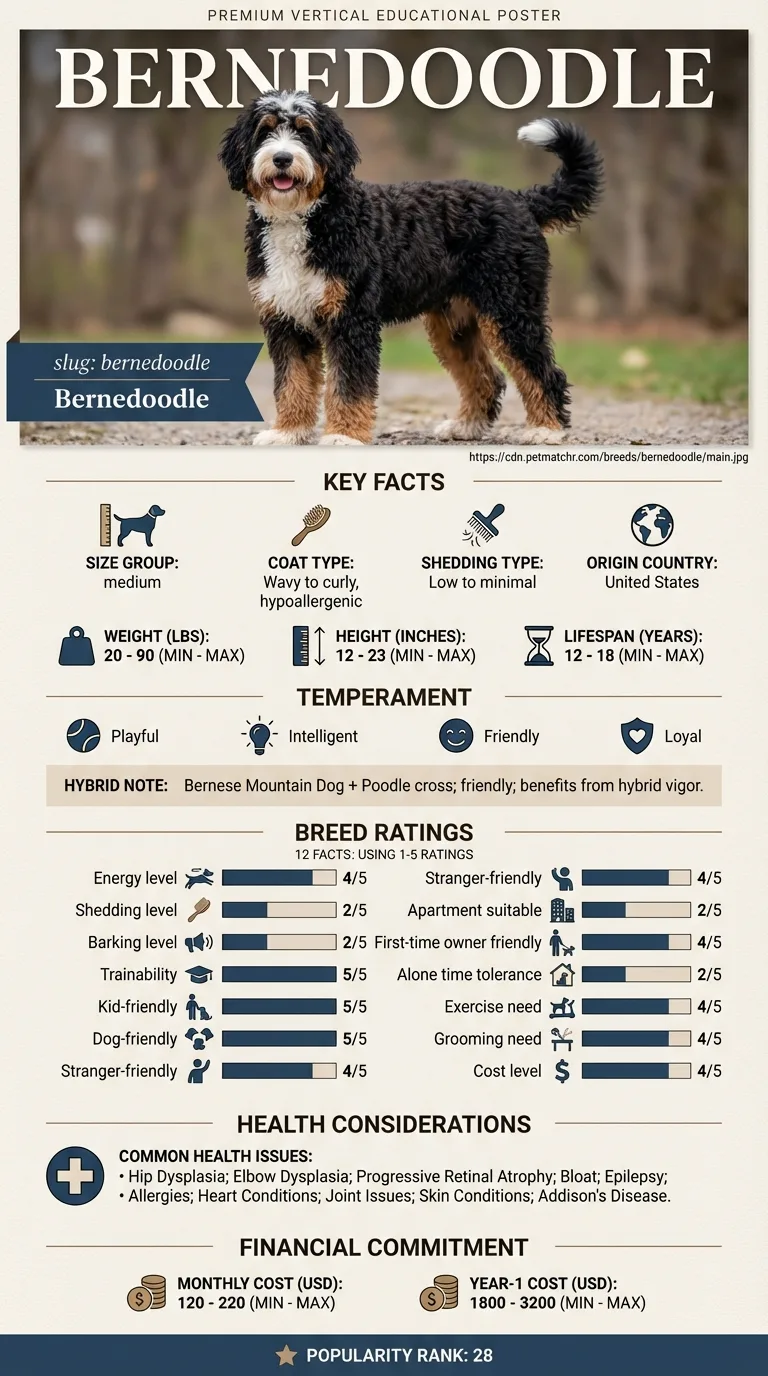
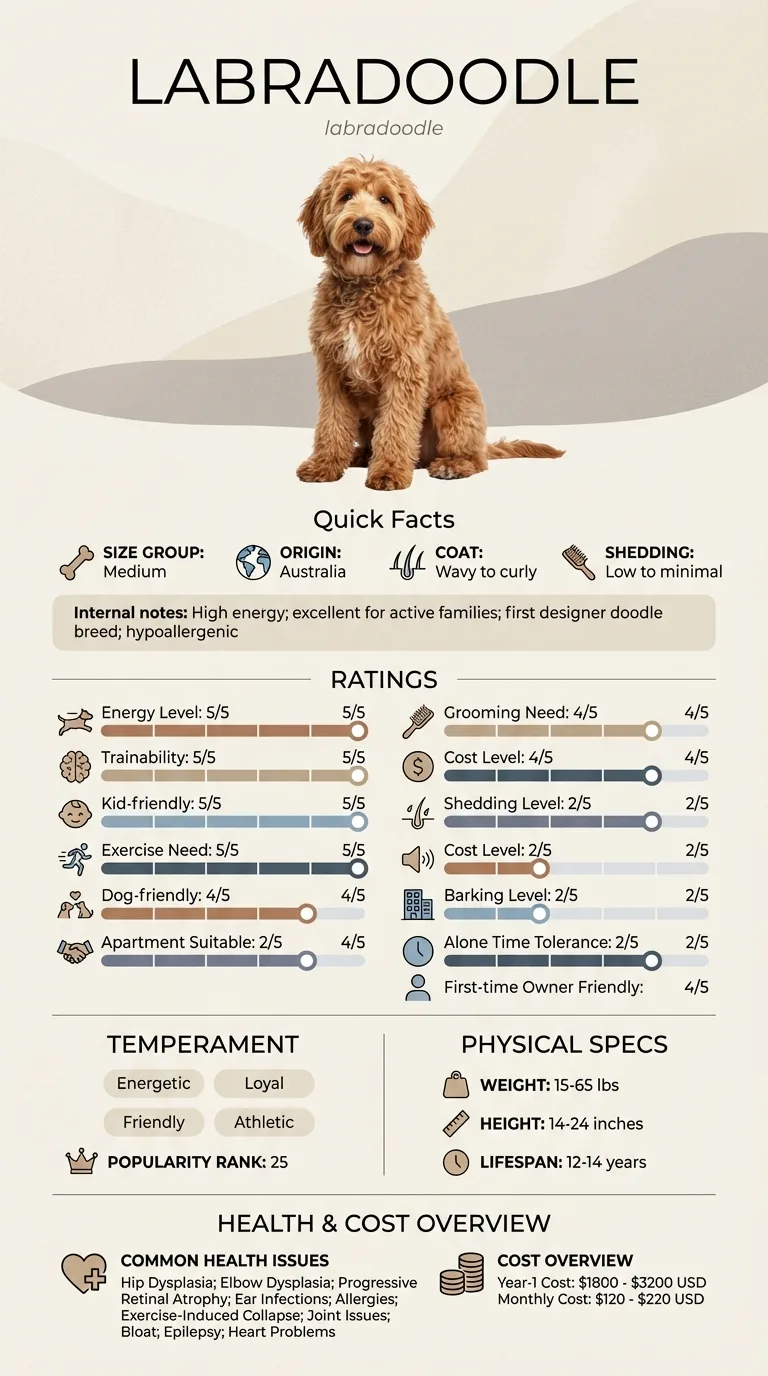
This is for someone already down to Bernedoodle and Labradoodle and deciding between them. Because the two are so evenly matched, the page works through every axis rather than leading with one. Both rate 2/5 for flats, so housing does not settle this one. There is no origin story here — only what changes about your week.
Between Bernedoodle and Labradoodle, they are closer than most pairings, and the choice comes down to temperament, and Bernedoodle is the lower-effort dog of the two to keep.
Choose Bernedoodle if your walking routine is modest and you already have another dog.
Choose Labradoodle if a smaller dog suits your car, your home or your back and you want a dog that can keep up with an active routine.
| Feature | bernedoodle | labradoodle | Winner |
|---|---|---|---|
| Size class | medium | medium | Equal |
| Weight | 20–90 lbs | 15–65 lbs | Equal |
| Height | 12–23 in | 14–24 in | Equal |
| Lifespan | 12–18 years | 12–14 years | bernedoodle |
| Exercise need | High (4/5) | Very high (5/5) | bernedoodle |
| Grooming need | High (4/5) | High (4/5) | Equal |
| Shedding | Low (2/5) | Low (2/5) | Equal |
| Energy level | High (4/5) | Very high (5/5) | Equal |
| Barking | Low (2/5) | Low (2/5) | Equal |
| Apartment suitability | Low (2/5) | Low (2/5) | Equal |
| Good for first-time owners | High (4/5) | High (4/5) | Equal |
| Tolerates being alone | Low (2/5) | Low (2/5) | Equal |
| Trainability | Very high (5/5) | Very high (5/5) | Equal |
| Good with kids | Very high (5/5) | Very high (5/5) | Equal |
| Good with other dogs | Very high (5/5) | High (4/5) | bernedoodle |
| Friendly to strangers | High (4/5) | High (4/5) | Equal |
| Cost level | High (4/5) | High (4/5) | Equal |
| Coat | Wavy to curly, hypoallergenic | Wavy to curly | Equal |
| Origin | United States | Australia | Equal |
| Typical monthly cost | $120–$220 | $120–$220 | Equal |
| Typical first-year cost | $1,800–$3,200 | $1,800–$3,200 | Equal |
Weight ranges overlap heavily -- 20 to 90 pounds for the Bernedoodle, 15 to 65 for the Labradoodle -- so size alone won't tell you much unless you're set on a specific standard, mini, or toy line from either breed. Height follows suit, 12-23 inches versus 14-24. Whichever you pick, talk to the breeder about which size line you're getting rather than relying on the breed name.
The Labradoodle asks for more: very high (5/5) exercise need against the Bernedoodle's high (4/5), which tracks with its Labrador retriever heritage and working-dog energy. Energy level is listed as high (4/5) for the Bernedoodle versus very high (5/5) for the Labradoodle. Both are active breeds, but if you're choosing based on how much daily exercise you can realistically provide, the Bernedoodle is the marginally lighter lift.
Grooming and shedding both tie here -- high (4/5) grooming need and low (2/5) shedding for both breeds. Both coats run wavy to curly, and both need regular brushing plus periodic professional grooming. This category gives you no reason to prefer one over the other.
Apartment suitability, barking, and alone-time tolerance all tie -- low (2/5) across the board for both breeds. Neither is suited to small-space living or long stretches alone, and neither is a particularly loud dog. If noise or apartment fit is your deciding factor, this pair won't help you choose.
Trainability ties at very high (5/5), and the first-time-owner rating ties too, at high (4/5). Both breeds train well with consistent, positive reinforcement, and neither has an edge for someone new to dog ownership based on the numbers here.
Kids, strangers, and cost level all tie -- very high (5/5) with kids, high (4/5) with strangers and on the cost scale. The Bernedoodle has a small edge with other dogs, very high (5/5) against the Labradoodle's high (4/5), the only real gap in this whole section.
Lifespan gives the Bernedoodle a real edge at the top end: 12-18 years versus 12-14 for the Labradoodle -- the ranges start together but the Bernedoodle can run four years longer. Hip dysplasia, elbow dysplasia, progressive retinal atrophy, allergies, bloat, and epilepsy all appear on both lists, which isn't surprising given how closely related these crossbreeds are. The Labradoodle's list adds exercise-induced collapse, tied to its retriever lineage.
Costs are identical: $120-220 a month, $1,800-3,200 in the first year, cost level rated high (4/5) for both. As with grooming, this category simply doesn't distinguish the two breeds -- the deciding factors elsewhere are exercise need and lifespan.
Bernedoodle weighs 20–90 lbs and lives 12–18 years; Labradoodle weighs 15–65 lbs and lives 12–14 years. No rated axis separates them by more than a single point, which makes this one of the closer pairings on the site. They are level on tolerates being alone, apartment suitability and barking, so those cannot decide it. Where the table declares a winner it means less work for the owner, nothing more; descriptive rows are left as ties on purpose. The value here is in the differences between the two columns; treat any single score as approximate.

Mostly two things -- exercise need (Labradoodle higher, 5/5 vs 4/5) and lifespan (Bernedoodle longer, 12-18 vs 12-14 years). Everything else in the data ties or is close.
The Labradoodle, rated very high (5/5) against the Bernedoodle's high (4/5).
The Bernedoodle, with a range extending to 18 years versus the Labradoodle's 14-year ceiling; both start at 12.
Yes -- $120-220 monthly and $1,800-3,200 in year one for both breeds.
Neither -- shedding ties at low (2/5) for both breeds.
Both are, but the Bernedoodle rates slightly higher, very high (5/5) against the Labradoodle's high (4/5).
Substantially -- hip dysplasia, elbow dysplasia, progressive retinal atrophy, allergies, bloat, and epilepsy all appear on both lists.
With most categories tied, let exercise tolerance and lifespan decide -- Bernedoodle for a slightly longer life expectancy, Labradoodle if you specifically want the higher-energy, Labrador-influenced temperament.
Identical -- $120-220 for both.
Labradoodle very high (5/5), Bernedoodle high (4/5).
Bernedoodle 12-18 years, Labradoodle 12-14 years.
Secure checkout on Stripe. We never see your card.
7-day money-back guarantee. Instant access.
Health information here is general and is not veterinary advice. If your dog shows pain, sudden behaviour change, or worsening symptoms, consult a licensed veterinarian.
Some links on this site are affiliate links. We may earn a commission at no extra cost to you, and we only suggest products we believe are helpful for dog owners.
We research and check what we publish, but we do not warrant that any figure, date, price, or statement is accurate, complete, or current, and we accept no liability for any loss, cost, injury, or other harm arising from the use of this site. Use it as one reference among several. You remain responsible for your own decisions and for your dog's care - confirm anything that matters with a licensed veterinarian or another qualified professional before you act on it. Full disclaimer.
Match your lifestyle to the right dog.
Take quizNot sure which breed is right for you? Take our 2-minute quiz to find out.
Take the quiz