Living
Which is the better overall choice?
For small-space living, the Dachshund; for a family wanting a bigger, more sociable dog with better training odds, the Bernedoodle.

Quick answer
Which is the better overall choice?
For small-space living, the Dachshund; for a family wanting a bigger, more sociable dog with better training odds, the Bernedoodle.
Bernedoodle or Dachshund? On paper they differ most on apartment suitability, and on the scales Bernedoodle is the heavier at 20–90 lbs. Here is how the two compare on everything that shapes an ordinary week.
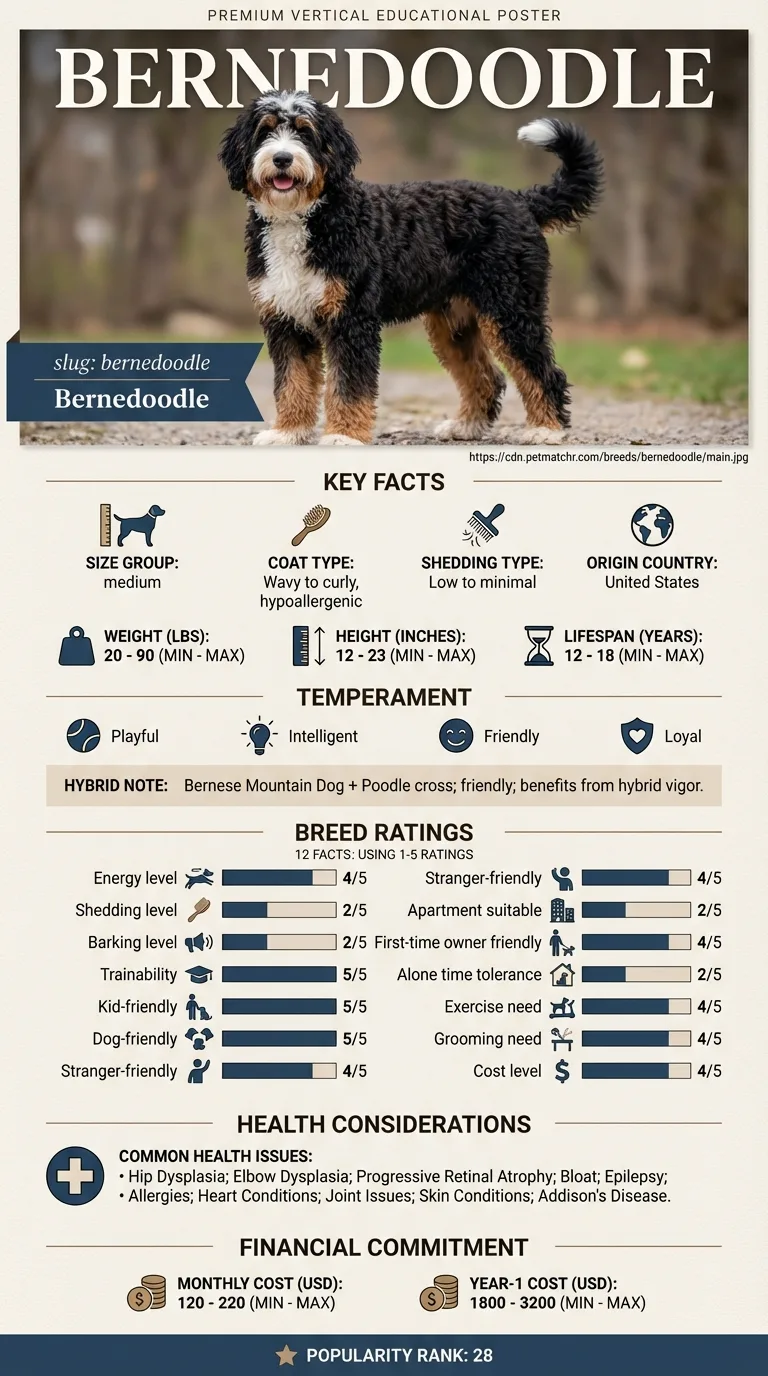
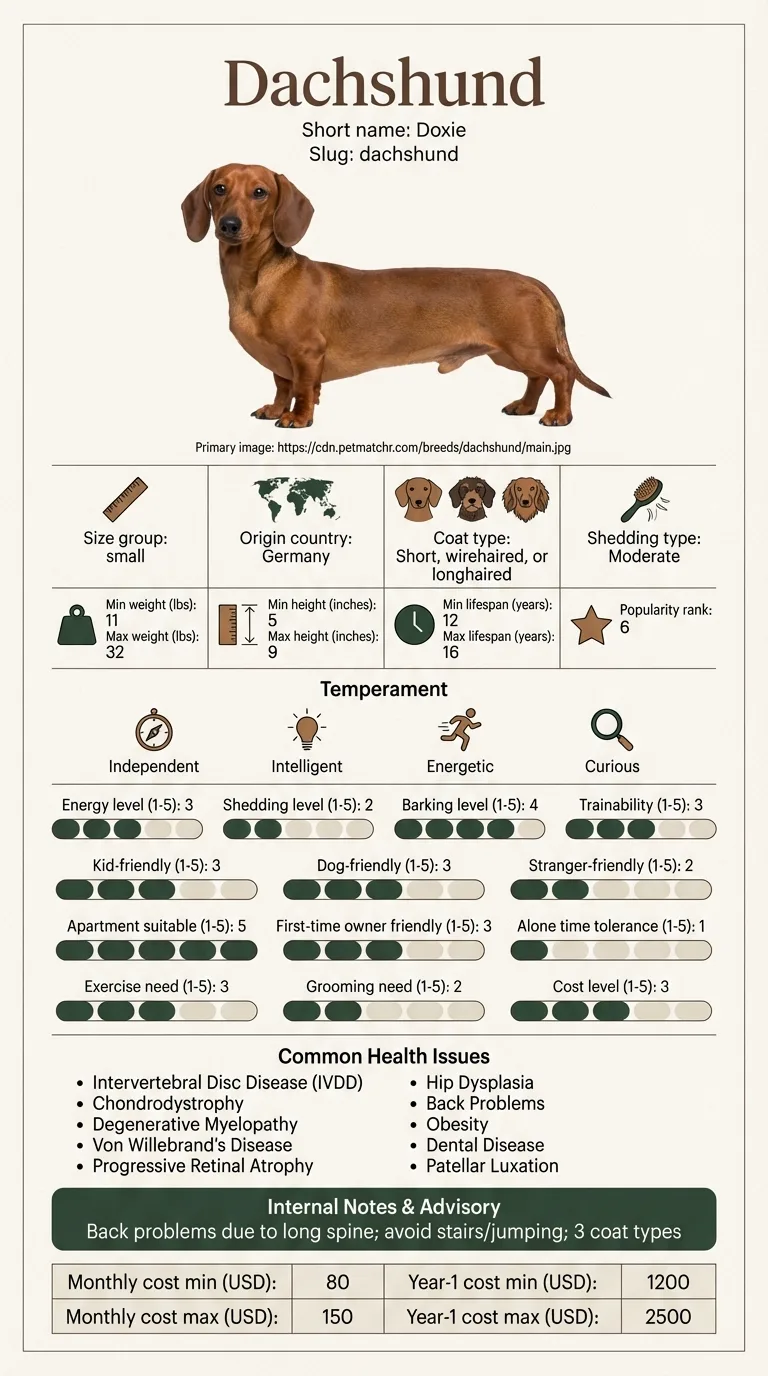
This is for someone already down to Bernedoodle and Dachshund and deciding between them. For this pair the decision usually turns on apartment suitability and grooming need, so those are covered first and in most detail. Anyone choosing from a flat has a clear answer here: Dachshund rates 5/5 against 2/5. It is written for the decision rather than the breed history.
Between Bernedoodle and Dachshund, apartment suitability is what separates them, and Dachshund is the lower-effort dog of the two to keep.
Choose Bernedoodle if this is your first dog, there are young children at home and you already have another dog.
Choose Dachshund if you are in a flat or a smaller home, you do not want a standing grooming appointment and your walking routine is modest.
| Feature | bernedoodle | dachshund | Winner |
|---|---|---|---|
| Size class | medium | small | Equal |
| Weight | 20–90 lbs | 11–32 lbs | Equal |
| Height | 12–23 in | 5–9 in | Equal |
| Lifespan | 12–18 years | 12–16 years | bernedoodle |
| Exercise need | High (4/5) | Moderate (3/5) | dachshund |
| Grooming need | High (4/5) | Low (2/5) | dachshund |
| Shedding | Low (2/5) | Low (2/5) | Equal |
| Energy level | High (4/5) | Moderate (3/5) | Equal |
| Barking | Low (2/5) | High (4/5) | bernedoodle |
| Apartment suitability | Low (2/5) | Very high (5/5) | dachshund |
| Good for first-time owners | High (4/5) | Moderate (3/5) | bernedoodle |
| Tolerates being alone | Low (2/5) | Very low (1/5) | bernedoodle |
| Trainability | Very high (5/5) | Moderate (3/5) | bernedoodle |
| Good with kids | Very high (5/5) | Moderate (3/5) | bernedoodle |
| Good with other dogs | Very high (5/5) | Moderate (3/5) | bernedoodle |
| Friendly to strangers | High (4/5) | Low (2/5) | bernedoodle |
| Cost level | High (4/5) | Moderate (3/5) | dachshund |
| Coat | Wavy to curly, hypoallergenic | Short, wirehaired, or longhaired | Equal |
| Origin | United States | Germany | Equal |
| Typical monthly cost | $120–$220 | $80–$150 | Equal |
| Typical first-year cost | $1,800–$3,200 | $1,200–$2,500 | Equal |
A Dachshund tops out around 32 lbs and 9 inches tall; even a mini Bernedoodle can weigh more than that, and a standard runs up to 90 lbs. This isn't really a which-is-bigger comparison so much as two different categories of dog. If square footage or a low counter-surfing risk matters, the Dachshund's small frame is the whole story here.
The Bernedoodle rates high (4/5) for exercise need against the Dachshund's moderate (3/5). Despite the Dachshund's short legs, it's not a couch dog - it was bred to go to ground after badgers - but it tops out at a lower daily activity requirement than the Bernedoodle, which inherited its drive from both the Bernese and the Poodle side. A short yard session plus a walk covers most Dachshunds; the Bernedoodle usually wants more.
This is a clear split. The Bernedoodle needs high-maintenance grooming (4/5) for its curly coat, while the Dachshund needs very little (2/5) regardless of whether you get the short, wire, or long-haired variety. Shedding itself is a tie - both rate low (2/5) - so the difference here is brushing and trim time, not hair on the furniture. Either way, keep nails and ears checked regularly, since both breeds are prone to ear issues if ignored.
The Dachshund is built for small spaces - it rates a full 5/5 on apartment suitability, the highest score in this comparison. The Bernedoodle rates a 2/5. Barking cuts the other way: the Dachshund is a notorious alert-barker (4/5) while the Bernedoodle stays quieter (2/5). Neither dog handles being left alone well, and the Dachshund is worse at it, rated 1/5 against the Bernedoodle's 2/5.
The Bernedoodle rates very high (5/5) for trainability and 4/5 for first-time owners; the Dachshund sits at moderate (3/5) on both counts. Dachshunds are famously stubborn, bred to think independently while chasing prey underground, and that same independence shows up at obedience class. A first-time owner will likely have an easier road with the Bernedoodle. Short, high-value-reward sessions tend to work better with a Dachshund than long drilling.
The Bernedoodle outscores the Dachshund across the board here: very high with kids and other dogs versus the Dachshund's moderate (3/5) on both, and high with strangers versus the Dachshund's low (2/5). None of these Dachshund scores are disqualifying, but they reflect a breed that tends to bond tightly with fewer people and can be snappish with rough handling from kids.
Both breeds live a comparably long time - 12-18 years for the Bernedoodle, 12-16 for the Dachshund - and both share hip dysplasia and progressive retinal atrophy on their health lists. The Dachshund's long spine brings its own well-known risk, intervertebral disc disease, plus chondrodystrophy-related joint issues; the Bernedoodle's list leans toward bloat, epilepsy, and skin and joint conditions instead.
The Dachshund is the cheaper dog to keep on every figure given: $80-150 a month against the Bernedoodle's $120-220, and $1,200-2,500 in year one versus $1,800-3,200. Smaller dogs eat less and the Dachshund's low grooming need keeps that line item down too. Factor in that a Bernedoodle's grooming alone can run close to what a Dachshund costs to feed and maintain in an entire month.
Bernedoodle weighs 20–90 lbs and lives 12–18 years; Dachshund weighs 11–32 lbs and lives 12–16 years. The two diverge most on apartment suitability, grooming need and barking and 4 other rated axes. Almost every rated axis separates them at least slightly. In the table, a "winner" means easier for an ordinary household — not better. Size, coat and origin are recorded without a verdict. Because both breeds are scored the same way, the gaps are reliable even where the absolute numbers are rough.

The Dachshund is a small breed (11-32 lbs) and the Bernedoodle's 20-90 lb range spans mini through standard sizing. Ask which size line a Bernedoodle breeder is selling - the name alone doesn't tell you where in that range your dog will land.
The Dachshund, decisively - it rates 5/5 for apartment suitability against the Bernedoodle's 2/5. It also needs less daily exercise. The tradeoff is barking: the Dachshund rates 4/5, well above the Bernedoodle's 2/5.
It's workable but rated only moderate (3/5), versus the Bernedoodle's high (4/5). Dachshunds are independent-minded and can be a harder training project than their size suggests.
The Dachshund runs $80-150 a month, the Bernedoodle $120-220. Over a first year that's roughly a $1,000 gap ($1,200-2,500 versus $1,800-3,200), driven mostly by grooming and food volume.
Some - hip dysplasia and progressive retinal atrophy appear on both lists. Otherwise they diverge sharply: the Dachshund's risks center on its long spine (IVDD, chondrodystrophy), while the Bernedoodle's run toward bloat, epilepsy, and skin conditions.
Rated moderate (3/5), noticeably below the Bernedoodle's very high (5/5). It's not that Dachshunds dislike children, but their small, long-backed build doesn't hold up well to rough handling, and supervision matters more here than with a sturdier breed.
The Dachshund, by a clear margin - 4/5 versus the Bernedoodle's 2/5. It's an alert breed bred to signal when something's moving underground, and that instinct doesn't switch off indoors.
For small-space living, the Dachshund; for a family wanting a bigger, more sociable dog with better training odds, the Bernedoodle.
Roughly $40-70 a month lower for the Dachshund, and about $600-700 less in the first year.
The Bernedoodle needs high (4/5) activity; the Dachshund is moderate (3/5) despite its energetic streak.
Both are long-lived breeds - 12-18 years for the Bernedoodle, 12-16 for the Dachshund.
Secure checkout on Stripe. We never see your card.
7-day money-back guarantee. Instant access.
Health information here is general and is not veterinary advice. If your dog shows pain, sudden behaviour change, or worsening symptoms, consult a licensed veterinarian.
Some links on this site are affiliate links. We may earn a commission at no extra cost to you, and we only suggest products we believe are helpful for dog owners.
We research and check what we publish, but we do not warrant that any figure, date, price, or statement is accurate, complete, or current, and we accept no liability for any loss, cost, injury, or other harm arising from the use of this site. Use it as one reference among several. You remain responsible for your own decisions and for your dog's care - confirm anything that matters with a licensed veterinarian or another qualified professional before you act on it. Full disclaimer.
Match your lifestyle to the right dog.
Take quizNot sure which breed is right for you? Take our 2-minute quiz to find out.
Take the quiz