Living
Akita vs Siberian Husky: which should I choose?
The Husky if you are genuinely athletic, have serious fencing and someone home during the day. The Akita if you cannot commit two hours of hard exercise daily and want a self-contained dog.

Quick answer
Akita vs Siberian Husky: which should I choose?
The Husky if you are genuinely athletic, have serious fencing and someone home during the day. The Akita if you cannot commit two hours of hard exercise daily and want a self-contained dog.
Both rate 1/5 for first-time owners and both shed at 5/5. They are related northern breeds with thick coats and strong opinions, and the reasons they are difficult could hardly be more different: the Akita is a guardian that decides things, and the Husky is a sled dog that leaves.
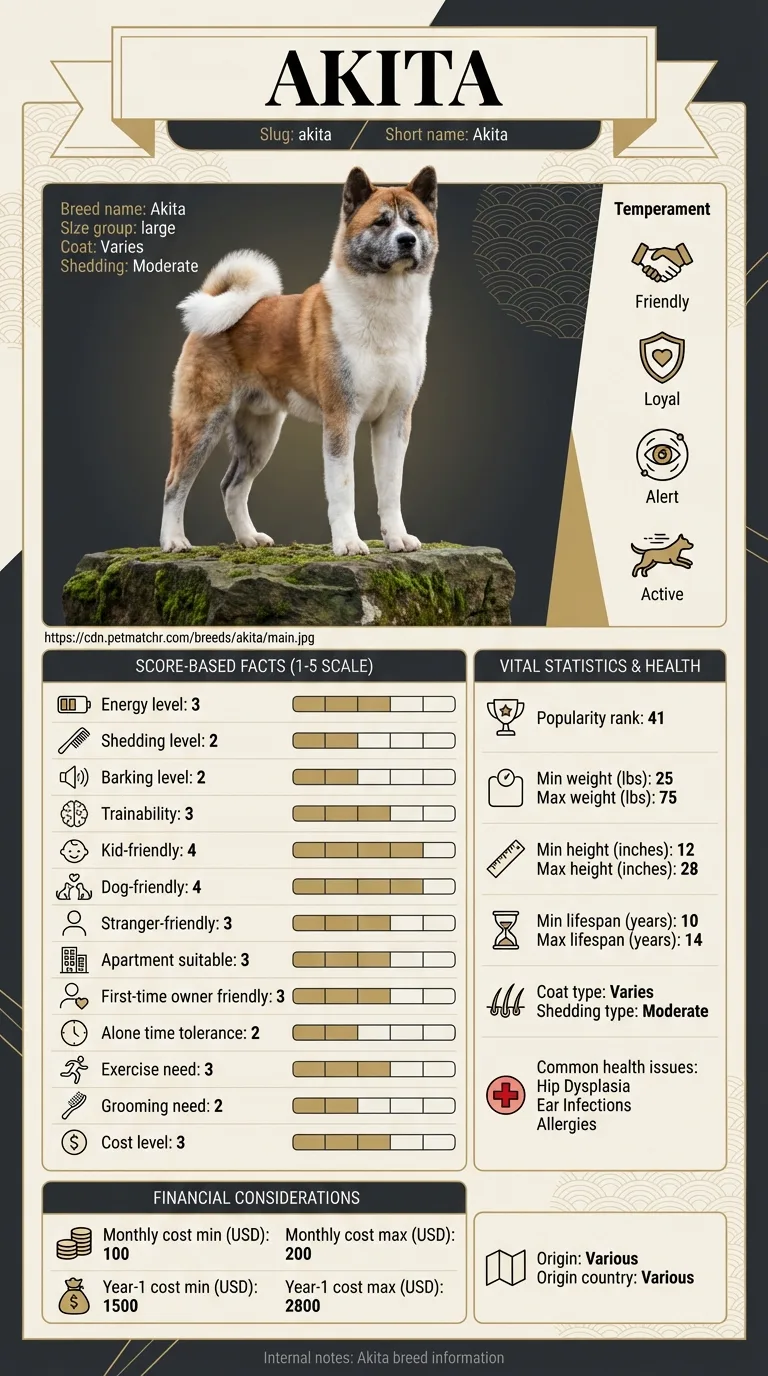
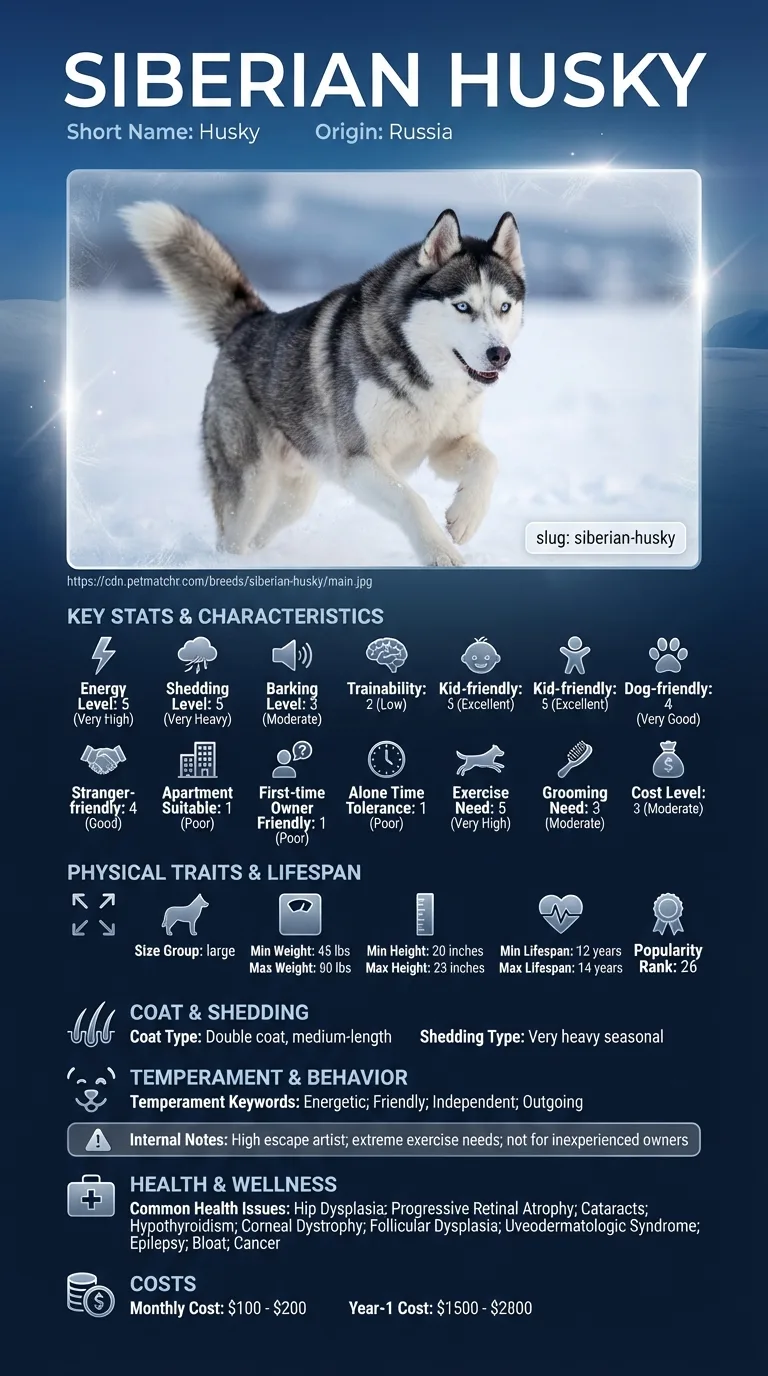
This page is for someone drawn to the northern breeds and weighing two of the best known. It covers the exercise gap, escaping and recall, an autoimmune eye and skin condition both breeds share, coat work, and cost.
The Husky is the friendlier dog and by far the more demanding one; the Akita asks for a walk and a fence, and the Husky asks for a lifestyle.
Choose the Akita if you cannot commit two hours of hard exercise a day. It needs 3/5 exercise against the Husky's 5/5, barks at 2/5 against 3/5, tolerates being alone at 3/5 against 1/5, and rates 2/5 for apartments against 1/5. You are accepting 2/5 with other dogs and strangers, and a shorter life.
Choose the Siberian Husky if you are genuinely athletic and want a sociable, cheerful dog. It rates 5/5 with children, 4/5 with other dogs and strangers, lives 12 to 14 years and costs $100–$200 a month. You are accepting 5/5 exercise, 5/5 shedding, a 1/5 tolerance for solitude, and a dog that will escape given any chance.
| Feature | akita | siberian husky | Winner |
|---|---|---|---|
| Weight | 70–130 lbs | 45–60 lbs | Equal |
| Height | 24–28 in | 20–23 in | Equal |
| Lifespan | 10–13 years | 12–14 years | siberian husky |
| Coat | Dense double coat | Medium double coat | Equal |
| Grooming need | Moderate (3/5) | Moderate (3/5) | Equal |
| Shedding | Very high (5/5) | Very high (5/5) | Equal |
| Energy level | Moderate (3/5) | Very high (5/5) | Equal |
| Exercise need | Moderate (3/5) | Very high (5/5) | akita |
| Trainability | Moderate (3/5) | Low (2/5) | akita |
| Barking | Low (2/5) | Moderate (3/5) | akita |
| Good with kids | Moderate (3/5) | Very high (5/5) | siberian husky |
| Good with other dogs | Low (2/5) | High (4/5) | siberian husky |
| Friendly to strangers | Low (2/5) | High (4/5) | siberian husky |
| Apartment suitability | Low (2/5) | Very low (1/5) | akita |
| Good for first-time owners | Very low (1/5) | Very low (1/5) | Equal |
| Tolerates being alone | Moderate (3/5) | Very low (1/5) | akita |
| Typical monthly cost | $110–$240 | $100–$200 | siberian husky |
| Typical first-year cost | $1,700–$3,200 | $1,500–$2,800 | siberian husky |
A Siberian Husky was bred to trot for hours in a team, and its 5/5 exercise rating is not decorative. Two hours a day of real work is a realistic figure, and it needs to be more than walking — running, cycling alongside, hiking, canicross or scootering all suit it.
Heat is the constraint. A double-coated northern dog cannot do that volume in a warm climate during the middle of the day, so summer exercise moves to the cool ends and long sessions are seasonal.
An under-exercised Husky is one of the most destructive dogs there is. Digging, chewing through doors and furniture, and howling are the standard outcomes, and the breed's 1/5 solitude rating compounds it — a Husky left alone and under-exercised is a rehoming waiting to happen, and it is the single most common story in Husky rescue.
The Akita at 3/5 wants forty-five to sixty minutes of walking, does not need a job, and does not deteriorate without one. Over a decade that difference is thousands of hours.
Huskies run. It is the defining practical fact about the breed and it is not a training failure.
A dog bred to cover distance does not have a strong instinct to stay near a person, and its recall in the presence of anything interesting is unreliable at 2/5 trainability. A loose Husky can be miles away in an hour, and the breed's prey drive toward cats and small animals is high.
Escaping is the related problem, and Huskies are among the most capable escape artists in dogs. They climb fences, dig under them, work at gate latches, and go through gaps that look impossible. Six-foot fencing with a dug-in base and secured gates is the baseline, and even that is not a guarantee.
The rules are therefore absolute: a long line rather than off-lead in open ground, gates checked and latched, and a microchip with current details.
The Akita needs a secure fence too, for a different reason — it is more likely to go through a boundary at another dog than over one out of wanderlust. Its recall should also be treated as conditional at all times.
Uveodermatologic syndrome appears on the Husky's condition list and belongs on the Akita's as well — it is one of the most distinctive conditions in the Akita and it appears across several northern and spitz breeds.
It is an autoimmune disease in which the body attacks its own pigment-producing cells. The eye signs come first and matter most: uveitis, or inflammation inside the eye, producing redness, squinting, cloudiness and pain, and if untreated it causes glaucoma and blindness quickly. The skin signs follow — loss of pigment around the nose, lips, eyelids and footpads, so a black nose fades to pink.
The crucial point is the order. The eye disease usually comes first, and the depigmentation that makes the diagnosis obvious often arrives later. A red, painful or cloudy eye in either breed is a same-day emergency, and prompt immunosuppressive treatment is what preserves sight.
The Husky's list also carries hip dysplasia, progressive retinal atrophy, cataracts, corneal dystrophy, hypothyroidism, follicular dysplasia, epilepsy, cancer and bloat. The Akita adds its wider autoimmune burden.
Both breeds shed at 5/5 and groom at 3/5, and the pattern is identical: undemanding for most of the year, then two or three weeks twice a year when the undercoat comes out in sheets. An undercoat rake and patience are the whole job.
Neither coat should ever be clipped. A double coat insulates against heat as well as cold, and a clipped one frequently regrows with a texture that works worse in both directions.
Both are far more comfortable in cold than in heat, and both need summer walks moved to early morning and late evening.
On money the Husky is slightly cheaper: $100–$200 a month against $110–$240, and $1,500–$2,800 against $1,700–$3,200 in the first year. It is also the smaller dog at 45 to 60 pounds.
The cost that matters is not financial. It is two hours a day, every day, for twelve to fourteen years, plus fencing that actually holds and a household that is not empty all day.
On lifespan the Husky is ahead at 12 to 14 years against 10 to 13.
Both breeds rate 1/5 for first-time owners, and it is worth being precise about why, because the two problems are not related.
The Akita is hard because of what it thinks. Reserve with strangers at 2/5, intolerance of other dogs at 2/5, and a guardian temperament that arrives at social maturity in a dog that by then weighs a hundred pounds.
The Husky is hard because of what it needs and where it goes. 5/5 energy, 5/5 exercise, 2/5 trainability, 1/5 for apartments and 1/5 for tolerating solitude. It is friendly with everyone — 5/5 with children, 4/5 with other dogs and strangers — and none of that helps when it is half a mile away and not listening.
Shedding and grooming both tie, at 5/5 and 3/5. These are the two heaviest-shedding breeds in this batch and the seasonal blow is the same operation in both.
The Akita is the quieter, more self-sufficient dog. The Husky is the more sociable and far more demanding one.

For unrelated reasons. The Akita is difficult because of what it thinks — reserve with strangers, intolerance of other dogs, and a guardian temperament that firms up at maturity. The Husky is difficult because of what it needs and where it goes: 5/5 exercise, 2/5 trainability, an unreliable recall and a serious escape instinct.
Around two hours a day of real work — running, cycling alongside, hiking, canicross or scootering — not walking. Heat is the constraint, so summer sessions move to the cool ends of the day. An under-exercised Husky digs, chews through doors and howls, and it is the most common story in Husky rescue.
In most cases, no. A breed built to cover distance has little instinct to stay near a person, and its recall is unreliable around anything interesting. A loose Husky can be miles away within the hour. Use a long line in open ground and treat recall as a bonus rather than a safety measure.
Six feet, dug in at the base, with secured gate latches — and even that is not a guarantee. Huskies climb, dig under, work at latches and squeeze through gaps that look impossible. They are among the most capable escape artists in dogs, and a standard garden fence is not adequate.
An autoimmune disease in which the body attacks its own pigment cells. Inflammation inside the eye comes first — redness, squinting, cloudiness and pain — and causes glaucoma and blindness quickly if untreated. Loss of pigment around the nose and eyelids often follows later. It appears in both these breeds.
Yes — both rate 5/5, the heaviest in this batch, with grooming tying at 3/5. Both are undemanding for most of the year and then blow their undercoat in sheets over two or three weeks, twice a year. Neither coat should ever be clipped.
The Husky, comfortably — 5/5 with children and 4/5 with other dogs against the Akita's 3/5 and 2/5. It was bred to work in teams alongside unfamiliar dogs and it is genuinely sociable. What it is not is a guard dog: it rates 4/5 with strangers and will welcome anybody.
The Husky if you are genuinely athletic, have serious fencing and someone home during the day. The Akita if you cannot commit two hours of hard exercise daily and want a self-contained dog.
The Husky runs $100–$200 a month and the Akita $110–$240, with first-year totals of $1,500–$2,800 and $1,700–$3,200. The Husky's real cost is time rather than money.
No. It rates 4/5 with strangers and will greet an intruder happily. If deterrence matters, the Akita at 2/5 is the breed doing that job — the Husky's appeal is sociability, not security.
A same-day emergency. Both are prone to autoimmune inflammation inside the eye, which causes glaucoma and blindness quickly if untreated. Prompt treatment is what preserves sight.
Secure checkout on Stripe. We never see your card.
7-day money-back guarantee. Instant access.
Health information here is general and is not veterinary advice. If your dog shows pain, sudden behaviour change, or worsening symptoms, consult a licensed veterinarian.
Some links on this site are affiliate links. We may earn a commission at no extra cost to you, and we only suggest products we believe are helpful for dog owners.
We research and check what we publish, but we do not warrant that any figure, date, price, or statement is accurate, complete, or current, and we accept no liability for any loss, cost, injury, or other harm arising from the use of this site. Use it as one reference among several. You remain responsible for your own decisions and for your dog's care - confirm anything that matters with a licensed veterinarian or another qualified professional before you act on it. Full disclaimer.
Match your lifestyle to the right dog.
Take quizNot sure which breed is right for you? Take our 2-minute quiz to find out.
Take the quiz