Living
Which one should I pick overall?
Unless you have a yard, an active schedule, and dog experience, the Schnauzer's numbers are far more forgiving across apartment fit, exercise, and alone-tolerance.

Quick answer
Which one should I pick overall?
Unless you have a yard, an active schedule, and dog experience, the Schnauzer's numbers are far more forgiving across apartment fit, exercise, and alone-tolerance.
Miniature Schnauzer or Siberian Husky? On paper they differ most on apartment suitability, and on the scales Siberian Husky is the heavier at 45–60 lbs. Here is how the two compare on everything that shapes an ordinary week.
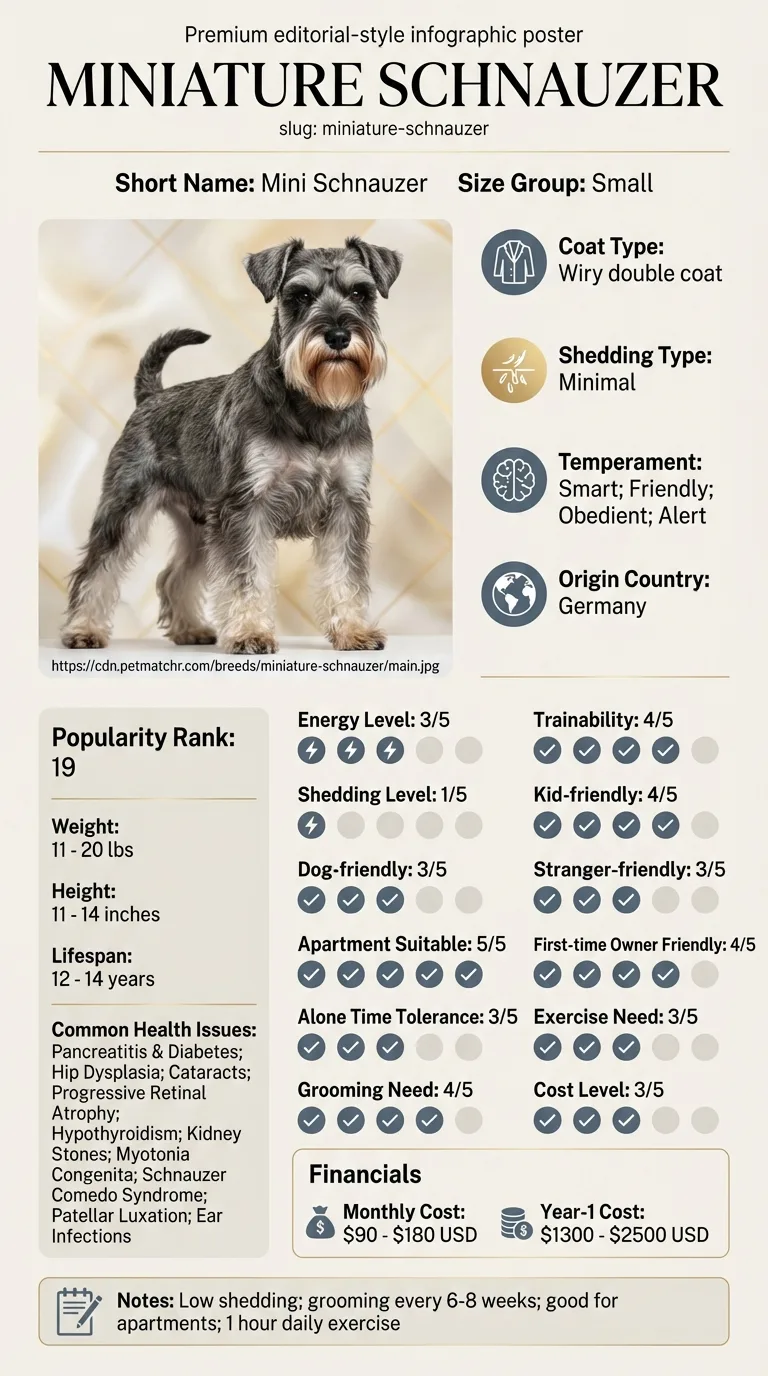
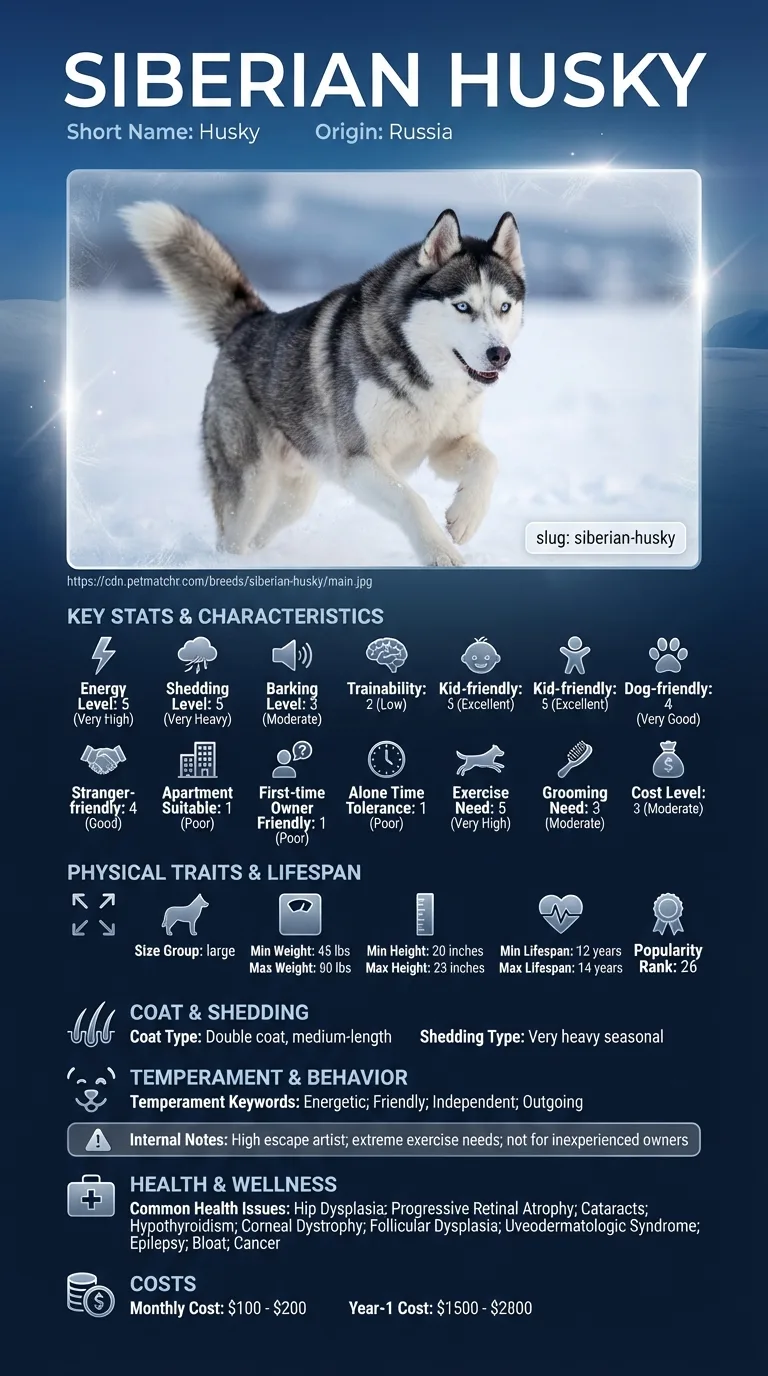
This is for someone already down to Miniature Schnauzer and Siberian Husky and deciding between them. For this pair the decision usually turns on apartment suitability and shedding, so those are covered first and in most detail. Anyone choosing from a flat has a clear answer here: Miniature Schnauzer rates 5/5 against 1/5. There is no origin story here — only what changes about your week.
Between Miniature Schnauzer and Siberian Husky, apartment suitability is what separates them, and Miniature Schnauzer is the lower-effort dog of the two to keep.
Choose Miniature Schnauzer if you are in a flat or a smaller home, this is your first dog and shedding is a problem in your house.
Choose Siberian Husky if you do not want a standing grooming appointment, there are young children at home and you already have another dog.
| Feature | miniature schnauzer | siberian husky | Winner |
|---|---|---|---|
| Size class | small | large | Equal |
| Weight | 11–20 lbs | 45–60 lbs | Equal |
| Height | 11–14 in | 20–23 in | Equal |
| Lifespan | 12–14 years | 12–14 years | Equal |
| Exercise need | Moderate (3/5) | Very high (5/5) | miniature schnauzer |
| Grooming need | High (4/5) | Moderate (3/5) | siberian husky |
| Shedding | Very low (1/5) | Very high (5/5) | miniature schnauzer |
| Energy level | Moderate (3/5) | Very high (5/5) | Equal |
| Barking | High (4/5) | Moderate (3/5) | siberian husky |
| Apartment suitability | Very high (5/5) | Very low (1/5) | miniature schnauzer |
| Good for first-time owners | High (4/5) | Very low (1/5) | miniature schnauzer |
| Tolerates being alone | Moderate (3/5) | Very low (1/5) | miniature schnauzer |
| Trainability | High (4/5) | Low (2/5) | miniature schnauzer |
| Good with kids | High (4/5) | Very high (5/5) | siberian husky |
| Good with other dogs | Moderate (3/5) | High (4/5) | siberian husky |
| Friendly to strangers | Moderate (3/5) | High (4/5) | siberian husky |
| Cost level | Moderate (3/5) | Moderate (3/5) | Equal |
| Coat | Wiry double coat | Double coat, medium-length | Equal |
| Origin | Germany | Russia | Equal |
| Typical monthly cost | $90–$180 | $100–$200 | Equal |
| Typical first-year cost | $1,300–$2,500 | $1,500–$2,800 | Equal |
The gap here is substantial: the Schnauzer's 11 to 20 lbs and 11 to 14 inches against the Husky's 45 to 60 lbs and 20 to 23 inches. Lifespan happens to tie at 12 to 14 years for both, unusual for a size difference this large, but almost nothing else in this comparison ties.
This is the biggest exercise gap in the whole comparison: the Husky rates a maximum 5/5, very high, against the Schnauzer's moderate 3/5. Huskies were bred to pull sleds for hours, and that work ethic doesn't switch off just because the dog lives in a house, plan on serious daily exercise, not a walk around the block.
Grooming effort actually favors the Husky slightly, 3/5 against the Schnauzer's 4/5, since there's no clipping or hand-stripping involved. Shedding is the opposite story entirely: the Husky rates a maximum 5/5, famous for "blowing coat" twice a year in dramatic fashion, against the Schnauzer's very low 1/5. If shedding is a dealbreaker, this comparison isn't close.
Apartment suitability is about as lopsided as this data gets, 5/5 for the Schnauzer against a very low 1/5 for the Husky. The Husky is quieter on the barking scale, 3/5 against the Schnauzer's 4/5, but that's cold comfort, Huskies are known for howling and for being determined escape artists when under-exercised in tight quarters.
The Husky rates very low for first-time owners, 1/5, the lowest score anywhere in this comparison, and low for trainability too, at 2/5. Independent, bred to problem-solve on its own out on a sled trail rather than take direction, the Husky is a genuinely demanding dog for a first-time owner to manage. The Schnauzer's steady 4/5 on both measures is a different experience entirely.
The Husky actually scores better with people and other dogs, 5/5 with kids against the Schnauzer's 4/5, 4/5 with other dogs against moderate 3/5, and 4/5 with strangers against 3/5. Huskies have a reputation as poor guard dogs precisely because they tend to like everyone, which shows up clearly in these numbers.
Lifespan ties at 12 to 14 years, but the Husky's health list runs to some conditions the Schnauzer doesn't share, including uveodermatologic syndrome and follicular dysplasia alongside more familiar risks like hip dysplasia and cataracts. The Schnauzer's own ten-condition list is different in character, pancreatitis, diabetes, and kidney stones instead of the Husky's eye and skin-focused risks.
Cost level ties at moderate for both, with the Husky running a bit higher, $100 to $200 a month against the Schnauzer's $90 to $180, and up to $2,800 in year one against $2,500. The bigger gap isn't in the dollar figures, it's in the time and yard space a Husky's exercise needs actually demand.
Miniature Schnauzer weighs 11–20 lbs and lives 12–14 years; Siberian Husky weighs 45–60 lbs and lives 12–14 years. The two diverge most on apartment suitability, shedding and good for first-time owners and 4 other rated axes. Almost every rated axis separates them at least slightly. Where the table declares a winner it means less work for the owner, nothing more; descriptive rows are left as ties on purpose. The value here is in the differences between the two columns; treat any single score as approximate.

Notably bigger, 45 to 60 lbs and 20 to 23 inches against the Schnauzer's 11 to 20 lbs and 11 to 14 inches.
The Husky, by far, a maximum 5/5 against the Schnauzer's very low 1/5. Huskies famously blow their coat twice a year.
No, it rates very low, 1/5, the lowest score in this entire comparison, against the Schnauzer's steady 4/5.
Not well, it rates very low, 1/5, against the Schnauzer's 5/5. Its 5/5 exercise need and 1/5 alone-tolerance rating are the real limiting factors.
Modest in dollar terms, $100 to $200 a month for the Husky against $90 to $180 for the Schnauzer, though the time and space costs run higher.
Some overlap, hip dysplasia, cataracts, and hypothyroidism appear on both lists, but the Husky's also includes uveodermatologic syndrome and follicular dysplasia.
Neither, lifespan ties exactly at 12 to 14 years for both.
Unless you have a yard, an active schedule, and dog experience, the Schnauzer's numbers are far more forgiving across apartment fit, exercise, and alone-tolerance.
$90 to $180 for the Schnauzer, $100 to $200 for the Husky. The real cost difference is in time and space, not dollars.
A lot, the maximum rating, 5/5, against the Schnauzer's moderate 3/5, the widest exercise gap in this batch of comparisons.
Neither, lifespan ties exactly at 12 to 14 years for both breeds.
Secure checkout on Stripe. We never see your card.
7-day money-back guarantee. Instant access.
Health information here is general and is not veterinary advice. If your dog shows pain, sudden behaviour change, or worsening symptoms, consult a licensed veterinarian.
Some links on this site are affiliate links. We may earn a commission at no extra cost to you, and we only suggest products we believe are helpful for dog owners.
We research and check what we publish, but we do not warrant that any figure, date, price, or statement is accurate, complete, or current, and we accept no liability for any loss, cost, injury, or other harm arising from the use of this site. Use it as one reference among several. You remain responsible for your own decisions and for your dog's care - confirm anything that matters with a licensed veterinarian or another qualified professional before you act on it. Full disclaimer.
Match your lifestyle to the right dog.
Take quizNot sure which breed is right for you? Take our 2-minute quiz to find out.
Take the quiz