Behavior
Needs more exercise?
Siberian Husky.

Quick answer
Needs more exercise?
Siberian Husky.
Cavalier King Charles Spaniel or Siberian Husky? On paper they differ most on apartment suitability, and on the scales Siberian Husky is the heavier at 45–60 lbs. Here is how the two compare on everything that shapes an ordinary week.
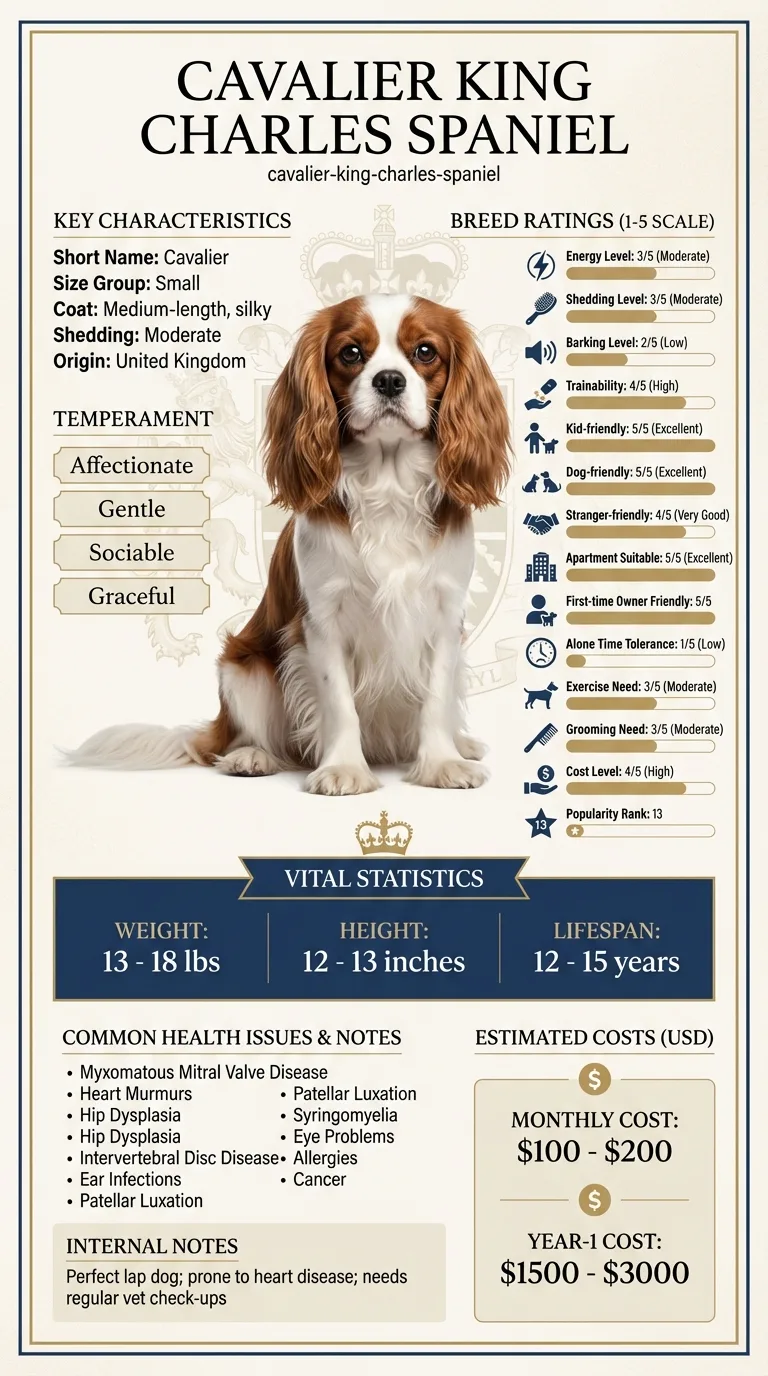
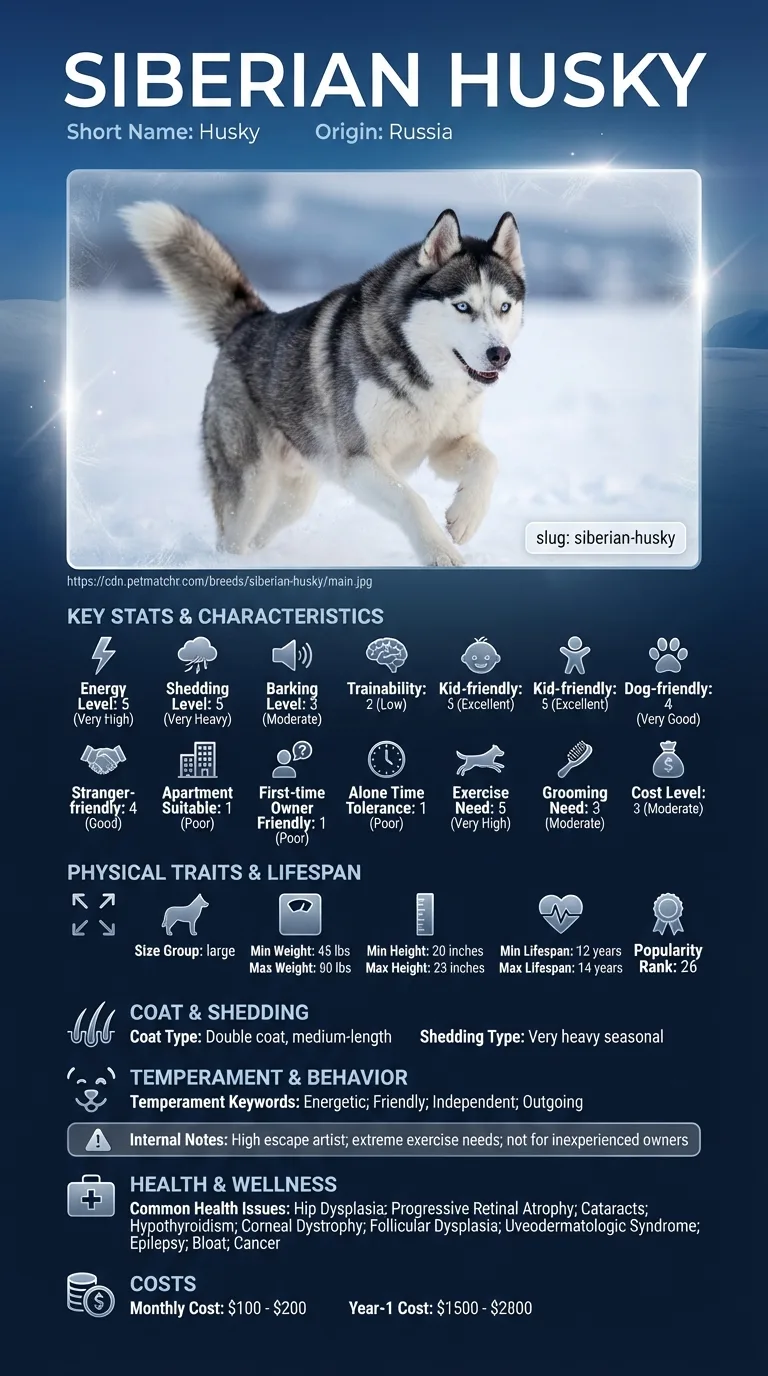
This is for someone already down to Cavalier King Charles Spaniel and Siberian Husky and deciding between them. For this pair the decision usually turns on apartment suitability and good for first-time owners, so those are covered first and in most detail. Anyone choosing from a flat has a clear answer here: Cavalier King Charles Spaniel rates 5/5 against 1/5. It is written for the decision rather than the breed history.
Between Cavalier King Charles Spaniel and Siberian Husky, apartment suitability is what separates them, and Cavalier King Charles Spaniel is the lower-effort dog of the two to keep.
Choose Cavalier King Charles Spaniel if you are in a flat or a smaller home, this is your first dog and shedding is a problem in your house.
Choose Siberian Husky if you want a dog that can keep up with an active routine.
| Feature | cavalier king charles spaniel | siberian husky | Winner |
|---|---|---|---|
| Size class | small | large | Equal |
| Weight | 13–18 lbs | 45–60 lbs | Equal |
| Height | 12–13 in | 20–23 in | Equal |
| Lifespan | 12–15 years | 12–14 years | cavalier king charles spaniel |
| Exercise need | Moderate (3/5) | Very high (5/5) | cavalier king charles spaniel |
| Grooming need | Moderate (3/5) | Moderate (3/5) | Equal |
| Shedding | Moderate (3/5) | Very high (5/5) | cavalier king charles spaniel |
| Energy level | Moderate (3/5) | Very high (5/5) | Equal |
| Barking | Low (2/5) | Moderate (3/5) | cavalier king charles spaniel |
| Apartment suitability | Very high (5/5) | Very low (1/5) | cavalier king charles spaniel |
| Good for first-time owners | Very high (5/5) | Very low (1/5) | cavalier king charles spaniel |
| Tolerates being alone | Very low (1/5) | Very low (1/5) | Equal |
| Trainability | High (4/5) | Low (2/5) | cavalier king charles spaniel |
| Good with kids | Very high (5/5) | Very high (5/5) | Equal |
| Good with other dogs | Very high (5/5) | High (4/5) | cavalier king charles spaniel |
| Friendly to strangers | High (4/5) | High (4/5) | Equal |
| Cost level | High (4/5) | Moderate (3/5) | siberian husky |
| Coat | Medium-length, silky | Double coat, medium-length | Equal |
| Origin | United Kingdom | Russia | Equal |
| Typical monthly cost | $100–$200 | $100–$200 | Equal |
| Typical first-year cost | $1,500–$3,000 | $1,500–$2,800 | Equal |
A Siberian Husky at 45-60 lbs and 20-23 inches is roughly three to four times the weight of a 13-18 lb, 12-13 inch Cavalier, putting it solidly in the large-breed category against the Cavalier's small frame. The Husky's athletic, wolf-like build and dense double coat reflect its sled-dog origins in harsh Siberian climates, engineered for endurance rather than lap-sitting. That working heritage shows up in more than looks - it shapes nearly every other category on this page, from exercise need to how well the breed tolerates apartment living.
The exercise gap here is one of the largest on this site: Moderate (3/5) for the Cavalier against Very high (5/5) for the Siberian Husky, a breed built to run for miles pulling weight through snow. An energetic, outgoing Husky that doesn't get serious daily exercise - not a stroll, but real running or sled-adjacent activity - tends to become destructive or attempt to escape, and Huskies are notorious for both digging and jumping fences. The Cavalier's moderate needs are trivial by comparison, met with a couple of ordinary walks a day.
Grooming ties at Moderate (3/5) for both breeds, but shedding tells a very different story: Moderate (3/5) for the Cavalier against Very high (5/5) for the Husky, whose thick double coat "blows" seasonally in dramatic volume. Husky owners often describe entire tumbleweeds of undercoat appearing during spring and fall shed cycles, requiring daily brushing during those windows even though the coat is otherwise fairly low-maintenance. The Cavalier's shedding is steadier and less dramatic overall, spread evenly through the year rather than concentrated into intense seasonal bursts.
Apartment suitability shows a stark gap: Very high (5/5) for the Cavalier against Very low (1/5) for the Siberian Husky, whose exercise needs and pack-oriented howling make small shared spaces genuinely difficult. Barking rates Low (2/5) for the Cavalier against Moderate (3/5) for the Husky, though Huskies are famous for howling and "talking" rather than conventional barking, a distinction that raw numbers don't fully capture. Both breeds tie at Very low (1/5) for tolerating time alone, making them equally poor choices for owners who need to leave a dog unsupervised for a full workday.
Trainability favors the Cavalier, High (4/5) against Low (2/5) for the Siberian Husky, and first-time-owner suitability shows an even steeper divide, Very high (5/5) versus Very low (1/5). An independent, energetic Husky was bred to run in a pack toward a destination, not to look to a single handler for constant direction, which makes traditional obedience training a genuine challenge. Huskies are also notorious escape artists, capable of scaling or digging under fences that would contain most other breeds, so containment planning matters as much as obedience work for a first-time Husky owner.
Good with kids ties at Very high (5/5) for both breeds, and friendly-to-strangers ties too, at High (4/5), reflecting the Husky's genuinely friendly, outgoing nature toward people despite its independent streak. The Cavalier edges ahead with other dogs, Very high (5/5) against High (4/5), though Huskies bred for pack sledding are generally quite sociable with other dogs as well. The real household consideration with a Husky isn't temperament toward family - it's whether the household can provide the sustained exercise and secure containment a Husky needs regardless of how friendly it is.
Lifespan slightly favors the Cavalier, 12-15 years against 12-14 for the Siberian Husky, though both ranges are respectable. The Husky's health list is notably eye-heavy - Progressive Retinal Atrophy, Cataracts, Corneal Dystrophy, and Uveodermatologic Syndrome all appear, alongside hip dysplasia, epilepsy, bloat, and cancer risk. The Cavalier's list instead concentrates on the heart and spine, led by Myxomatous Mitral Valve Disease and syringomyelia. A Husky owner should prioritize regular eye exams throughout the dog's life, while a Cavalier owner should prioritize cardiac screening starting relatively young.
Cost level favors the Husky, Moderate (3/5) against High (4/5) for the Cavalier, with monthly costs tying at $100-200 for both and first-year costs close as well, $1,500-3,000 versus $1,500-2,800. Despite the similar totals, the money goes to different places: a Husky's costs lean toward secure fencing, higher food volume for an active large dog, and eye-condition screening, while a Cavalier's costs lean toward cardiac monitoring and coat care. Owners comparing the two should look past the similar top-line numbers to what each breed actually needs the budget spent on.
Cavalier King Charles Spaniel weighs 13–18 lbs and lives 12–15 years; Siberian Husky weighs 45–60 lbs and lives 12–14 years. The two diverge most on apartment suitability, good for first-time owners and exercise need and 3 other rated axes. They are level on tolerates being alone, grooming need and good with kids, so those cannot decide it. In the table, a "winner" means easier for an ordinary household — not better. Size, coat and origin are recorded without a verdict. Because both breeds are scored the same way, the gaps are reliable even where the absolute numbers are rough.

Considerably more - the Husky rates Very high (5/5) against the Cavalier's Moderate (3/5).
Not generally - they rate Very low (1/5) for apartment suitability against the Cavalier's Very high (5/5).
They rate Moderate (3/5) for barking, though Huskies are more known for howling and vocalizing than conventional barking.
The Cavalier, rated High (4/5) against the Husky's Low (2/5).
No - it rates Very low (1/5) for first-time owners against the Cavalier's Very high (5/5).
The Husky, rated Very high (5/5) against the Cavalier's Moderate (3/5), especially during seasonal coat blow.
Yes - both tie at Very low (1/5) for tolerating time alone, so neither suits a full-time away-from-home schedule without support.
Siberian Husky.
Siberian Husky.
Cavalier King Charles Spaniel.
Neither breed.
Secure checkout on Stripe. We never see your card.
7-day money-back guarantee. Instant access.
Health information here is general and is not veterinary advice. If your dog shows pain, sudden behaviour change, or worsening symptoms, consult a licensed veterinarian.
Some links on this site are affiliate links. We may earn a commission at no extra cost to you, and we only suggest products we believe are helpful for dog owners.
We research and check what we publish, but we do not warrant that any figure, date, price, or statement is accurate, complete, or current, and we accept no liability for any loss, cost, injury, or other harm arising from the use of this site. Use it as one reference among several. You remain responsible for your own decisions and for your dog's care - confirm anything that matters with a licensed veterinarian or another qualified professional before you act on it. Full disclaimer.
Match your lifestyle to the right dog.
Take quizNot sure which breed is right for you? Take our 2-minute quiz to find out.
Take the quiz