Living
Which one should most people pick?
If you want a low-maintenance apartment dog, the Maltese; if you have space, time, and want an athletic companion, the Husky. The gap between them is too wide for a one-size-fits-all answer.

Quick answer
Which one should most people pick?
If you want a low-maintenance apartment dog, the Maltese; if you have space, time, and want an athletic companion, the Husky. The gap between them is too wide for a one-size-fits-all answer.
Maltese or Siberian Husky? On paper they differ most on apartment suitability, and on the scales Siberian Husky is the heavier at 45–60 lbs. Here is how the two compare on everything that shapes an ordinary week.
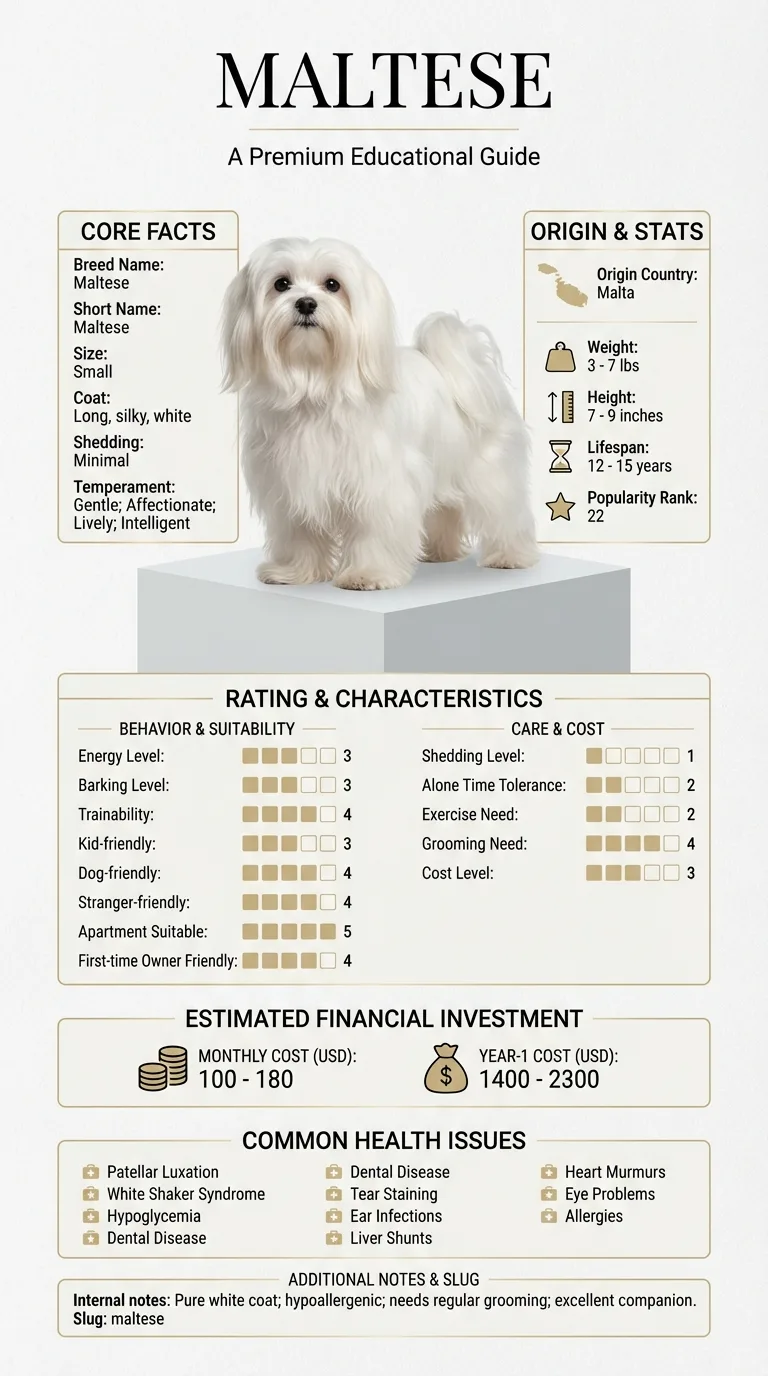
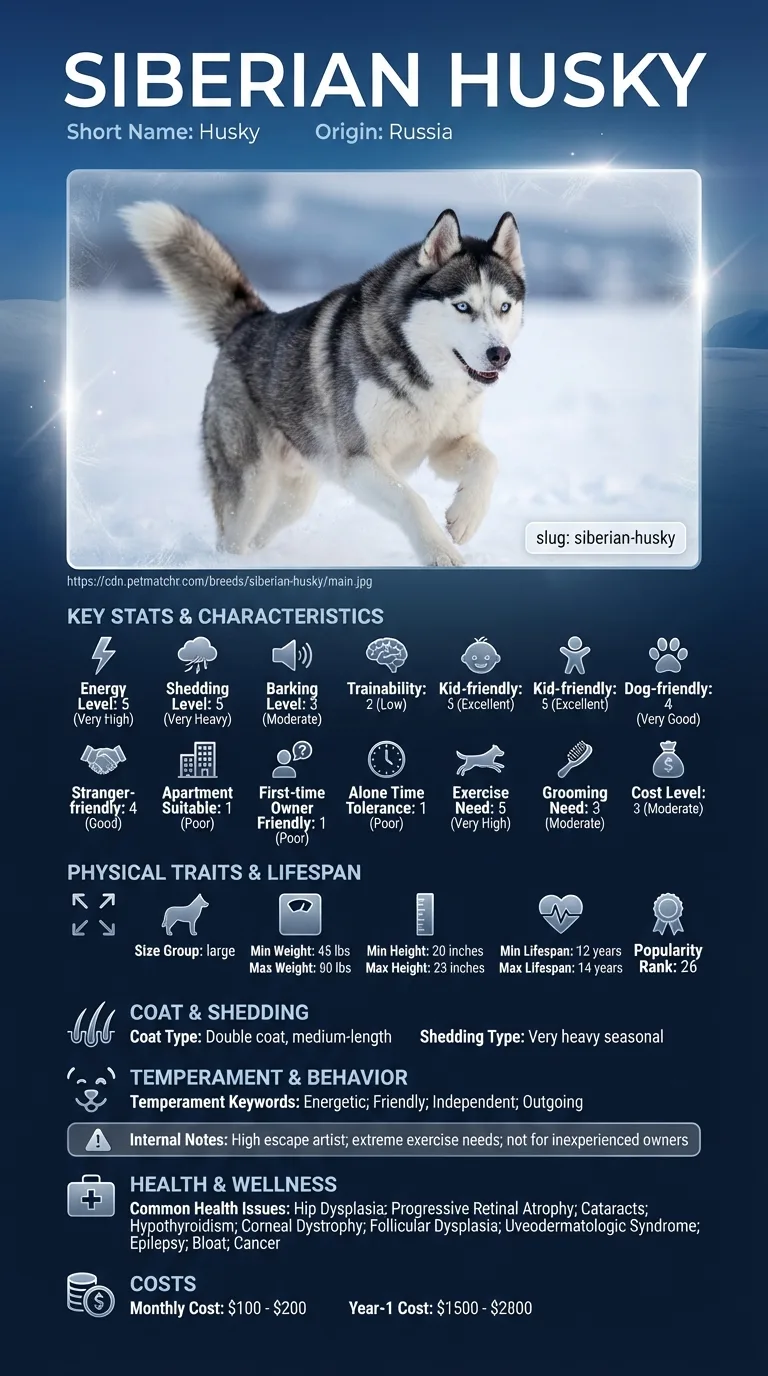
This is for someone already down to Maltese and Siberian Husky and deciding between them. For this pair the decision usually turns on apartment suitability and shedding, so those are covered first and in most detail. Anyone choosing from a flat has a clear answer here: Maltese rates 5/5 against 1/5. It is written for the decision rather than the breed history.
Between Maltese and Siberian Husky, apartment suitability is what separates them, and Maltese is the lower-effort dog of the two to keep.
Choose Maltese if you are in a flat or a smaller home, this is your first dog and shedding is a problem in your house.
Choose Siberian Husky if you do not want a standing grooming appointment, there are young children at home and you want a dog that can keep up with an active routine.
| Feature | maltese | siberian husky | Winner |
|---|---|---|---|
| Size class | small | large | Equal |
| Weight | 3–7 lbs | 45–60 lbs | Equal |
| Height | 7–9 in | 20–23 in | Equal |
| Lifespan | 12–15 years | 12–14 years | maltese |
| Exercise need | Low (2/5) | Very high (5/5) | maltese |
| Grooming need | High (4/5) | Moderate (3/5) | siberian husky |
| Shedding | Very low (1/5) | Very high (5/5) | maltese |
| Energy level | Moderate (3/5) | Very high (5/5) | Equal |
| Barking | Moderate (3/5) | Moderate (3/5) | Equal |
| Apartment suitability | Very high (5/5) | Very low (1/5) | maltese |
| Good for first-time owners | High (4/5) | Very low (1/5) | maltese |
| Tolerates being alone | Low (2/5) | Very low (1/5) | maltese |
| Trainability | High (4/5) | Low (2/5) | maltese |
| Good with kids | Moderate (3/5) | Very high (5/5) | siberian husky |
| Good with other dogs | High (4/5) | High (4/5) | Equal |
| Friendly to strangers | High (4/5) | High (4/5) | Equal |
| Cost level | Moderate (3/5) | Moderate (3/5) | Equal |
| Coat | Long, silky, white | Double coat, medium-length | Equal |
| Origin | Malta | Russia | Equal |
| Typical monthly cost | $100–$180 | $100–$200 | Equal |
| Typical first-year cost | $1,400–$2,300 | $1,500–$2,800 | Equal |
Maltese tops out at 7 lbs, standing 7-9 inches; the Husky runs 45-60 lbs and 20-23 inches. That's roughly an eight-to-one weight gap, one of the widest pairings on this site. A Husky puppy will outweigh a full-grown Maltese within a couple of months. These two occupy entirely different categories, toy companion versus working sled dog, and that shows up in everything from leash strength needed to crate size.
Maltese scores a low 2/5 for exercise need; the Husky sits at the top of the scale, 5/5. A short leash walk and some indoor play covers a Maltese's day. A Husky bred to pull sleds for miles needs real daily mileage; a walk around the block won't touch it. Energy level tells the same story: Maltese moderate (3/5), Husky very high (5/5).
Grooming need actually favors the Husky here, 3/5 versus the Maltese's 4/5, because that long silky white coat mats and needs regular brushing and trimming to stay presentable. Shedding flips hard: Maltese sits at a very low 1/5, while the Husky's double coat blows out seasonally at 5/5. If you can't handle fur on furniture, the Husky is the harder sell despite its lower grooming score.
Apartment suitability could not be more different: Maltese rates 5/5, Husky 1/5. Both breeds score a moderate 3/5 for barking, so noise complaints aren't the deciding factor; space and exercise access are. Neither dog tolerates being left alone well, Maltese 2/5, Husky an even lower 1/5, so long solo workdays are a problem with either one.
The Maltese rates high for first-time owners (4/5) and trains easily (4/5), a combination that makes it a forgiving choice for someone who has never managed a dog's obedience work before. The Husky is the opposite on both counts, 1/5 for first-time owners and 2/5 for trainability, reflecting its independent streak and instinct to run rather than a lack of intelligence. A Husky that gets loose off-leash is a real recovery risk given that low trainability score; a Maltese is not.
With kids the Husky actually wins outright, rated very high (5/5) against the Maltese's moderate 3/5; Huskies are known for patience with children despite their size and pulling strength. Both breeds score identically well with other dogs (4/5) and with strangers (4/5), so neither is a good guard-dog pick despite the size difference, and both can be socialized around a busy household without much trouble.
Maltese live longer on average, 12-15 years against the Husky's 12-14, a modest but consistent edge at both ends of the range. Their health lists don't overlap at all: Maltese owners watch for patellar luxation, hypoglycemia, and liver shunts, while Husky owners deal with hip dysplasia, progressive retinal atrophy, and a higher cancer risk, plus autoimmune skin conditions. Neither list is short, but they point to very different vet visits and different pet insurance considerations.
Monthly costs land close together, $100-180 for the Maltese versus $100-200 for the Husky, and both carry a moderate 3/5 cost rating overall. First-year costs show more separation, $1,400-2,300 for the Maltese against $1,500-2,800 for the Husky, largely a function of the Husky's size and higher food volume. Neither breed carries the steep expense of a giant or heavily-groomed toy breed.
Maltese weighs 3–7 lbs and lives 12–15 years; Siberian Husky weighs 45–60 lbs and lives 12–14 years. The two diverge most on apartment suitability, shedding and exercise need and 4 other rated axes. They are level on barking, cost level and good with other dogs, so those cannot decide it. In the table, a "winner" means easier for an ordinary household — not better. Size, coat and origin are recorded without a verdict. Because both breeds are scored the same way, the gaps are reliable even where the absolute numbers are rough.

The Husky is dramatically larger, 45-60 lbs and 20-23 inches tall, compared to the Maltese's 3-7 lbs and 7-9 inches. There's no overlap between the two size ranges at all.
The Husky, by a wide margin, it rates 5/5 for shedding against the Maltese's 1/5. The Husky's double coat blows out seasonally and leaves fur everywhere; the Maltese barely sheds.
The Maltese is; it rates 4/5 for first-time owners and 4/5 for trainability. The Husky rates just 1/5 and 2/5 on those same measures, and its independent streak makes it a harder breed to start with.
The Maltese, rated 5/5 for apartment suitability against the Husky's 1/5. The Husky's very high exercise need (5/5) and low tolerance for being alone (1/5) both work against small-space living.
They're close, $100-180 for the Maltese and $100-200 for the Husky, with both rated a moderate 3/5 for overall cost level.
Not based on their listed conditions. The Maltese's list (patellar luxation, hypoglycemia, liver shunts, heart murmurs) and the Husky's (hip dysplasia, PRA, epilepsy, bloat) don't overlap, so there's no shared condition to watch for across both.
The Maltese, by about a year at the top end, 12-15 years versus the Husky's 12-14.
If you want a low-maintenance apartment dog, the Maltese; if you have space, time, and want an athletic companion, the Husky. The gap between them is too wide for a one-size-fits-all answer.
Minimal, $100-180 for the Maltese versus $100-200 for the Husky, both rated moderate (3/5) on cost.
The Maltese needs very little (2/5); the Husky needs a lot (5/5), daily real exercise, not just a walk.
The Maltese, 12-15 years against the Husky's 12-14, though the difference is small.
Secure checkout on Stripe. We never see your card.
7-day money-back guarantee. Instant access.
Health information here is general and is not veterinary advice. If your dog shows pain, sudden behaviour change, or worsening symptoms, consult a licensed veterinarian.
Some links on this site are affiliate links. We may earn a commission at no extra cost to you, and we only suggest products we believe are helpful for dog owners.
We research and check what we publish, but we do not warrant that any figure, date, price, or statement is accurate, complete, or current, and we accept no liability for any loss, cost, injury, or other harm arising from the use of this site. Use it as one reference among several. You remain responsible for your own decisions and for your dog's care - confirm anything that matters with a licensed veterinarian or another qualified professional before you act on it. Full disclaimer.
Match your lifestyle to the right dog.
Take quizNot sure which breed is right for you? Take our 2-minute quiz to find out.
Take the quiz