Labradoodle vs Siberian Husky: Which Suits Your Home?
Quick answer
Labradoodle or Siberian Husky — which should a first-time owner get?
The Labradoodle, without much competition — its 5/5 trainability and 4/5 first-time-owner rating against the Husky's 2/5 and 1/5 make it the far safer choice for someone new to dogs.
Labradoodle or Siberian Husky? On paper they differ most on shedding, and on the scales Siberian Husky is the heavier at 45–60 lbs. Here is how the two compare on everything that shapes an ordinary week.
This is for someone already down to Labradoodle and Siberian Husky and deciding between them. For this pair the decision usually turns on shedding and good for first-time owners, so those are covered first and in most detail. Anyone choosing from a flat has a clear answer here: Labradoodle rates 2/5 against 1/5. Breed history is left out; what follows is what you will actually live with.
Quick verdict
Between Labradoodle and Siberian Husky, shedding is what separates them, and Labradoodle is the lower-effort dog of the two to keep.
Choose labradoodle if...
Choose Labradoodle if this is your first dog, shedding is a problem in your house and you want a dog that picks up training quickly.
Choose siberian husky if...
Choose Siberian Husky if you do not want a standing grooming appointment.
Head-to-head comparison
Feature
labradoodle
siberian husky
Winner
Size class
medium
large
Equal
Weight
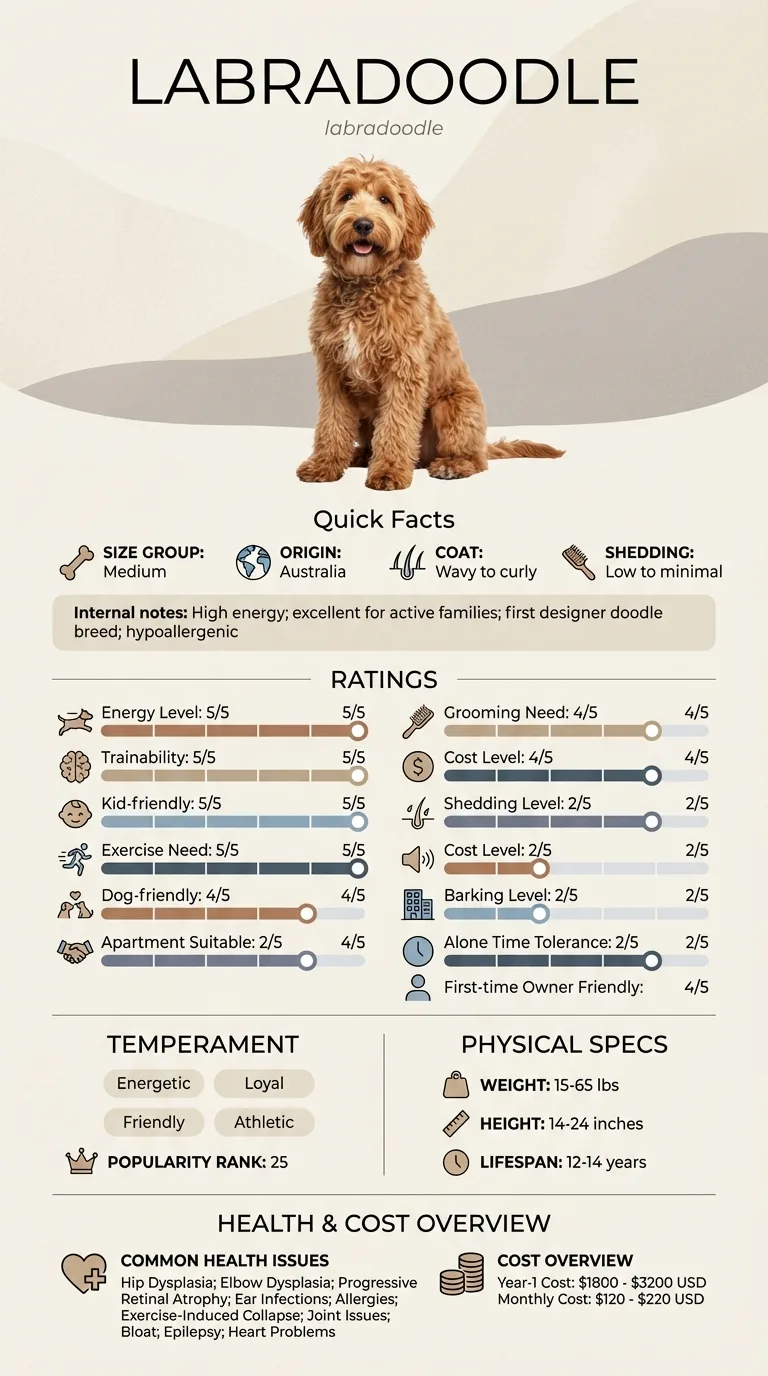
15–65 lbs
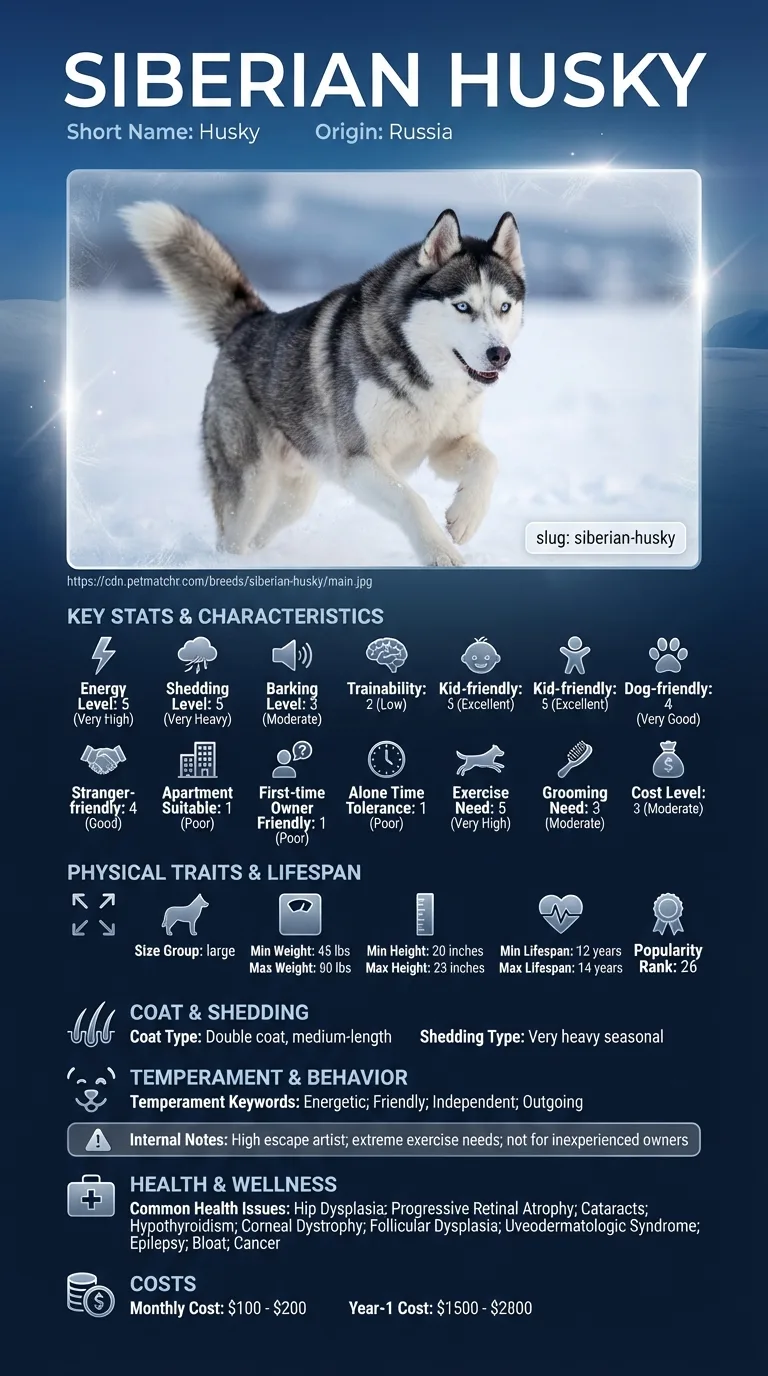
45–60 lbs
Equal
Height
14–24 in
20–23 in
Equal
Lifespan
12–14 years
12–14 years
Equal
Exercise need
Very high (5/5)
Very high (5/5)
Equal
Grooming need
High (4/5)
Moderate (3/5)
siberian husky
Shedding
Low (2/5)
Very high (5/5)
labradoodle
Energy level
Very high (5/5)
Very high (5/5)
Equal
Barking
Low (2/5)
Moderate (3/5)
labradoodle
Apartment suitability
Low (2/5)
Very low (1/5)
labradoodle
Good for first-time owners
High (4/5)
Very low (1/5)
labradoodle
Tolerates being alone
Low (2/5)
Very low (1/5)
labradoodle
Trainability
Very high (5/5)
Low (2/5)
labradoodle
Good with kids
Very high (5/5)
Very high (5/5)
Equal
Good with other dogs
High (4/5)
High (4/5)
Equal
Friendly to strangers
High (4/5)
High (4/5)
Equal
Cost level
High (4/5)
Moderate (3/5)
siberian husky
Coat
Wavy to curly
Double coat, medium-length
Equal
Origin
Australia
Russia
Equal
Typical monthly cost
$120–$220
$100–$200
Equal
Typical first-year cost
$1,800–$3,200
$1,500–$2,800
Equal
Deep dive
Size and build
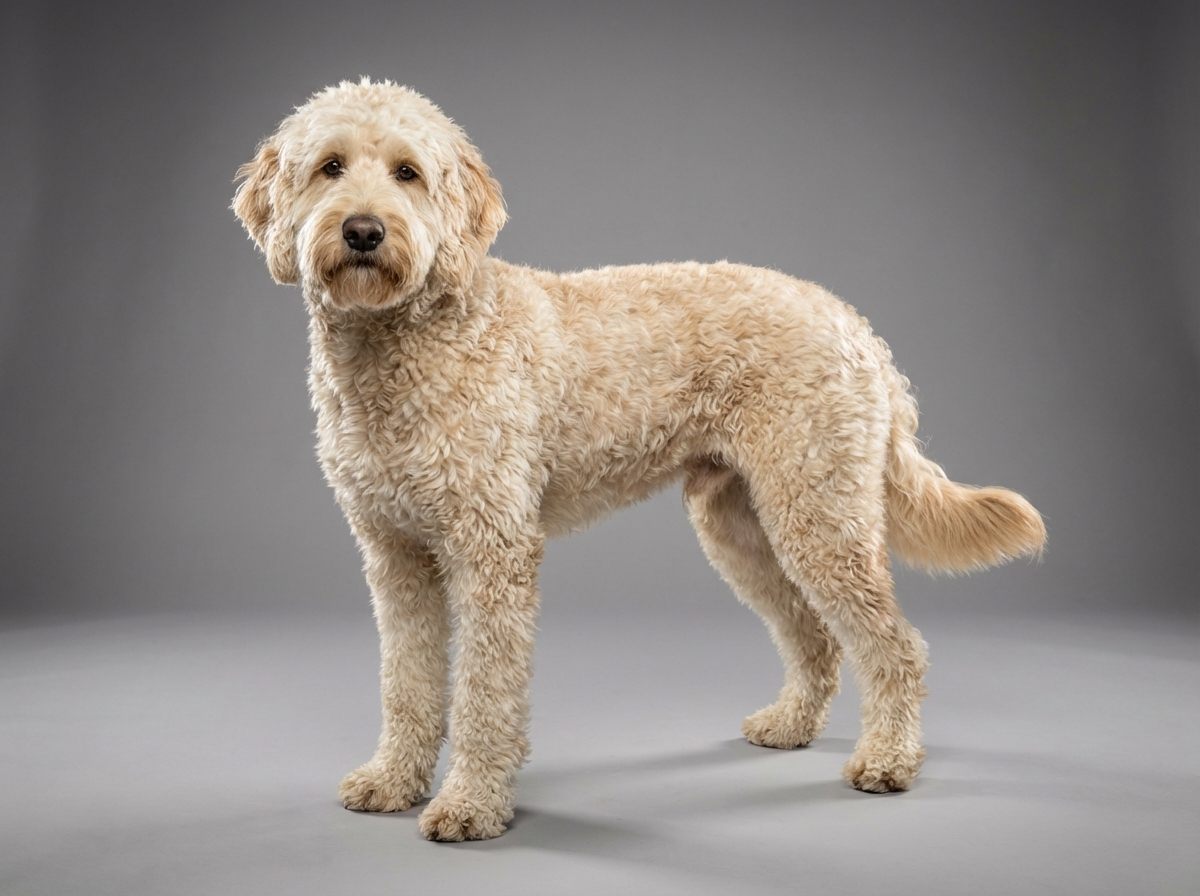
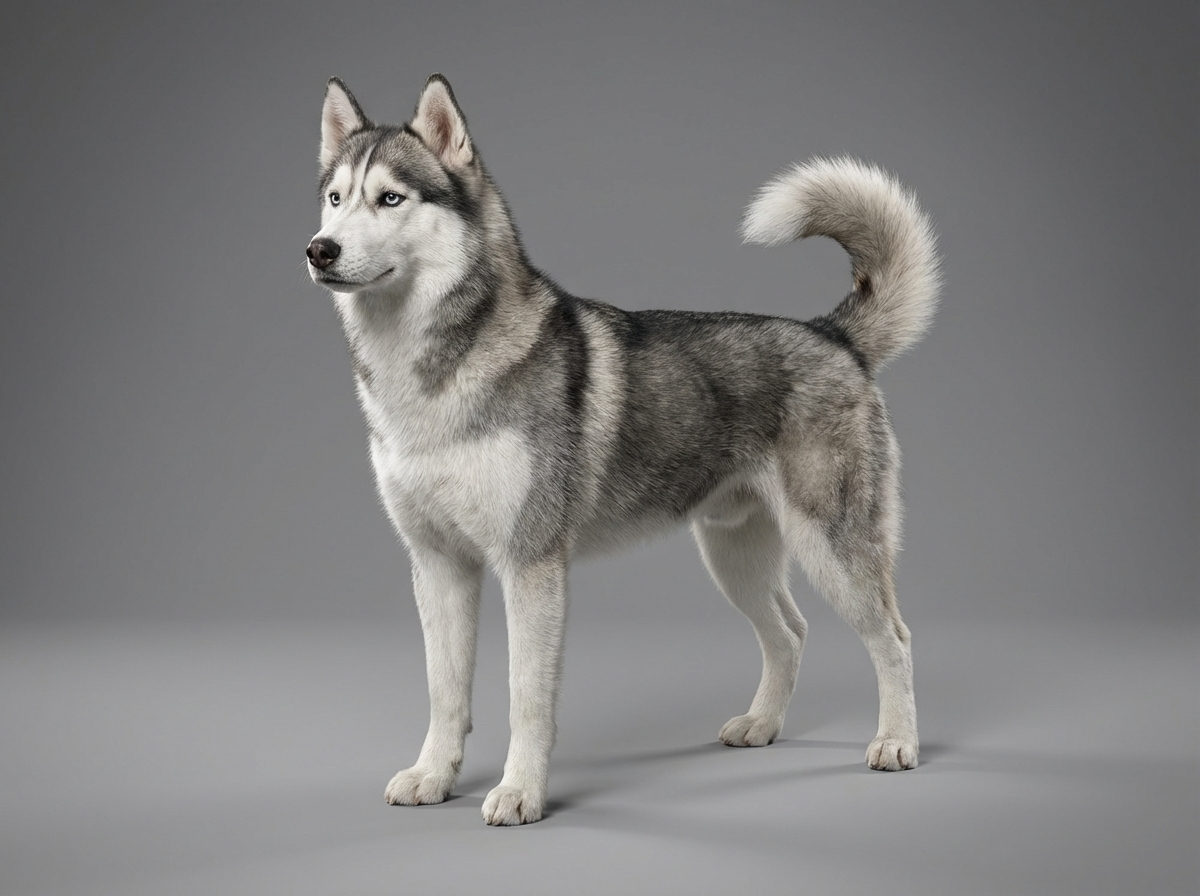
Weight ranges overlap more than you'd think — a large Labradoodle and a Siberian Husky can both land around 55-60 lbs — but the breeds' averages sit apart: 15-65 lbs and 14-24 inches for the Labradoodle against a tighter 45-60 lbs and 20-23 inches for the Husky. The Husky is the more consistently medium-large dog; the Labradoodle's range depends entirely on which size variety you get.
Energy and exercise
Exercise need ties at 5/5 for both breeds, and energy level ties too. Neither is a low-key dog. The real difference shows up in how that energy gets used: a Husky was bred to run for miles pulling weight, and without that outlet it tends toward destructive behavior faster than a Labradoodle does. Matching either breed means genuinely daily, vigorous activity — not a stroll around the block.
Grooming and shedding
The Husky needs less brushing overall (3/5 grooming) than the Labradoodle's curlier coat (4/5), but don't let that fool you on shedding — the Husky rates a full 5/5, with seasonal coat blows that leave fur everywhere, against the Labradoodle's low 2/5. If you're picking based on vacuum time, the Labradoodle wins clearly despite its higher grooming score.
Apartment living, noise and time alone
Both breeds score poorly for apartment life — 2/5 for the Labradoodle, an even lower 1/5 for the Husky — and both struggle badly with being left alone, 2/5 and 1/5 respectively. The Husky edges toward more vocal behavior too, including its well-known tendency to howl rather than bark. Neither dog is a realistic pick for long solo workdays in a small space.
Training and owner experience
This is the sharpest divide in the whole comparison. The Labradoodle rates 4/5 for first-time owners and 5/5 for trainability. The Husky rates just 1/5 and 2/5 on those same measures — it's an intelligent breed but an independent one, bred to think for itself on the trail rather than take direction. A first-dog owner is taking on real risk with a Husky.
Kids, other dogs and visitors
Good with kids ties at 5/5 for both. Other dogs and strangers also land close — 4/5 for the Husky, 4/5 for the Labradoodle on both. Socially, these breeds are more alike than different; the gap between them is almost entirely about trainability and independence, not friendliness. A well-socialized Husky can be just as warm with visitors — getting it well-socialized is the harder part.
Health and lifespan
Lifespan ties at 12-14 years. Hip dysplasia, progressive retinal atrophy, epilepsy, and bloat show up on both breeds' lists. The Husky's list also includes several eye conditions — cataracts and corneal dystrophy among them — plus cancer risk, while the Labradoodle carries elbow dysplasia and exercise-induced collapse that the Husky doesn't. Ask any breeder about eye testing regardless of which you choose.
Cost to keep
The Husky is the cheaper breed on paper — cost level 3/5 against the Labradoodle's 4/5, monthly costs of $100-200 versus $120-220, and a first year of $1,500-2,800 versus $1,800-3,200. Food volume is comparable given their overlapping weight ranges; the Labradoodle's higher grooming bill accounts for most of the gap.
Labradoodle vs Siberian Husky at a glance
Labradoodle weighs 15–65 lbs and lives 12–14 years; Siberian Husky weighs 45–60 lbs and lives 12–14 years. The two diverge most on shedding, good for first-time owners and trainability. They are level on good with other dogs, energy level and exercise need, so those cannot decide it. The comparison marks an easier option only where one exists. Facts like weight and country of origin are not scored. Both dogs are rated from the same dataset, which is what makes the numbers comparable with each other even though any individual dog sits somewhere inside its breed's range.
Labradoodle vs Siberian Husky: Which Suits Your Home? - Labradoodle vs Siberian Husky at a glance
Frequently asked questions
Is a Husky a good first dog?
Not really — it rates just 1/5 for first-time owners and 2/5 for trainability, reflecting its independent, escape-prone nature. The Labradoodle, at 4/5 and 5/5 respectively, is the far more forgiving choice for someone new to dog ownership.
Which breed sheds more?
The Husky, by a wide margin — 5/5 against the Labradoodle's 2/5. Its double coat blows out seasonally and needs regular brushing to manage the volume.
Do either of these fit apartment living?
Not comfortably. The Labradoodle rates 2/5 for apartment suitability and the Husky an even lower 1/5. Both also tolerate being alone poorly, so neither suits a small space with long workday absences.
How much exercise does each need?
Both breeds max out the scale at 5/5 for exercise need. Real, daily, vigorous activity is non-negotiable for either — this isn't a once-a-week jog situation.
Are they good with kids?
Yes, both rate 5/5 for being good with kids, making this one of the few places these breeds are equally strong.
What health conditions do they have in common?
Hip dysplasia, progressive retinal atrophy, epilepsy, and bloat appear on both lists. The Husky adds more eye-related conditions and cancer risk to its profile.
Which costs less to own?
The Husky, at $100-200 a month against the Labradoodle's $120-220, and a lower first-year total too. The difference mostly comes down to grooming.
Labradoodle or Siberian Husky — which should a first-time owner get?
The Labradoodle, without much competition — its 5/5 trainability and 4/5 first-time-owner rating against the Husky's 2/5 and 1/5 make it the far safer choice for someone new to dogs.
Costs
What's the monthly cost?
$120-220 for a Labradoodle, $100-200 for a Husky — both landing in similar territory, with grooming as the main variable.
Living
How much exercise do they need?
Both need serious daily exercise — each rates a full 5/5. Neither is suited to a sedentary household.
Health
Which lives longer?
Neither — both share the same 12-14 year lifespan range.
Related DogBreedCompass guides
Labradoodle breed guide – Readers comparing the two usually want the full profile of Labradoodle before deciding.
Siberian Husky breed guide – The same for Siberian Husky, so the comparison can be checked against the detail.
Labradoodle vs Bernedoodle – Bernedoodle is the closest breed to Labradoodle on the measured axes, so it is the natural next comparison.
Health information here is general and is not veterinary advice. If your dog shows pain, sudden behaviour change, or worsening symptoms, consult a licensed veterinarian.
Some links on this site are affiliate links. We may earn a commission at no extra cost to you, and we only suggest products we believe are helpful for dog owners.
We research and check what we publish, but we do not warrant that any figure, date, price, or statement is accurate, complete, or current, and we accept no liability for any loss, cost, injury, or other harm arising from the use of this site. Use it as one reference among several. You remain responsible for your own decisions and for your dog's care - confirm anything that matters with a licensed veterinarian or another qualified professional before you act on it. Full disclaimer.