Living
Havanese or Siberian Husky -- which fits your life?
Choose the Havanese unless you can genuinely commit to a Husky's very high exercise needs -- its 5/5 rating there and 1/5 first-time-owner score are hard to talk yourself around.

Quick answer
Havanese or Siberian Husky -- which fits your life?
Choose the Havanese unless you can genuinely commit to a Husky's very high exercise needs -- its 5/5 rating there and 1/5 first-time-owner score are hard to talk yourself around.
Havanese or Siberian Husky? On paper they differ most on apartment suitability, and on the scales Siberian Husky is the heavier at 45–60 lbs. Here is how the two compare on everything that shapes an ordinary week.
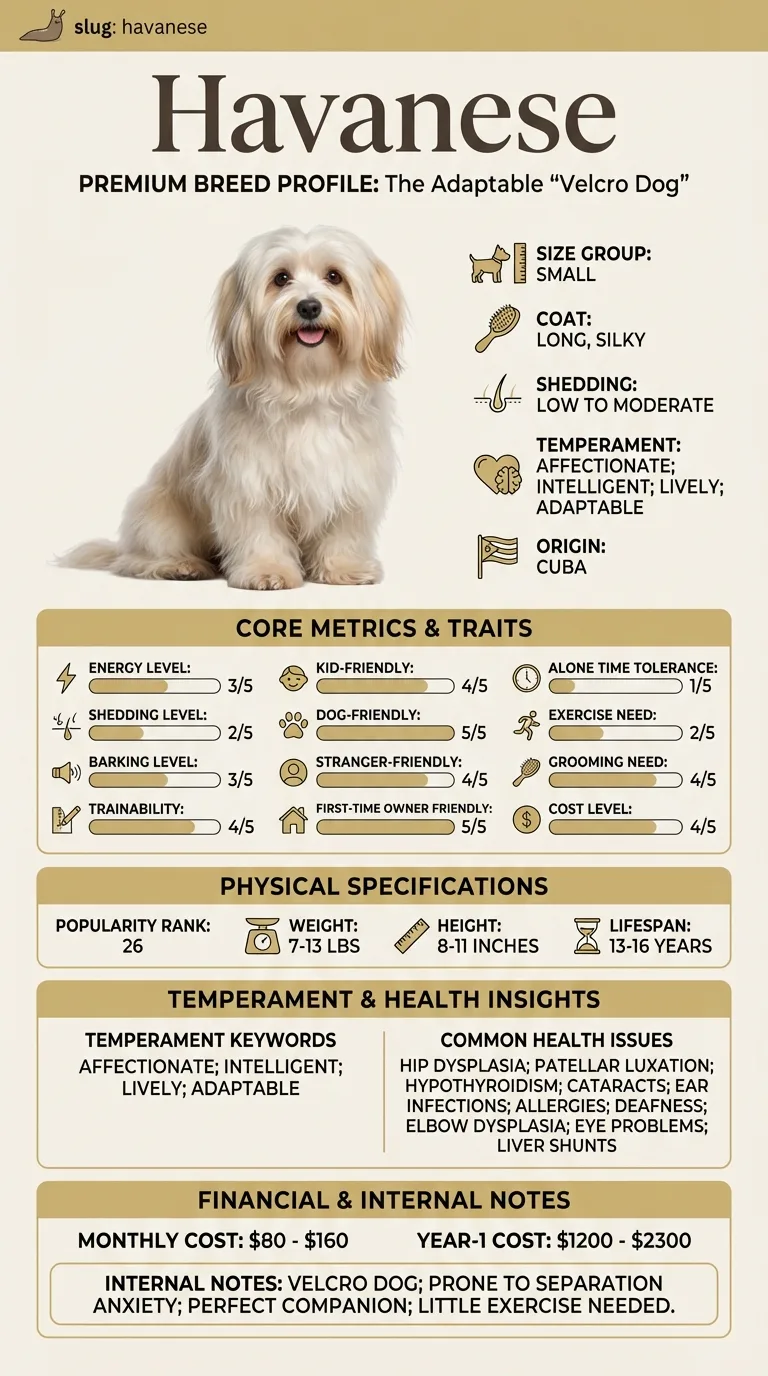
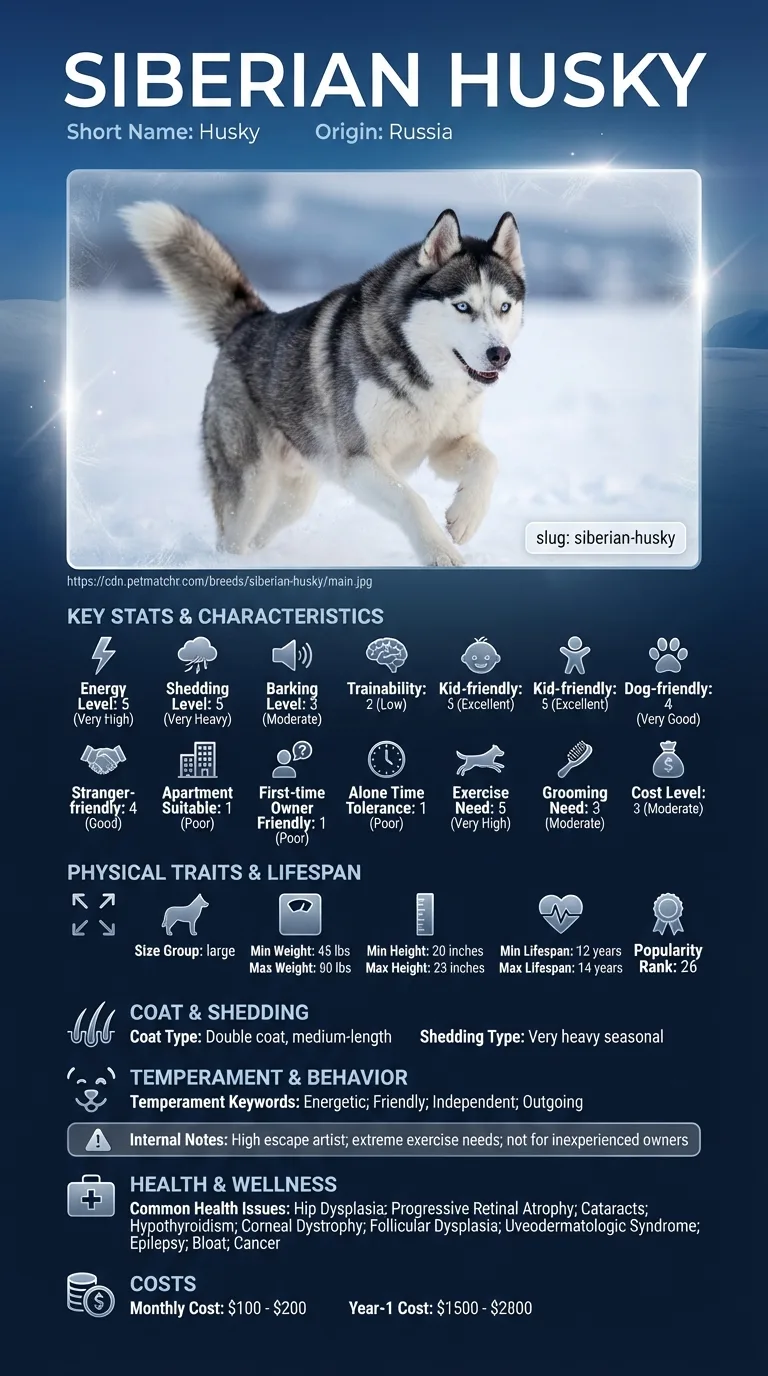
This is for someone already down to Havanese and Siberian Husky and deciding between them. For this pair the decision usually turns on apartment suitability and good for first-time owners, so those are covered first and in most detail. Anyone choosing from a flat has a clear answer here: Havanese rates 5/5 against 1/5. It is written for the decision rather than the breed history.
Between Havanese and Siberian Husky, apartment suitability is what separates them, and Havanese is the lower-effort dog of the two to keep.
Choose Havanese if you are in a flat or a smaller home, this is your first dog and shedding is a problem in your house.
Choose Siberian Husky if you do not want a standing grooming appointment, there are young children at home and you want a dog that can keep up with an active routine.
| Feature | havanese | siberian husky | Winner |
|---|---|---|---|
| Size class | small | large | Equal |
| Weight | 7–13 lbs | 45–60 lbs | Equal |
| Height | 8–11 in | 20–23 in | Equal |
| Lifespan | 13–16 years | 12–14 years | havanese |
| Exercise need | Low (2/5) | Very high (5/5) | havanese |
| Grooming need | High (4/5) | Moderate (3/5) | siberian husky |
| Shedding | Low (2/5) | Very high (5/5) | havanese |
| Energy level | Moderate (3/5) | Very high (5/5) | Equal |
| Barking | Moderate (3/5) | Moderate (3/5) | Equal |
| Apartment suitability | Very high (5/5) | Very low (1/5) | havanese |
| Good for first-time owners | Very high (5/5) | Very low (1/5) | havanese |
| Tolerates being alone | Very low (1/5) | Very low (1/5) | Equal |
| Trainability | High (4/5) | Low (2/5) | havanese |
| Good with kids | High (4/5) | Very high (5/5) | siberian husky |
| Good with other dogs | Very high (5/5) | High (4/5) | havanese |
| Friendly to strangers | High (4/5) | High (4/5) | Equal |
| Cost level | High (4/5) | Moderate (3/5) | siberian husky |
| Coat | Long, silky | Double coat, medium-length | Equal |
| Origin | Cuba | Russia | Equal |
| Typical monthly cost | $80–$160 | $100–$200 | Equal |
| Typical first-year cost | $1,200–$2,300 | $1,500–$2,800 | Equal |
The Husky is a substantially larger dog, 45-60 lbs and 20-23 inches against the Havanese's 7-13 lbs and 8-11 inches, built for endurance work, not lap-sitting. Its medium-length double coat and athletic frame reflect a working history pulling sleds across long distances in Russia, a background that shapes nearly every behavioral score that follows, from exercise need to how well it tolerates a small apartment.
This is the defining gap in the whole comparison: exercise need rates 5/5, very high, for the Husky against 2/5 for the Havanese, and energy level follows the same pattern, very high versus moderate. A Husky bred for pulling sleds over distance needs an owner who can actually meet that demand, not just intend to. Its "Energetic" temperament tag isn't marketing language here -- it's a direct match to the highest exercise-need rating this comparison produces.
The Havanese needs slightly more day-to-day grooming, 4/5 vs 3/5, but the Husky sheds dramatically more, 5/5, the top of the scale, against the Havanese's 2/5. Between brushing frequency and shedding volume, both breeds ask something of you, just different somethings. Huskies are known for intense seasonal coat blows on top of that baseline shedding, so expect uneven grooming demands across the year rather than a steady routine.
Havanese scores 5/5 for apartment life, the Husky just 1/5, the lowest on this scale. Barking is rated the same, moderate, for both, so it's the Husky's exercise needs and size driving that gap, not noise. A Husky confined to a small space without adequate daily exercise is a common source of destructive behavior, which is really what this low apartment score is warning against.
Havanese trains higher, 4/5 vs 2/5, and rates far better for first-time owners, 5/5 vs 1/5, the lowest possible score. Huskies are intelligent but "Independent" working dogs, and that combination makes them a genuinely demanding first pet -- smart enough to problem-solve their way out of poor containment, independent enough to ignore commands that don't interest them. Recall training in particular is a well-known challenge for the breed.
The Husky actually scores higher with kids, 5/5 vs 4/5, and both are rated equally friendly to strangers (4/5). The Havanese leads with other dogs, 5/5 vs 4/5. Neither tolerates being left alone well -- both rate a rock-bottom 1/5, a shared weak point despite everything else that separates them. That shared low score is worth sitting with: even a highly social, family-friendly Husky isn't a dog you can leave alone all day any more than a Havanese is.
The Havanese lives somewhat longer, 13-16 years vs 12-14 for the Husky. The Husky's ten-condition health list includes several eye-specific conditions, corneal dystrophy and uveodermatologic syndrome among them, alongside more common issues like hip dysplasia and hypothyroidism. Those eye conditions are relatively specific to the breed, so a vet unfamiliar with Huskies may not think to screen for them without prompting.
Costs run close in dollar terms: $80-160 monthly for the Havanese versus $100-200 for the Husky, and $1,200-2,300 against $1,500-2,800 in the first year, though the cost-tier rating favors the Havanese, 4/5, over the Husky, 3/5, likely reflecting the Havanese's steeper grooming bills relative to its size. A Husky's real hidden cost is usually secure fencing and containment given how far the breed's exercise needs can push it to roam.
Havanese weighs 7–13 lbs and lives 13–16 years; Siberian Husky weighs 45–60 lbs and lives 12–14 years. The two diverge most on apartment suitability, good for first-time owners and exercise need and 3 other rated axes. They are level on tolerates being alone, barking and friendly to strangers, so those cannot decide it. In the table, a "winner" means easier for an ordinary household — not better. Size, coat and origin are recorded without a verdict. Because both breeds are scored the same way, the gaps are reliable even where the absolute numbers are rough.

A lot -- rated 5/5, very high, against the Havanese's 2/5. This is the single biggest difference in the entire comparison and should be the deciding factor for most people.
Rated 1/5, the lowest possible score for first-time owners, against the Havanese's 5/5. Huskies are intelligent, independent, and demanding -- not a breed to take on without prior dog experience.
The Husky, rated 5/5, the top of the scale, against the Havanese's 2/5 -- a well-known trait of the breed's dense double coat.
No -- rated 1/5, the lowest apartment score in this comparison, driven by its high exercise needs and large size rather than by noise, which is rated the same, moderate, for both breeds.
Not well -- both rate a rock-bottom 1/5 for tolerating being alone, a rare point of agreement between two otherwise very different breeds.
The Husky runs slightly higher in dollar terms, $100-200 monthly versus $80-160 for the Havanese, though the site rates the Havanese's overall cost tier higher, likely due to its grooming needs.
The Havanese, 13-16 years against the Husky's 12-14.
Choose the Havanese unless you can genuinely commit to a Husky's very high exercise needs -- its 5/5 rating there and 1/5 first-time-owner score are hard to talk yourself around.
$80-160 for the Havanese versus $100-200 for the Husky.
Enormously different -- 5/5 for the Husky, 2/5 for the Havanese.
Havanese 13-16 years, Husky 12-14 years.
Secure checkout on Stripe. We never see your card.
7-day money-back guarantee. Instant access.
Health information here is general and is not veterinary advice. If your dog shows pain, sudden behaviour change, or worsening symptoms, consult a licensed veterinarian.
Some links on this site are affiliate links. We may earn a commission at no extra cost to you, and we only suggest products we believe are helpful for dog owners.
We research and check what we publish, but we do not warrant that any figure, date, price, or statement is accurate, complete, or current, and we accept no liability for any loss, cost, injury, or other harm arising from the use of this site. Use it as one reference among several. You remain responsible for your own decisions and for your dog's care - confirm anything that matters with a licensed veterinarian or another qualified professional before you act on it. Full disclaimer.
Match your lifestyle to the right dog.
Take quizNot sure which breed is right for you? Take our 2-minute quiz to find out.
Take the quiz