Behavior
Which is the better overall choice?
The Bulldog for most owners — low exercise needs and high apartment suitability. The Husky only makes sense with an experienced owner and real space to run it.

Quick answer
Which is the better overall choice?
The Bulldog for most owners — low exercise needs and high apartment suitability. The Husky only makes sense with an experienced owner and real space to run it.
Bulldog (English) or Siberian Husky? On paper they differ most on apartment suitability, and on the scales Siberian Husky is the heavier at 45–60 lbs. Here is how the two compare on everything that shapes an ordinary week.
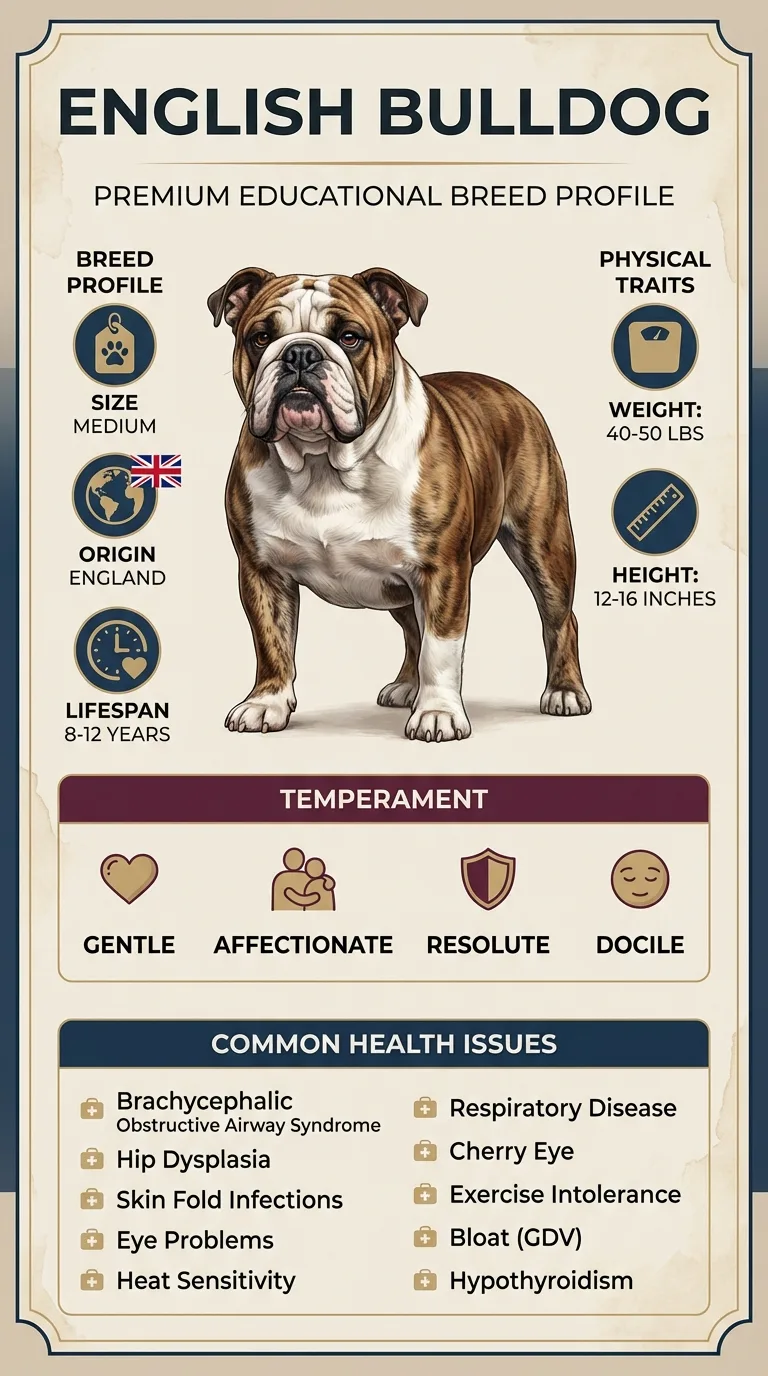
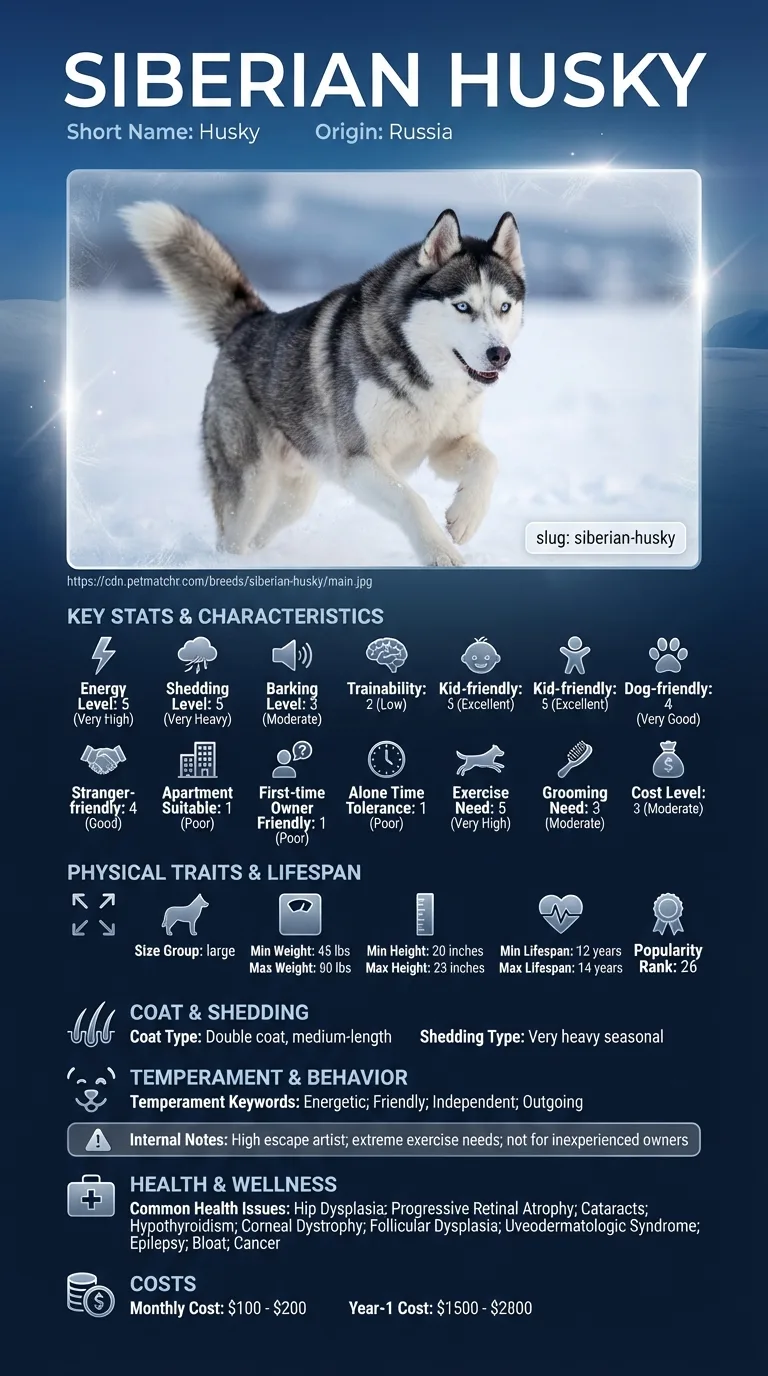
This is for someone already down to Bulldog (English) and Siberian Husky and deciding between them. For this pair the decision usually turns on apartment suitability and exercise need, so those are covered first and in most detail. Anyone choosing from a flat has a clear answer here: Bulldog (English) rates 5/5 against 1/5. It is written for the decision rather than the breed history.
Between Bulldog (English) and Siberian Husky, apartment suitability is what separates them, and Bulldog (English) is the lower-effort dog of the two to keep.
Choose Bulldog (English) if you are in a flat or a smaller home, this is your first dog and shedding is a problem in your house.
Choose Siberian Husky if you want a dog that can keep up with an active routine.
| Feature | bulldog | siberian husky | Winner |
|---|---|---|---|
| Size class | medium | large | Equal |
| Weight | 40–50 lbs | 45–60 lbs | Equal |
| Height | 12–16 in | 20–23 in | Equal |
| Lifespan | 8–12 years | 12–14 years | siberian husky |
| Exercise need | Low (2/5) | Very high (5/5) | bulldog |
| Grooming need | Moderate (3/5) | Moderate (3/5) | Equal |
| Shedding | Moderate (3/5) | Very high (5/5) | bulldog |
| Energy level | Low (2/5) | Very high (5/5) | Equal |
| Barking | Low (2/5) | Moderate (3/5) | bulldog |
| Apartment suitability | Very high (5/5) | Very low (1/5) | bulldog |
| Good for first-time owners | Moderate (3/5) | Very low (1/5) | bulldog |
| Tolerates being alone | Moderate (3/5) | Very low (1/5) | bulldog |
| Trainability | Moderate (3/5) | Low (2/5) | bulldog |
| Good with kids | Very high (5/5) | Very high (5/5) | Equal |
| Good with other dogs | High (4/5) | High (4/5) | Equal |
| Friendly to strangers | High (4/5) | High (4/5) | Equal |
| Cost level | Very high (5/5) | Moderate (3/5) | siberian husky |
| Coat | Short, smooth | Double coat, medium-length | Equal |
| Origin | England | Russia | Equal |
| Typical monthly cost | $150–$350 | $100–$200 | Equal |
| Typical first-year cost | $2,500–$5,000 | $1,500–$2,800 | Equal |
This is a large-versus-medium matchup: the Husky stands 20-23 inches and carries 45-60 lbs of lean, working-dog muscle, while the Bulldog is a compact 12-16 inches and 40-50 lbs. The weights are closer than you'd expect given the height difference — the Bulldog is simply built shorter and denser, the Husky longer-legged and built for distance. Picture a sled dog next to a dog built like a barrel and you have the physical contrast, even though a scale would put them within about 15 pounds of each other.
The exercise gap here is about as wide as this site tracks: 2/5 for the Bulldog against a full 5/5 for the Husky. Huskies were bred to pull sleds for miles and need serious daily output — running, hiking, or structured exercise — or they'll find their own outlets, often destructive ones. A Bulldog's exercise needs stop at a short walk.
Grooming need actually ties at moderate (3/5) for both, but shedding does not — the Husky rates a very high 5/5 against the Bulldog's moderate 3/5. Huskies blow their thick double coat twice a year in a way that produces genuinely large amounts of loose fur, even though the coat itself doesn't need much cutting or styling. Regular brushing during a coat blow can cut down on the mess considerably; skipping it just means the fur ends up on your floor and furniture instead.
Apartment suitability is about as lopsided as this comparison gets: 5/5 for the Bulldog, 1/5 for the Husky. Add in a Husky's very low first-time-owner score (1/5) and very low tolerance for being alone (1/5), and the picture is clear — this is a breed that needs space, company, and an experienced handler, none of which describe most apartment living.
The Bulldog actually rates higher for trainability here, 3/5 to the Husky's 2/5, which surprises people expecting the working breed to be easier. Huskies are intelligent but independent and bred to think for themselves on the trail, not to take orders — that shows up directly in the Husky's very low (1/5) first-time-owner score against the Bulldog's moderate 3/5. A Husky that decides recall isn't worth its time will act on that decision, which is why secure containment matters as much as obedience work with this breed.
These two tie across the board with kids, other dogs, and strangers — all rated very high or high for both. Where they don't tie is everything around exercise and independence: a well-run Husky is genuinely friendly, but keeping one well-run requires far more daily commitment than a Bulldog does. A tired, well-exercised Husky and an under-exercised one can look like two different dogs socially, which isn't as true of the lower-drive Bulldog.
The Husky lives longer, 12-14 years against the Bulldog's 8-12. Its health list includes epilepsy, cancer, and several eye conditions unrelated to the Bulldog's brachycephalic issues, but three conditions overlap directly: hip dysplasia, hypothyroidism, and bloat. A Bulldog's compromised airway remains its most breed-defining risk; a Husky's isn't. Given the shared bloat risk, both benefit from slower feeding routines and avoiding hard exercise right after meals, regardless of which breed you choose.
Cost level rates the Bulldog very high (5/5) against the Husky's moderate (3/5), and the ranges follow suit: $150-350 monthly and up to $5,000 in year one for the Bulldog, versus $100-200 and up to $2,800 for the Husky. The Husky's costs run more toward fencing and containment than vet bills. Factor in a secure yard or reinforced fencing as a near-mandatory upfront cost for a Husky, since a low apartment-suitability score and a strong prey drive tend to go together.
Bulldog (English) weighs 40–50 lbs and lives 8–12 years; Siberian Husky weighs 45–60 lbs and lives 12–14 years. The two diverge most on apartment suitability, exercise need and energy level and 4 other rated axes. They are level on good with other dogs, grooming need and good with kids, so those cannot decide it. In the table, a "winner" means easier for an ordinary household — not better. Size, coat and origin are recorded without a verdict. Because both breeds are scored the same way, the gaps are reliable even where the absolute numbers are rough.

The Husky — it's classed large at 45-60 lbs and 20-23 inches, versus the Bulldog's medium 40-50 lbs and 12-16 inches. The height difference is more dramatic than the weight difference.
The Husky, by a lot — 5/5 against the Bulldog's 3/5. Twice-yearly coat blows produce noticeably more loose fur than the Bulldog's steady, moderate shedding.
No — it rates a very low 1/5 for first-time owners, the lowest score in this comparison. The Bulldog's moderate 3/5 makes it the far more forgiving starting breed.
The Bulldog, decisively — 5/5 versus the Husky's very low 1/5. High exercise needs, low alone-tolerance, and heavy shedding all work against the Husky in small, shared spaces.
The Husky, at $100-200 monthly and $1,500-2,800 in year one against the Bulldog's $150-350 and $2,500-5,000 — though a Husky's fencing and containment needs can add costs the ratings don't fully capture.
Yes, three: hip dysplasia, hypothyroidism, and bloat. Beyond that they differ — the Husky carries several eye conditions and epilepsy, while the Bulldog's risks center on its airway and skin folds.
The Husky, at 12-14 years against 8-12 for the Bulldog.
The Bulldog for most owners — low exercise needs and high apartment suitability. The Husky only makes sense with an experienced owner and real space to run it.
The Husky, at $100-200 versus the Bulldog's $150-350.
The Husky, at a full 5/5 against the Bulldog's 2/5 — one of the widest gaps tracked on this site.
The Husky, at 12-14 years versus 8-12 for the Bulldog.
Secure checkout on Stripe. We never see your card.
7-day money-back guarantee. Instant access.
Health information here is general and is not veterinary advice. If your dog shows pain, sudden behaviour change, or worsening symptoms, consult a licensed veterinarian.
Some links on this site are affiliate links. We may earn a commission at no extra cost to you, and we only suggest products we believe are helpful for dog owners.
We research and check what we publish, but we do not warrant that any figure, date, price, or statement is accurate, complete, or current, and we accept no liability for any loss, cost, injury, or other harm arising from the use of this site. Use it as one reference among several. You remain responsible for your own decisions and for your dog's care - confirm anything that matters with a licensed veterinarian or another qualified professional before you act on it. Full disclaimer.
Match your lifestyle to the right dog.
Take quizNot sure which breed is right for you? Take our 2-minute quiz to find out.
Take the quiz