Behavior
Which one should I actually get?
For a workmanlike guard dog with real leadership needs, the Shepherd. For a friendlier all-rounder with less protective baggage, the Labradoodle, it wins more of the household categories on the table.

Quick answer
Which one should I actually get?
For a workmanlike guard dog with real leadership needs, the Shepherd. For a friendlier all-rounder with less protective baggage, the Labradoodle, it wins more of the household categories on the table.
German Shepherd or Labradoodle? On paper they differ most on shedding, and on the scales German Shepherd is the heavier at 50–90 lbs. Here is how the two compare on everything that shapes an ordinary week.
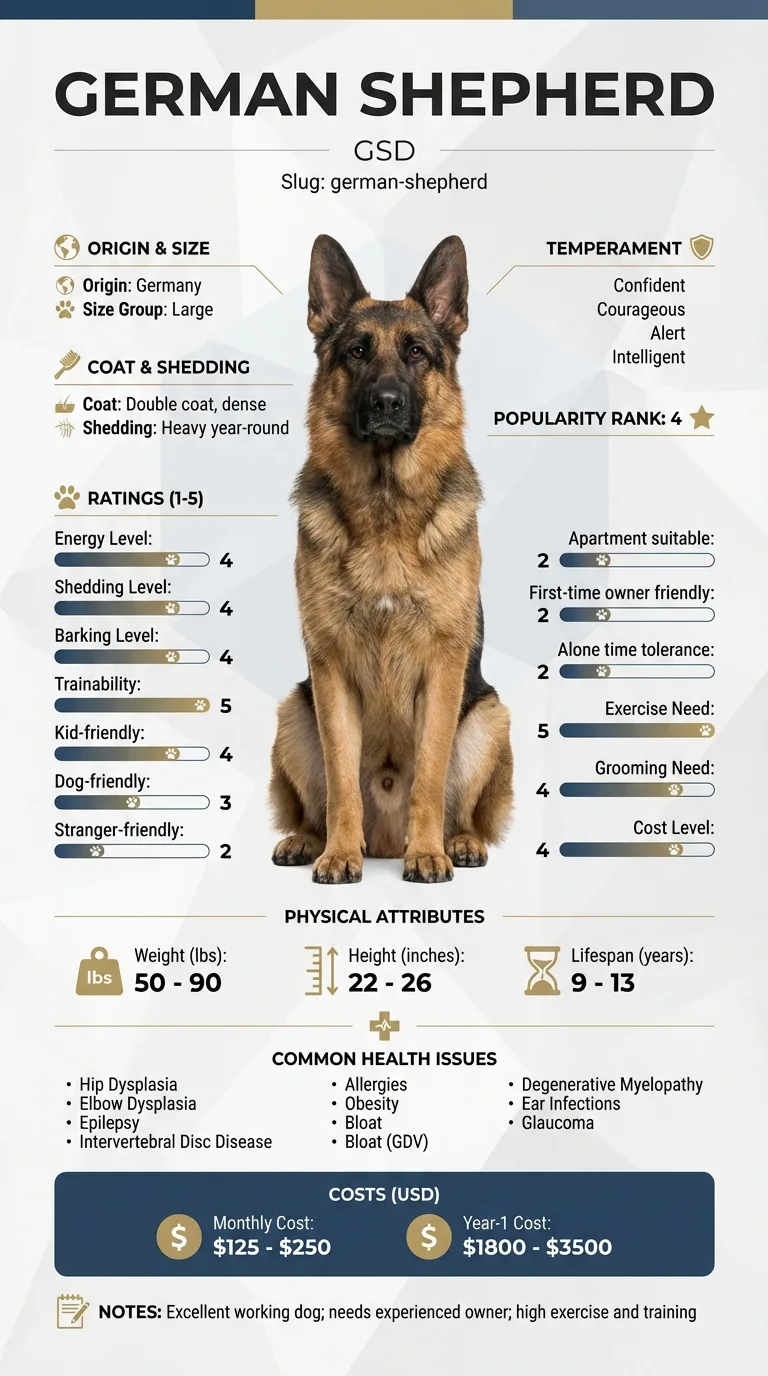
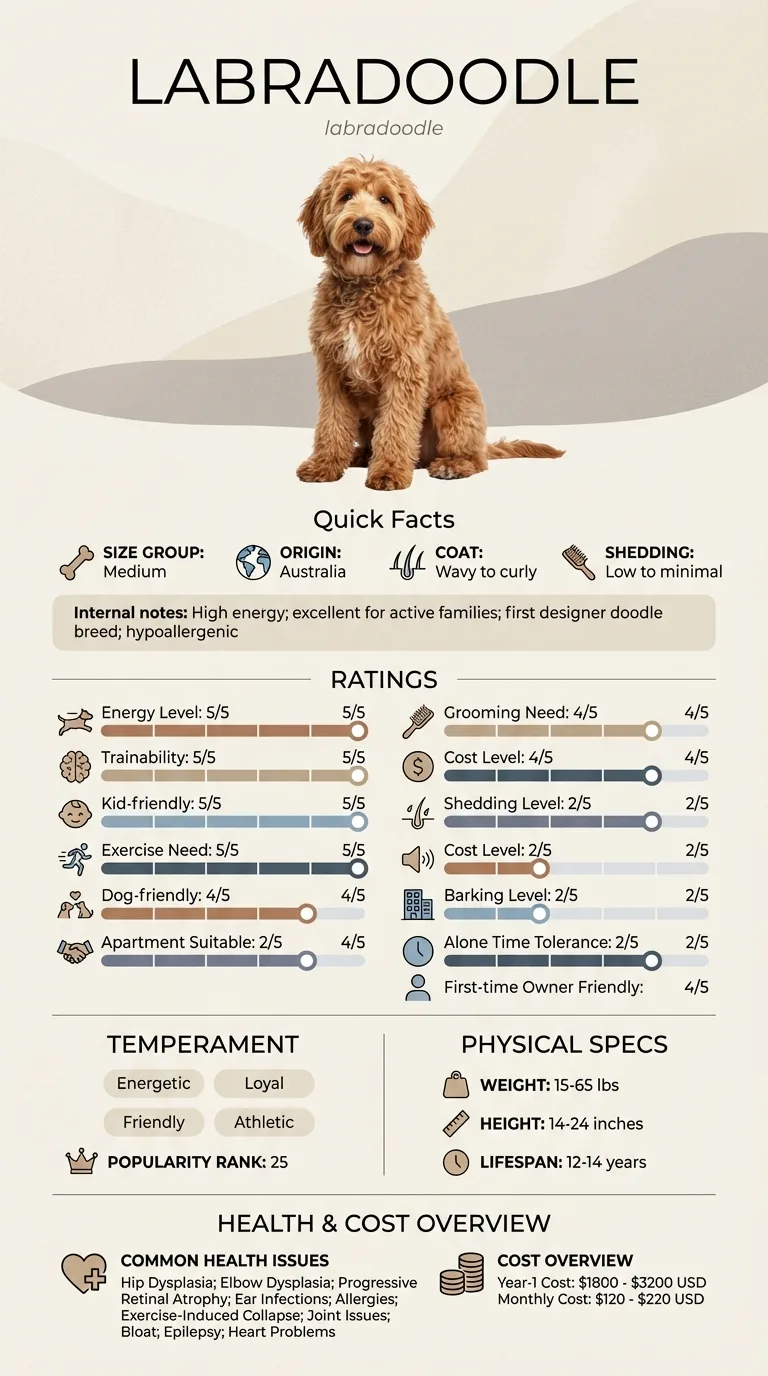
This is for someone already down to German Shepherd and Labradoodle and deciding between them. For this pair the decision usually turns on shedding and good for first-time owners, so those are covered first and in most detail. Both rate 2/5 for flats, so housing does not settle this one. Breed history is left out; what follows is what you will actually live with.
Between German Shepherd and Labradoodle, shedding is what separates them, and Labradoodle is the lower-effort dog of the two to keep.
Choose German Shepherd if you want a dog that is more watchful with visitors.
Choose Labradoodle if this is your first dog, shedding is a problem in your house and there are young children at home.
| Feature | german shepherd | labradoodle | Winner |
|---|---|---|---|
| Size class | large | medium | Equal |
| Weight | 50–90 lbs | 15–65 lbs | Equal |
| Height | 22–26 in | 14–24 in | Equal |
| Lifespan | 9–13 years | 12–14 years | labradoodle |
| Exercise need | Very high (5/5) | Very high (5/5) | Equal |
| Grooming need | High (4/5) | High (4/5) | Equal |
| Shedding | High (4/5) | Low (2/5) | labradoodle |
| Energy level | High (4/5) | Very high (5/5) | Equal |
| Barking | High (4/5) | Low (2/5) | labradoodle |
| Apartment suitability | Low (2/5) | Low (2/5) | Equal |
| Good for first-time owners | Low (2/5) | High (4/5) | labradoodle |
| Tolerates being alone | Low (2/5) | Low (2/5) | Equal |
| Trainability | Very high (5/5) | Very high (5/5) | Equal |
| Good with kids | High (4/5) | Very high (5/5) | labradoodle |
| Good with other dogs | Moderate (3/5) | High (4/5) | labradoodle |
| Friendly to strangers | Low (2/5) | High (4/5) | labradoodle |
| Cost level | High (4/5) | High (4/5) | Equal |
| Coat | Double coat, dense | Wavy to curly | Equal |
| Origin | Germany | Australia | Equal |
| Typical monthly cost | $125–$250 | $120–$220 | Equal |
| Typical first-year cost | $1,800–$3,500 | $1,800–$3,200 | Equal |
A German Shepherd settles into the 50-90 lb range at 22-26 inches, a solid mid-to-large frame built for work. Labradoodle sizing is all over the map, 15 to 65 lbs and 14 to 24 inches depending on whether you land a mini or a standard cross. That spread means the breed name alone won't tell you what's showing up at ten months old, so ask the breeder about parent sizes before you commit to either.
Both dogs need serious daily output. Exercise need sits at 5/5 for each, no easing into either one gradually. The Labradoodle actually edges the Shepherd on raw energy level, 5/5 versus 4/5, meaning it can outlast the Shepherd on a long day of fetch even though the Shepherd's drive is more purposeful. Neither is a dog you exercise once and call done for the day.
Grooming demand is identical on paper, 4/5 for both, but the coats behave differently once you're living with the fur. The Shepherd's dense double coat sheds at a 4/5 clip, expect it on your clothes year-round with two heavier blowouts a season. The Labradoodle's wavy-to-curly coat sheds at just 2/5, so the maintenance shifts from vacuuming to brushing out mats and booking regular trims.
Neither breed scores well for apartment life, both sit at 2/5, and both tolerate solitude just as poorly. Where they split is noise: the German Shepherd barks at a 4/5 rate, the kind of alert-barking that carries through shared walls, while the Labradoodle sits at 2/5. In a building with thin walls, that gap alone might decide it.
Trainability is tied at 5/5, both breeds pick up commands fast and want the work. The real gap is in who should be holding the leash: the German Shepherd rates only 2/5 for first-time owners, the Labradoodle rates 4/5. A Shepherd's intelligence needs a confident, consistent handler or it finds its own jobs to do; a Labradoodle's easier temperament forgives more rookie mistakes.
Both breeds do well with kids, but the Labradoodle edges ahead at 5/5 against the Shepherd's still-solid 4/5. The bigger gap shows up with strangers and other dogs: the Labradoodle is friendly to visitors (4/5) and gets along with other dogs (4/5), while the Shepherd's protective instinct pulls those numbers down to 2/5 and 3/5. A Shepherd in a busy household needs more deliberate socialization to keep pace.
The Labradoodle's 12-14 year lifespan beats the Shepherd's 9-13, a gap worth weighing for a lifetime commitment. Both breeds share a long list of the same risks though, hip and elbow dysplasia, epilepsy, allergies, bloat, ear infections, so crossing to a Labradoodle doesn't dodge the Shepherd's structural problems, it just adds a few years on average. Ask breeders on both sides for hip clearances.
Cost level lands at 4/5 for both, and the monthly numbers barely separate them, $125-$250 for the Shepherd against $120-$220 for the Labradoodle. First-year costs run $1,800-$3,500 versus $1,800-$3,200, so budget for the same ballpark regardless of which one you pick. The real cost variable with a Labradoodle is grooming frequency, which can push that range higher if you skip DIY maintenance.
German Shepherd weighs 50–90 lbs and lives 9–13 years; Labradoodle weighs 15–65 lbs and lives 12–14 years. The two diverge most on shedding, good for first-time owners and barking and 1 other rated axes. They are level on tolerates being alone, apartment suitability and cost level, so those cannot decide it. The comparison marks an easier option only where one exists. Facts like weight and country of origin are not scored. Both dogs are rated from the same dataset, which is what makes the numbers comparable with each other even though any individual dog sits somewhere inside its breed's range.

The German Shepherd is more consistently large at 50-90 lbs and 22-26 inches. The Labradoodle's size depends heavily on which generation and size category you get, ranging from 15 to 65 lbs, so a mini Labradoodle will be much smaller than a Shepherd while a standard one can come close.
The Labradoodle, by a wide margin, it rates 2/5 for shedding against the Shepherd's 4/5. If shedding is your main concern, that's the clearer factor than grooming effort, which is rated the same, 4/5, for both.
The Labradoodle is the better bet, rating 4/5 for first-time owners against the Shepherd's 2/5. The Shepherd's combination of high drive and strong protective instinct rewards experienced handlers more than beginners.
Not really, both score 2/5 for apartment suitability and 2/5 for tolerating time alone. If you're apartment-bound, this comparison doesn't hand you a good answer either way.
Plan on $120-$250 a month for either dog, with the Shepherd running slightly higher on average. First-year costs including setup run $1,800-$3,500 for the Shepherd and $1,800-$3,200 for the Labradoodle.
Yes, substantially, hip dysplasia, elbow dysplasia, epilepsy, allergies, bloat, and ear infections show up on both lists. The Labradoodle also carries progressive retinal atrophy and exercise-induced collapse that aren't on the Shepherd's list.
The Labradoodle, clearly, 4/5 on both counts versus the Shepherd's 2/5 with strangers and 3/5 with other dogs. That traces back to what each breed was bred to do: the Shepherd to guard, the Labradoodle to be a companion.
For a workmanlike guard dog with real leadership needs, the Shepherd. For a friendlier all-rounder with less protective baggage, the Labradoodle, it wins more of the household categories on the table.
Close to a wash, $125-$250 for the Shepherd against $120-$220 for the Labradoodle. Budget about the same either way.
Both rate 5/5 for exercise need. Expect over an hour of real activity daily from either dog, non-negotiable.
The Labradoodle, at 12-14 years versus the Shepherd's 9-13, worth weighing if more years with the dog matters to you.
Secure checkout on Stripe. We never see your card.
7-day money-back guarantee. Instant access.
Health information here is general and is not veterinary advice. If your dog shows pain, sudden behaviour change, or worsening symptoms, consult a licensed veterinarian.
Some links on this site are affiliate links. We may earn a commission at no extra cost to you, and we only suggest products we believe are helpful for dog owners.
We research and check what we publish, but we do not warrant that any figure, date, price, or statement is accurate, complete, or current, and we accept no liability for any loss, cost, injury, or other harm arising from the use of this site. Use it as one reference among several. You remain responsible for your own decisions and for your dog's care - confirm anything that matters with a licensed veterinarian or another qualified professional before you act on it. Full disclaimer.
Match your lifestyle to the right dog.
Take quizNot sure which breed is right for you? Take our 2-minute quiz to find out.
Take the quiz