Living
Labradoodle or Poodle -- quick take?
Depends on which poodle size you're weighing it against, but the Labradoodle brings a fixed 5/5 exercise demand and a 12-14 year lifespan regardless.

Quick answer
Labradoodle or Poodle -- quick take?
Depends on which poodle size you're weighing it against, but the Labradoodle brings a fixed 5/5 exercise demand and a 12-14 year lifespan regardless.
Labradoodle or Poodle? On paper they differ most on exercise need, and on the scales Labradoodle is the heavier at 15–65 lbs. Here is how the two compare on everything that shapes an ordinary week.
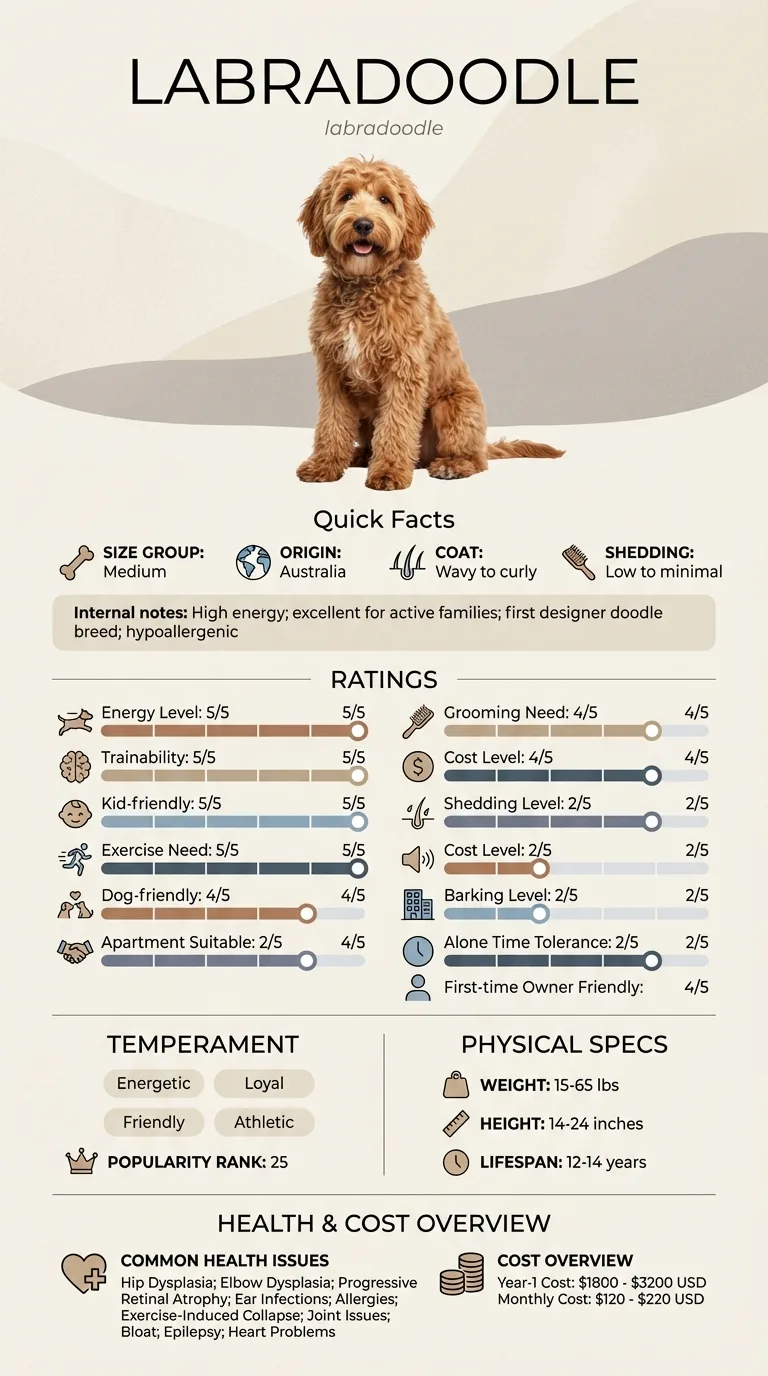
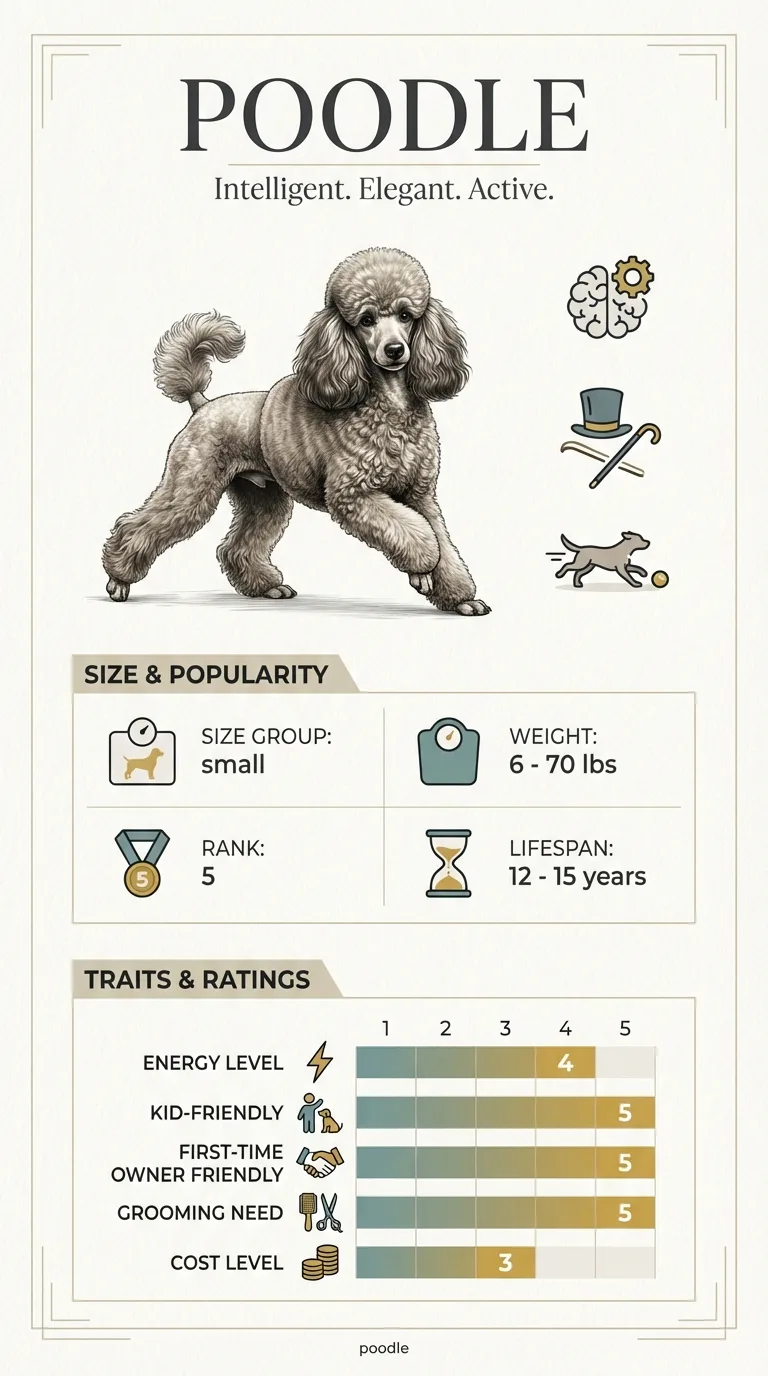
This is for someone already down to Labradoodle and Poodle and deciding between them. For this pair the decision usually turns on exercise need and trainability, so those are covered first and in most detail. Anyone choosing from a flat has a clear answer here: Labradoodle rates 2/5 against 0/5. The focus throughout is on daily consequences rather than breed background.
Between Labradoodle and Poodle, exercise need is what separates them, and Poodle is the lower-effort dog of the two to keep.
Choose Labradoodle if you do not want a standing grooming appointment, you already have another dog and you want a dog that picks up training quickly.
Choose Poodle if this is your first dog, shedding is a problem in your house and your walking routine is modest.
| Feature | labradoodle | poodle | Winner |
|---|---|---|---|
| Size class | medium | small | Equal |
| Weight | 15–65 lbs | 6–70 lbs | Equal |
| Height | 14–24 in | 0–0 in | Equal |
| Lifespan | 12–14 years | 12–15 years | poodle |
| Exercise need | Very high (5/5) | — (0/5) | poodle |
| Grooming need | High (4/5) | Very high (5/5) | labradoodle |
| Shedding | Low (2/5) | — (0/5) | poodle |
| Energy level | Very high (5/5) | High (4/5) | Equal |
| Barking | Low (2/5) | — (0/5) | poodle |
| Apartment suitability | Low (2/5) | — (0/5) | labradoodle |
| Good for first-time owners | High (4/5) | Very high (5/5) | poodle |
| Tolerates being alone | Low (2/5) | — (0/5) | labradoodle |
| Trainability | Very high (5/5) | — (0/5) | labradoodle |
| Good with kids | Very high (5/5) | Very high (5/5) | Equal |
| Good with other dogs | High (4/5) | — (0/5) | labradoodle |
| Friendly to strangers | High (4/5) | — (0/5) | labradoodle |
| Cost level | High (4/5) | Moderate (3/5) | poodle |
| Coat | Wavy to curly | Curly, dense single coat | Equal |
| Origin | Australia | — | Equal |
| Typical monthly cost | $120–$220 | $0–$0 | Equal |
| Typical first-year cost | $1,800–$3,200 | $0–$0 | Equal |
"Labradoodle" here means one dog: 15 to 65 pounds, 14 to 24 inches at the shoulder. "Poodle" without a size tag covers three official varieties, which is why the weight range on this page runs from 6 pounds to 70 -- a toy poodle and a standard poodle have almost nothing in common physically. If you already know which poodle size you want, the size-specific comparison will serve you better than this one.
The Labradoodle's exercise need is rated 5/5, the top mark on this site -- daily aerobic work, not a stroll around the block. Poodle exercise needs swing hard by size, from a toy poodle's modest requirements to a standard poodle's working-dog stamina, so this undifferentiated entry can't give you one honest number for that side. What's certain is the Labradoodle side of the equation.
The Labradoodle needs high grooming attention (4/5) and sheds low (2/5) -- expect brushing several times a week and a clip every six to eight weeks. Poodles as a family carry some of the densest, curliest coats rated on this site, so whichever size you eventually land on, budget for a professional groomer on a standing schedule.
Apartment suitability sits low for the Labradoodle at 2/5, and it doesn't tolerate being left alone well either, also rated 2/5. Barking is low (2/5), so it's not a noise problem so much as a boredom-and-energy one. The Poodle side of this comparison doesn't carry a usable number here since it spans three very different sizes.
Trainability rates a full 5/5 for the Labradoodle, and it's rated high (4/5) for first-time owners. Poodles as a group are just as famous for trainability -- it's a big reason breeders cross them into so many "doodle" lines -- but exact first-time-owner numbers depend on size, which this generic entry doesn't pin down.
The Labradoodle rates very high with kids (5/5), high with other dogs (4/5), and high with strangers (4/5). No comparable per-trait numbers exist for the undifferentiated Poodle entry on this page -- for real figures, use one of the size-specific poodle comparisons instead.
The Labradoodle's ten flagged conditions include hip and elbow dysplasia, progressive retinal atrophy, allergies, bloat, and epilepsy, against a 12-14 year lifespan. The generic Poodle entry shows a 12-15 year range, a full year longer at the top end, but doesn't break out specific conditions at this undifferentiated level -- check a size-specific page for that detail.
The Labradoodle sits at a high cost level (4/5), running $120-$220 a month with $1,800-$3,200 in first-year costs once you count the puppy, shots, and initial gear. The undifferentiated Poodle entry doesn't carry monthly figures here -- a toy and a standard poodle cost differently enough that one number wouldn't mean much, so use the size-specific comparisons for real dollars.
Labradoodle weighs 15–65 lbs and lives 12–14 years; Poodle weighs 6–70 lbs and lives 12–15 years. The two diverge most on exercise need, trainability and good with other dogs and 5 other rated axes. Almost every rated axis separates them at least slightly. The table below marks a winner only where one breed is genuinely easier for a typical owner; size and origin are facts rather than merits and stay level. Ratings come from one source applied to both breeds, so they are meaningful against each other rather than as absolute scores.

It depends entirely on which Poodle you mean. A Labradoodle runs 15-65 pounds; "Poodle" without a size covers 6 to 70 pounds because it spans toy, miniature, and standard varieties. Pick a size-specific comparison if size is what actually matters to you.
The Labradoodle sheds low, rated 2/5. Poodles are broadly known as low-to-non-shedding dogs too, though the exact rating on this site depends on which size you're comparing.
The Labradoodle scores high (4/5) for first-time owners. Poodles have a strong reputation for trainability and adaptability as well, but this generic page doesn't average that into one score across all three sizes.
$120-$220 a month, with $1,800-$3,200 in the first year covering the puppy and setup costs. The undifferentiated Poodle listing doesn't carry a comparable monthly figure since size affects food, grooming, and vet costs too much to average honestly.
The Labradoodle's list includes hip and elbow dysplasia, allergies, bloat, and epilepsy among ten flagged conditions. This generic Poodle entry doesn't break out conditions -- go to a size-specific comparison for the Poodle's actual health list.
A lot -- it's rated 5/5, the top mark tracked on this site. Expect a real daily outlet, not a quick lap around the block.
If you already know whether you want a toy, miniature, or standard poodle, use that page instead -- it carries real numbers for weight, cost, and health specific to that size. This page is really the starting point before you've narrowed it down.
Depends on which poodle size you're weighing it against, but the Labradoodle brings a fixed 5/5 exercise demand and a 12-14 year lifespan regardless.
Labradoodle runs $120-$220 a month. The undifferentiated Poodle entry doesn't carry a monthly figure since it spans three very different sizes.
The Labradoodle needs a lot -- rated 5/5, real daily exercise. Poodle exercise needs depend heavily on which size you mean.
Labradoodle: 12-14 years. Poodle (unspecified size): 12-15 years, an edge likely coming from the smaller varieties, which tend to outlive larger dogs.
Secure checkout on Stripe. We never see your card.
7-day money-back guarantee. Instant access.
Health information here is general and is not veterinary advice. If your dog shows pain, sudden behaviour change, or worsening symptoms, consult a licensed veterinarian.
Some links on this site are affiliate links. We may earn a commission at no extra cost to you, and we only suggest products we believe are helpful for dog owners.
We research and check what we publish, but we do not warrant that any figure, date, price, or statement is accurate, complete, or current, and we accept no liability for any loss, cost, injury, or other harm arising from the use of this site. Use it as one reference among several. You remain responsible for your own decisions and for your dog's care - confirm anything that matters with a licensed veterinarian or another qualified professional before you act on it. Full disclaimer.
Match your lifestyle to the right dog.
Take quizNot sure which breed is right for you? Take our 2-minute quiz to find out.
Take the quiz