Costs
Akita cost in Charlotte
About $110–$215/month, $1,650–$2,950 for year one — rising with the city's rapid growth.

See Akita price across all cities →
Quick answer
Akita cost in Charlotte
About $110–$215/month, $1,650–$2,950 for year one — rising with the city's rapid growth.
An Akita in Charlotte costs about $110–$215 a month, with the first year around $1,650–$2,950 — a moderate budget in one of the fastest-growing metro areas in the country.
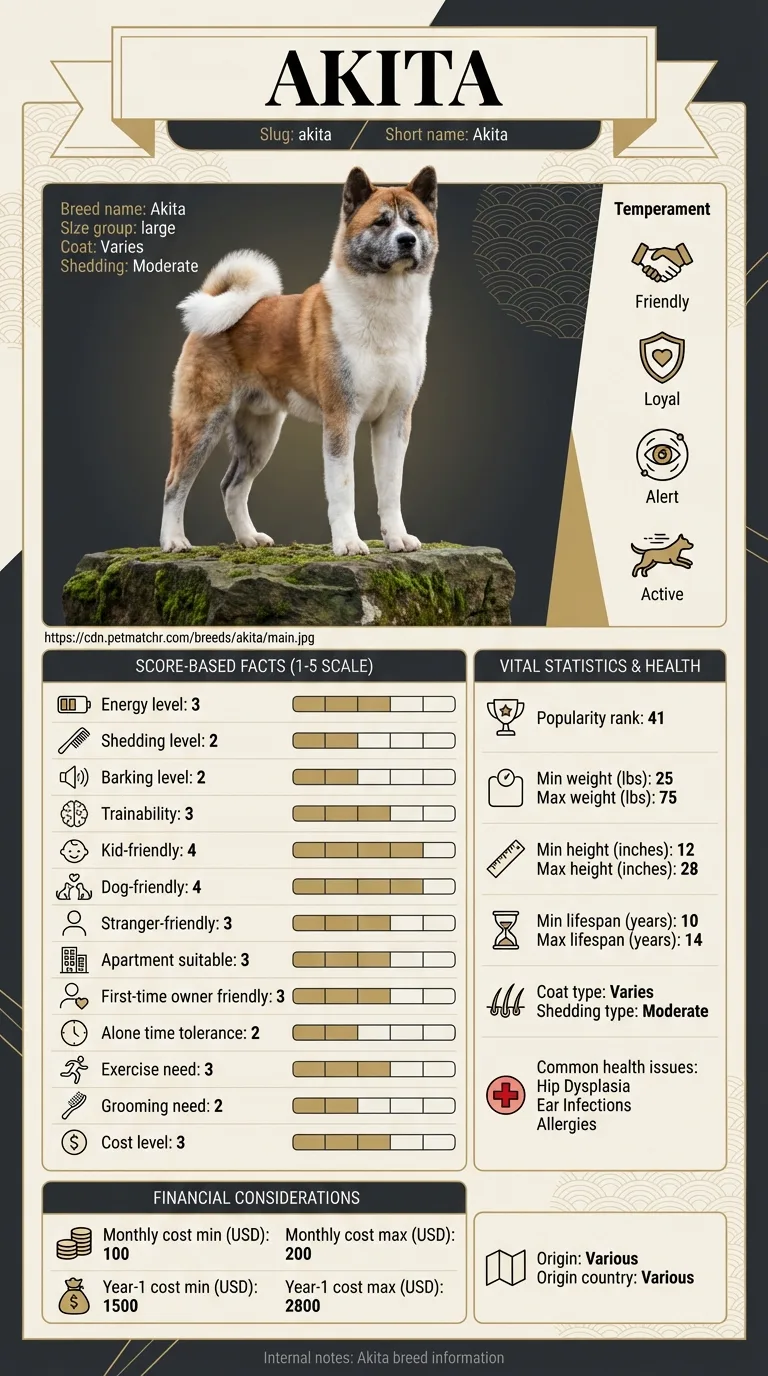
The same breed-specific risks apply here as anywhere — hip dysplasia and the Akita's tendency toward ear infections are the likeliest sources of an unplanned bill. Charlotte's long warm season also means parasite prevention runs close to ten months of the year, a real recurring cost on top of the breed's own health considerations.
These figures adjust the Akita's typical national cost range for Charlotte's current market — a fast-growing banking hub whose pet-service pricing has climbed above what a comparable, slower-growing Southern city would cost.
Estimate · source: estimation · confidence: medium · updated 2026-10-06 · not a quote
| Item | Cost range |
|---|---|
One-time setup (initial vet visit, spay/neuter, large-breed gear) Covers the first exam, vaccinations, spay/neuter if needed, and gear sized for the breed's adult weight — priced at Charlotte's current, growth-adjusted rates. | $400 - $700 |
| Item | Cost range |
|---|---|
Food Sized for the breed's large adult frame; an AAFCO-compliant food matters more than brand name once that standard is met. | $50 - $82 |
Grooming Akitas mostly self-groom; at-home brushing through the coat-blow seasons covers most needs without frequent professional visits. | $10 - $25 |
Flea, tick & heartworm prevention Active roughly ten months of the year given the Piedmont's warm season, landing between a Deep South city's near-year-round cost and a northern city's short one. | $16 - $30 |
Each range starts from a national baseline for this breed's size class and is then adjusted for local cost of living and veterinary pricing. The baselines, and the source each one came from, are listed on our sources page (dataset 2026.09). Two inputs, the purchase price and the emergency reserve, have no published national figure we could verify, so we leave them to you rather than invent them.
These are planning estimates, not quotes. Your own numbers will move with the individual dog, your vet and your insurer. Build a budget with your own figures.
For an Akita in Charlotte, buying insurance sooner rather than later carries extra weight: local vet prices have been rising along with the city's growth, so a policy bought now is likely cheaper than the same one purchased in a few years.
Given the breed's hip dysplasia risk and a local market that's actively climbing, purchasing insurance while the dog is young locks in a lower rate before both the dog ages and Charlotte's prices rise further.
Owners who've built a genuine emergency fund and are comfortable revisiting that number periodically as Charlotte's growth continues can reasonably self-insure instead of committing to a recurring premium.
In a market where prices are still climbing, the most useful habit in Charlotte is checking current pricing rather than assuming an older estimate still holds.
Charlotte's growth over the past fifteen years has been unusually fast, fueled largely by its role as a major U.S. banking center — a wave of corporate relocations and new residents has pushed housing costs up substantially, and veterinary and pet-service pricing has followed that trend, if more gradually. Compared with a similarly sized Southern city that hasn't seen the same growth, Charlotte's routine pet-care costs now run a bit above what a purely regional cost-of-living number would suggest.
Climate here sits in the Piedmont — warm and humid for a good stretch of the year, but with real winters that a Deep South or Gulf Coast city doesn't get. That gives Charlotte a parasite season that runs close to ten months rather than the near-year-round activity of a coastal humid city, a middle-ground outcome that's neither the shortest nor the longest season covered on this site.
Charlotte's rapid growth has also meant a lot of new housing development, much of it in denser, more urban formats than the single-family-with-a-yard pattern that used to dominate the region. For a large breed like the Akita, that can mean less automatic yard access than an owner might assume from a 'Southern city' stereotype — worth checking specifically for any given neighborhood or building rather than assuming.

A Charlotte Akita owner used a cost estimate from an online forum post written a few years earlier to plan their budget, only to find routine vet visits running noticeably higher once they actually started paying for them. A conversation with the clinic revealed that local pricing had risen substantially as the city's population and cost of living had grown in the years since that estimate was written. Adjusting the household budget upward and checking current pricing directly with a local clinic, rather than relying on an older secondhand number, closed the gap going forward.
Key takeaway: In a fast-growing city like Charlotte, even a well-intentioned cost estimate can go stale within a few years — confirming current, local pricing is worth the extra step before finalizing a budget.
Around $110–$215, covering food, routine vet care, grooming and parasite prevention. Charlotte's rapid growth as a banking hub has pushed this somewhat above what a smaller, slower-growing Southern city would cost.
Roughly $1,650–$2,950, including the initial vet exam, spay/neuter if needed, and large-breed gear on top of ongoing monthly costs.
Charlotte's growth as a major banking and finance center over the past decade and a half has driven a wave of corporate relocations and new residents, pushing housing and, more gradually, pet-service pricing up faster than in a comparable Southern city without that growth.
It's a middle-ground outcome — the Piedmont region gets real winters, unlike a Deep South or coastal city, but the warm season is still long enough to keep flea and tick prevention active for close to ten months most years.
Worth pricing out given the breed's hip dysplasia risk, especially as Charlotte's vet market continues adjusting to the city's rapid growth — a policy bought while the dog is young locks in a lower rate before local prices climb further.
Around $700 is a reasonable floor for a typical significant vet visit today. Given how quickly Charlotte's costs have been moving, it's worth revisiting that number periodically rather than treating it as fixed.
About $110–$215/month, $1,650–$2,950 for year one — rising with the city's rapid growth.
This guide is not medical advice. If your dog shows pain, sudden behavior change, or worsening symptoms, consult a licensed veterinarian.
Some links may be affiliate links. We may earn a commission at no extra cost to you. We only suggest products we believe are helpful for dog owners.
We research and check what we publish, but we do not warrant that any figure, date, price, or statement is accurate, complete, or current, and we accept no liability for any loss, cost, injury, or other harm arising from the use of this site. Use it as one reference among several. You remain responsible for your own decisions and for your dog's care - confirm anything that matters with a licensed veterinarian or another qualified professional before you act on it. Full disclaimer.
One sheet with every line item, the emergency fund and when insurance pays off - unlocks on this page.
You get: 12-month budget sheet
No spam. One-click unsubscribe. See our privacy policy.
See a sample page before you decide.