Living
Which is the better choice overall?
The Cocker fits smaller homes and calmer routines better; the Labradoodle needs an owner ready for serious daily exercise, regardless of home size.

Quick answer
Which is the better choice overall?
The Cocker fits smaller homes and calmer routines better; the Labradoodle needs an owner ready for serious daily exercise, regardless of home size.
Cocker Spaniel or Labradoodle? On paper they differ most on exercise need, and on the scales Labradoodle is the heavier at 15–65 lbs. Here is how the two compare on everything that shapes an ordinary week.
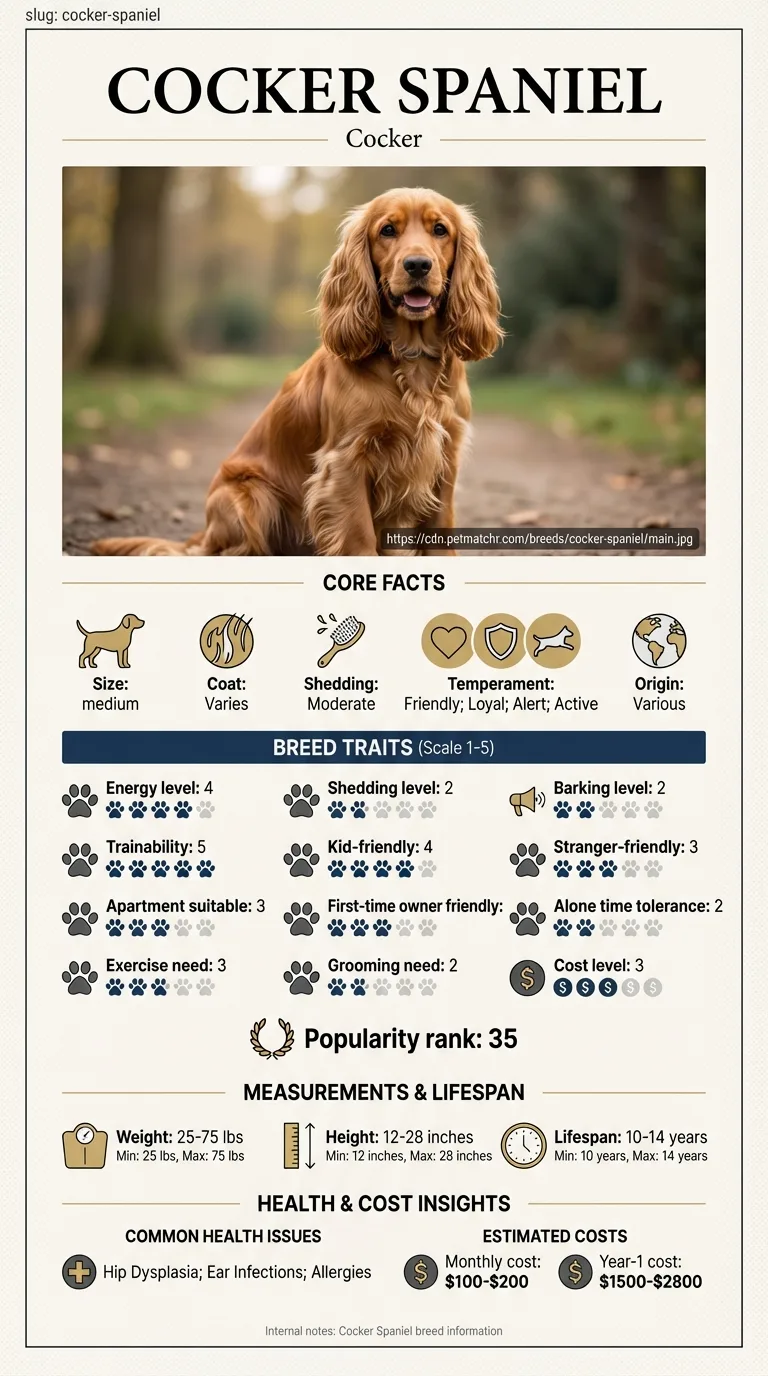
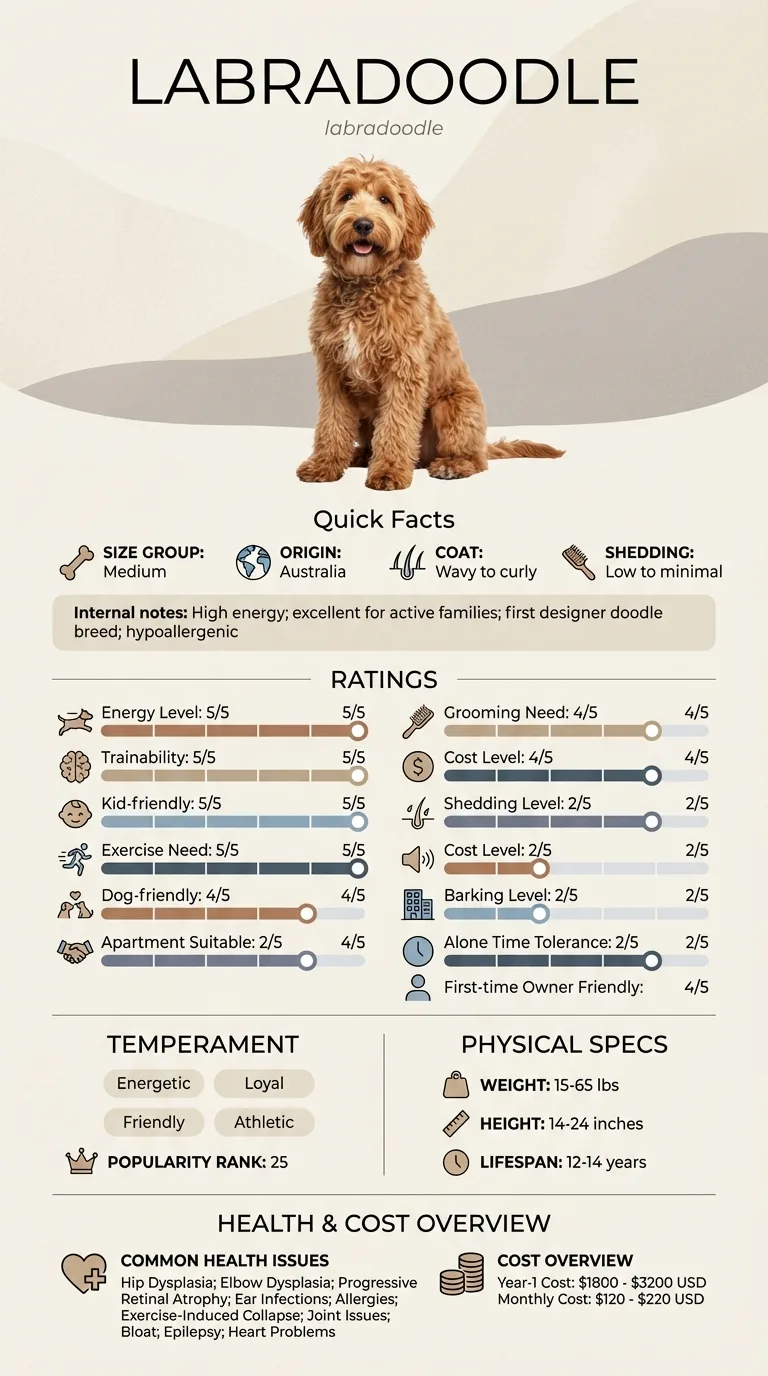
This is for someone already down to Cocker Spaniel and Labradoodle and deciding between them. For this pair the decision usually turns on exercise need and energy level, so those are covered first and in most detail. Anyone choosing from a flat has a clear answer here: Cocker Spaniel rates 4/5 against 2/5. Breed history is left out; what follows is what you will actually live with.
Between Cocker Spaniel and Labradoodle, exercise need is what separates them, and Cocker Spaniel is the lower-effort dog of the two to keep.
Choose Cocker Spaniel if you are in a flat or a smaller home, your walking routine is modest and a smaller dog suits your car, your home or your back.
Choose Labradoodle if you do not want a standing grooming appointment, shedding is a problem in your house and you want a dog that picks up training quickly.
| Feature | cocker spaniel | labradoodle | Winner |
|---|---|---|---|
| Size class | small | medium | Equal |
| Weight | 20–30 lbs | 15–65 lbs | Equal |
| Height | 13–16 in | 14–24 in | Equal |
| Lifespan | 10–14 years | 12–14 years | labradoodle |
| Exercise need | Moderate (3/5) | Very high (5/5) | cocker spaniel |
| Grooming need | Very high (5/5) | High (4/5) | labradoodle |
| Shedding | Moderate (3/5) | Low (2/5) | labradoodle |
| Energy level | Moderate (3/5) | Very high (5/5) | Equal |
| Barking | Moderate (3/5) | Low (2/5) | labradoodle |
| Apartment suitability | High (4/5) | Low (2/5) | cocker spaniel |
| Good for first-time owners | High (4/5) | High (4/5) | Equal |
| Tolerates being alone | Low (2/5) | Low (2/5) | Equal |
| Trainability | High (4/5) | Very high (5/5) | labradoodle |
| Good with kids | Very high (5/5) | Very high (5/5) | Equal |
| Good with other dogs | High (4/5) | High (4/5) | Equal |
| Friendly to strangers | High (4/5) | High (4/5) | Equal |
| Cost level | Moderate (3/5) | High (4/5) | cocker spaniel |
| Coat | Silky and feathered | Wavy to curly | Equal |
| Origin | Various | Australia | Equal |
| Typical monthly cost | $80–$150 | $120–$220 | Equal |
| Typical first-year cost | $1,100–$2,300 | $1,800–$3,200 | Equal |
Like most Poodle crosses, the Labradoodle's size depends heavily on which parent line it comes from -- the breed spans 15 to 65 lbs and 14 to 24 inches. The Cocker, by contrast, is a fixed 20-30 lbs and 13-16 inches. A mini Labradoodle might land close to Cocker size; a standard will tower well past it, so confirm parentage before you commit to a puppy.
The Labradoodle is a genuinely high-energy dog -- 5/5 for exercise need, the maximum rating -- inherited from its Labrador side. The Cocker's moderate 3/5 is a different lifestyle entirely. If your idea of exercise is a leisurely evening walk, the Labradoodle will likely be under-stimulated in a way the Cocker won't.
Grooming demands are close -- Cocker at 5/5, Labradoodle at 4/5 -- so plan on regular brushing and professional trims either way. Shedding favors the Labradoodle clearly, though: 2/5 against the Cocker's 3/5, a real difference if allergies or hair on furniture are a concern.
The Cocker is the far better apartment dog here -- 4/5 versus the Labradoodle's low 2/5. It's not a barking issue; the Labradoodle is actually quieter (2/5 versus the Cocker's 3/5). It comes back to that 5/5 exercise need again -- a high-drive dog in a small space without enough outlet tends to become a problem, regardless of how much noise it makes.
Both breeds are workable for a first-time owner, tied at 4/5, but the Labradoodle edges ahead on raw trainability, 5/5 versus the Cocker's 4/5. Labrador ancestry tends to bring strong food motivation and eagerness to work, which shows up here.
The two breeds are evenly matched socially: both score 5/5 with kids, 4/5 with other dogs, and 4/5 with strangers. There's genuinely no clear winner in this category -- whichever breed you pick, you're getting a dog built to be friendly rather than wary.
The Labradoodle's expected lifespan, 12-14 years, sits comfortably within the Cocker's 10-14 range, so there's no clear advantage either way. Its health list runs longer at ten conditions, including exercise-induced collapse and bloat, three of which -- hip dysplasia, progressive retinal atrophy, and ear infections -- also appear on the Cocker's shorter list.
The Labradoodle costs more to keep: $120-220 monthly and $1,800-3,200 in year one, against the Cocker's $80-150 and $1,100-2,300. At cost level 4/5 versus 3/5, the larger average size and grooming needs both push the Labradoodle's bills higher across the board.
Cocker Spaniel weighs 20–30 lbs and lives 10–14 years; Labradoodle weighs 15–65 lbs and lives 12–14 years. The two diverge most on exercise need, energy level and apartment suitability. They are level on tolerates being alone, good with other dogs and good for first-time owners, so those cannot decide it. The comparison marks an easier option only where one exists. Facts like weight and country of origin are not scored. Both dogs are rated from the same dataset, which is what makes the numbers comparable with each other even though any individual dog sits somewhere inside its breed's range.

A lot -- anywhere from 15 to 65 lbs and 14 to 24 inches, depending on whether it comes from mini or standard Poodle lines. The Cocker, at a fixed 20-30 lbs, is far more predictable.
The Labradoodle, rated 5/5 -- the maximum -- against the Cocker's moderate 3/5. It's a genuinely high-drive dog that needs real daily activity.
The Cocker is the better fit, 4/5 versus the Labradoodle's 2/5. The gap is mostly about exercise needs rather than noise, since the Labradoodle is actually the quieter of the two.
The Labradoodle, 2/5 versus the Cocker's 3/5, thanks to its Poodle-influenced coat.
The Labradoodle runs higher -- $120-220 a month versus $80-150 for the Cocker, and $1,800-3,200 versus $1,100-2,300 in year one.
Yes, three conditions overlap: hip dysplasia, progressive retinal atrophy, and ear infections. The Labradoodle's list also includes exercise-induced collapse and bloat, which aren't flagged for the Cocker.
They're close -- 12-14 years for the Labradoodle against 10-14 for the Cocker. Neither has a meaningful edge here.
The Cocker fits smaller homes and calmer routines better; the Labradoodle needs an owner ready for serious daily exercise, regardless of home size.
$80-150 for the Cocker versus $120-220 for the Labradoodle.
The Labradoodle, rated 5/5 -- the maximum -- against the Cocker's moderate 3/5.
About the same -- 12-14 years for the Labradoodle, 10-14 for the Cocker.
Secure checkout on Stripe. We never see your card.
7-day money-back guarantee. Instant access.

Health information here is general and is not veterinary advice. If your dog shows pain, sudden behaviour change, or worsening symptoms, consult a licensed veterinarian.
Some links on this site are affiliate links. We may earn a commission at no extra cost to you, and we only suggest products we believe are helpful for dog owners.
We research and check what we publish, but we do not warrant that any figure, date, price, or statement is accurate, complete, or current, and we accept no liability for any loss, cost, injury, or other harm arising from the use of this site. Use it as one reference among several. You remain responsible for your own decisions and for your dog's care - confirm anything that matters with a licensed veterinarian or another qualified professional before you act on it. Full disclaimer.
Match your lifestyle to the right dog.
Take quizNot sure which breed is right for you? Take our 2-minute quiz to find out.
Take the quiz