Akita or Poodle: Both Breeds Are Misread, in Opposite Directions
Quick answer
Akita vs Poodle: which should I choose?
A Poodle if shedding is the deciding factor and you will fund grooming every six to eight weeks and do daily mental work. The Akita if you would rather rake a coat twice a year and want a dog that needs no occupation.
The Poodle is assumed to be delicate and it is a working water retriever. The Akita is assumed to be a fluffy Japanese companion and it is a guardian that makes its own decisions. Both reputations mislead, and in this comparison they mislead in opposite directions, which is why so many people end up with the wrong one.
This page is for someone weighing a Poodle against a large guardian and working from the popular impression of each. It covers what the Poodle temperament is actually like, what the coat commits you to, the allergy question answered honestly, and how each fits an ordinary week.
Quick verdict
The Poodle is a serious working dog in a coat that needs professional maintenance for life; the Akita is a serious guardian in a coat that needs no professional at all.
Choose akita if...
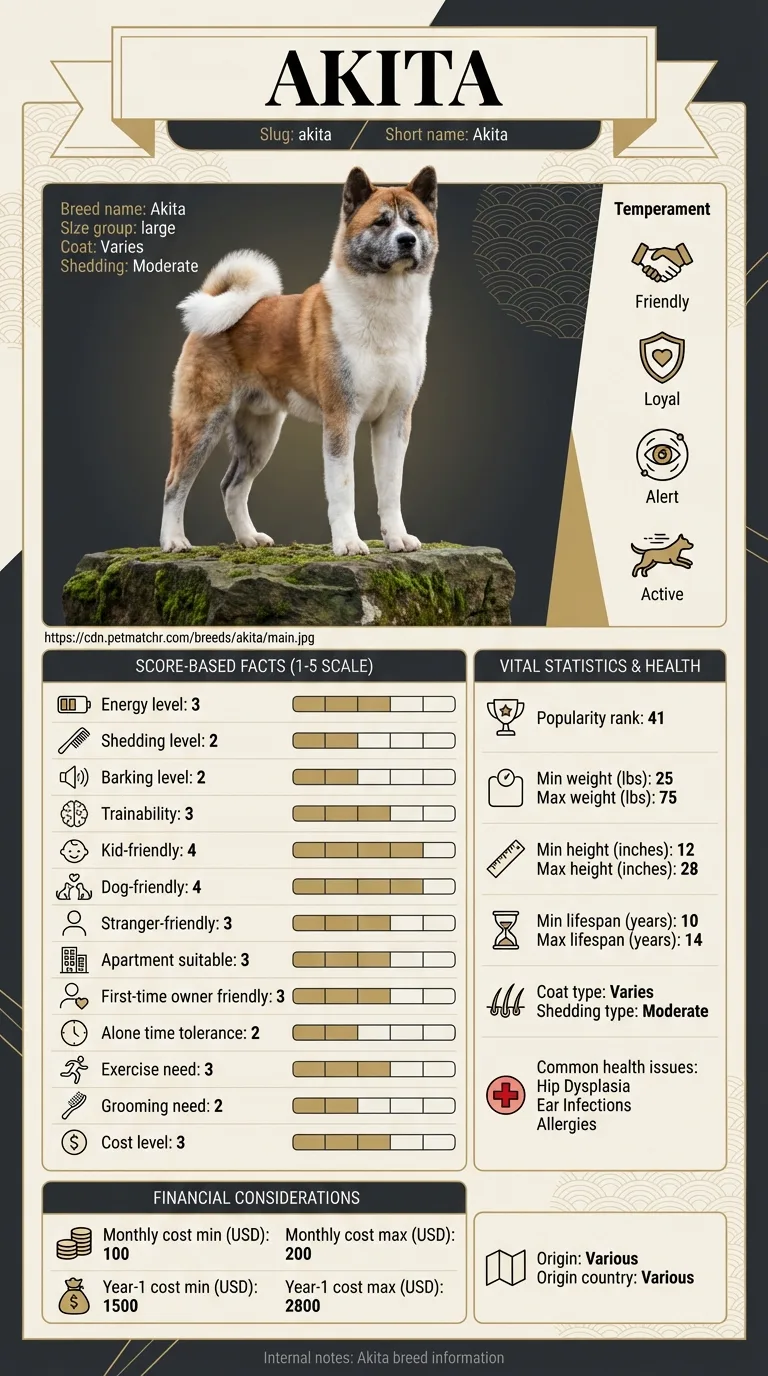
Choose the Akita if you want a low-input dog and will not fund lifelong grooming. It grooms at 3/5 against the Poodle's 5/5, needs no mental work, and does not mind an empty afternoon. You are accepting very heavy shedding, a guardian temperament that has to be actively socialised, and a large dog that needs space.
Choose poodle if...
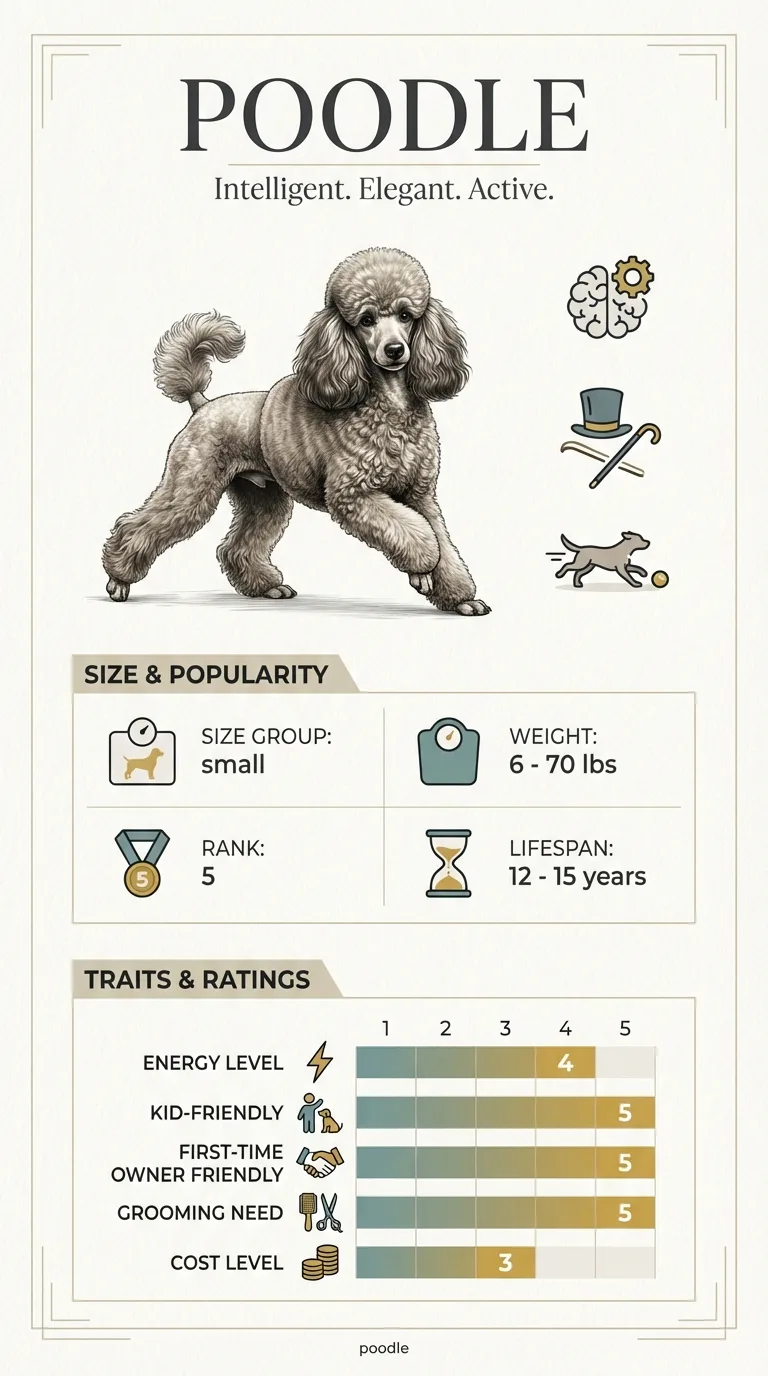
Choose a Poodle if you want a dog that sheds almost nothing and will genuinely train, and you will pay a groomer every six to eight weeks for its whole life. It is friendly with children, sociable with other dogs, and lives longer than the Akita. You are accepting a coat that mats and a dog that needs occupying.
Head-to-head comparison
Feature
akita
poodle
Winner
Weight
70–130 lbs
6–70 lbs by size
Equal
Height
24–28 in
Varies by size
Equal
Lifespan
10–13 years
12–15 years
poodle
Coat
Dense double coat
Curly single coat
Equal
Grooming need
Moderate (3/5)
Very high (5/5)
akita
Shedding
Very high (5/5)
Very low
poodle
Good with kids
Moderate (3/5)
Very high (5/5)
poodle
Good for first-time owners
Very low (1/5)
Very high (5/5)
poodle
Coat maintenance
Rake twice a year
Groomer every 6–8 weeks
akita
Professional grooming
Never needed
Required for life
akita
Matting risk
None
High
akita
Suits an allergy household
Poorly
Often, not always
poodle
Needs mental work
No
Yes, daily
akita
Guarding instinct
Strong
Minimal
akita
Origin
Japan
Germany and France
Equal
Size options
One
Three
poodle
Typical monthly cost
$110–$240
$100–$300 by size
Equal
Cost driver
Food
Grooming
Equal
Deep dive
Akita vs Poodle: what each breed is actually like
Start with the Poodle, because its reputation is the more misleading of the two.
It is not a delicate breed. It was built to retrieve waterfowl in cold water, the show trim descends from a working clip designed to insulate the joints while freeing the legs to swim, and Poodles still compete at a high level in obedience, agility, tracking and gundog work. The clipped topiary look is a grooming fashion, not a description of the dog underneath.
What that means practically is that a Poodle needs a job. Give it structured work and it is one of the easiest dogs alive to live with. Give it nothing and it becomes anxious, vocal and inventive.
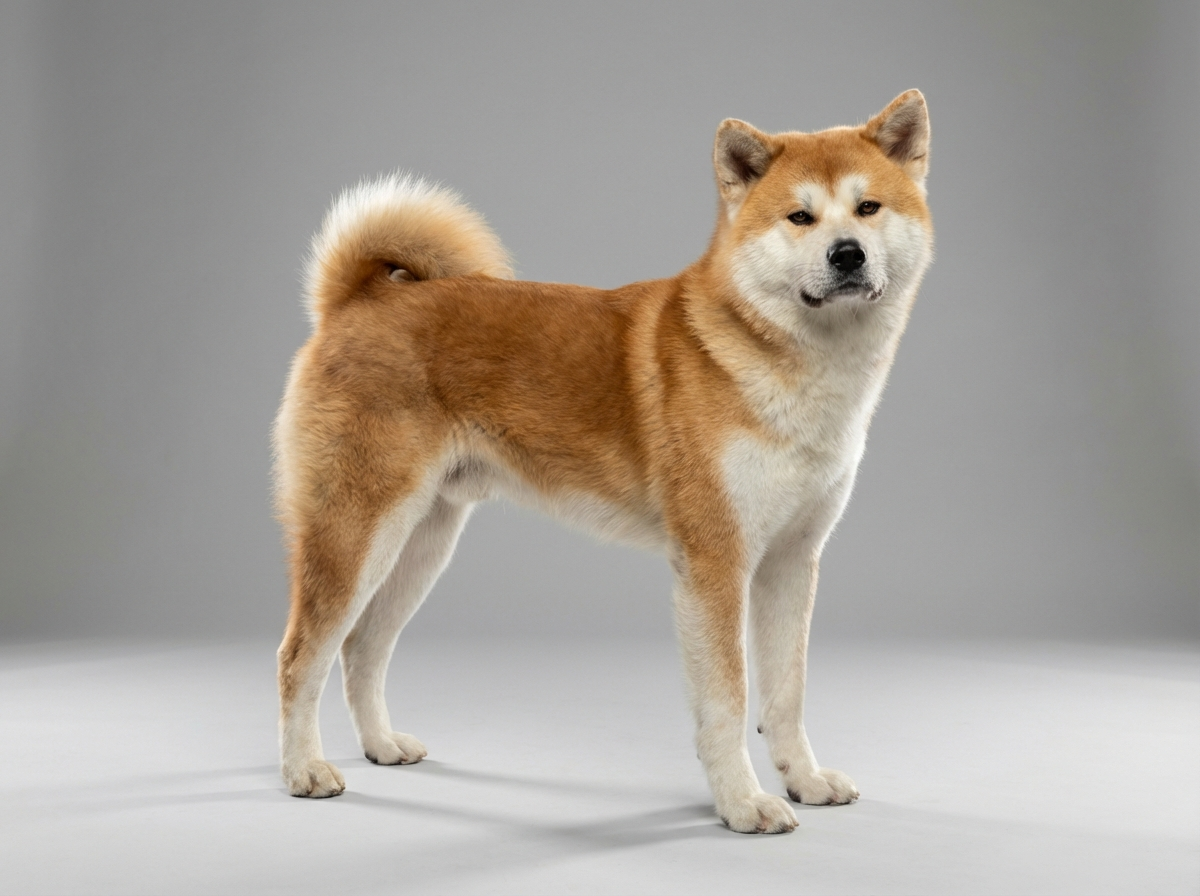
The Akita is misread in the other direction. Its stillness and its coat make it look like a large companion breed, and it is a guardian with genuine reserve toward strangers and genuine intolerance of other dogs, both of which arrive properly at social maturity around two years old.
One of these dogs is more capable than it looks. The other is more serious.
The coat is the decision
Almost everyone choosing between these two is really choosing between two coats, so it is worth being precise about what each involves.
The Poodle's curly single coat sheds almost nothing. The hair that dies stays in the curl, so it does not land on furniture — and it mats. Combing to the skin several times a week is the maintenance, and a professional groom every six to eight weeks is the rest of it. That is not a phase; it is the arrangement for the dog's whole life, and Poodles live a long time.
There are choices within that. A short all-over trim — variously called a puppy, lamb or teddy clip — is far easier to maintain than anything longer and is what most pet Poodles wear. Nobody is harmed by it and the dog is more comfortable.
The Akita's dense double coat is the exact inverse. It never mats, never needs a groomer, and should never be clipped, because it insulates against heat as well as cold. In exchange it sheds enormously, and twice a year the undercoat comes out in handfuls for two or three weeks.
One coat costs money. The other costs a vacuum cleaner.
The allergy question, answered plainly
No dog is hypoallergenic, including the Poodle. The proteins people react to are in dander, saliva and urine, not in hair itself.
What a non-shedding coat does is hold dander in the coat instead of distributing it around the house. That reduces exposure substantially and it is why so many allergy sufferers do well with Poodles — but it does not eliminate the allergen, and individual reactions vary a great deal between dogs.
If allergy is the reason you are here, the sensible test is to spend several hours, more than once, in a home where an adult Poodle from the specific line lives. A ten-minute meeting proves nothing. And keep in mind that a coat which holds dander needs washing and grooming to keep doing so.
The Akita is close to a worst case for an allergic household: 5/5 shedding, a dense undercoat that comes out in clouds twice a year, and dander distributed everywhere with it.
On this single question the comparison is not close, and it is worth deciding on before anything else on the page.
What a week with each looks like
A Poodle's week has structure in it. A proper walk, some off-lead running where possible, and — the part people skip — ten to twenty minutes of something to think about. Retrieves, scent games, trick chains, obedience. A Poodle that gets this is settled and delightful. A Poodle that does not is the source of most complaints about the breed.
It is also a closely bonded dog that does not enjoy long absences, and a sensitive one that responds badly to sharp handling.
An Akita's week has a walk in it. Forty-five to sixty minutes, a securely fenced garden, and a route planned to avoid unfamiliar dogs. There is no enrichment programme, no training schedule, no need for a job. It will sleep through the afternoon and not resent it.
With children the Poodle rates higher and is the easier household dog. With visitors it greets; the Akita assesses.
If your honest answer to the question "will I do fifteen minutes of training most days for the next decade" is no, that is not a failing — it is a reason to choose the Akita.
Where the money goes in each case
Running costs land in a similar band. A Poodle sits somewhere between roughly $100 and $300 a month depending on which size you choose, and the Akita at $110–$240. Food explains most of the Akita's figure and very little of the Poodle's.
The number missing from both is grooming, and only one breed has it. Every six to eight weeks, priced by size, for twelve to fifteen years or more. For a Standard that is a significant annual line; for a Toy or Miniature it is smaller but equally permanent. If you learn to clip the dog yourself the cost falls sharply and the time cost rises.
Ear care is the other Poodle routine — hair grows inside the canal and traps moisture, so plucking or trimming and drying after baths is ordinary maintenance.
The Akita's expensive risks are autoimmune disease, which is costly to diagnose and often lifelong to manage, and bloat, a four-figure emergency in a large deep-chested dog.
For exact figures by size, the Standard and Miniature comparisons are the more useful pages.
Akita vs Poodle at a glance
Both breeds are misread, in opposite directions. The Poodle is assumed delicate and is actually a working water retriever built to retrieve waterfowl in cold water; the Akita is assumed to be a fluffy companion breed and is a guardian that makes its own decisions about visitors.
The practical split follows from that. The Poodle sheds almost nothing but needs a professional groomer every six to eight weeks for life, trains at a high level, and is genuinely sociable with children and other dogs. The Akita's dense double coat needs no professional attention at all but sheds enormously twice a year, and its guardian temperament has to be actively socialised rather than simply exercised.
No dog is truly hypoallergenic, including the Poodle, but a coat that holds its dead hair rather than shedding it does reduce airborne dander substantially.
Choose the Akita for a low-input dog that needs no groomer. Choose the Poodle for a trainable, low-shedding dog and commit to the grooming bill that comes with it.
Akita or Poodle: Both Breeds Are Misread, in Opposite Directions - Akita vs Poodle at a glance
Frequently asked questions
Are Poodles really delicate dogs?
No. The Poodle was built to retrieve waterfowl in cold water, and the show trim descends from a working clip that insulated the joints while freeing the legs to swim. Poodles compete at a high level in obedience, agility, tracking and gundog work. The topiary look is a grooming fashion, not a description of the dog.
Are Poodles hypoallergenic?
No dog is. The allergens are proteins in dander, saliva and urine rather than in hair, so a non-shedding coat reduces exposure without removing the cause. Many allergy sufferers do well with a Poodle, but reactions vary between individual dogs — spend several hours with adults from the line before committing.
How much grooming does a Poodle need?
Combing to the skin several times a week plus a professional groom every six to eight weeks, for the whole of a long life. A short all-over trim — a puppy, lamb or teddy clip — is much easier to maintain than anything longer and is what most pet Poodles wear.
Which is better for an allergy household?
The Poodle, and it is not close. The Akita sheds at 5/5, blows a dense undercoat twice a year and distributes dander with it — close to a worst case. A Poodle's coat holds dander rather than spreading it, which substantially reduces exposure for most sufferers.
Which needs less from an owner day to day?
The Akita. Its week is a walk, a secure garden and a route that avoids unfamiliar dogs. A Poodle needs the walk plus ten to twenty minutes of mental work most days, and it does not cope well with long absences. If you will not do the training, that is a reason to choose the Akita.
Which Poodle size should I get?
The Standard is a 45 to 70 pound athletic water dog that needs real exercise and space. The Miniature suits a flat and lives longest. The Toy is smaller again and more fragile. Temperament, coat and grooming are the same across all three, so the size decides the logistics.
Which is the better guard dog?
The Akita, decisively. Guarding is what it was bred for — reserve toward strangers, intolerance of unfamiliar dogs, and a presence that does most of the work. Poodles are alert and will bark, but they have no guarding instinct to speak of and should not be bought for security.
A Poodle if shedding is the deciding factor and you will fund grooming every six to eight weeks and do daily mental work. The Akita if you would rather rake a coat twice a year and want a dog that needs no occupation.
Costs
How much does each cost per month?
A Poodle runs roughly $100–$300 a month depending on size and the Akita $110–$240. Only the Poodle has a grooming bill on top, every six to eight weeks for life.
Living
Which sheds less?
The Poodle, by an enormous margin. Its dead hair stays in the curl rather than falling out. The Akita sheds at 5/5 and blows a dense undercoat in clumps twice a year.
Training
Does a Poodle need training every day?
Most days, yes — ten to twenty minutes of retrieves, scent games or trick work. It is a working retriever and the mental work is what settles it. Walking alone produces a fitter dog with the same unmet need.
Related DogBreedCompass guides
Akita breed guide – The Akita profile covers guardian temperament and the long socialisation window the breed needs.
Poodle breed guide – The Poodle profile covers the three sizes, coat options and health testing.
Akita vs Standard Poodle – The Standard comparison has the exact figures for the large size.
Akita vs Miniature Poodle – The Miniature comparison has the exact figures for the apartment size.
Poodle ear infections – Ear infections are routine maintenance in coats with hair growing in the canal.
Akita autoimmune diseases – Autoimmune disease is the Akita's most distinctive burden and the first question for a breeder.
Health information here is general and is not veterinary advice. If your dog shows pain, sudden behaviour change, or worsening symptoms, consult a licensed veterinarian.
Some links on this site are affiliate links. We may earn a commission at no extra cost to you, and we only suggest products we believe are helpful for dog owners.
We research and check what we publish, but we do not warrant that any figure, date, price, or statement is accurate, complete, or current, and we accept no liability for any loss, cost, injury, or other harm arising from the use of this site. Use it as one reference among several. You remain responsible for your own decisions and for your dog's care - confirm anything that matters with a licensed veterinarian or another qualified professional before you act on it. Full disclaimer.