Living
Which one should I get?
In a small apartment with limited time for exercise, the Maltese's 5/5 apartment score and 2/5 exercise need fit better. With a yard and kids who play rough, the Labradoodle's size and 5/5 kid rating hold up better.

Quick answer
Which one should I get?
In a small apartment with limited time for exercise, the Maltese's 5/5 apartment score and 2/5 exercise need fit better. With a yard and kids who play rough, the Labradoodle's size and 5/5 kid rating hold up better.
Labradoodle or Maltese? On paper they differ most on exercise need, and on the scales Labradoodle is the heavier at 15–65 lbs. Here is how the two compare on everything that shapes an ordinary week.
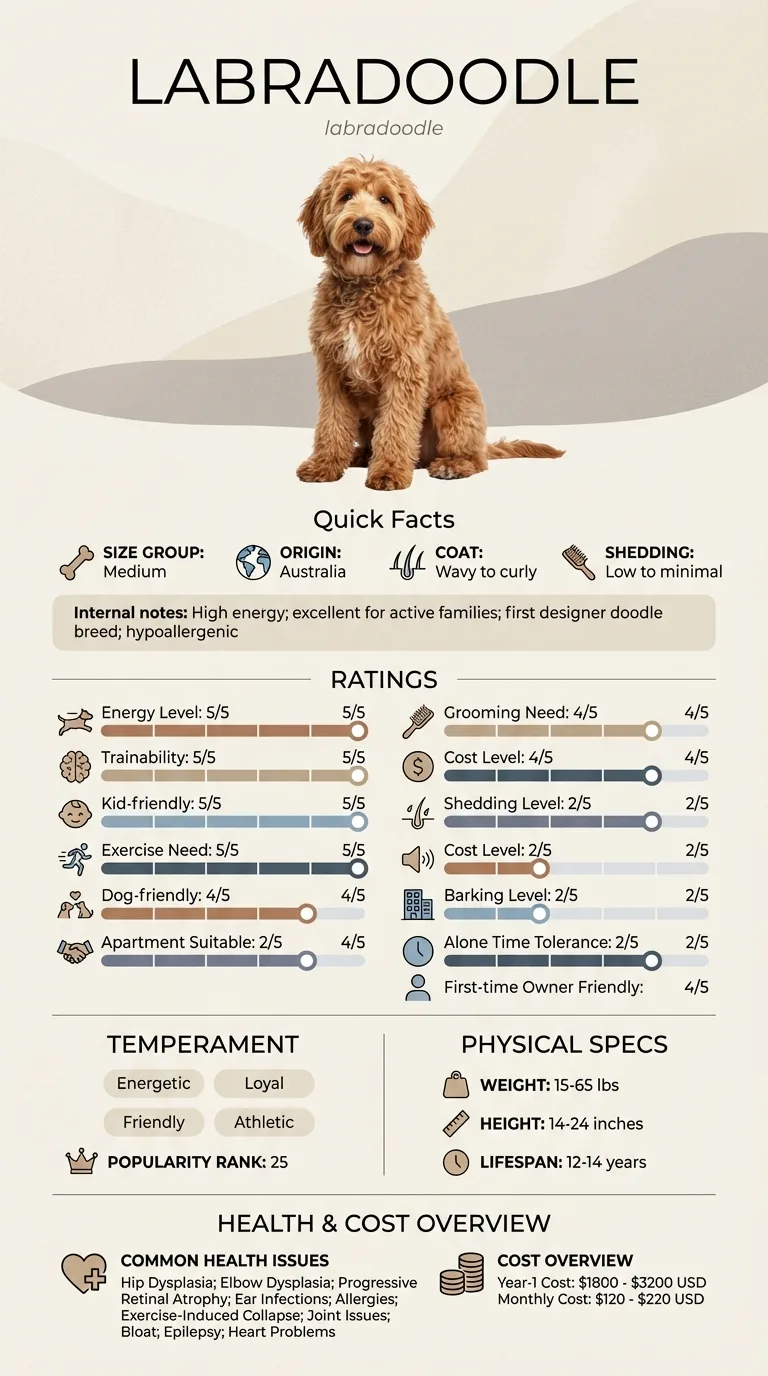
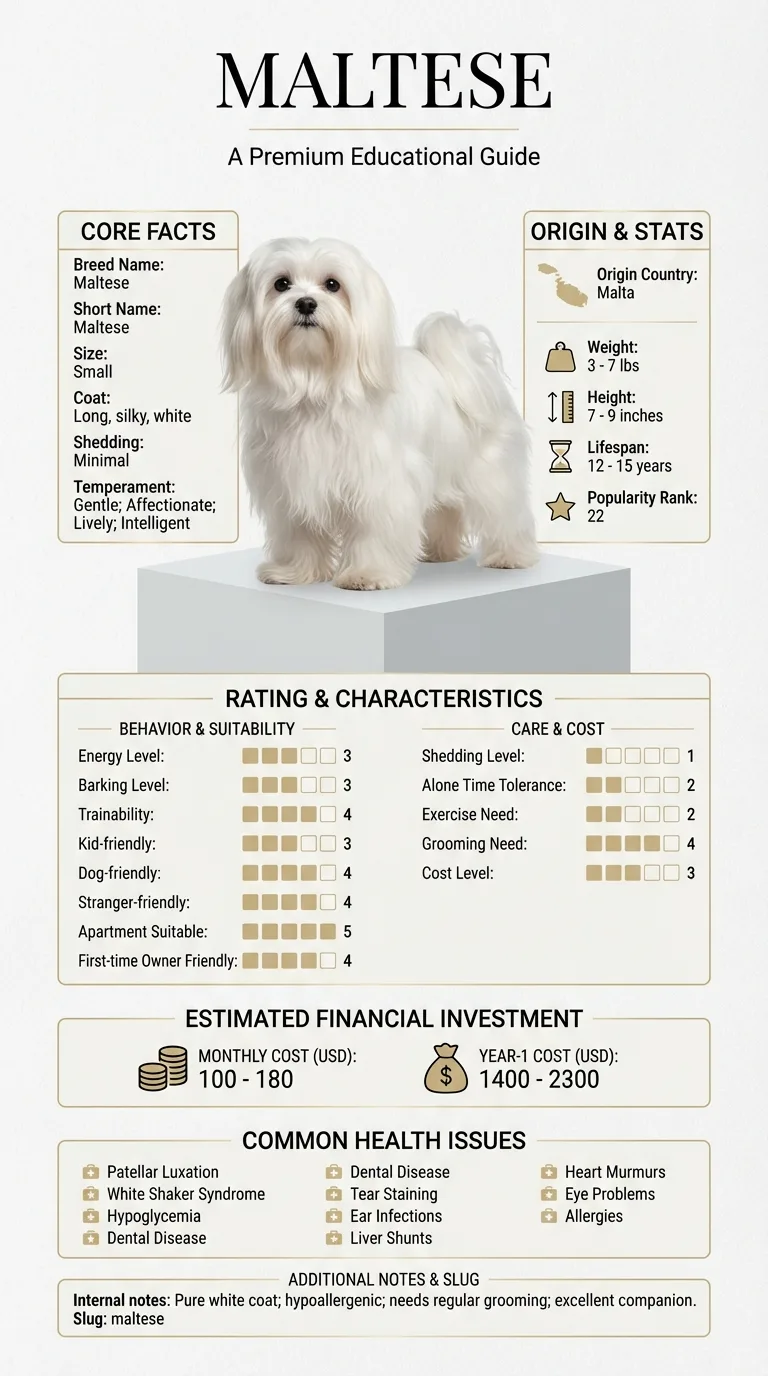
This is for someone already down to Labradoodle and Maltese and deciding between them. For this pair the decision usually turns on exercise need and apartment suitability, so those are covered first and in most detail. Anyone choosing from a flat has a clear answer here: Maltese rates 5/5 against 2/5. There is no origin story here — only what changes about your week.
Between Labradoodle and Maltese, exercise need is what separates them, and Maltese is the lower-effort dog of the two to keep.
Choose Labradoodle if there are young children at home, you want a dog that picks up training quickly and you want a dog that can keep up with an active routine.
Choose Maltese if you are in a flat or a smaller home, shedding is a problem in your house and your walking routine is modest.
| Feature | labradoodle | maltese | Winner |
|---|---|---|---|
| Size class | medium | small | Equal |
| Weight | 15–65 lbs | 3–7 lbs | Equal |
| Height | 14–24 in | 7–9 in | Equal |
| Lifespan | 12–14 years | 12–15 years | maltese |
| Exercise need | Very high (5/5) | Low (2/5) | maltese |
| Grooming need | High (4/5) | High (4/5) | Equal |
| Shedding | Low (2/5) | Very low (1/5) | maltese |
| Energy level | Very high (5/5) | Moderate (3/5) | Equal |
| Barking | Low (2/5) | Moderate (3/5) | labradoodle |
| Apartment suitability | Low (2/5) | Very high (5/5) | maltese |
| Good for first-time owners | High (4/5) | High (4/5) | Equal |
| Tolerates being alone | Low (2/5) | Low (2/5) | Equal |
| Trainability | Very high (5/5) | High (4/5) | labradoodle |
| Good with kids | Very high (5/5) | Moderate (3/5) | labradoodle |
| Good with other dogs | High (4/5) | High (4/5) | Equal |
| Friendly to strangers | High (4/5) | High (4/5) | Equal |
| Cost level | High (4/5) | Moderate (3/5) | maltese |
| Coat | Wavy to curly | Long, silky, white | Equal |
| Origin | Australia | Malta | Equal |
| Typical monthly cost | $120–$220 | $100–$180 | Equal |
| Typical first-year cost | $1,800–$3,200 | $1,400–$2,300 | Equal |
There's no subtlety in this comparison. The Labradoodle spans 15-65 lbs and 14-24 inches; the Maltese runs 3-7 lbs and 7-9 inches. At the top of its range, a Labradoodle can outweigh a Maltese by close to twenty times. If you're set on the Maltese for its size alone, know that a mini Labradoodle line still won't get anywhere close to matching it.
The Labradoodle's exercise need rates 5/5, very high, while the Maltese sits at 2/5, low. That gap should carry real weight in the decision: a Labradoodle wants daily runs and real activity, while a Maltese is content with short walks and indoor play. Neither dog's energy label matches what its lap-dog looks suggest, but the exercise number tells the real story.
Both breeds tie at 4/5 for grooming need, so don't assume the tiny dog is the low-maintenance one. The Maltese's long white coat mats without regular brushing, and the Labradoodle's curls need similar upkeep. Shedding is low for both, 2/5 for the Labradoodle and 1/5 for the Maltese, which is why both get marketed as allergy-friendlier options, though neither is truly non-shedding.
The Maltese wins this one clearly, 5/5 apartment suitability against the Labradoodle's 2/5. Barking runs slightly higher for the Maltese, 3/5 versus 2/5, so it's not silent, but its small size and modest exercise needs make it the far easier fit for a small space. Both breeds tolerate being alone poorly, tying at 2/5, so a full-time office job is a poor match for either.
Both breeds are rated equally good for first-time owners, 4/5. Trainability tilts toward the Labradoodle, 5/5 versus the Maltese's 4/5, which tracks with the Poodle influence in its genetics. Neither is a difficult dog to train; the Labradoodle just has a slight edge in how quickly it picks things up, especially on multi-step commands and retrieval games it was originally bred to perform.
The Labradoodle is the stronger pick for a house with kids, 5/5 versus the Maltese's 3/5, largely a function of size and resilience during rough play. Good with other dogs and friendly to strangers both tie at 4/5, so sociability isn't the deciding factor here; durability around small children is, particularly with toddlers who haven't learned gentle handling yet and can accidentally hurt a toy-sized dog.
The Maltese edges ahead on lifespan, 12-15 years against the Labradoodle's 12-14. The two health lists barely overlap, sharing only ear infections and allergies. The Labradoodle's risks lean toward joint and orthopedic issues from its larger frame, while the Maltese's list includes tear staining and liver shunts, both more common in small toy breeds with delicate builds and faster metabolisms.
Cost level favors the Maltese, 3/5 against the Labradoodle's 4/5, and the dollar ranges agree: $100-180 monthly for the Maltese versus $120-220 for the Labradoodle. First-year costs run $1,400-2,300 for the Maltese against $1,800-3,200 for the Labradoodle. A bigger dog simply costs more to feed and medicate, and that adds up over a decade-plus lifespan of routine vet visits and food bills.
Labradoodle weighs 15–65 lbs and lives 12–14 years; Maltese weighs 3–7 lbs and lives 12–15 years. The two diverge most on exercise need, apartment suitability and energy level and 1 other rated axes. They are level on tolerates being alone, good with other dogs and good for first-time owners, so those cannot decide it. Where the table declares a winner it means less work for the owner, nothing more; descriptive rows are left as ties on purpose. The value here is in the differences between the two columns; treat any single score as approximate.

Both get recommended for allergy-conscious households because of their low-shedding coats, which is often the actual reason people end up weighing them against each other despite the huge size gap. Once shedding is off the table as a factor, size and exercise need become the real deciding questions.
The Maltese, by a wide margin, 5/5 apartment suitability against the Labradoodle's 2/5. The Labradoodle's very high exercise need just doesn't fit small-space living the way the Maltese's low exercise need does.
No, that's a common assumption worth correcting. Both breeds tie at 4/5 grooming need; the Maltese's long coat mats just as readily as the Labradoodle's curls without regular brushing.
The Labradoodle, 5/5 against the Maltese's 3/5. Size and sturdiness matter here: a Labradoodle can handle more physical play from small children than a 3-7 lb Maltese can safely tolerate.
The Maltese, at $100-180 a month against $120-220 for the Labradoodle. First-year costs follow the same pattern, $1,400-2,300 versus $1,800-3,200, mostly a function of the size difference in food and medication.
Only lightly. Ear infections and allergies show up on both lists. Beyond that the Labradoodle skews toward joint and orthopedic conditions tied to its larger frame, while the Maltese's risks, like tear staining and liver shunts, are more typical of small toy breeds.
The Maltese, slightly, at 12-15 years against the Labradoodle's 12-14. It's a modest edge, not a dramatic one, but smaller dogs do tend to outlast larger ones.
In a small apartment with limited time for exercise, the Maltese's 5/5 apartment score and 2/5 exercise need fit better. With a yard and kids who play rough, the Labradoodle's size and 5/5 kid rating hold up better.
$100-180 for a Maltese versus $120-220 for a Labradoodle, a gap driven mostly by the size difference in food and vet care.
The Labradoodle rates 5/5, very high, and needs real daily activity. The Maltese rates 2/5, low, and is fine with short walks.
The Maltese, at 12-15 years against the Labradoodle's 12-14, though both are relatively long-lived compared to giant breeds.
Secure checkout on Stripe. We never see your card.
7-day money-back guarantee. Instant access.
Health information here is general and is not veterinary advice. If your dog shows pain, sudden behaviour change, or worsening symptoms, consult a licensed veterinarian.
Some links on this site are affiliate links. We may earn a commission at no extra cost to you, and we only suggest products we believe are helpful for dog owners.
We research and check what we publish, but we do not warrant that any figure, date, price, or statement is accurate, complete, or current, and we accept no liability for any loss, cost, injury, or other harm arising from the use of this site. Use it as one reference among several. You remain responsible for your own decisions and for your dog's care - confirm anything that matters with a licensed veterinarian or another qualified professional before you act on it. Full disclaimer.
Match your lifestyle to the right dog.
Take quizNot sure which breed is right for you? Take our 2-minute quiz to find out.
Take the quiz