Living
Which is better for a small apartment?
The Dachshund, rated very high 5/5 for apartment suitability versus the Labradoodle's low 2/5.

Quick answer
Which is better for a small apartment?
The Dachshund, rated very high 5/5 for apartment suitability versus the Labradoodle's low 2/5.
Dachshund or Labradoodle? On paper they differ most on apartment suitability, and on the scales Labradoodle is the heavier at 15–65 lbs. Here is how the two compare on everything that shapes an ordinary week.
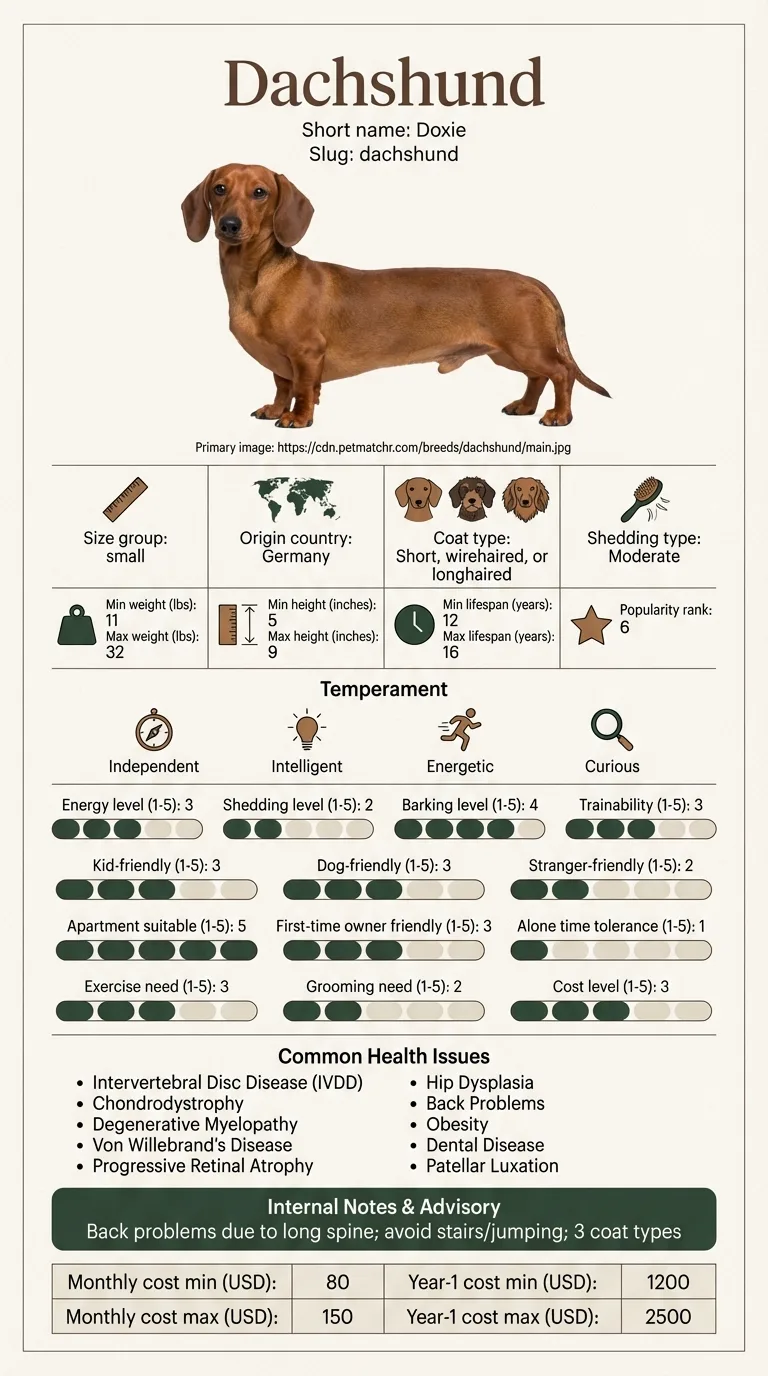
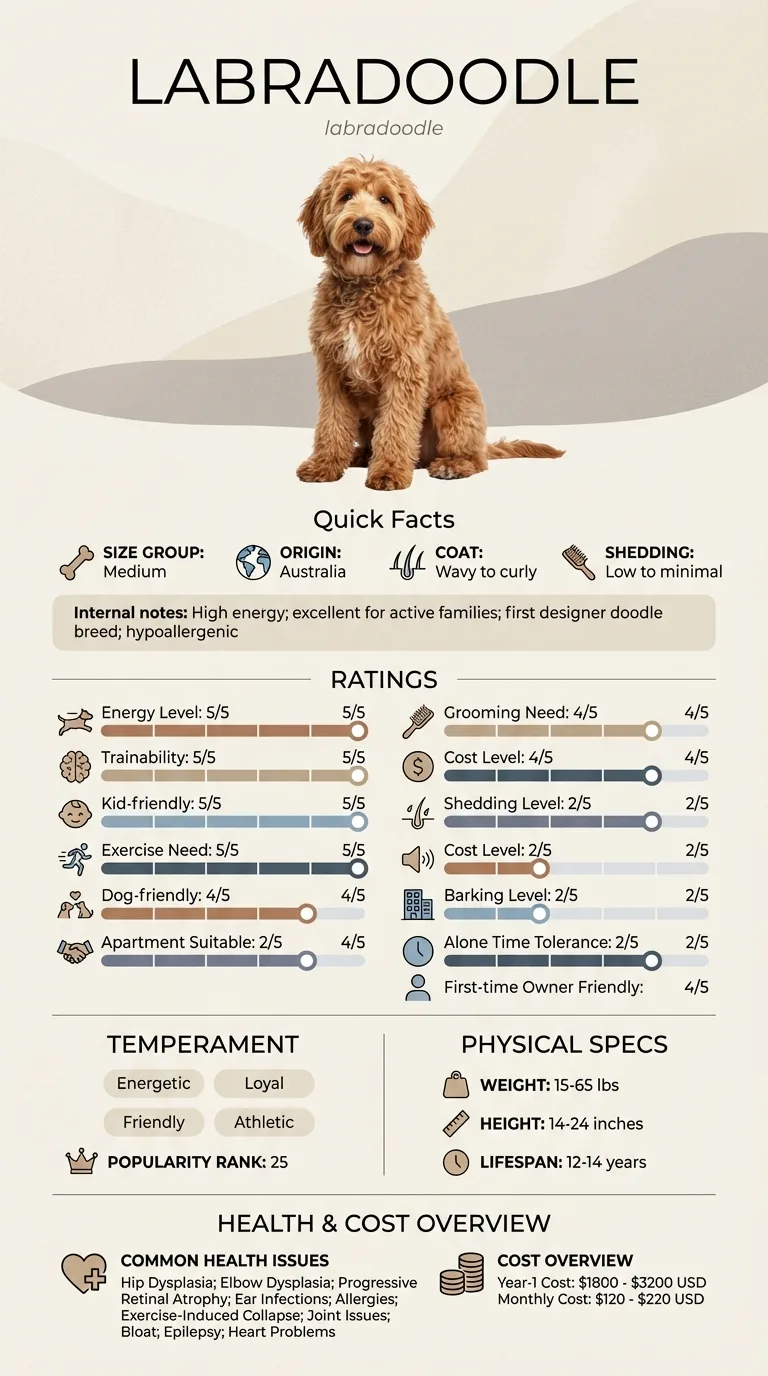
This is for someone already down to Dachshund and Labradoodle and deciding between them. For this pair the decision usually turns on apartment suitability and exercise need, so those are covered first and in most detail. Anyone choosing from a flat has a clear answer here: Dachshund rates 5/5 against 2/5. It is written for the decision rather than the breed history.
Between Dachshund and Labradoodle, apartment suitability is what separates them, and Dachshund is the lower-effort dog of the two to keep.
Choose Dachshund if you are in a flat or a smaller home, you do not want a standing grooming appointment and your walking routine is modest.
Choose Labradoodle if this is your first dog, there are young children at home and you already have another dog.
| Feature | dachshund | labradoodle | Winner |
|---|---|---|---|
| Size class | small | medium | Equal |
| Weight | 11–32 lbs | 15–65 lbs | Equal |
| Height | 5–9 in | 14–24 in | Equal |
| Lifespan | 12–16 years | 12–14 years | dachshund |
| Exercise need | Moderate (3/5) | Very high (5/5) | dachshund |
| Grooming need | Low (2/5) | High (4/5) | dachshund |
| Shedding | Low (2/5) | Low (2/5) | Equal |
| Energy level | Moderate (3/5) | Very high (5/5) | Equal |
| Barking | High (4/5) | Low (2/5) | labradoodle |
| Apartment suitability | Very high (5/5) | Low (2/5) | dachshund |
| Good for first-time owners | Moderate (3/5) | High (4/5) | labradoodle |
| Tolerates being alone | Very low (1/5) | Low (2/5) | labradoodle |
| Trainability | Moderate (3/5) | Very high (5/5) | labradoodle |
| Good with kids | Moderate (3/5) | Very high (5/5) | labradoodle |
| Good with other dogs | Moderate (3/5) | High (4/5) | labradoodle |
| Friendly to strangers | Low (2/5) | High (4/5) | labradoodle |
| Cost level | Moderate (3/5) | High (4/5) | dachshund |
| Coat | Short, wirehaired, or longhaired | Wavy to curly | Equal |
| Origin | Germany | Australia | Equal |
| Typical monthly cost | $80–$150 | $120–$220 | Equal |
| Typical first-year cost | $1,200–$2,500 | $1,800–$3,200 | Equal |
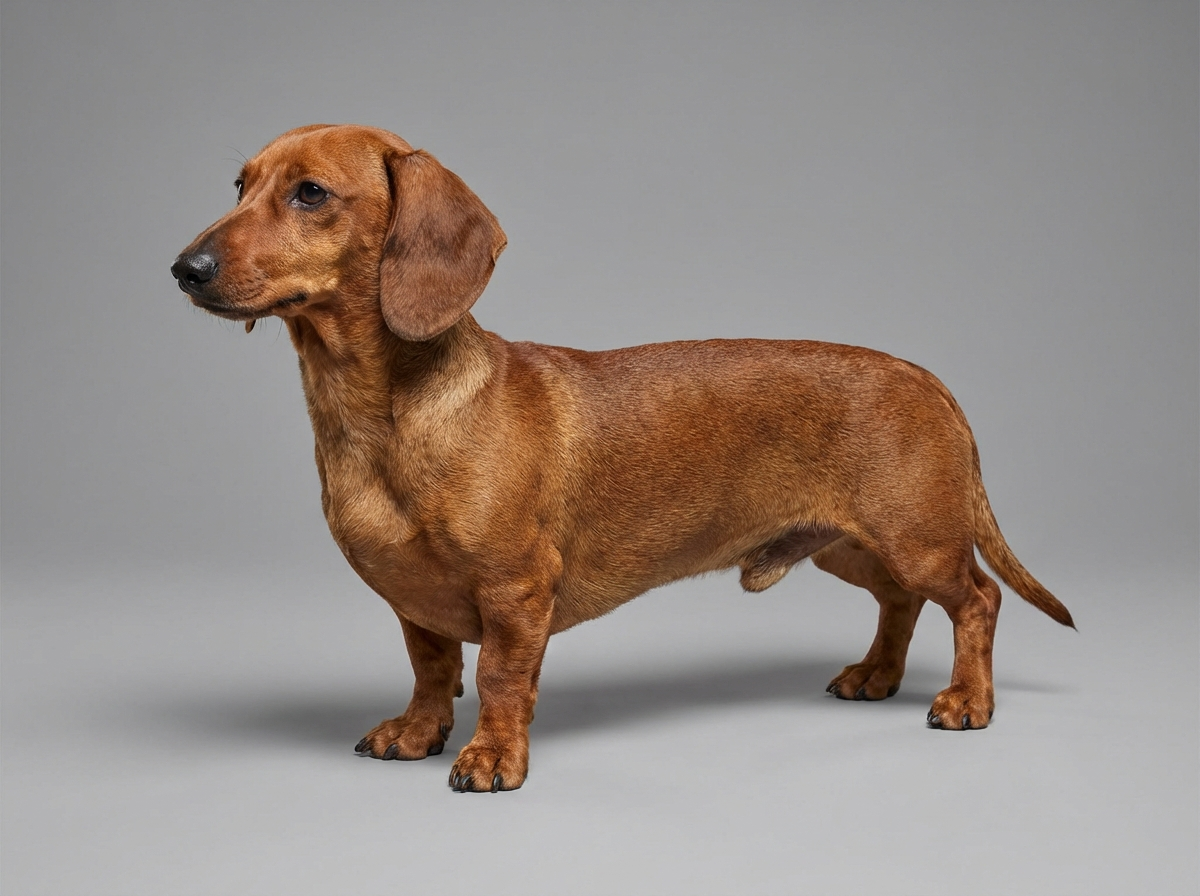
Five to nine inches at the shoulder — that's the Dachshund's entire height range, low enough that its 11-to-32-pound body reads as long rather than tall. A Labradoodle stands 14 to 24 inches and can weigh up to 65 pounds, meaning even a small Labradoodle is likely to stand taller than a large Dachshund lying flat. The two breeds' builds aren't just different sizes; they're different shapes, with the Dachshund's elongated, short-legged frame a known factor in its back health, versus the Labradoodle's more conventionally proportioned, athletic structure inherited from its Labrador and Poodle ancestry.
A Labradoodle's exercise need rates very high, 5/5, and its energy level does too — a dog that wants real daily output, not a stroll. The Dachshund sits at a moderate 3/5 for both measures, content with shorter, more manageable activity. That gap matters practically: a Dachshund's short legs and long spine make high-impact exercise like jumping something to actively avoid, given its IVDD risk, while a Labradoodle's structure supports the running, swimming, and fetch sessions its energy level demands. An owner hoping to tire out a Labradoodle with a Dachshund-level walk will end up with a restless, understimulated dog.
Grooming need runs opposite to what the coats might suggest: the Labradoodle rates high, 4/5, against the Dachshund's low, 2/5, even though both tie at low, 2/5, for shedding. The Dachshund's short, wirehaired, or longhaired coat options are generally low-fuss; the Labradoodle's wavy-to-curly coat, prized for being allergy-friendlier, still needs regular brushing and periodic clipping to avoid matting. A Labradoodle owner gets the shedding benefit without the grooming break — expect a routine closer to a Poodle's than to a typical retriever's.
The Dachshund is rated very high, 5/5, for apartment suitability, while the Labradoodle scores low, 2/5 — nearly opposite ends of the scale. Barking cuts the other way, though: the Dachshund rates high, 4/5, a known trait in the breed, against the Labradoodle's low, 2/5. An apartment-dwelling Dachshund owner should expect more vocal alerting at doors and hallway noise, while a Labradoodle in the same space will likely be quieter but under-exercised unless given real daily outdoor time it's unlikely to get from apartment living alone.
Trainability favors the Labradoodle clearly, very high 5/5 against the Dachshund's moderate 3/5, and first-time-owner suitability follows the same pattern, high 4/5 versus moderate 3/5. The Dachshund's independent, curious temperament — traits that made it an effective badger hunter — translate into a dog that thinks for itself in training sessions rather than deferring automatically. A Labradoodle's loyal, friendly nature, inherited substantially from the Labrador side, tends to make it more responsive to reward-based training from an earlier age, part of why it's commonly bred as a service and therapy dog.
Good with kids: moderate 3/5 for the Dachshund against very high, 5/5, for the Labradoodle — a meaningful gap for a family with young children. Good with other dogs and friendly to strangers follow the same trend, moderate versus high and low versus high respectively. A Dachshund's low 2/5 stranger-friendliness and history as a solitary hunting dog make it naturally more reserved and, with its long back, more injury-prone around rough play. A Labradoodle's high scores across the board make it the more forgiving choice for a busy, social household.
The Dachshund actually outlives the Labradoodle, 12 to 16 years against 12 to 14, despite carrying a more structurally-driven health list: intervertebral disc disease, chondrodystrophy, and back problems all trace to its elongated spine, alongside degenerative myelopathy and patellar luxation. The Labradoodle's ten-condition list leans toward larger-breed and crossbred concerns instead — hip and elbow dysplasia, bloat, exercise-induced collapse, and heart problems. A Dachshund owner is managing one structural vulnerability specifically, while a Labradoodle owner is watching a broader spread of joint and organ conditions.
Cost level rates moderate, 3/5, for the Dachshund against high, 4/5, for the Labradoodle, and the numbers track: $80–$150 monthly and $1,200–$2,500 first-year for the Dachshund versus $120–$220 monthly and $1,800–$3,200 for the Labradoodle. Much of that gap comes from size — more food, larger-dose medications, and higher-volume grooming for a dog that can reach 65 pounds. A Dachshund owner should still budget for possible IVDD-related veterinary costs, which can be substantial even though they don't show up in the routine monthly figure.
Dachshund weighs 11–32 lbs and lives 12–16 years; Labradoodle weighs 15–65 lbs and lives 12–14 years. The two diverge most on apartment suitability, exercise need and grooming need and 5 other rated axes. Almost every rated axis separates them at least slightly. In the table, a "winner" means easier for an ordinary household — not better. Size, coat and origin are recorded without a verdict. Because both breeds are scored the same way, the gaps are reliable even where the absolute numbers are rough.

Its short-legged, elongated build is linked to intervertebral disc disease and back problems, both listed as common health concerns — jumping on and off furniture is a frequently cited risk factor worth minimizing.
The Labradoodle by a clear margin — very high 5/5 exercise need and energy level, against the Dachshund's moderate 3/5 for both.
The Dachshund, rated high 4/5 for barking versus the Labradoodle's low 2/5, despite being the far more apartment-suited of the two.
The Labradoodle, rated very high 5/5 for good-with-kids against the Dachshund's moderate 3/5.
The Labradoodle, very high 5/5 trainability versus the Dachshund's moderate 3/5 — the Dachshund's independent streak makes it a slower study.
The Dachshund, 12–16 years, edges out the Labradoodle's 12–14 year range despite its spine-related health risks.
The Labradoodle, at $1,800–$3,200, versus $1,200–$2,500 for the Dachshund — mostly a function of its larger size.
The Dachshund, rated very high 5/5 for apartment suitability versus the Labradoodle's low 2/5.
Neither does well — the Dachshund rates very low 1/5 and the Labradoodle low 2/5 for tolerating time alone.
Neither — both tie at low 2/5 for shedding.
The Labradoodle, with a very high 5/5 exercise need against the Dachshund's moderate 3/5.
Secure checkout on Stripe. We never see your card.
7-day money-back guarantee. Instant access.
Health information here is general and is not veterinary advice. If your dog shows pain, sudden behaviour change, or worsening symptoms, consult a licensed veterinarian.
Some links on this site are affiliate links. We may earn a commission at no extra cost to you, and we only suggest products we believe are helpful for dog owners.
We research and check what we publish, but we do not warrant that any figure, date, price, or statement is accurate, complete, or current, and we accept no liability for any loss, cost, injury, or other harm arising from the use of this site. Use it as one reference among several. You remain responsible for your own decisions and for your dog's care - confirm anything that matters with a licensed veterinarian or another qualified professional before you act on it. Full disclaimer.
Match your lifestyle to the right dog.
Take quizNot sure which breed is right for you? Take our 2-minute quiz to find out.
Take the quiz