Living
Akita vs German Shorthaired Pointer: which should I choose?
The GSP if you genuinely run, cycle, hike or hunt and want a dog that can do all of it. The Akita if you are not going to change your routine — it needs a walk, not a landscape.

Quick answer
Akita vs German Shorthaired Pointer: which should I choose?
The GSP if you genuinely run, cycle, hike or hunt and want a dog that can do all of it. The Akita if you are not going to change your routine — it needs a walk, not a landscape.
The German Shorthaired Pointer rates 1/5 for apartments — the lowest rating on this site, lower than the Cane Corso and lower than any giant breed. It weighs 45 to 70 pounds. The rating is not about size at all, and understanding why is most of what you need to know about this dog.
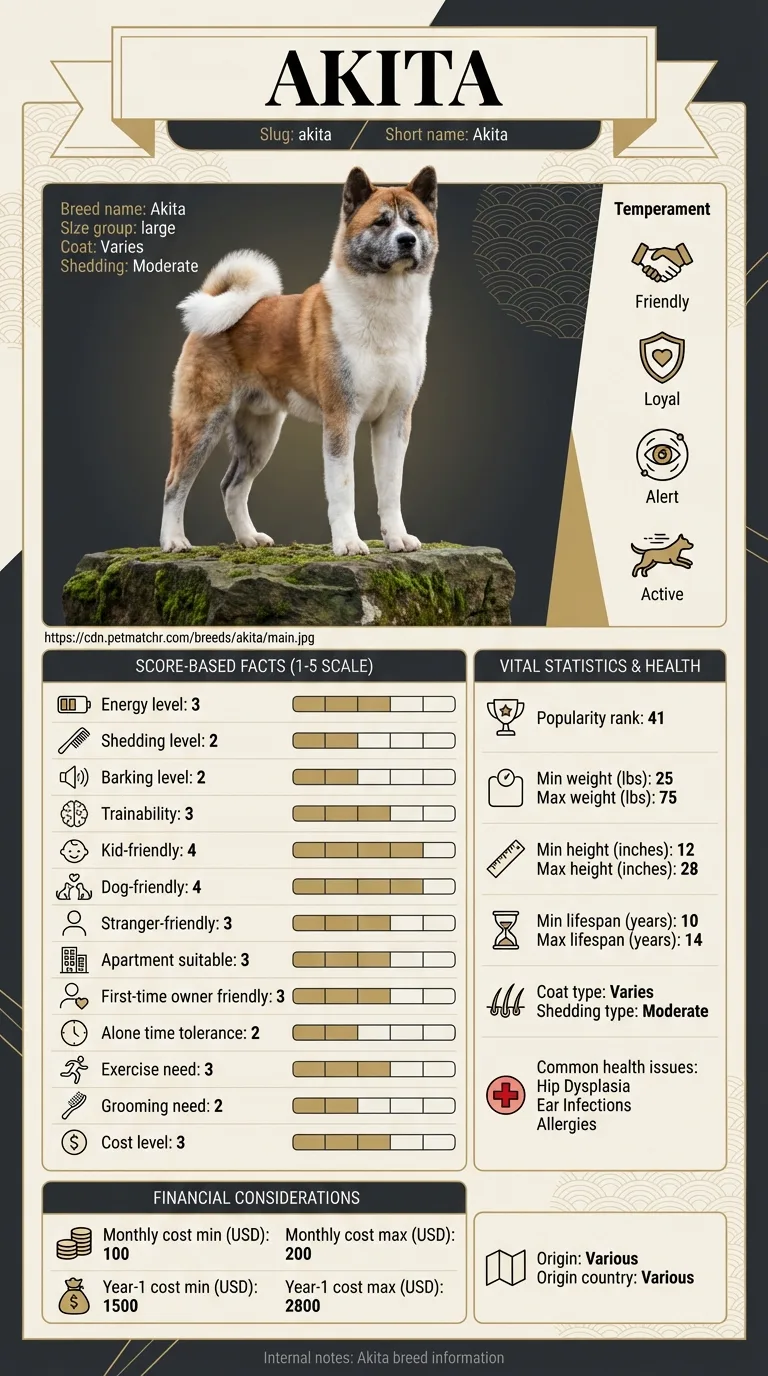
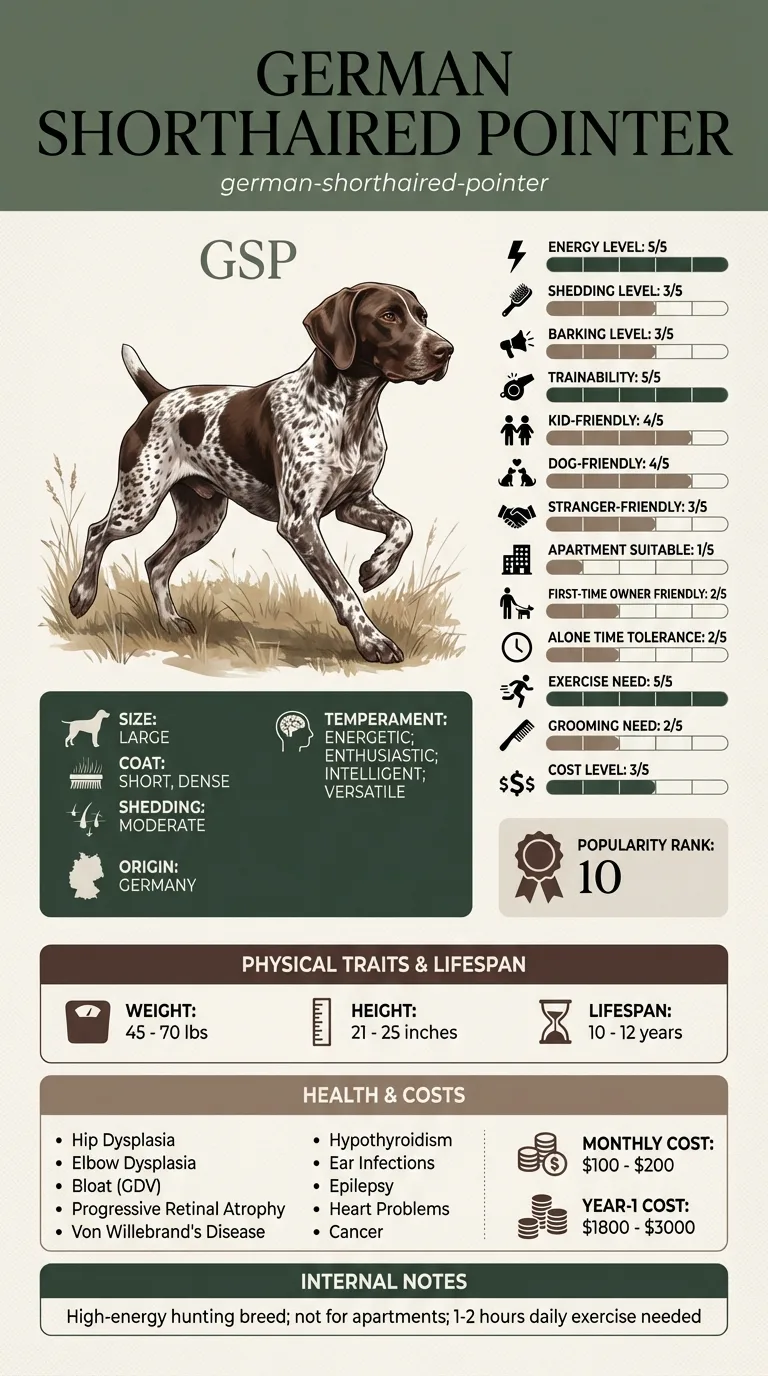
This page is for someone weighing an athletic sporting breed against a low-output guardian. It covers what 5/5 exercise means in a pointer, why the apartment rating is what it is, bloat and bleeding disorders, coat and cold tolerance, and running costs.
The German Shorthaired Pointer is one of the most capable dogs available to an athletic owner and one of the worst possible choices for a sedentary one; the Akita is indifferent to how active you are.
Choose the Akita if you are not going to run. It needs 3/5 exercise against the GSP's 5/5, rates 2/5 for apartments against 1/5, tolerates being alone at 3/5 against 2/5, and lives 10 to 13 years against 10 to 12. You are accepting 3/5 trainability, 2/5 with other dogs and strangers, and 5/5 shedding.
Choose the GSP if you genuinely run, cycle, hike or hunt and want a dog that can do all of it. It rates 5/5 for trainability, 4/5 with children and other dogs, grooms at only 2/5, and costs $100–$200 a month. You are accepting 5/5 exercise and energy, a 1/5 apartment rating, and a real bloat risk.
| Feature | akita | german shorthaired pointer | Winner |
|---|---|---|---|
| Weight | 70–130 lbs | 45–70 lbs | Equal |
| Height | 24–28 in | 21–25 in | Equal |
| Lifespan | 10–13 years | 10–12 years | akita |
| Coat | Dense double coat | Short and dense | Equal |
| Grooming need | Moderate (3/5) | Low (2/5) | german shorthaired pointer |
| Shedding | Very high (5/5) | Moderate (3/5) | german shorthaired pointer |
| Energy level | Moderate (3/5) | Very high (5/5) | Equal |
| Exercise need | Moderate (3/5) | Very high (5/5) | akita |
| Trainability | Moderate (3/5) | Very high (5/5) | german shorthaired pointer |
| Barking | Low (2/5) | Moderate (3/5) | akita |
| Good with kids | Moderate (3/5) | High (4/5) | german shorthaired pointer |
| Good with other dogs | Low (2/5) | High (4/5) | german shorthaired pointer |
| Friendly to strangers | Low (2/5) | Moderate (3/5) | german shorthaired pointer |
| Apartment suitability | Low (2/5) | Very low (1/5) | akita |
| Good for first-time owners | Very low (1/5) | Low (2/5) | german shorthaired pointer |
| Tolerates being alone | Moderate (3/5) | Low (2/5) | akita |
| Typical monthly cost | $110–$240 | $100–$200 | german shorthaired pointer |
| Typical first-year cost | $1,700–$3,200 | $1,800–$3,000 | Equal |
Two hours a day is the honest figure for an adult GSP, and it should be hard exercise rather than walking. This is a breed that keeps pace with a bicycle, runs alongside a distance runner, and is still ready in the evening.
Mental work is required on top. Pointing breeds work at range and think about the ground they cover; scent games, retrieves, and directional training satisfy something walking does not touch. A GSP given only physical exercise becomes extremely fit and no calmer.
The failure mode is well documented in rescue: adolescent GSPs surrendered between one and two years old because a household that could manage a puppy could not manage an athlete. It is the single most common story attached to this breed.
The Akita's 3/5 is met by forty-five to sixty minutes of walking, and it does not deteriorate without a job. That is the whole comparison in one line: one of these dogs needs your lifestyle to change, and one does not.
The GSP's 5/5 trainability is genuine and it is a pleasure to train — enthusiastic, quick, and eager for the interaction. It does well in obedience, agility, gundog work and scent sports.
It is also a soft, closely attached breed, which surprises people expecting a hard-working machine. GSPs lean on their people, follow them around, and rate 2/5 for tolerating solitude. A household out all day needs a plan: absence training from the first week, a genuinely tired dog before leaving, and usually a midday walker.
With other dogs at 4/5 and children at 4/5 it is easy to live with socially. The caveat is exuberance rather than temperament — a fifty-pound dog that has not run enough is a hazard to a toddler by accident.
Recall needs proofing against game. Prey drive is high, and a GSP that has locked onto a scent or a running animal is not listening in any useful sense.
The Akita's independence is the mirror image: less attachment, less need for you, and correspondingly less influence when it matters.
Bloat sits high on the German Shorthaired Pointer's list and deserves to. A deep, narrow chest on a lean athletic frame is the classic conformation for gastric dilatation-volvulus, in which the stomach distends and twists — an emergency measured in hours, not days.
Every GSP household should recognise the signs: unproductive retching, a swelling or drum-tight abdomen, restlessness and an inability to settle. Know where the nearest out-of-hours surgery is before you need it. Some owners of at-risk breeds elect a preventive gastropexy at the time of neutering, which is worth discussing with a vet.
Von Willebrand's disease is the second item to name. It is an inherited clotting disorder with a DNA test, and the usual way owners discover it is during surgery. Test before any elective procedure.
Hip and elbow dysplasia, progressive retinal atrophy, hypothyroidism, epilepsy, heart problems and cancer complete the list.
The Akita is also deep-chested and carries the same bloat risk, alongside autoimmune disorders, hypothyroidism, progressive retinal atrophy and hip dysplasia.
The GSP's short dense coat rates 2/5 for grooming — a rubber curry once a week covers it — and sheds moderately at 3/5 in short stiff hairs that work into fabric and are surprisingly persistent.
It is water-resistant but thin, and a lean muscular dog with little body fat gets cold. GSPs genuinely need a coat in winter weather and should not be left outside in it. They are far better suited to heat than the Akita, whose dense double coat means summer walks move to the cooler ends of the day and which should never be clipped.
On money the two are close. The GSP runs $100–$200 a month against $110–$240, but first-year costs land at $1,800–$3,000 against $1,700–$3,200 — effectively equivalent, because an athletic dog eats well and a growing one needs good nutrition.
The cost that does not appear in either figure is time. Two hours a day, every day, for ten to twelve years is the GSP's real price, and it is not one that can be paid at weekends.
Lifespan runs 10 to 13 years against 10 to 12.
A 1/5 apartment rating on a 45 to 70 pound dog is worth explaining, because it is lower than several breeds twice its weight.
The reason is output. A GSP is not a dog that needs a garden; it is a dog that needs a landscape. 5/5 energy and 5/5 exercise in an animal built for all-day work means that a flat is not a size problem but a stimulation problem, and a bored GSP indoors is destructive on a scale that surprises people — doors, skirting boards, sofas.
The Akita's 2/5 is a size problem. It is quiet at 2/5 barking, needs 3/5 exercise, and its difficulty in a flat is 130 pounds in a shared corridor plus 5/5 shedding.
What the GSP gives you in exchange is a superb outdoor dog: 5/5 trainable, 4/5 with children and other dogs, a low-maintenance coat at 2/5 grooming, and the ability to run, swim, track and retrieve competently.

Because the rating reflects output rather than size. At 5/5 energy and 5/5 exercise, a GSP in a flat is a stimulation problem, not a space problem, and a bored one is destructive on a scale that surprises people. Several breeds twice its weight rate higher because they simply need less.
Around two hours a day of genuine work, not walking — running, cycling alongside, hiking or gundog work — plus mental work such as scent games and directional training. A GSP given only physical exercise becomes extremely fit and no calmer, which is the mistake most first-time owners make.
Yes, at 4/5 with children and 4/5 with other dogs, provided the exercise happens. They are affectionate and closely attached — softer than their working reputation suggests. The main risk with small children is accidental: a fifty-pound dog that has not run enough is a hazard by collision rather than intent.
A deep, narrow chest on a lean frame is the classic conformation for gastric dilatation-volvulus, where the stomach distends and twists. It is an emergency measured in hours. Learn the signs — unproductive retching, a drum-tight abdomen, restlessness — and ask a vet about preventive gastropexy at neutering.
Not comfortably. It rates 2/5 for solitude and is a closely attached breed that leans on its people. A full-time household needs absence training from the first week, a genuinely tired dog before leaving, and usually a midday walker. The Akita at 3/5 is self-contained by comparison.
The Akita, easily. Its dense double coat handles temperatures that keep most breeds indoors. The GSP's coat is water-resistant but thin, and a lean muscular dog with little body fat gets genuinely cold — it needs a coat in winter and should not be left outside in it.
They are close. The GSP runs $100–$200 a month against the Akita's $110–$240, but first-year costs land at $1,800–$3,000 against $1,700–$3,200 — effectively equivalent. The GSP's real price is time: two hours a day for ten to twelve years.
The GSP if you genuinely run, cycle, hike or hunt and want a dog that can do all of it. The Akita if you are not going to change your routine — it needs a walk, not a landscape.
The GSP runs $100–$200 a month and the Akita $110–$240, with first-year totals of $1,800–$3,000 and $1,700–$3,200 — close enough to treat as equivalent.
Adolescence. Dogs surrendered between one and two years old by households that could manage a puppy but not an athlete. It is the single most common story attached to the breed.
Von Willebrand's disease, an inherited clotting disorder with a DNA test. Most owners discover it during an operation, so testing before any elective procedure including neutering is the sensible order.
Secure checkout on Stripe. We never see your card.
7-day money-back guarantee. Instant access.
Health information here is general and is not veterinary advice. If your dog shows pain, sudden behaviour change, or worsening symptoms, consult a licensed veterinarian.
Some links on this site are affiliate links. We may earn a commission at no extra cost to you, and we only suggest products we believe are helpful for dog owners.
We research and check what we publish, but we do not warrant that any figure, date, price, or statement is accurate, complete, or current, and we accept no liability for any loss, cost, injury, or other harm arising from the use of this site. Use it as one reference among several. You remain responsible for your own decisions and for your dog's care - confirm anything that matters with a licensed veterinarian or another qualified professional before you act on it. Full disclaimer.
Match your lifestyle to the right dog.
Take quizNot sure which breed is right for you? Take our 2-minute quiz to find out.
Take the quiz