Living
Which fits a typical home better?
The Dachshund, for anyone without a yard -- its 5/5 apartment score against the GSP's 1/5 makes the case on its own.

Quick answer
Which fits a typical home better?
The Dachshund, for anyone without a yard -- its 5/5 apartment score against the GSP's 1/5 makes the case on its own.
Choosing between a Dachshund and a German Shorthaired Pointer? Both breeds have unique traits that may suit different lifestyles. Here’s a straightforward comparison to help you decide.
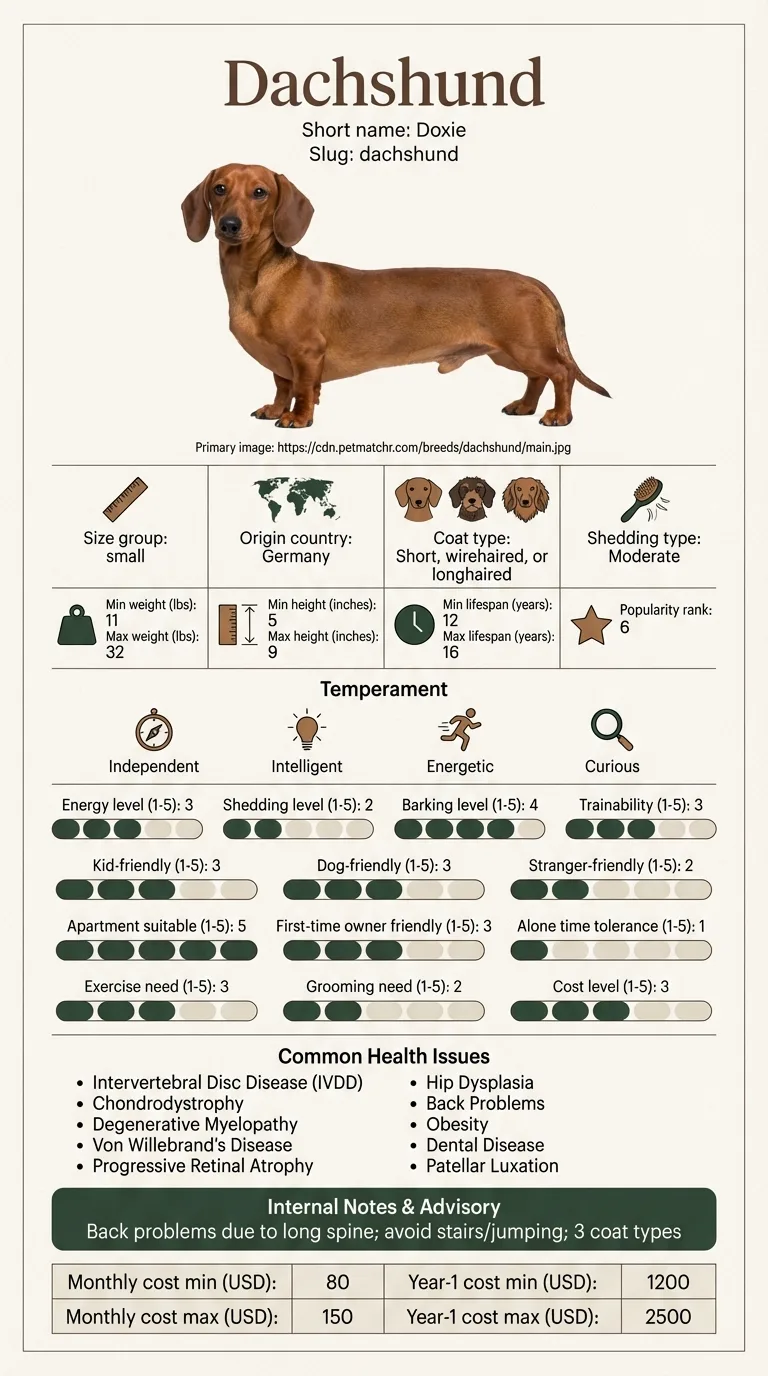
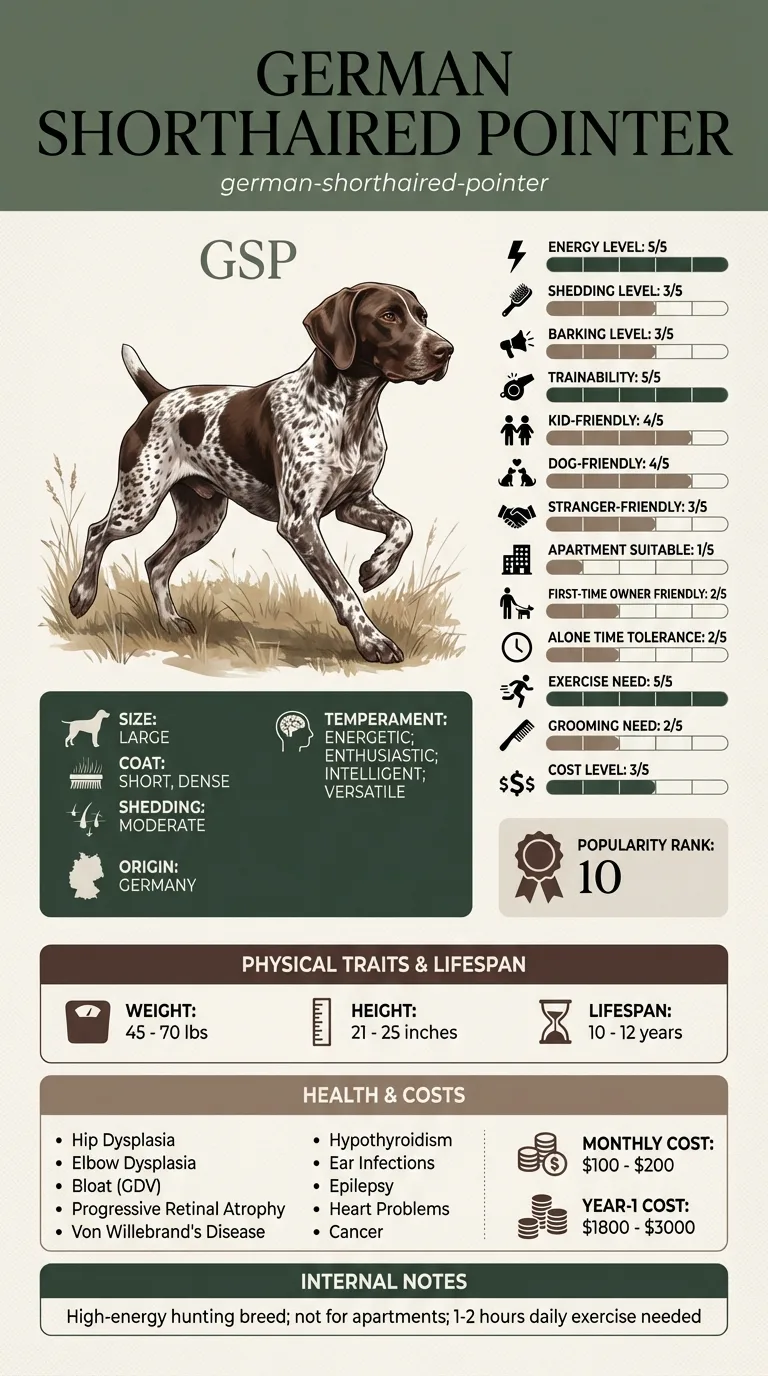
If you're considering adding a dog to your family, you might be feeling overwhelmed by the choices. You could be a first-time dog owner, a parent looking for a family-friendly pet, or a busy professional trying to find a suitable companion for apartment living. Understanding the differences between the Dachshund and the German Shorthaired Pointer is crucial for making an informed decision that fits your home and lifestyle.
If you need a smaller, apartment-friendly dog that’s good with kids, go for the Dachshund; if you want a larger, active dog for outdoor adventures, choose the German Shorthaired Pointer.
Pick a Dachshund if you live in an apartment, have young children, or prefer a dog that requires moderate exercise and grooming.
Opt for a German Shorthaired Pointer if you have ample space, enjoy outdoor activities, and can commit to daily exercise and training.
| Feature | dachshund | german shorthaired pointer | Winner |
|---|---|---|---|
| Size class | small | large | Equal |
| Weight | 11–32 lbs | 45–70 lbs | Equal |
| Height | 5–9 in | 21–25 in | Equal |
| Lifespan | 12–16 years | 10–12 years | dachshund |
| Exercise need | Moderate (3/5) | Very high (5/5) | dachshund |
| Grooming need | Low (2/5) | Low (2/5) | Equal |
| Shedding | Low (2/5) | Moderate (3/5) | dachshund |
| Energy level | Moderate (3/5) | Very high (5/5) | Equal |
| Barking | High (4/5) | Moderate (3/5) | german shorthaired pointer |
| Apartment suitability | Very high (5/5) | Very low (1/5) | dachshund |
| Good for first-time owners | Moderate (3/5) | Low (2/5) | dachshund |
| Tolerates being alone | Very low (1/5) | Low (2/5) | german shorthaired pointer |
| Trainability | Moderate (3/5) | Very high (5/5) | german shorthaired pointer |
| Good with kids | Moderate (3/5) | High (4/5) | german shorthaired pointer |
| Good with other dogs | Moderate (3/5) | High (4/5) | german shorthaired pointer |
| Friendly to strangers | Low (2/5) | Moderate (3/5) | german shorthaired pointer |
| Cost level | Moderate (3/5) | Moderate (3/5) | Equal |
| Coat | Short, wirehaired, or longhaired | Short, dense | Equal |
| Origin | Germany | Germany | Equal |
| Typical monthly cost | $80–$150 | $100–$200 | Equal |
| Typical first-year cost | $1,200–$2,500 | $1,800–$3,000 | Equal |
Forty-five to seventy pounds and 21 to 25 inches tall -- that's the German Shorthaired Pointer's frame, dwarfing the Dachshund's 11 to 32 lbs and 5 to 9 inches. This isn't small-versus-medium; it's small versus genuinely large. A GSP needs a car with real cargo space and a bed sized accordingly, while a Dachshund travels fine in a bag.
Exercise need is where these two diverge hardest: the GSP rates very high (5/5), the Dachshund moderate (3/5), and the GSP's energy level itself hits 5/5. GSPs were bred as all-day hunting dogs and behave like it -- an hour of leash walking won't cut it. The Dachshund's needs are real but far more forgiving for owners without acreage.
Grooming need ties at low (2/5) for both breeds, but shedding doesn't -- the Dachshund holds at low (2/5) while the GSP climbs to moderate (3/5) despite its short coat. Both are wash-and-go breeds in terms of styling, but expect more loose hair around the house with the Pointer, especially during seasonal coat blow.
The scores here are stark: 5/5 apartment suitability for the Dachshund against a rock-bottom 1/5 for the GSP. That low score isn't really about size -- it's the very high exercise need translating badly into confined spaces. The Dachshund also barks more (4/5 vs 3/5), so it's not silent, but a bored, under-exercised GSP is the harder problem to manage in a small unit.
The GSP rates very high (5/5) for trainability against the Dachshund's moderate (3/5), yet the table scores it lower for first-time owners (2/5 vs 3/5) -- trainability and ease aren't the same thing when a dog also needs serious daily exercise. A Dachshund is more stubborn in session but less demanding overall; a GSP learns fast but only thrives with an owner who can match its energy.
On every social metric, the GSP scores higher: good with kids (4/5 vs 3/5), good with other dogs (4/5 vs 3/5), and friendly to strangers (3/5 vs 2/5). Its enthusiastic, versatile temperament shows up here. The Dachshund isn't a poor family dog, but it's more reserved with strangers and needs careful handling around young kids given its back.
The Dachshund's 12-to-16-year lifespan beats the GSP's 10 to 12, but both carry long health lists -- ten conditions each. Three overlap directly: hip dysplasia, Von Willebrand's disease, and progressive retinal atrophy show up for both breeds. The GSP's remaining risks lean toward bloat, heart problems, and cancer; the Dachshund's toward its spine and joints.
Both breeds land at a moderate 3/5 cost rating, but the dollar figures pull apart at the extremes: $80-$150 monthly and $1,200-$2,500 first-year for the Dachshund versus $100-$200 monthly and $1,800-$3,000 first-year for the GSP. A bigger dog eats more and needs larger medication doses, which shows up in that first-year gap.


More than most homes without a yard can offer -- it scores a very high 5/5 for exercise need and just 1/5 for apartment suitability. This is a dog built for daily runs or field work, not a couch companion.
The Dachshund edges it out, 3/5 versus the GSP's 2/5, mostly because the GSP's exercise demands are harder for a new owner to keep up with, even though it trains faster.
Yes -- hip dysplasia, Von Willebrand's disease, and progressive retinal atrophy appear on both breeds' lists. Beyond that they diverge: the Dachshund toward back and disc issues, the GSP toward bloat and heart problems.
The GSP, at a moderate 3/5 against the Dachshund's low 2/5, despite the Pointer's short coat.
$80 to $150 for a Dachshund, $100 to $200 for a GSP. Both are rated a moderate 3/5 on overall cost, but the Pointer's larger size pushes food and vet bills higher.
The Dachshund, at 12 to 16 years against the GSP's 10 to 12 -- a meaningful gap for anyone weighing long-term commitment.
Possibly. It barks less than the Dachshund (3/5 vs 4/5), but its very high exercise need and energy level mean an under-stimulated GSP can become restless or destructive in a low-activity home.
The Dachshund, for anyone without a yard -- its 5/5 apartment score against the GSP's 1/5 makes the case on its own.
$1,200-$2,500 for a Dachshund versus $1,800-$3,000 for a GSP, both landing at a moderate 3/5 cost rating overall.
The GSP needs very high daily exercise (5/5); the Dachshund's moderate 3/5 need is a fraction of that.
The Dachshund, 12-16 years versus the GSP's 10-12.
Secure checkout on Stripe. We never see your card.
7-day money-back guarantee. Instant access.
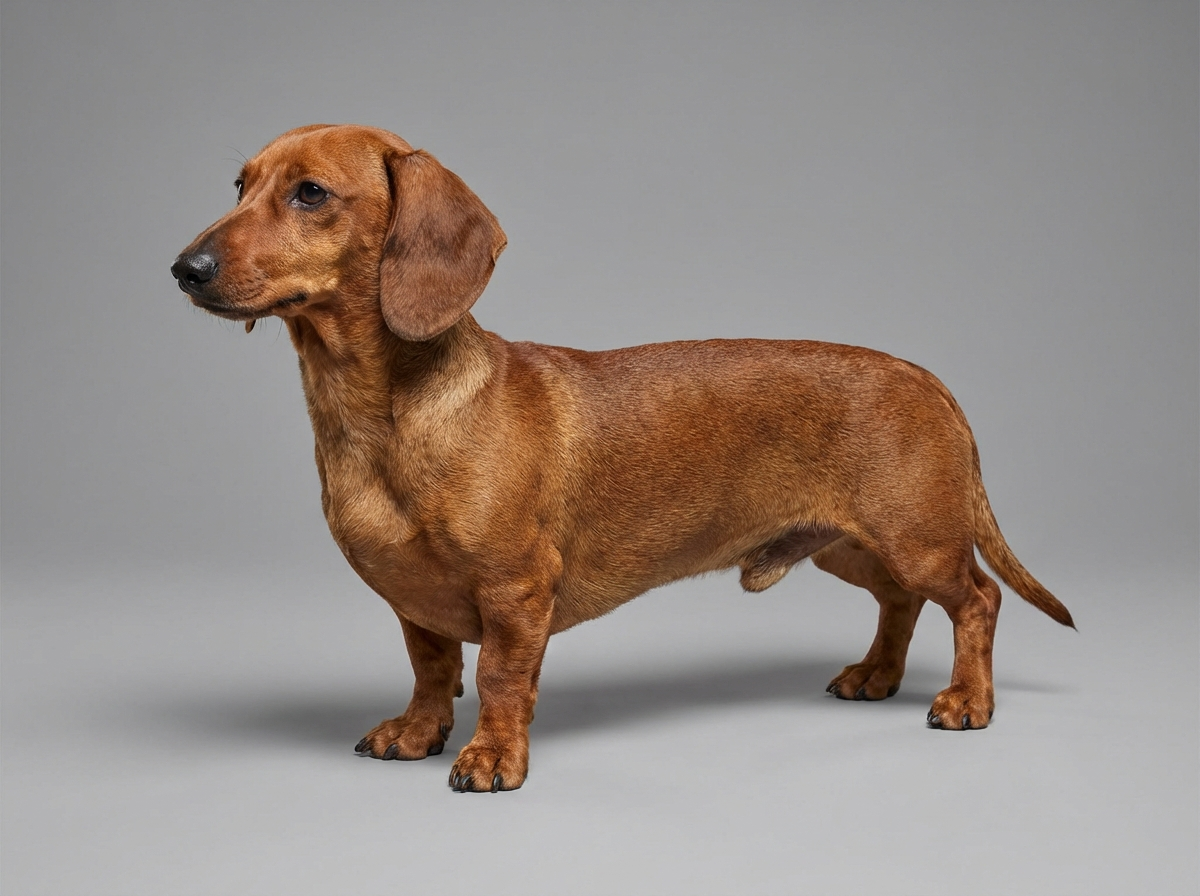
This guide is not medical advice. If your dog shows pain, sudden behavior change, or worsening symptoms, consult a licensed veterinarian.
Some links may be affiliate links. We may earn a commission at no extra cost to you. We only suggest products we believe are helpful for dog owners.
We research and check what we publish, but we do not warrant that any figure, date, price, or statement is accurate, complete, or current, and we accept no liability for any loss, cost, injury, or other harm arising from the use of this site. Use it as one reference among several. You remain responsible for your own decisions and for your dog's care - confirm anything that matters with a licensed veterinarian or another qualified professional before you act on it. Full disclaimer.
Match your lifestyle to the right dog.
Take quizNot sure which breed is right for you? Take our 2-minute quiz to find out.
Take the quiz