Behavior
Which should most people pick?
For small homes, first-time owners, or lower-activity lifestyles, the Maltese is the clear fit; the GSP suits active, experienced owners with space to spare.

Quick answer
Which should most people pick?
For small homes, first-time owners, or lower-activity lifestyles, the Maltese is the clear fit; the GSP suits active, experienced owners with space to spare.
German Shorthaired Pointer or Maltese? On paper they differ most on apartment suitability, and on the scales German Shorthaired Pointer is the heavier at 45–70 lbs. Here is how the two compare on everything that shapes an ordinary week.
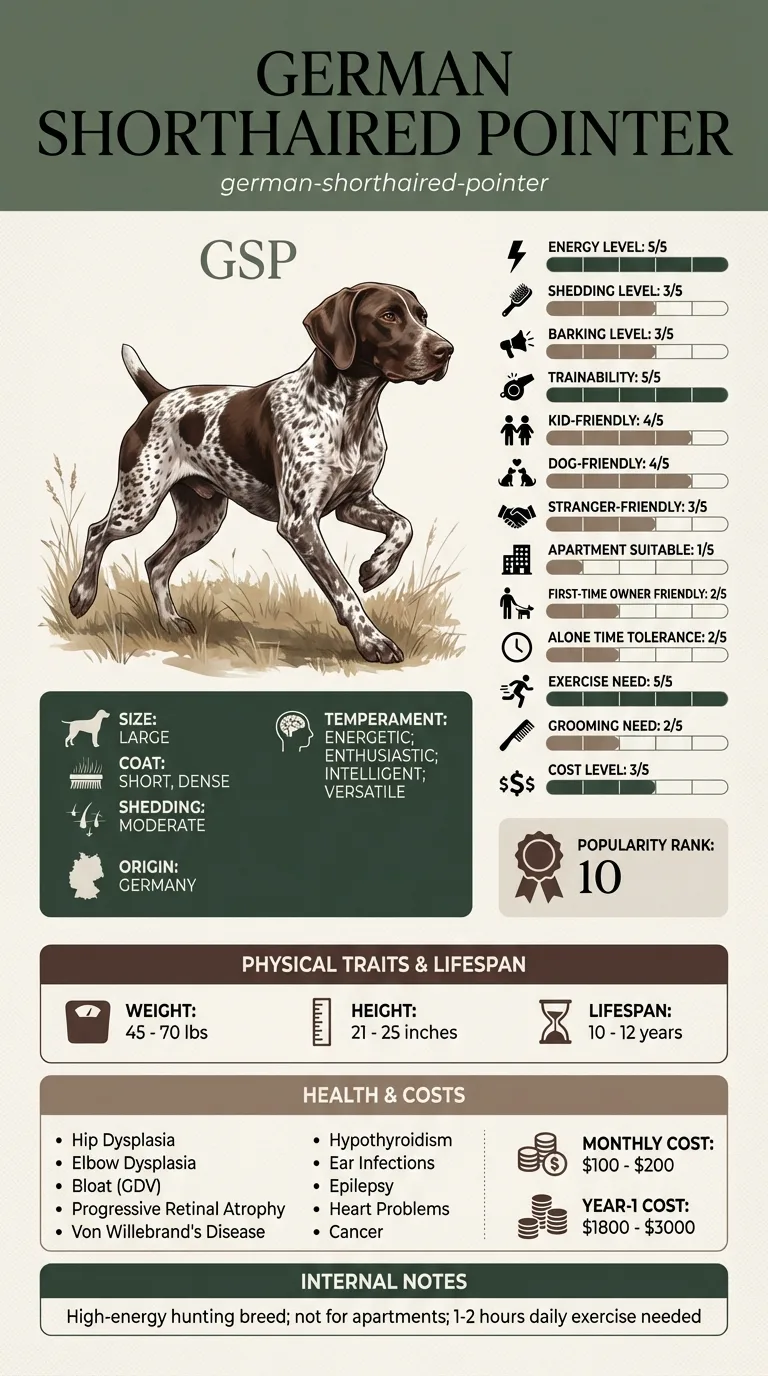
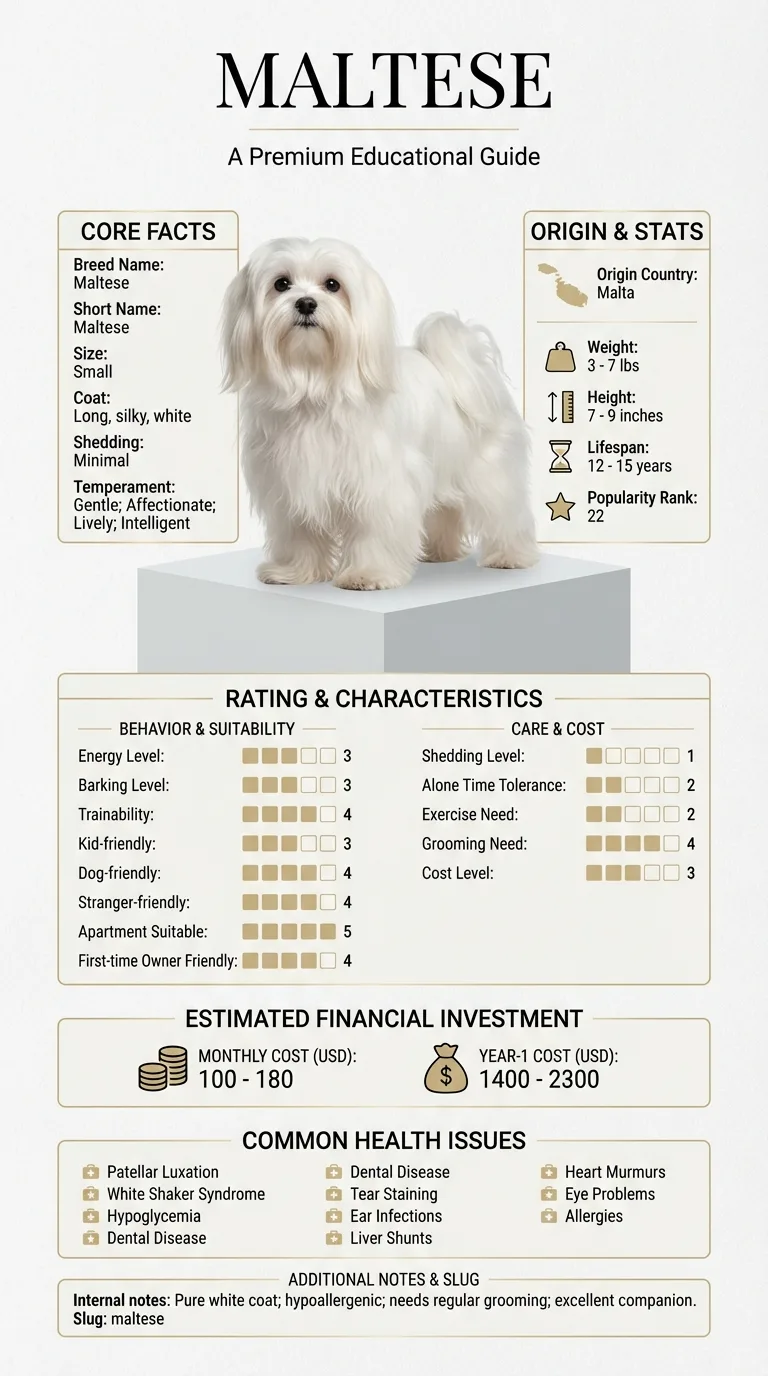
This is for someone already down to German Shorthaired Pointer and Maltese and deciding between them. For this pair the decision usually turns on apartment suitability and exercise need, so those are covered first and in most detail. Anyone choosing from a flat has a clear answer here: Maltese rates 5/5 against 1/5. It is written for the decision rather than the breed history.
Between German Shorthaired Pointer and Maltese, apartment suitability is what separates them, and Maltese is the lower-effort dog of the two to keep.
Choose German Shorthaired Pointer if you do not want a standing grooming appointment, there are young children at home and you want a dog that picks up training quickly.
Choose Maltese if you are in a flat or a smaller home, this is your first dog and shedding is a problem in your house.
| Feature | german shorthaired pointer | maltese | Winner |
|---|---|---|---|
| Size class | large | small | Equal |
| Weight | 45–70 lbs | 3–7 lbs | Equal |
| Height | 21–25 in | 7–9 in | Equal |
| Lifespan | 10–12 years | 12–15 years | maltese |
| Exercise need | Very high (5/5) | Low (2/5) | maltese |
| Grooming need | Low (2/5) | High (4/5) | german shorthaired pointer |
| Shedding | Moderate (3/5) | Very low (1/5) | maltese |
| Energy level | Very high (5/5) | Moderate (3/5) | Equal |
| Barking | Moderate (3/5) | Moderate (3/5) | Equal |
| Apartment suitability | Very low (1/5) | Very high (5/5) | maltese |
| Good for first-time owners | Low (2/5) | High (4/5) | maltese |
| Tolerates being alone | Low (2/5) | Low (2/5) | Equal |
| Trainability | Very high (5/5) | High (4/5) | german shorthaired pointer |
| Good with kids | High (4/5) | Moderate (3/5) | german shorthaired pointer |
| Good with other dogs | High (4/5) | High (4/5) | Equal |
| Friendly to strangers | Moderate (3/5) | High (4/5) | maltese |
| Cost level | Moderate (3/5) | Moderate (3/5) | Equal |
| Coat | Short, dense | Long, silky, white | Equal |
| Origin | Germany | Malta | Equal |
| Typical monthly cost | $100–$200 | $100–$180 | Equal |
| Typical first-year cost | $1,800–$3,000 | $1,400–$2,300 | Equal |
A 3-7 lb Maltese could ride comfortably in a GSP's mouth. The numbers aren't close: 45-70 lbs versus 3-7, 21-25 inches versus 7-9. This isn't really a "which breed" question so much as a "what kind of dog do you want to live with" question — the physical experience of owning either one is entirely different.
The GSP demands very high exercise (5/5); the Maltese is content at low (2/5). A brisk walk and some indoor play satisfies a Maltese fully, while a GSP left at that level will become anxious and destructive. If your daily routine doesn't include serious outdoor time, the Maltese is the only realistic option of the two.
The GSP needs almost no grooming (2/5) and sheds moderately (3/5). The Maltese flips that: high grooming demand (4/5) for that long white coat, but very low shedding (1/5), which is why it's a popular pick for people with mild allergies. Expect regular brushing, bathing, and probably professional trims every few weeks if the Maltese wins your vote, plus daily attention to tear staining around the eyes.
The Maltese is built for small-space living, rating very high (5/5) for apartment suitability against the GSP's very low (1/5) — as wide a gap as this data shows. Barking is a tie at moderate (3/5), so the tiny dog isn't necessarily the quieter one, and some Maltese are prone to alert-barking at hallway noise. Both breeds tolerate being alone equally poorly (low, 2/5), so neither is a fit for an empty house all day.
The GSP trains slightly better (very high, 5/5, versus high, 4/5), but the first-time-owner gap runs the other way and runs wide: 2/5 for the GSP versus 4/5 for the Maltese. A toy breed's manageable size and lower exercise demands make it a far gentler learning curve for someone new to dogs, since the physical stakes of an untrained dog are much lower at 7 lbs than at 70.
This is one spot where the GSP actually leads: high (4/5) with kids versus the Maltese's moderate (3/5) — a Maltese's small, fragile frame doesn't hold up as well to rough play from young children. The Maltese pulls ahead with strangers (high, 4/5, versus moderate, 3/5), and the two tie with other dogs (high, 4/5).
The Maltese lives longer, typically 12-15 years against the GSP's 10-12. Their health profiles barely overlap — ear infections is about the only shared item. The GSP's risks run toward bloat and joint dysplasia; the Maltese's toward patellar luxation, dental disease, tear staining, and liver shunts, reflecting how differently their bodies are built despite both being generally healthy, well-established breeds.
Monthly costs sit close ($100-200 for the GSP, $100-180 for the Maltese), and both rate moderate overall on cost level despite the size gap — the Maltese's grooming bills offset what it saves on food. First-year totals run a bit lower for the Maltese ($1,400-2,300 versus $1,800-3,000), a modest gap given how different the two dogs are physically.
German Shorthaired Pointer weighs 45–70 lbs and lives 10–12 years; Maltese weighs 3–7 lbs and lives 12–15 years. The two diverge most on apartment suitability, exercise need and grooming need and 3 other rated axes. They are level on tolerates being alone, barking and cost level, so those cannot decide it. In the table, a "winner" means easier for an ordinary household — not better. Size, coat and origin are recorded without a verdict. Because both breeds are scored the same way, the gaps are reliable even where the absolute numbers are rough.

By a lot — the Maltese tops out around 7 lbs, while the GSP starts at 45. This is one of the largest size gaps in any breed matchup.
The Maltese, decisively — very high (5/5) apartment suitability versus the GSP's very low (1/5).
Moderately (3/5), which is actually lower than the GSP's high (4/5) rating. A Maltese's small, delicate frame makes it more vulnerable to rough handling by young children.
The Maltese, at very low (1/5) versus the GSP's moderate (3/5), which is why it's often chosen by allergy-sensitive households.
Small — both rate moderate on overall cost level, with monthly ranges of roughly $100-200 for the GSP and $100-180 for the Maltese.
Barely — ear infections is the main overlap. Their body types are different enough that most other conditions don't cross over.
The Maltese, typically 12-15 years versus the GSP's 10-12.
For small homes, first-time owners, or lower-activity lifestyles, the Maltese is the clear fit; the GSP suits active, experienced owners with space to spare.
Roughly $100-200 for the GSP and $100-180 for the Maltese — closer than the size gap would suggest.
The GSP needs very high (5/5) exercise; the Maltese is fine with low (2/5).
The Maltese, at 12-15 years versus the GSP's 10-12.
Secure checkout on Stripe. We never see your card.
7-day money-back guarantee. Instant access.
Health information here is general and is not veterinary advice. If your dog shows pain, sudden behaviour change, or worsening symptoms, consult a licensed veterinarian.
Some links on this site are affiliate links. We may earn a commission at no extra cost to you, and we only suggest products we believe are helpful for dog owners.
We research and check what we publish, but we do not warrant that any figure, date, price, or statement is accurate, complete, or current, and we accept no liability for any loss, cost, injury, or other harm arising from the use of this site. Use it as one reference among several. You remain responsible for your own decisions and for your dog's care - confirm anything that matters with a licensed veterinarian or another qualified professional before you act on it. Full disclaimer.
Match your lifestyle to the right dog.
Take quizNot sure which breed is right for you? Take our 2-minute quiz to find out.
Take the quiz