Behavior
Which breed suits more first-time owners?
The Cocker Spaniel, rated high (4/5) versus the Shepherd's low (2/5) - the Shepherd's size and protective instincts ask more of a handler.

Quick answer
Which breed suits more first-time owners?
The Cocker Spaniel, rated high (4/5) versus the Shepherd's low (2/5) - the Shepherd's size and protective instincts ask more of a handler.
Cocker Spaniel or German Shepherd? On paper they differ most on exercise need, and on the scales German Shepherd is the heavier at 50–90 lbs. Here is how the two compare on everything that shapes an ordinary week.
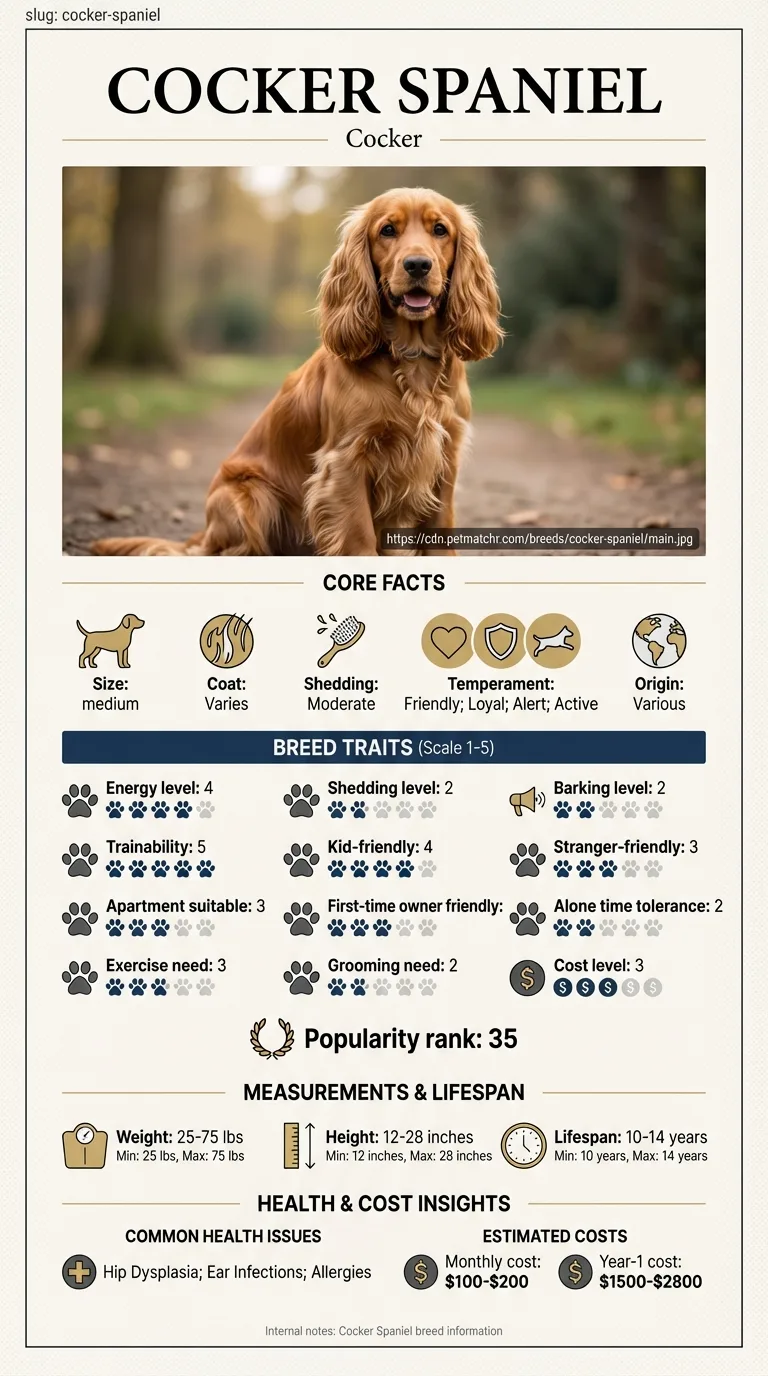
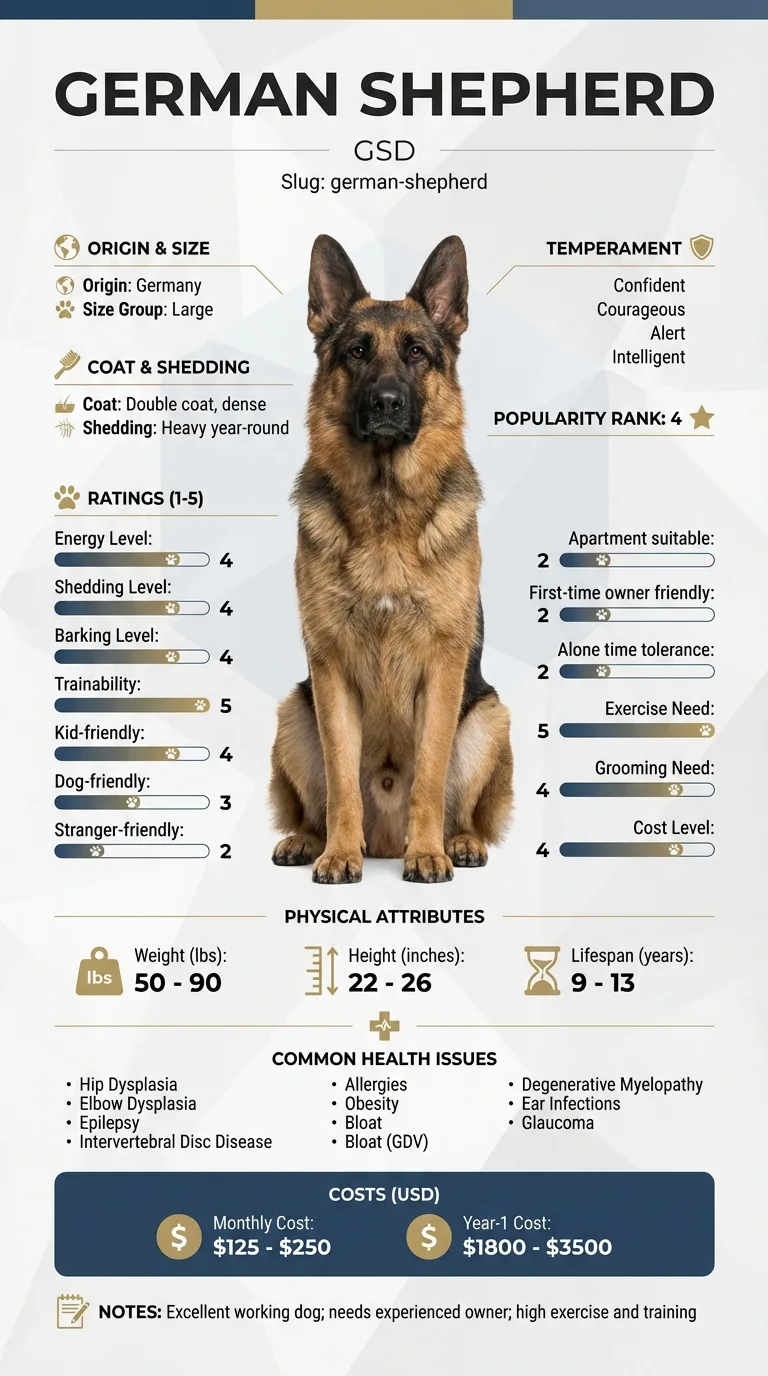
This is for someone already down to Cocker Spaniel and German Shepherd and deciding between them. For this pair the decision usually turns on exercise need and apartment suitability, so those are covered first and in most detail. Anyone choosing from a flat has a clear answer here: Cocker Spaniel rates 4/5 against 2/5. There is no origin story here — only what changes about your week.
Between Cocker Spaniel and German Shepherd, exercise need is what separates them, and Cocker Spaniel is the lower-effort dog of the two to keep.
Choose Cocker Spaniel if you are in a flat or a smaller home, this is your first dog and shedding is a problem in your house.
Choose German Shepherd if you do not want a standing grooming appointment, you want a dog that picks up training quickly and you want a dog that can keep up with an active routine.
| Feature | cocker spaniel | german shepherd | Winner |
|---|---|---|---|
| Size class | small | large | Equal |
| Weight | 20–30 lbs | 50–90 lbs | Equal |
| Height | 13–16 in | 22–26 in | Equal |
| Lifespan | 10–14 years | 9–13 years | cocker spaniel |
| Exercise need | Moderate (3/5) | Very high (5/5) | cocker spaniel |
| Grooming need | Very high (5/5) | High (4/5) | german shepherd |
| Shedding | Moderate (3/5) | High (4/5) | cocker spaniel |
| Energy level | Moderate (3/5) | High (4/5) | Equal |
| Barking | Moderate (3/5) | High (4/5) | cocker spaniel |
| Apartment suitability | High (4/5) | Low (2/5) | cocker spaniel |
| Good for first-time owners | High (4/5) | Low (2/5) | cocker spaniel |
| Tolerates being alone | Low (2/5) | Low (2/5) | Equal |
| Trainability | High (4/5) | Very high (5/5) | german shepherd |
| Good with kids | Very high (5/5) | High (4/5) | cocker spaniel |
| Good with other dogs | High (4/5) | Moderate (3/5) | cocker spaniel |
| Friendly to strangers | High (4/5) | Low (2/5) | cocker spaniel |
| Cost level | Moderate (3/5) | High (4/5) | cocker spaniel |
| Coat | Silky and feathered | Double coat, dense | Equal |
| Origin | Various | Germany | Equal |
| Typical monthly cost | $80–$150 | $125–$250 | Equal |
| Typical first-year cost | $1,100–$2,300 | $1,800–$3,500 | Equal |
German Shepherd is a large-class dog through and through - 50-90 lbs and 22-26 inches - dwarfing the small-class Cocker Spaniel's 20-30 lbs and 13-16 inches. This isn't a subtle size gap; a full-grown Shepherd can weigh three times what a Cocker does, with a dense double coat adding to the visual scale difference.
German Shepherd's exercise need rates very high (5/5), a full two tiers above the Cocker's moderate (3/5). This is a working breed bred for herding and now widely used in police and service roles - it needs a job or serious daily exertion to stay balanced. The Cocker's needs are real but far more modest by comparison.
Cocker Spaniel needs more hands-on grooming (5/5 vs 4/5 for the Shepherd), but the Shepherd sheds more (high, 4/5, versus the Cocker's moderate 3/5) thanks to its dense double coat blowing out seasonally. Neither is a low-shed breed - expect a vacuum in regular rotation with either one, for different reasons.
Cocker Spaniel is rated high for apartments (4/5); German Shepherd is low (2/5), driven by its size and exercise needs. It also barks more (high, 4/5, versus the Cocker's moderate 3/5) - a trait tied to its alert, protective instincts. Neither tolerates being alone well (both low, 2/5), so a Shepherd in a small space with long solo hours is a difficult combination.
German Shepherd trains at very high (5/5), edging out the Cocker's high (4/5) - this is one of the most trainable breeds around, widely used in working roles for a reason. But first-time-owner suitability flips hard the other way: low (2/5) for the Shepherd versus high (4/5) for the Cocker. Trainability and ease-of-ownership aren't the same thing here; the Shepherd needs a confident, consistent handler.
Cocker Spaniel rates higher with kids (5/5 vs 4/5), other dogs (4/5 vs 3/5), and notably strangers (4/5 vs 2/5) - the Shepherd's guardian instincts show up clearly in that last number. If you want a dog that's naturally warm to everyone who walks through the door, the Cocker delivers that more reliably; the Shepherd's wariness is a feature for some households and a liability for others.
Cocker Spaniel lives slightly longer, 10-14 years versus the Shepherd's 9-13. The Shepherd's health list is considerably longer too - ten conditions including epilepsy, IVDD, bloat, and degenerative myelopathy, a progressive spinal cord disease that's a well-known concern in the breed. Cocker Spaniel's five listed conditions are more contained, though both share hip dysplasia and ear infection risk.
German Shepherd costs more across the board: high cost level (4/5) against the Cocker's moderate (3/5), $125-250 monthly versus $80-150, and $1,800-3,500 in year one against $1,100-2,300. Bigger dog, bigger food bill, and a longer health-risk list that can mean more diagnostic and management costs over its lifetime.
Cocker Spaniel weighs 20–30 lbs and lives 10–14 years; German Shepherd weighs 50–90 lbs and lives 9–13 years. The two diverge most on exercise need, apartment suitability and good for first-time owners and 1 other rated axes. Almost every rated axis separates them at least slightly. Where the table declares a winner it means less work for the owner, nothing more; descriptive rows are left as ties on purpose. The value here is in the differences between the two columns; treat any single score as approximate.

Substantially - up to 90 lbs versus 30 lbs, and a foot taller at the shoulder (22-26 inches vs 13-16).
The German Shepherd, rated very high (5/5) versus the Cocker's moderate (3/5) - it needs a job or serious daily activity to stay well-adjusted.
The Cocker Spaniel, clearly - rated high (4/5) for first-time owners versus the Shepherd's low (2/5), despite the Shepherd actually training slightly better.
The Cocker Spaniel by a wide margin (4/5 vs 2/5). The Shepherd's wariness of strangers reflects its guardian breeding.
Meaningfully more - $125-250 monthly and $1,800-3,500 in year one, versus $80-150 and $1,100-2,300 for the Cocker.
A longer list, including epilepsy, bloat, and degenerative myelopathy - a progressive spinal disease well documented in the breed. The Cocker's risks are fewer and don't include these.
The Cocker Spaniel, slightly - 10 to 14 years versus 9 to 13 for the Shepherd.
The Cocker Spaniel, rated high (4/5) versus the Shepherd's low (2/5) - the Shepherd's size and protective instincts ask more of a handler.
Roughly $45-100, with the Shepherd running $125-250 versus the Cocker's $80-150.
A full two tiers more - very high (5/5) versus the Cocker's moderate (3/5).
The Cocker Spaniel, slightly - 10 to 14 years versus 9 to 13 for the Shepherd, whose health list runs notably longer.
Secure checkout on Stripe. We never see your card.
7-day money-back guarantee. Instant access.

Health information here is general and is not veterinary advice. If your dog shows pain, sudden behaviour change, or worsening symptoms, consult a licensed veterinarian.
Some links on this site are affiliate links. We may earn a commission at no extra cost to you, and we only suggest products we believe are helpful for dog owners.
We research and check what we publish, but we do not warrant that any figure, date, price, or statement is accurate, complete, or current, and we accept no liability for any loss, cost, injury, or other harm arising from the use of this site. Use it as one reference among several. You remain responsible for your own decisions and for your dog's care - confirm anything that matters with a licensed veterinarian or another qualified professional before you act on it. Full disclaimer.
Match your lifestyle to the right dog.
Take quizNot sure which breed is right for you? Take our 2-minute quiz to find out.
Take the quiz